| about us |
what's new
|
unit studies
|
unit study helps |
hss resources
|
fiar resources | indexes | lapbooking |
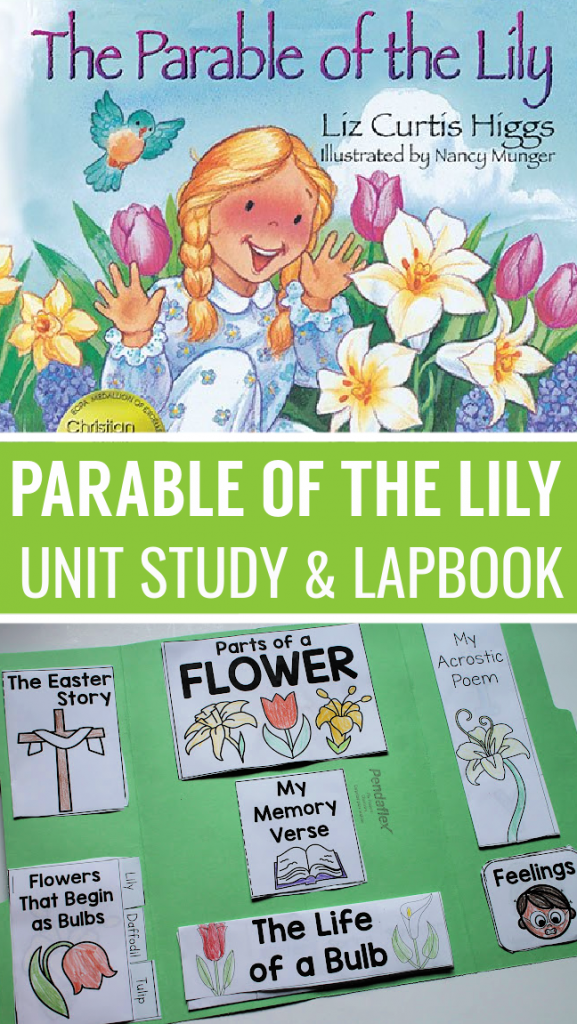
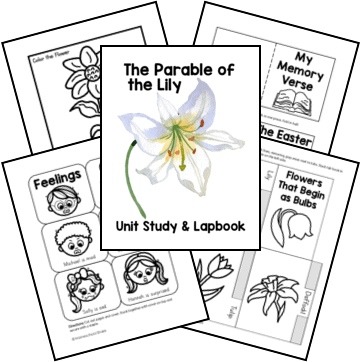
The Parable of the Lily
| Author: Liz Curtis Higgs Illustrator: Nancy Munger ISBN: 1400308445 |
Unit Study prepared by Candace Crabtree
SOCIAL
STUDIES
Occupations: Farmer
Maggie’s dad is a farmer. Take some time to go into detail with your
child about all that a farmer does. Talk about the different types of farmers as
well – those that grow vegetables, those that have dairy cattle, those that have
horses, etc.
Concerning the farmer’s jobs – talk about all the many things a farmer must do! In part of the story, when spring comes, the farmer must begin to hoe the soil getting it ready for the seeds to be planted…talk about the hoeing process with your child if you have never done so.
Feelings – Disappointment and
Anger
Maggie dealt with disappointment when she opened her gift. Why was she
disappointed? Have you ever been disappointed? What happened? And what can we do
when we are disappointed? Do you think Jesus or God is ever disappointed? Talk
about being disappointed in others as well as ourselves…but remind your child
that we can talk to God about our disappointments.
Also, after Maggie shows her disappointment the book tells us that her father was sad to see her disappointment. Why do you think that was? Do you think your parents are ever sad to see you upset or disappointed? Of course! Your parents love you very much, and we don’t like to see you disappointed. You can also talk about how much God provides for the birds of the air and the grass in the fields and how much MORE He gives to us His children…He wants us to be joyful too!
More feelings – Maggie gets MAD at the box with the dirt in it – why? Have you ever spilled something or dropped something or broken something and gotten mad? What do you think we should do when we feel that way?
BIBLE
Bible Verses in Story
There are so many wonderful Scriptures that are throughout this book to help tell the story. Perhaps choose one to really focus on with your child this week. For handwriting, you can practice writing the verse. And, this could be your verse to memorize as well!
James 1:17 – “Every perfect gift is from God.”
Matthew 24:44 – “So you also must be ready. The Son of Man will come at a time you don’t expect Him.”
Isaiah 53:2d – “There was nothing in his appearance to make us desire him.”
Isaiah 53:2a, b – “HE grew up like a small plant before the Lord. He was like a root growing in a dry land.”
John 3:16 – “For God loved the world so much that he gave his only Son.”
Isaiah 53:2c – “He had no special beauty or form to make us notice him.”
1 Corinthians 4:5 – “Wait until the Lord comes. He will bring to light things that are now hidden in darkness.”
Isaiah 61:11 In the same way the Lord God will make grow what is right.”
John 12:24 – “I tell you the truth, a seed must fall to the ground and die. Then it makes many seeds.”
Isaiah 53:3 – “He was hated and rejected by people. People would not even look at him.”
Luke 24:1 – “Very early on the first day of the week, the women came.”
2 Corinthians 9:15 – “Thanks be to God for his gift that is too wonderful to explain.”
Matthew 6:29 – “But I tell you that even Solomon with his riches was not dressed as beautifully as one of these flowers.”
Matthew 28:8 – “They were afraid, but they were also very happy. They ran to tell…what had happened.”
Isaiah 33:17 – “Your eyes will see the king in his beauty.”
Isaiah 53:4 - “But he took our suffering on him and felt our pain for us.”
1 John 4:9 – “This is how God showed his love to us: He sent his only Son into the world to give us life through him.”
The Easter Story
Each year for Easter I plan to tell my children a little bit more about
the crucifixion and resurrection…as they get older and are able to understand
more. Depending on what your child knows already, spend some time this week
retelling the true Easter story. There are also wonderful coloring pages, I plan
to color 1 page per day as we go through the days before Easter, each day
focusing on one part of the story.
If you are using this unit study the week before Easter, you may want to have a
resurrection basket at the end of the study (or present it on Easter morning).
As you present your student with the basket, explain what each item represents.
Resurrection Basket
1. Palm leaf for
Christ’s triumphant entry into Jerusalem.
2. Animal Crackers for the unleavened bread of the Passover Feast.
3. Chocolate coins for the pieces of silver Judas accepted to betray Jesus.
(You could also substitute with 30 silver pieces-- 30 nickels)
4. Lollipop sticks for the nails in His hands and feet. (upside down in
basket)
5. Grape juice for the blood he shed. (single serving boxes)
6. Sponge for the vinegar-soaked sponge Jesus drank from.
7. Cross to represent the cross Christ died on.
8. Black cloth for the darkness that covered the Earth at His death.
9. Bath product such as bubble bath and washcloth for the perfumed shroud in
which Christ was buried.
10. Hollow chocolate eggs for the empty tomb on Easter morning.
11. Green grass for the new life we have in Jesus.
12. Fluffy marshmallow candy for the cloud into which Jesus ascended.
Forgiveness
At the end of the story Maggie asks her father for forgiveness. Why does
she do this? Can you recall a time you’ve had to ask for forgiveness? What about
our heavenly Father…when should we go to Him and say we are sorry? Maggie’s
father says that forgiveness is what Easter is all about…discuss this with your
child.
Word Study: Lily
Look up verses in the Bible that have the word “lily” in it. Discuss
these verses.
1. Luke 12:27 – “Consider how the lilies grow. They do not labor or spin. Yet I tell you, not even Solomon in all his splendor was dressed like one of these. If that is how God clothes the grass of the field…how much more will he clothe you?” (oh how our wonderful Father in heaven provides for us!)
2. Song of Solomon 2:1 – “I am a rose of Sharon, a lily of the valleys.” (the lily is used to describe something or someone beautiful!)
Parable of the Sower
Read the Parable of the Sower in Matthew 13 and discuss with your child.
LANGUAGE ARTS
Vocabulary
1. shuffle – Maggie “shuffled” through the snow
2. mysterious – “Maggie loved getting presents, especially a gift as mysterious as this one.”
3. ordinary – “one very ordinary afternoon…”
4. bulb – “like a bulb that would some day bloom into a plant.”
5. cellar – “she marched down the cellar steps…”
6. splintered – “the crate splintered into pieces, soil was everywhere.”
7. fragrant – “its scent was as fragrant as the most expensive perfume.”
Poetry
Spend one day focusing on flowers and poetry. Possibly read some poetry
about flowers and be sure to try to write some yourself! Maybe even a simple
acrostic with the word Lily. Use this
Prepared Sheet
if you'd like.
Nursery Rhyme
You may want to teach this nursery rhyme to your student this week.
You could also use it for copywork.
Mary , Mary , quite contrary,
How does your garden grow?
With silver bells and cockle shells,
And pretty maids all in a row.
SCIENCE
Farm Ideas
This book compares Jesus to a seed and farming. This would be a wonderful time to do a mini-unit (or more if you like!) on planting, sewing, reaping…farming in general! There are so many spiritual applications we can take from gardening, growing plants, etc. Maybe a fun field trip would be a trip to a local farm, especially if there are baby animals to see!
1. Here’s a
cute song to sing with your child:
Farm
Sounds
(tune: Wheels on the Bus)
adapted by John Saltsman
The cows in the barn
go moo, moo, moo,
Moo, moo, moo -- moo, moo, moo.
The cows in the barn go moo, moo, moo,
All around the farm.
Other verses:
... pigs in the pen go oink, oink, oink
... hens in the coop go cluck, cluck, cluck
... rooster on the fence goes cock-a-doodle-do
... ducks in the pond go quack, quack, quack
... lambs on the hill go baa, baa, baa
... bunnies in the hutch go (silently wiggle nose with finger)
2. Make a farm book with your child. Each page will say:
A ______ lives on a farm. Fill in each
page with a different animal, have your child draw this animal or search in
magazines for pictures of farm animals.
3. Talk about the difference between
farm animals and zoo animals. Go through different animals and ask if your child
knows where they live, a zoo or a farm? Elephant? Giraffe? Chicken? Hippo? Pig?
4. Sing "Old MacDonald Had a Farm"
5. Read Mrs. Wishy Washy from the
Wright Group for a FUN book about being on the farm. With this book you’ll want
to make sure and find (or create) a mud puddle to play in afterwards!
6. You could read The Carrot Seed
to go with the farm unit!
7. Big Red Barn by Margaret Wise
Brown is another classic farm book! Your early readers can help you to read this
one, too!
8. Discuss your child’s favorite farm
animal, draw a picture of this animal, pretend to be this animal and act it out.
9. Make a farm scene – there are several print outs on this site, a barn, different animals, etc. :
http://www.abcteach.com/directory/theme_units/farm/
10. Don’t forget to pull out all your
farm toys this week! Little People farm, any animals or books you may have
around the house.
11. LOTS of farm coloring pages found here:http://www.alphabet-soup.net/farm/farmcolor.html
Seasons
This book starts out in winter, but concludes in the spring with flowers
blooming! Discuss all of the things we do in each season and why so many people
look forward to spring after a cold winter. Ask your child what NEW things
happen in Spring!
Types of
Flowers
Learn about the flower the LILY. If possible, buy a lily to have at your
house to examine and enjoy. You may want to introduce the names of the
parts of the flower (a lily is really good for this!).
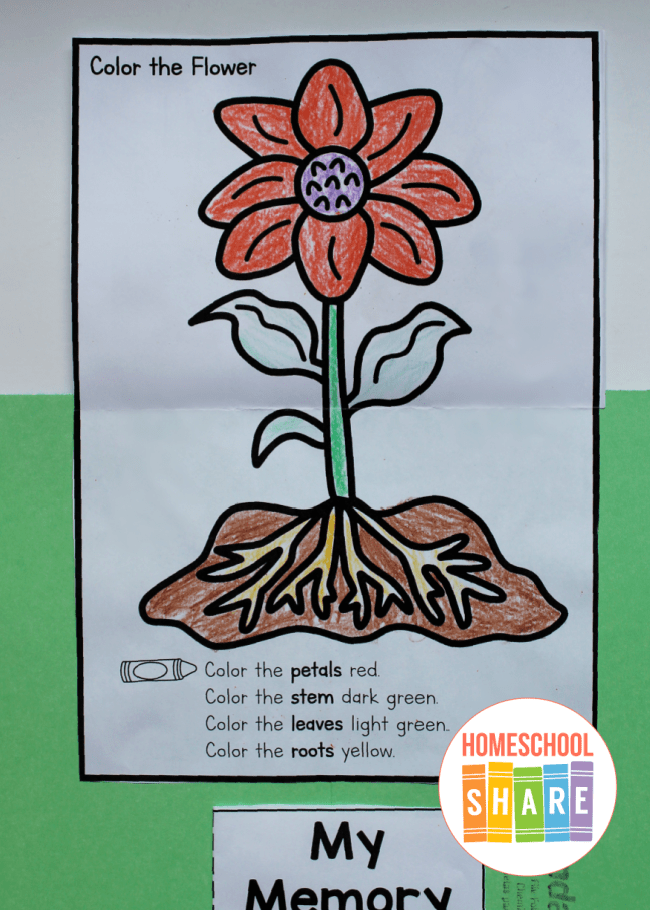
Here is a flower diagram. For the basics, you would probably just want
to show your student the stamen, pistil, petal, stem, and sepal. This book
also mentions daffodils and tulips. Maybe take some time to show your child
pictures of each flower. Possibly go to a flower shop to view all of the pretty
flowers. If your older student is rowing along with you, let him research
all the different kinds of lilies (lily of the valley, day lily, tiger lily,
water lily, calla lily, etc.).
You can teach your child the names of many spring flowers by playing this
Flower Memory Game.
Play this as you would play any memory or concentration game.
Coloring Pages
Lily
Coloring Page 1
Lily Coloring
Page 2
Lily Coloring Page 3
Lily
Coloring Page 4
Tulip
Coloring Page 1
Tulip Coloring Page 2
Coloring page of Cross with Lilies
Seeds and Planting
Plant a seed this week. There are many wonderful FIAR or
Before FIAR selections that you could use as go-alongs such as The Carrot
Seed or Miss Rumphius…or you can just plant a seed, water it, give it
sunlight and watch it grow! The plant in the Parable of the Lily says to
put in a dark, cool place. What are the directions for the seed you are going to
plant?
Many lessons on seeds, choose as few or as many as you’d like to focus on this week.
1. Discuss what a seed is – it protects what is inside like a coat protects us from the cold. Let a lima bean sit in water overnight, in the morning pull it apart and look at the various parts. Perhaps your child can draw the different parts also! (seed coat, root, leaves, food storage, embryo)
2. Seeds come in all different shapes and sizes – perhaps collect a bunch of different seeds and compare/contrast them. (acorn, carrots, lettuce, watermelon, apple, nuts, etc.) Measure them, draw them.
3. Did you know that seeds “travel?” How? Wind, animals, water, etc. Have your child take off their shoes and walk around outside. When you come in see if there are any seeds on the socks!
4. What do seeds need to grow? Discuss what we (as humans) need to grow as well…compare, contrast.
5. Lots of different plants grow from seeds. Discuss and name as many as you can think of!
6. How do people use and need plants?
APPLIED MATH
Counting
Count the different types of flowers throughout the story.
Addition, Subtraction with Seeds
Buy some seeds and have “seed math” with your child. Do addition,
subtraction and even graphing!
Use this Prepared Seed
Math Booklet to have fun learning about addition (if you don't have any
seeds on hand, you can have your student draw the seeds).
Measurement
Spend one day measuring the seeds you purchased. Compare the sizes
of different types. Use comparison words such as bigger, biggest,
smaller, and smallest.
ARTS AND CRAFTS
Drawing
You can practice drawing a “still life” picture of a lily. Buy a potted
lily at the flower shop with your child. This will really help this story to
come to “life.” And, discuss what a still-life portrait is, observe the flower
and allow your child to draw it!
Color: Shades
When Maggie notices spring coming, she notices the weather is warmer and
the gray skies have turned into “robin’s egg blue.” Possibly let your child
paint or color a picture of a spring sky – trying to find the perfect shade of
blue for spring.
Lily Craft at Enchanted Learning
COOKING AND
JUST FOR FUN
1) If you are learning about the farm this week, bake bread together and then make the BUTTER to go with it!
Place some heavy cream (whipping cream) in a baby food jar. Fill each jar half way with the cream. Insert a clean marble into the jar. Have the students shake the jar. Next, mix in a pinch of salt and a few drops of yellow food coloring. Spread the butter on the bread for your students to taste. (generally you have to shake, shake and shake some more!)
2) Make “mud” together by making chocolate pudding and using oreo cookies crushed up to be the dirt. Don’t forget to hide a little worm (gummy) inside the dirt! Use your spoon and start digging!
Materials and information on this website belong to the original composers. It may be used for your own personal and school use.
Material may not be used for resale.
© 2005-07 HSS