| about us |
what's new
|
unit studies
|
unit study helps |
fiar resources
|
indexes | lapbooking |
The Old Man and His Door
|
|
Author Gary Soto Illustrator: Joe Cepeda ISBN: 0698116542 Summary: When an old man's wife asks him to take a pig (el puerco) to roast at a party, he thinks she means the front door (la puerta). As he lugs the heavy wooden door to the festivities, he assists various animals and people and manages to collect a hat full of honey, a goose egg, a fish, and two watermelons. When he finally arrives, his wife is not angry about the confusion because the food her husband brings makes for a fine feast, even without the pig. |
Unit and Lapbook Prepared by Ami
with art lesson by Brandy Shutt
Note from Ami: Before you read the story, ask your student to think about
the title. What could this story be about!?
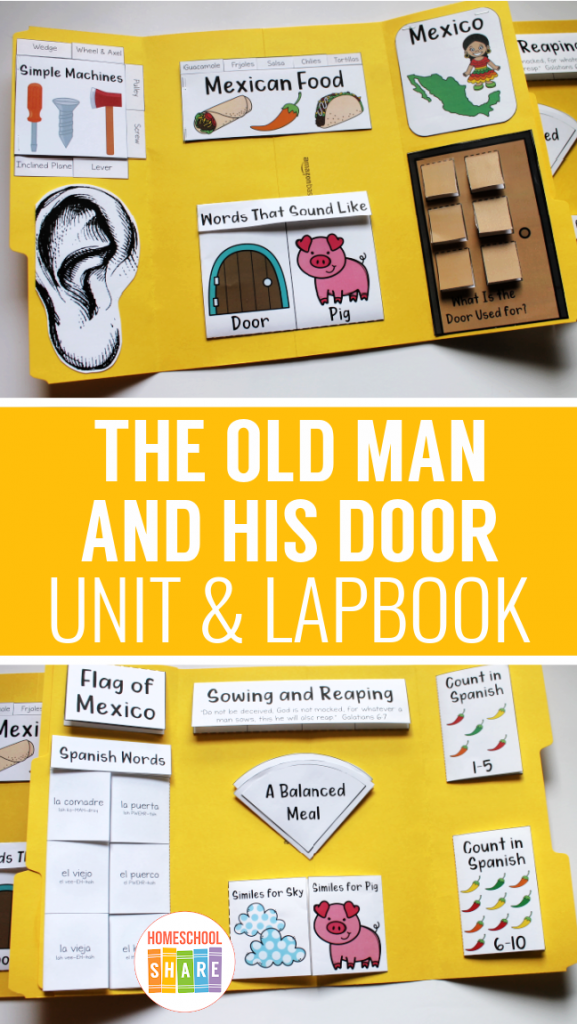
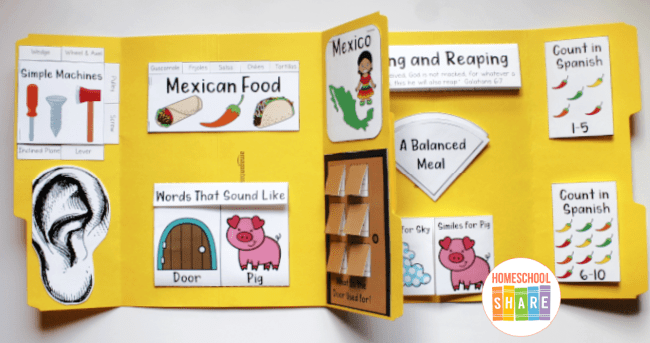
Lapbook Templates
Social Studies
Geography: Mexico
This story is set in Mexico. What does your student know about Mexico?
Find Mexico on the map. Ask some questions-- |
Where is it located? How far away from you?
Is it on the same continent? What borders Mexico? Discuss these
things with your student.
Five Fast Facts About Mexico
1. Capital: Mexico City
2. Location: between the United States of America (at the north) and Guatemala
and Belize (at the south). At Mexico's west is the Pacific Ocean; at the east is
the Gulf of Mexico and the Caribbean Sea
3. Climate: includes hot deserts, forests, tropical rainforests, as well
as some chapparal
4. Area: covers almost 2 million square kilometers of land
5. States: divided into 32 states
Lapbook Components:
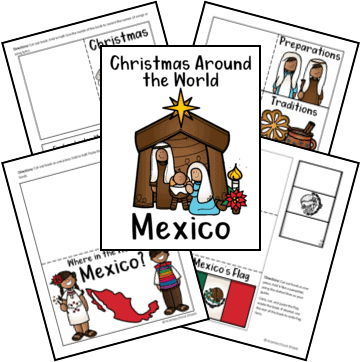
Mexico Fast Facts
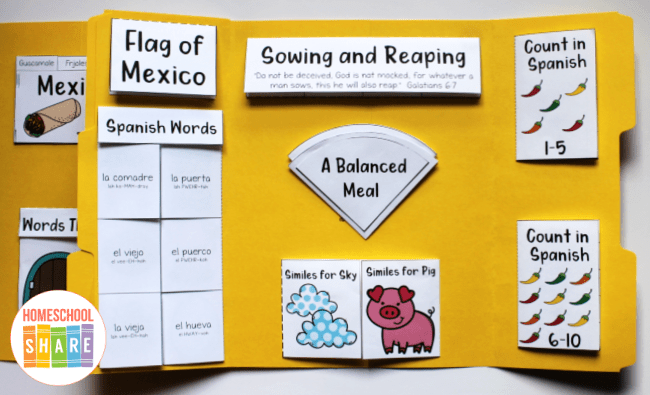
Flag of
Mexico
Where is
Mexico? Shutterfold
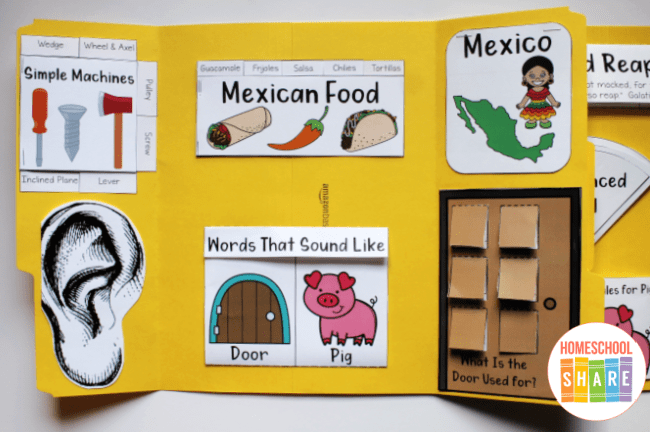
Culture: Mexican Food
The old man grows chilies and tomatoes in his garden; he also has an avocado
tree. Your student may be curious about the traditional foods cooked and
served in Mexico. Mexican foods are known for their varied flavors,
colorful decoration, and variety of spices.
Tortillas
A staple food of Mexico, tortillas can be made of flour or corn. Tortillas
are served alongside a meal (as bread would be). They are used in many
dishes; they may be rolled and baked for enchiladas, fried for tacos, or grilled
for quesadillas.
Frijoles
A good source of protein, beans of different varieties are most commonly boiled
and then fried. They can be a main ingredient in a meal or served as a side.
Chilies
Peppers of all shapes and sizes find their way into various Mexican dishes
adding not only flavor but also color. Larger chilies are usually not as
hot as the smaller ones. Point out different kinds of peppers the next
time you are in the produce department with your student. How many
different colors of peppers can he find? Don't touch any habañeros!
They are extremely hot!
Guacamole
Guacamole is a dip made of avocado mashed with onions, chilies and cilantro.
Salsa
A mix of red or green tomatoes, onion, chili and cilantro. Served as a
sauce or dip.
Find some authentic Mexican recipes to make with your student this week.
Culture: Spanish Language
This book incorporates tons of Spanish words! Does your student know
what a glossary is? Show her the glossary at the beginning of the book,
and show her how to find the meanings of the Spanish words and phrases.
Lapbook Components
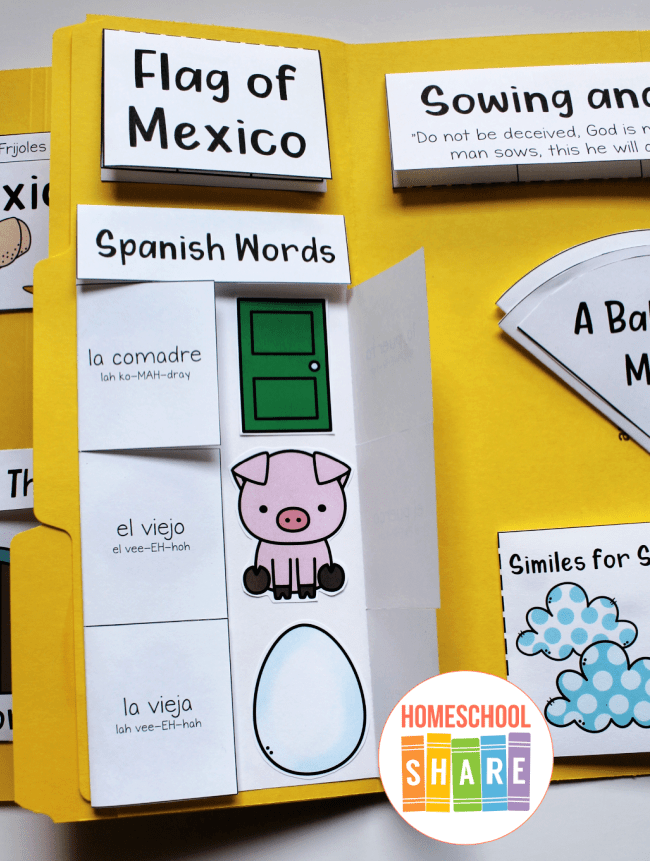
Spanish Words ~ Count to
Ten
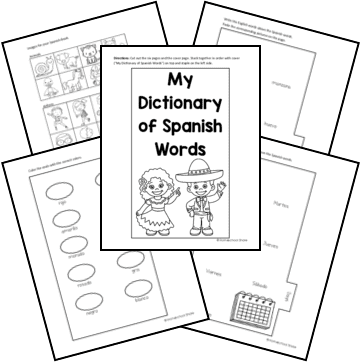
Spanish Word Dictionary
Hotdog
Hotdog Book Instructions
Human Relationships: The Importance of Listening
The old man didn't listen to his wife very well. He was distracted.
What was distracting him? What are some things that distract us when we
are suppose to be listening to someone talk?
Why is it important to listen to someone when they are talking? It's
important to listen to parents because they could be giving instructions or
other necessary information. It's important to listen to siblings so they
will know that you care about them and care about what they have to say.
When we don't listen, we are telling someone that they aren't important...what
they have to say doesn't really matter.
You may also want to take some time to discuss the importance of not talking TOO
much. When we talk too much, we may be sending a message to others
that we think too highly of ourselves. If we talk too much,
people may not want to listen to what we have to say (which may be why the old
man didn't listen to his wife!).
Complete the
Listening Ear
Shape for your lapbook, if desired.
Bible and Character
Kindness and Sowing & Reaping
Not only did the only man plant chilies and tomatoes, he also planted seeds
of kindness. Can your student recall the times that the old man showed
kindness? (to the crying child, to the goose, to the boy in the lake, and
to the man moving the piano)
The Bible tells us in Galatians
6:7, "Do not be deceived, God is not mocked; for whatever a man sows, this he
will also reap." Does the old man reap kindness? How? (He
receives a kiss, an egg, a fish, and a watermelon in return for helping others.)
Sowing and
Reaping Peek-a-Boo Book
Language Arts
Genre: Folktale
A folktale is a story that is first passed on by word of mouth rather than
by writing; it changes by successive retellings before being written down.
It may be recorded by more than one person who has heard a slightly different
version resulting in many different versions of the same tell. In these
variations, the plot is the usually the same, but the setting, details, etc.
change.
The genre of folktale encompasses
many other types of stories including fairytales, legends of all types, fables,
tall tales. Is your student familiar with tall tales? Fables?
Legends?
Why would the story of The Old Man and His Door be passed down? Do
you think someone invented it to prove a point? What is the message (or
moral)? Do you think the story might have also been retold because
it is humorous?
Have your student practice telling this story (in the oral tradition) this week.
You may even want to let him present it to the family after a meal, or you could
even record him with a video camera.
Similes
Soto uses at least two good similes in this story. A simile is a
comparison between two objects using like or as.
Find Soto's similes ("pigs as plump as..." and "blue sky as wide as...").
Let your student think of some other similes to describe the sky and a pig.
Lapbook Component: My Similes Shutterfold
Comprehension
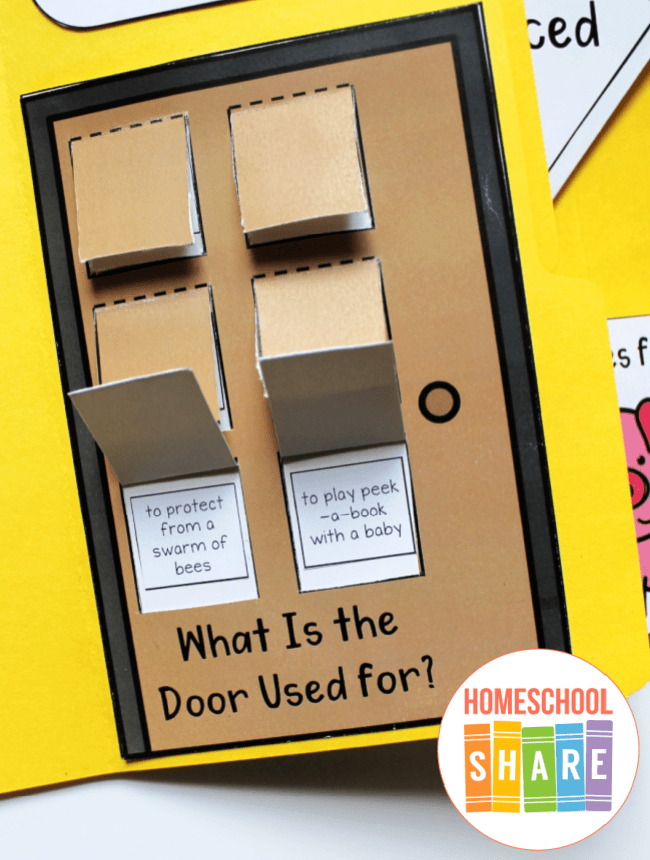
Can your student remember the ways the door was used? Can you think of
any other fun uses for a door? Maybe a discussion on this topic will inspire your student to
write a story!
Complete What is the
Door Used For? lapbook component.
Rhyming Words
The old woman told the old man to bring the PIG, but he thought she told him
to bring the DOOR. Those words don't sound alike in English, but
discuss words that do. Make a list of rhyming words for pig as well as a
list for door or make a list of words that could easily be mistaken for door
(dork, adore) and pig (pick, pit, etc.).
Lapbook Component:
Words That Sound
Like... Matchbook
Science
Honey and Honeybees
The old man in this story bumps a beehive with his door. A swarm of
angry bees flies out!
Note from Ami: As I started working on this lesson, I started making some
honeybee minit books. Well, before I knew it, I had an entire lapbook. Please visit our Honeybee Lapbook
Page to find everything you'll need to do a honeybee lesson with your
student.
You might also want to have fun with this
Simple Machines: Inclined Planes
The old man uses the door to help move the piano to the truck. How did
this make the job easier? He used the door as a simple machine known as
an inclined plane. An inclined plane is a flat surface whose
endpoints are at different heights. By moving an object up an inclined plane
rather than directly from one height to another, the amount of force required is
reduced. Examples where inclined planes are to be found include: ramp,
sloping roads and hills, windshield, funnel, water slide, chisels, hatchets,
plows, air hammers, carpenter's planes, and wedges. Demonstrate how an
inclined plane can make work easier.
By basic
definition a machine is
any device that makes work easier. A simple machine is one that uses only one
application of force. A complex machine is any device that is made from two or
more simple machines.
A list of the six traditional simple machines are:
However, three
of them--wedge, screw, and pulley--are really modifications of the three main
ones (the lever, the wheel and axle, and the inclined plane).
The six simple machines can be broken down into two basic families of simple
machines: the inclined plane family and the lever family. So, if we break the
six simple machines down into the two families, we have:
The Inclined Plane Family:
1. inclined plane (see definition above at the beginning of the
lesson)
2. wedge - an object with at least one slanting side ending in a sharp
edge which cuts material
3. screw - an inclined plane wrapped around a plane which holds things
together or lifts materials
The Lever
Family:
1. lever - a stiff bar which rests on a support called a fulcrum which
lifts or moves loads
2. wheel and
axle - a wheel with a rod (called an axle) through its center lifts or moves
loads
3. pulley - uses grooved wheels and a rope to raise, lower, or move a load
Explain what
each simple machine is, what it does, and show pictures of each (see website
mentioned below for gobs of pictures). Go around the house or even the
neighborhood and see how many simple machines your student can find.
Complete
Simple Machines Layer Book for your lapbook, if desired.
Simple Machines Website
Evan Moor Giant Science Resource Book pages 256-267
A Nutritious Meal
If your student isn't familiar with the food pyramid, you will need to introduce
the basics of the food groups (see information below lesson).
The people in the story ended up having a lunch of egg, fish, watermelon,
and honey. Is this a balanced meal? What is a balanced
meal?
Here are some general guidelines to follow:
Have a portion of protein the size of your palm.
Have a serving or two of grains (whole grains are your best choice).
Make sure your vegetable and/or fruit portion is the size of both your palms.
Have a serving of dairy.
What is missing in the meal at the barbecue? Have your
student create his own
Balanced Meal Plate & Cone
Pocket and include it in his lapbook.
Food Pyramid Information (taken from
Stone
Soup Unit Study)
Grains – (6-11 servings a day) Point out foods students might not think of
as grains –oatmeal, corn meal, or rice and popcorn. Tell students that some
grains are whole grains. At least half the grains they eat should be whole
grain. Some names for whole grains are whole wheat, whole-grain corn, and
oatmeal. Show them the words “whole grain” on the ingredients label or the front
of a cereal box and ask them to look for it on a cereal box at home.
Vegetables – (3-5 servings a day) Do your students eat fresh vegetables? Frozen?
Canned? Dark green and orange vegetables are especially important.
(Examples include spinach, broccoli, carrots, and sweet potatoes.) Ask students
to name dark green and orange vegetables they’d like to try.
Fruits – (2-4 servings a day) Explain that fruit can be fresh, canned, frozen,
or dried. Ask children about their favorite fruits. What type or form do they
eat?
Milk –(2-3 servings a day) Ask students to name some foods in the milk group
(milk, cheese, yogurt, ice cream). Where does milk come from? Do they drink milk
every day? For children who are lactose intolerant, there are lactose-free
products.
Meat and Beans –(2-3 servings a day) Ask students to name foods from the meat
and beans group (meat, fish, chicken, turkey, eggs, dry beans, and peas, nuts,
and seeds). Do they ever eat beans at home for dinner?
Applied Math
Circles
The old man circled the house three times and the avocado tree nine times.
How many circles did he make? How many circles can you find in
your own home?
Art
At the party, they had a pinata. Top your week off with a homemade
pinata! (instructions and photos contributed by Brandy Shutt)
Materials:
18" balloon
newspaper
string
tissue paper
crepe paper
glue (flour, sugar, water)
bowl
paper mache paste
paint, markers, stickers, etc.
Step 1
Find a paste mixture that you like (there are many). We boiled two cups of
water. Then separately mixed one cup of water with one cup of flour. Then we
mixed the flour mixture with the boiling mixture and added 3 tablespoons of
sugar. Return to a boil. Turn it off and let it cool. Your paste is then
ready to work with. If you do what we did, this paste can be refrigerated
for about 3-4 days. It is best to work with it at room temperature, otherwise
it is very cold.
Step 2
Tear strips of newspaper about 1inch wide and 1 1/2 inches long. You will
have three layers so use comics for one of your layers to tell it apart from the
others.
Step 3
Take your 18" balloon and set it in a bowl. Dip your strips of paper into
the glue and begin covering the balloon. Do one layer being sure to overlap
each strip and cover the entire balloon. Now cover your paste and wait. Let it
dry for 24 hours to be sure it is dry on the inside.
Step 4
This is the time to add your string. Wrap the string in such a way as to
leave about 3 inches in the place where you want it to hang. Now begin your
second layer, with the comics, in the opposite direction of the first layer. Be
sure to cover the string completely. Now wait 24 hours for this layer to dry.
Don't forget to cover and refrigerate your paste.
Step 5
POP your balloon. Remove the balloon carefully. If all of it does not come
out it is okay, just watch it when it breaks if there are small children.
Finish with this last layer in the opposite direction of the comics being sure
to overlap and cover all.
Step 6
Fill the pinata with candy and small toys. Layer tissue paper and candy to
prevent all the goodies from falling to the bottom. Fill completely.
Step 7
Paper mache the hole with some newspaper. It does not have to be as thick
as the rest of the pinata, but make it look as smooth as possible.
Step 8
It is time to decorate. Using tissue paper is very common to get a large
amount of colorful coverage. Depending on your design you can decide what is
best for you. We were making a piece of candy for Valentines Day so we used red
tissue paper to create the ends. At this point you can use regular glue. You
can also paint or use crepe paper. We covered our tissue paper with little
strips of crepe paper. This is when you can let the creative juices flow.
There are many ideas on-line.
Step 9
Hang it somewhere safe and get your stick out. It is time to party!
Traditionally you should blindfold the one hitting the pinata, but we found, for
kids, it is hard enough with their eyes open. Have Fun!
Materials and information on this website belong to the original composers. It may be used for your own personal and school use.
Material may not be used for resale. © 2005-07 HSS