Google
 
The Mitten Free Unit Study

 The Mitten
 

Author: Jan Brett
ISBN: 039921920X


Literature Based Unit by Ginger A.


This unit is designed for preschool and kindergarten use.

Before you begin this unit, you may want to print these items
Animal Masks
Mitten Pattern and Animals
Design Your Own Mitten

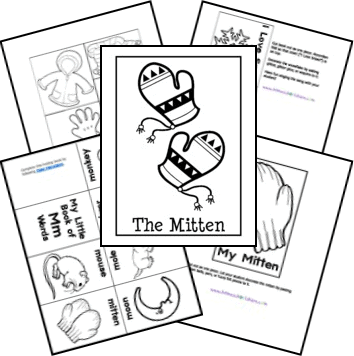
Mitten Mini Book


Language Arts


Story Sequence
After reading The Mitten color the mitten and animal pages [cut out the animals]. Practice story sequencing by placing the animals onto the mitten in the correct order. Don’t glue these down yet, so that this can be practiced and reinforced during the unit study. At the end of the unit glue the animals to the mitten.

You can also use these-- Sequencing Cards


Drama

Use the masks to put on a play or skit of The Mitten. An older child could write character names to be taped to the actors’ t-shirts.   You can use these for story re-tellings, too -- Story Patterns


Genre: Folktale

This is a retelling of a Ukrainian Folktale. What does retelling mean? What is a folktale? Is this an original story?  You may want to include reading another variation of this tale, The Mitten by Alvin Tresselt. 

Discussion
Did grandmother give Nicki good advice? Why do you think Baba made the white mittens for Nicki?


Sayings
What happens after all the animals crawl into the mitten? Have you ever heard anyone use the phrase “the straw that broke the camel’s back”? How is this saying similar to the story of The Mitten?


From GoEnglish.com -- The straw that broke the camel's back is the last thing you are willing to accept after which you will not put up with any more. Example: "You broke a lot of rules and we tried to ignore it. But stealing money from us was the straw that broke the camel's back. We're sending you home to your parents."

You are at the last straw when you are just about to lose your patience. The straw that broke the camel's back is the last thing that that happened that finally made you upset. Example: "He came to work late every day that week. Then on Friday, he didn't show up at all." Reply: "That was the straw that broke the camel's back."

There is a limit to how much straw (long yellow grass) a camel can carry on its back. If you keep putting more straw on top, it will finally break the camel's back. When you are at the last straw you are finally angry and will not take any more. Example: "You have been rude to me all day. I've had it. That's the last straw!"


Computer Skills

Type a letter to your grandmother using this special mitten greeting card and envelope.


Social Studies


Read more about Ukraine then tell your student the information he would find interesting.
 

Where does this story take place? What language is spoken there? What does Baba mean? What do you call your grandmother?

Symbols of Ukraine
Map Printout
Flag Printout  [note: The flag is two broad stripes of color and would be a good sewing project.]


Recipes from other cultures are always fun to try. This Ukrainian recipe (from Ukrainian Daughter's Cookbook) for sweet nothings sounds good.


Khrustyky (Sweet Nothings)

Ingredients
6 egg yolks

1 cup flour

1tsp. vinegar

1 tsp. sugar

pinch of salt


- Beat the egg yolks well, add sugar, vinegar and flour.
- Mix well, then knead dough until smooth, on a lightly floured board. Cover with a warm bowl, let stand 10-15 minutes, and no longer (I once let the dough sit for a time, and they didn't turn out well at all).
- Roll the dough out paper thin and cut, diagonally, in 1" wide strips. Then, cut these strips into diamond pieces about 2" long (See Figure 1).

 
Figure 1


Slit each piece in the centre. Take two of the corners, bring them up and pass them both through the slit (Figure 2). Pull the corners tightly through (Figure 3 - a side view) until the corners are back at their original position. This is hard to describe, but you'll know it's right when the bow doesn't pop back out of position, it should stay as is when its done right. Alan Granofsky says his Lithuanian family only tuck one corner into the slit and pull firmly through, so you can try that too!
Figure 2 Figure 3


Fry in deep fat, 350° until very lightly brown. Drain and sprinkle with icing sugar.

Math


Counting
Count the number of animals that are inside the mitten.


Compare
Look at a real mitten. Compare the size of the mitten to the animals pictured in the book. Which animals could really fit into a mitten?
Observe a mitten and a glove. How are they alike? Different? 


Matching 

Work on matching skills. Gather all the mittens [and gloves] in your home. [or cut out several pairs of paper mittens] Mix them up and let your child match the pairs. How many is a pair? Or make a mitten folder game. Patterns are available at this site.


Size
Put the mitten pairs [used above] in order form smallest to largest.

Measurement
Discuss the word stretch. The mitten in the story stretched a lot. Name some items that can stretch. [tee-shirts, socks, pony tail holders, etc.] Measure a rubber band and record its length. Now stretch the rubber band and measure it again. Compare the numbers. What happened?


Science


Predictions
Make a prediction. Gather some small plastic or stuffed animals. Predict how many will fit into the mitten. Count the number of animals that fit. Compare the number that fit into the mitten to your prediction. Are the numbers close?


Animal Tracks
Study the animal tracks in the story. Which animal made the tracks? Paint some animal tracks onto dark colored construction paper using white paint. Explore outside, try to find animal tracks. Pour a little Plaster of Paris into a track and make a mold of the track. [You can also make a track with your own footprint if animal tracks aren’t found]. 
Simple Animal Tracks Sheet from Kizclub
Animal Tracks (simple) from bry-back manor


Camouflage
Talk about camouflage. Name some animals that are protected in winter due to their white fur. Why was the mitten so hard to see? It blended in with the snow. Why are animals with white fur hard to see in the winter? They blend in with the snow. Try this game to learn more about camouflage.

Cover a table with a white sheet. Put a variety of solid white items on the table. Let your child study the table for a minute or two then leave the room. How many items does he remember? Repeat the game but this time put a variety of brightly colored objects on the table. Which was easier to remember?

Cut out a mitten and a rabbit from white construction paper and glue to a piece of white paper. Your child can write or trace the word camouflage at the top of the paper.


Animals with “snow camo”

http://www.enchantedlearning.com/subjects/mammals/fox/Arcticfoxprintout.shtml

http://www.enchantedlearning.com/subjects/mammals/lagomorphs/Hare.shtml


Fibers

Introduce the term fiber to your student [show him different materials]. What type of fiber do you think was used to make these mittens? [wool] Go to a craft store or fabric center and look at some skeins of wool. [not all craft stores have wool so call and ask before you go.] Does the wool feel the same as cotton and synthetic fibers?


Art


Print the big mitten pattern from Jan Brett’s site onto white cardstock. Punch holes around the edge and use white yarn to lace the mitten. 

Let your student design his own mitten


Purchase some iron on transfer paper and print the transfers for this story. Decorate a book bag or sweatshirt following the directions at Jan Brett’s site.


Cut out mitten shapes from white felt. Purchase a length of polar fleece [any color but white] and make a no-sew scarf. Hand sew the mittens on each end of the scarf [you can add pony beads to the fringe]. Hancock’s Sewing center and Hobby Lobby have free instructions for lots of no-sew fleece items.

Just for Fun and Other Resources

Here are some bookmarks to use with this story

Coloring Page

Coloring Page 2 (Bear)
Coloring Page 3 (Rabbit)

Animals in Winter Activity Card
 

For Copywork
Mitten Shapebook pattern lined
Mitten Shapebook Pattern unlined

 
More Mitten Ideas


Mitten to Sew Pattern from Bryback Manor

Mitten Alphabet Matching (lower/upper case letters) Memory Game


Materials and information on this website belong to the original composers. It may be used for your own personal and school use. 

Material may not be used for resale © 2005-07 HSS