| about us |
what's new
|
unit studies
|
unit study helps |
fiar resources
|
indexes | lapbooking |
Maple Syrup
Unit and Lapbook
Prepared by Wende, Jodi Small, and Ami Brainerd
Books Used:
My First Little House Book –
Sugar Snow
Sugarbush Spring
by Marsha Wilson Chall
Library List
Sugar on Snow by Nan Parson Rossiter
Sugaring by Jessie Haas
My Little House Cookbook
At Grandpa's Sugar Bush by Margaret Carney
The Maple Syrup Book by Marilyn Linton
Fun With Nature by Boring, Burns and Dandy (or another tree field guide
book)
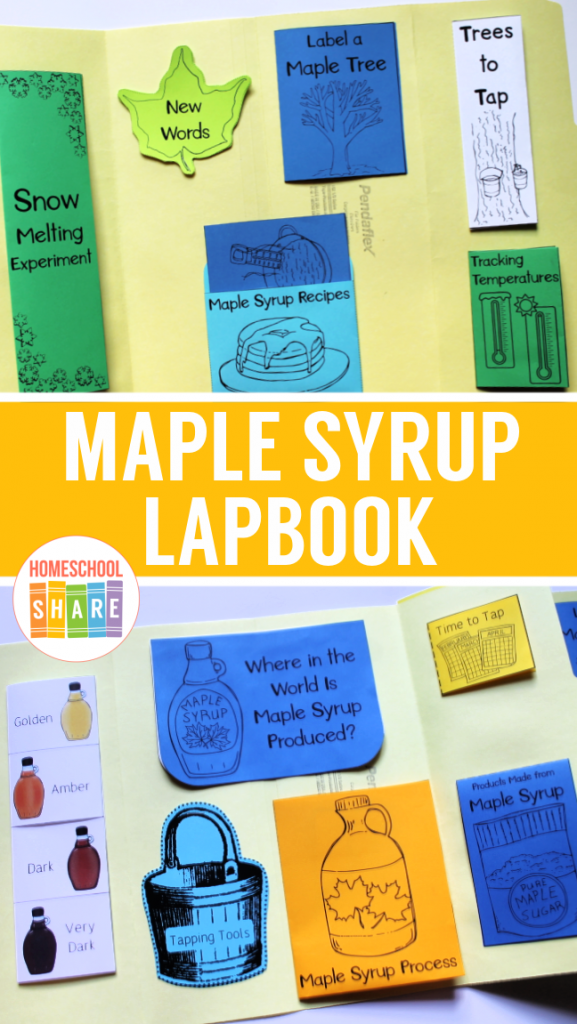
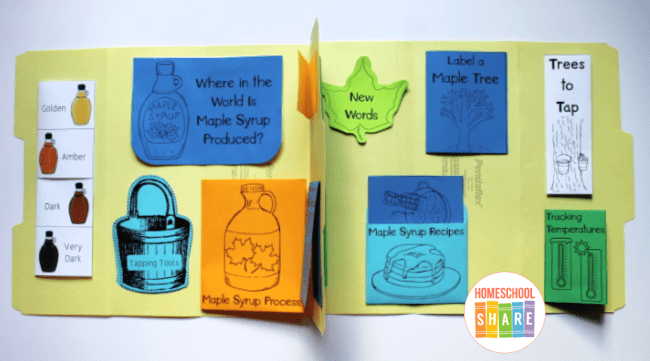
Lapbook Components and Other Printables
Science –
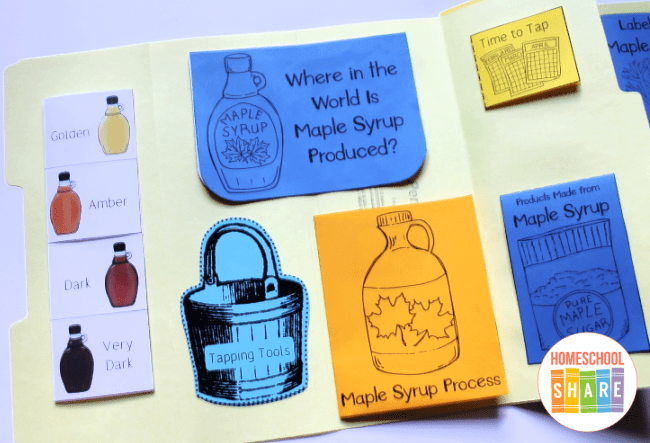
Process Sequencing Cards with Pocketbook
Tools Bucket Shape Book
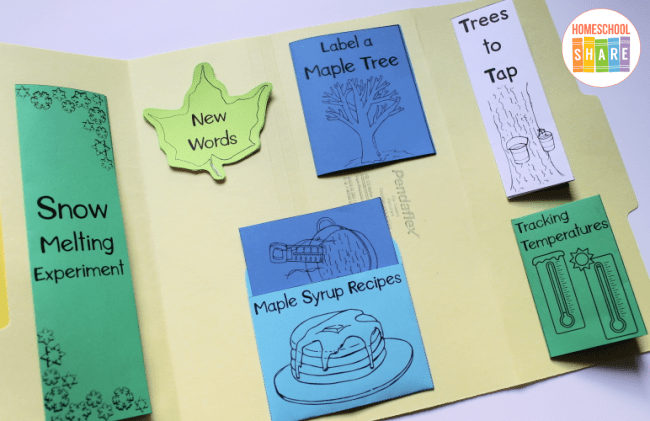
What Tree to Tap Flap Book
Social Studies –
Language Arts –
Vocabulary Leaf Shape Book (with definitions)
Vocabulary Leaf Shape Book (blank)
Copywork Simple Fold (manuscript)
Copywork Simple Fold (cursive)
Math –
Liquid Measure Cards and Pocket
Liquid Measure Layer Book
(this is an alternative to the cards above)
Temperature Hotdog Book
Snow Melting Experiment Tri-fold
Snow
Melting Experiment Prepared Page
Art –
Cooking -
Maple Recipes with Pocket
Blank Recipe Cards
Misc. –
Possible Covers
(one says Maple Syrup and the other says Sugarbush Spring)
Coloring Page I
Coloring Page II
these could be glued to the back of your lapbook, if desired
Science
Maple Syrup
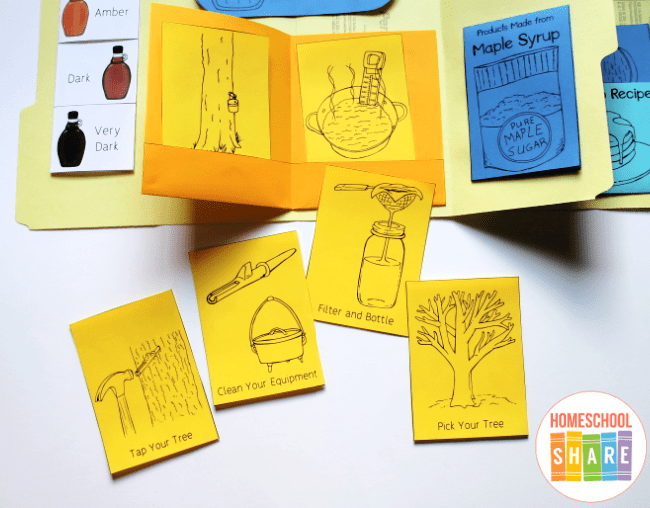
Discuss the process
of making maple syrup. Have child complete
Syrup Process Sequencing Cards
and store in pocketbook.
Some special tools are needed for tapping trees and making syrup. These can be
recorded in
Tools Bucket Shape Book.
Tools needed to tap the tree
include :
An auger-- a hand drill or power drill with a 7/16 inch drill bit
spiel (preferably with hooks)
sap bucket
Supplies needed to make maple syrup:
large plastic pail
large pot
cheesecloth or cone-shaped paper coffee filters
canning jars or bottles
cooking or candy thermometer
oven mitts
slotted spoon
sieve
What to do
1. Clean Your Equipment
Clean all of your equipment and rinse it well with hot water. Let it dry
completely.
2. Pick Your Tree
Select a maple tree that is at least 10 inches in diameter at 4.5 feet high.
Do not attempt to tap a smaller tree; you will do permanent damage.
3. Tap Your Tree
Do not tap a tree when the temperature is below 25 degrees Fahrenheit.
At about 4.5 feet, drill a hole on the sunny (south) side of your tree. Drill
on an upward angle to a depth of no more than 3 inches. If your tree is larger
than 18 inches in diameter, you can drill another hole. It should be at least 6
inches away from the first hole (you want to measure horizontally not
vertically). Carefully and gently tap the spiel into the hole.
4. Collect the Sap
Place your bucket on the hook (below the spiel). Attach a cover to prevent
unpleasant things from getting into your sap such as bugs, bark, and rain.
Collect your sap at least once a day. If you leave it longer than a day, it may
spoil. If the weather gets below freezing, your bucket might split. If you
can't boil your sap immediately, store it in your freezer. Before you boil
it, strain it through a cheesecloth.
5. Boil the Sap
Bring the sap to a boil. Continue boiling until it reaches 219 degrees
Fahrenheit.
(If you would like to try this at home, I highly recommend that you read the
information provided in The Maple Syrup Book by Eagleson & Hasner)
6. Filter and Bottle
You can use any bottle you would like to store your syrup as long as it is clean
and dry.
Filter your syrup through a cheesecloth or a few cone-shaped coffee filters
stack together. You want to remove the sugar sand that was produced while the
sap was boiling. Pour filtered syrup into the bottle, attach the cap, and place
the container on its side (this will sterilize the lid).
Source: The Maple Syrup Book by Eagleson and Hasner
Compare the 1800’s methods in Sugar Snow to the methods in Sugarbush
Spring. The sap is usually running from the maple trees by the end of
February, and if you happen to live in an area with deciduous (leaf losing)
trees, you may find a local nature center that does maple-tapping
demonstrations.
History of maple tapping, and general info
Maple
Trees
Read about maple
trees on pages 252-253 in Fun With Nature (or another field guide type
book). Go for a nature walk to locate maple trees. If you are looking in late
winter, before the buds have opened, you can identify a maple by its bark, seed
pod “helicopters”, and its characteristic “eye to eye” leaf growth. Color or
draw pictures of maple leaves, seedpods or trees.
You may also want to discuss the life cycle of a maple tree with your child. While completing Lifecycle of a Maple Wheel, have your child identify each stage of the maple tree’s growth:
1.) Seed - Inside a seed coat is a tiny living plant, called an embryo.
Under the right
conditions, including temperature, air and water, the tiny plant will break
through the seed coat
and "germinate".
2.) Roots and Shoots - After the seed germinates, the roots grow down into
the ground and the
shoots grow up towards the sunlight. The first leaves emerge from these new
shoots.
3.) Leaves - The shoot thickens into a stem and then into a trunk. The first
true leaves emerge
from this trunk
4.) Seed Pods - Branches grow off the main trunk, and buds then appear. They
develop many new leaves, and finally the seed pods, which will eventually fall
to the ground, and start the cycle of life once again.
Review the different parts of a tree with your student. Let your student label
this
Maple Tree. (Note: your student will need to draw the roots.) Be sure to
label the following: branches, seed, canopy of leaves, roots, and trunk. An
older student may want to write the words and definitions.
branches - woody parts of the tree that grow from the trunk.
canopy of leaves - the upper parts of the tree, where the leaves are
roots - structures that gets food and water from the soil, stores energy, and
provides support for the plant.
trunk - the main support of the tree
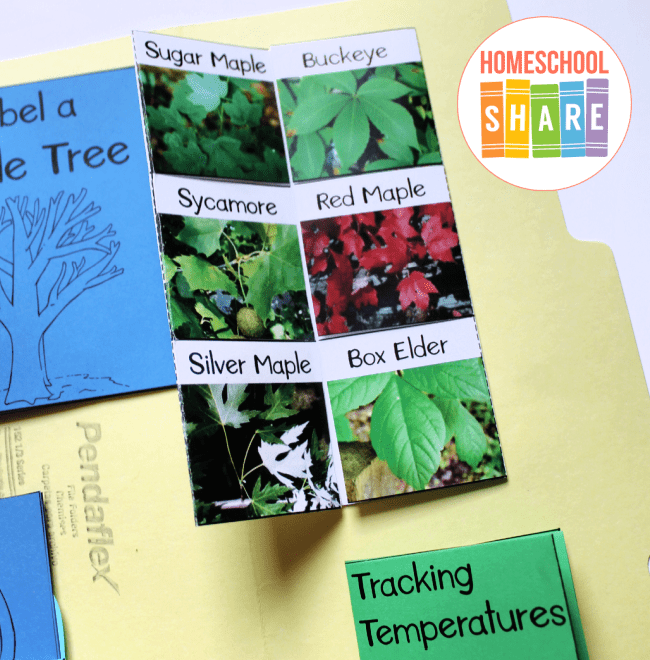
Explain to your student that only certain kinds of trees can be tapped for
maple syrup. These include four different varieties of maple trees-- silver
maple, red maple, ash leaf maple (known more commonly as a box elder), and sugar
maples. Sugar Maples contain more sugar than the other three kinds; the sugar
maple produces the best flavored maple syrup (the others are dark in color and
less flavorful). What Tree
to Tap Flap Book
Snow
Both
of the stories for this unit mention snow. Snow is formed when ice crystals in
a cloud bump together and stick to each other. If the temperature of the air
below the cloud is cold enough, snow falls. All snowflakes have six sides, but
no two snowflakes are just alike. Have children cut paper snowflakes making sure
no two are alike.
Evaporation
If you have the opportunity, take some time to show your student the process of evaporation. If you have some tomatoes, boil them down to make tomato sauce. You could also boil down some apples to make apple butter. Show them the steam and explain how the water is being removed and why the sauce or butter (and maple syrup) starts with a large quantity, but yields a much smaller amount.
Pioneer Life (for
My First Little House Book – Sugar Snow)
This story is based on the childhood of Laura Ingalls in the 1870’s. Point out
the pictures of the log cabin, clothing, open fire, and punched tin lantern, and
candlelight. Discuss the pastimes the Ingalls family had, the girls playing
paper dolls, Pa whittling wood, Ma sewing. Compare them to the pastimes your
family members have. Would your child enjoy living as a pioneer, without
television, or electronic games, no cars or telephones or running water? If you
use a timeline in your homeschool, add a picture of the Sugar Snow book
jacket.
Wisconsin (for
My First Little House Book – Sugar Snow)
Laura lived in the Big Woods of Wisconsin. Show child on a United States map
where Wisconsin is, and identify the state as being in the Great Lakes region.
Wisconsin is called the Badger State because the lead miners in the early 1800’s
lived in caves dug out of the ground, just like badgers. There is more butter
and cheese made in Wisconsin than in any other state, and its forests make
lumber and paper making important industries.
Relationships
A recurring theme in both Sugar Snow and Sugarbush Spring is the
importance of family relationships. In Sugar Snow the children play
together, the family tells stories around the fire, and Pa and Grandpa were
together getting the syrup ready. In Sugarbush Spring the extended family
works, cooks, reads, and plays games together as well. It seems that the maple
syrup may have been a family tradition, something that was look forward to and
enjoyed by all. Discuss childhood memories of spending time with your family
and friends and traditions that your family may have now. If you can’t think of
any traditions you have, why not start making memories now.
Using the Internet or the book The Maple Syrup Book by Eagleson and Hasner, research where maple syrup is produced. Locate Quebec, Vermont, Ontario, Maine, and New York on a map of North America. Complete Maple Syrup Producers Map lapbook component if desired.
Estimation
You and your child
can do this fun experiment with snow,
using attached graph sheet. If lapbooking, you may want to paste bars from
graph sheet into
Snow Melting Experiment Tri-fold. Pack snow into a glass (if you don’t have
snow, crushed ice will work too), and help child measure how deep the snow is
and record it on graph. Ask him how much water he thinks will be in the glass
after the snow melts, and record that answer as well. Now place the glass in a
warm spot, allowing the snow to melt, and record the amount of water in the
glass. How close was your child’s guess?
Temperature
In
Sugarbush Spring a thermometer is observed to tell the temperature of the
syrup. The warmer the temperature, the higher the liquid in the thermometer
rises. When the syrup reaches 212 degrees, it reaches the point at which water
boils. The syrup must reach 219 degrees in order to be done. What is the
difference between the boiling point of water and the temperature at which the
syrup is ready?
Also make mention that water freezes at 32 degrees, and point out the picture of
Laura in Sugar Snow, where she is watching the icicles melt. Have child
observe a thermometer every day for a week and record his findings. Use
Temperature Hotdog Book if desired
following these instructions. *Start this book on Monday so that your
student can record information in it for 6 days. Encourage your older student to
write more than a simple yes or no on the last question; if the weather is too
cold, have him calculate the difference and record that as well (i.e. "no,
because it is 9 degrees to cold")
Liquid Measurements
In Sugarbush Spring Grandma and Grandpa fill bottles with syrup. Discuss the different size bottles, and how liquids are measured. In the story, they use gallons, and quarts, and pints. Explain to your child that there are two pints in one quart, and four quarts in a gallon. Use attached manipulatives and pocket to demonstrate liquid measurements, and solve these story problems:
It takes 40 gallons of maple sap to yield one gallon of maple syrup. Four
quarts are equal to one gallon.
1. How many gallons of maple sap would you need to yield 3 gallons of syrup?
2. How many gallons of maple sap would you need to yield 5 gallons of syrup?
3. How many gallons of maple sap would you need to yield 10 gallons of syrup?
4. If you had five gallons of maple sap, how many quarts do you have?
5. If you have 40 quarts of maple sap, how many gallons do you have?
6. How many quarts of maple sap would it take to yield one gallon of maple
syrup?
7. If you have six gallons of maple syrup, and you give one to a neighbor and
two to your grandmother, how many do you have left?
8. If you
want to have three gallons of maple syrup on your shelf at the end of sugaring
season and one gallon in your refrigerator, how many gallons of sap do you need
to tap from your trees?
Diameter
In order to
determine if a tree is ready to tap, it must be at least 10 inches in diameter.
Does your student know what the word diameter means?
Diameter is the measurement equal to the distance across the center of a
circle. Have your child measure various circles around the house, such as
plates, bowls, and tables. Measure the diameter of circles on
attached
worksheet, if desired.
Pie Graph
With your older student, make a pie graph based on the following data for
the leaders in maple syrup production.
Quebec 81.4%
Vermont 5.5%
Ontario 3.3%
Maine 3.3 %
New York 2.7%
Other 3.8%
Let your student
make a graph online to include in his lapbook. He gets to input the
numbers, choose the colors, and everything else!
-information from The Maple Syrup Book by Janet Eagleson and Rosemary
Hasner
Language Arts
Vocabulary
Note: these are not necessarily words you will encounter in the books you read,
but words that you will encounter as you complete the lessons in this unit. Use
Vocabulary Leaf Shape Book (with definitions) or
Vocabulary Leaf Shape Book (blank) to record words, if desired.
spiel: a spout inserted in a tree to draw off sap
evaporate: to remove some of the water from (as by heating)
sap:
a watery solution that
circulates through a tree carrying food and nutrients
sugar house: a building where maple sap is boiled to make maple syrup and maple
sugar
auger: a tool made like a spiral or screw and used for boring holes
deciduous: a tree with leaves that fall off
grade: a standard of quality
Onomatopoeia is the use of words whose sound suggests its meaning. Can your child find the onomatopoeia used by the author throughout Sugarbush Spring? The sound of the crow, “caw, caw, caw”, the sound of tree being tapped, “tap, tap, tap”, the sound of the dripping sap, “ping, ping, dripple, dripple, dripple”, and the sound of a sigh, “aaah” are all uses of onomatopoeia.
For handwriting practice, child could complete short maple poem Copywork Simple Fold (manuscript) or Copywork Simple Fold (cursive) exercises.
Sometimes an author will use a descriptive device called a simile to give the reader a better mental image of what is being discussed. A simile is a comparison using the words “like” or “as”. Marsha Wilson Chall uses this throughout Sugarbush Spring. Can your child find any of the similes?
The holes on the maple trees are compared to “front and back belly buttons”.
Steam coming from sugarhouse to said to be “soft as clouds”.
Bottles of syrup “colored like fall leaves”
Another descriptive device used by Marsha Wilson Chall is called a metaphor. A metaphor is a comparison not using the words “like” or “as”. An example of a metaphor is:
Maple steam is bathtub warm, cotton-candy sweet.
~ Having children help to measure and mix, make Laura’s Little Maple Cakes from My Little House Cookbook.
~Have
your child help to read and prepare various
Maple Recipes. Copy any favorites onto
Blank Recipe Cards.
~Maple Syrup Products
Some products made from maple syrup include: maple butter, maple taffy (and
other candies), maple fudge, and maple sugar. If you choose to use the
lapbooking component, you may want to introduce your student to Internet
research. Sit down together and type in "products made from maple syrup" into a
search engine. Did you find anything? If you have an encyclopedia, see if
there is a list given there. What other ways can you find out this
information? Record findings in the
Products made from Maple minit book. Note- print on cardstock for best
results. This book is patterned after
Jimmie's Snake Circle book. Please look at the directions for her book if
you encounter any trouble or have questions.