| about us |
what's new
|
unit studies
|
unit study helps |
hss resources
|
fiar resources | indexes | lapbooking |
Lapbook
Character Study: Stewardship
Discuss how you take care of the home God has given
you (upkeep, cleaning, etc.). How does your
student take care of what he has been given?
Why is it important to be a good steward?
Social Studies:
Rural Life and City Life
Discuss rural and city life with your student.
You may want to make a list.
Heidi's note--we just discussed what it was like
in the book and the difference between our home (city) vs. at
Grandma's house (rural) with what we smell, see,
hear (and made lists). City--see lots
of cars, houses lining streets, people of different
colors and religions, tall buildings, street lights, and
flowers growing in planters; smell exhaust, sewers,
and asphalt; hear semi-trucks, sirens, lawnmowers,
and planes. Rural--see cows, fields, deer, flowers
growing along the narrow roadway, hawks gliding on
the wind, and trees; smell manure, grass, corn,
flowers, and hay; hear birds, cows, owls, horses,
and tractors.
A fun go-along may be Town Mouse, Country Mouse by Jan Brett.
Social Studies: Progress (Transportation)
Progress is described as the gradual development and
improvement of civilization. In The Little House
we see the progression of the countryside turned
to city streets, through the eyes of a house. Do you
think the Little House saw this as progress? We have
also seen throughout this story the progress that
transportation has made throughout history, both in
modes of personal and public transportation. As you
read through the story with your child, and observe
the vehicles on the inside covers, you may want to
expand upon the history of these modes.
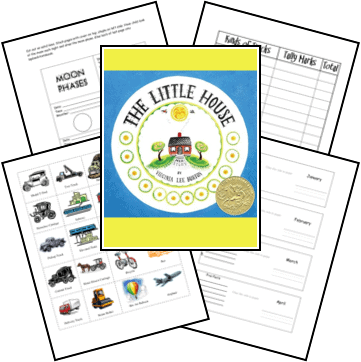
Transportation Timeline Flap Book
Personal Transportation –
The first wheeled vehicles were invented c.3500 B.C.
Various animals pulled these carts. The same basic
designs, which were used for thousands of years, can
be seen on the first thirteen pages of this story.
On the inside cover of The Little House you can see the progression from horse drawn vehicles to people powered vehicles. In 1839 the first bicycle was invented, called the “velocipede”, which had to be pushed along by the riders’ feet because there were no pedals. By 1870 the first pedaled bicycles were invented, most having extremely large front wheels and tiny back wheels. These then progressed into geared bicycles, and even two seated units called tandem bicycles.
Beginning on page fourteen, the Little House saw horseless carriages. Gottlieb Daimler was the inventor of the first horseless carriage when he attached an engine to an old fashioned coach in 1886. While these horseless carriages transported people where they wanted to go quickly, they were only available to the wealthy. In 1908, Henry Ford developed a car that everyone could afford, the Model T, and the evolution of the automobile would never be the same.
This book was written in 1942. Compare the newest cars in 1942 to the cars that are produced today. Discuss with your child some of the ways they have progressed, i.e. safer, more comfortable, less pollution, faster, etc.
Public Transportation –
As the countryside progressed into a populated city,
problems in traveling from place to place presented
themselves. These problems were overcome with the
introduction of public transportation, also called
“mass transit”.
Have your child look at the trolley cars on page 22. Also called “streetcars”, these modes of transportation were very popular in the early 1900’s. Trolleys travel along rails that are built into city streets. Some trolleys still exist today, but people prefer quicker modes of transportation.
On page 24 an elevated train is pictured. Also called “the el”, these rapid-transit systems are built on tracks running above the street level. While early ells were steam powered, causing much dust and smoke, modern versions are powered by electricity.
After the elevated train was running above the Little House, a subway system was installed under the Little House. Has your child ever seen or ridden in a subway? The first city in the United States to ever have a subway was Boston in 1897. It transports large amounts of people in trains through tunnels underground. Like the elevated trains, the subways were first steam powered and are now powered by electricity.
If at all possible, take your child for a ride in a
trolley, train, or subway.
Lapbook Component:
Train Tab
Book
Go-along books: Maybelle the Cable Car
by Virginia Lee Burton, Choo-Choo the Runaway
Engine by Virginia Lee Burton
Commercial Transportation –
Have your child look through The Little House
and identify all the trucks he can find. What is
each one being used for? He will find trucks that
are hauling groceries, animals, and building
supplies. He will find dump trucks, tow trucks,
tanker trucks, and flat bed trucks. We all depend on
trucks, and the world would not be the same without
them. Trucks are built heavier and sturdier than
cars. They carry heavy loads, and they need to be
dependable because people and businesses are
counting on them to deliver products in a timely
manner.
The very first trucks were on the road in 1900. Like the first trains and cars, they were powered by steam. They were not very dependable, could not carry heavy loads, and broke down often. When the United States entered World War I in 1917, inventors went to work to create a truck that would be strong and dependable. The trucks would then have large, heavy tires, and were powered by gasoline. It was important to have good, strong trucks as the lives of the people depended on it.
As you travel, have your child pick out the different trucks that are driving on the roads today. How are they different than the ones pictured in The Little House? How many different types of trucks can he spot? Have him keep track using attached sheet, and insert into prepared pocket, as desired.
Your youngest student may enjoy The Truck Book
by Bill Gere, a Golden Book about different kinds of
trucks.
Lapbook Component:
Kinds of
Trucks Page with Pocket
Language Arts: Classic Story
Art/Music: Vivaldi's "Four Seasons"
Science: The Four
Seasons
Discuss the four seasons with your
student. Make a chart and determine which
holidays fall in each season. Have your
student add more characteristics to each list on the
chart (some ideas: clothing appropriate for the
season, weather that is typical of the season, and
activities people do during the season).
You could also print the following clip-art from
kizclub and let your student sort it by season and
make a seasons collage (add in words and other
drawings, clippings from magazines, etc.)
Spring Clip-Art Color
Spring Clip-Art Black & White
Summer Clip-Art Color
Summer Clip-Art Black & White
Fall Clip-Art Color
Fall Clip-Art Black & White
Winter Clip-Art Color
Winter Clip-Art Black & White
Your older student may enjoy researching why we have
seasons.
Science: Moon Phases
From Earth, we can only see one side of the moon
(one side is always in shadow) because the moon
rotates once on its axis every time it travels
around Earth. The side that we can see
seems to change. However, the moon doesn't
really shrink and grow. The moon reflects
sunlight. The amount of reflected sunlight we
get to see in our night sky depends upon the
position of the Earth, the moon, and the sun so
varying portions of the moon's lighted side face
Earth at different times. The phases include
the new moon, crescent moon, half moon, and full
moon. (If your student is too young to
understand the above concepts, simply mention that
the moon doesn't really shrink. It appears to
shrink because at different times it reflects
different amounts of sunlight.)
Your young astronomer may want to watch the night
sky for a month and chart the moon (on the nights he
can see it) as it goes through its cycle.
Moon Phase Booklet by Wende
Phases of the Moon Demonstration
Label the Moon Phases Diagram
More Moon Information
Extend your Moon Study-- Hands of a Child Moon
Project Pack
Make Moon Phase Cookies
Using sugar cookies (circle shaped) and a cup of
yellow icing, make each phase of the moon by using
the icing to color in the lighted part. Make
the phases in sequence and display them (take a
picture!). Then, gobble up your science fun!
Science: Sun and other Stars
When the Little House lived in the country she liked
to watch the sun rise and set each day, and she
liked to watch the stars twinkle each night. Have
your child look at pages 2-3, as the sun rises and
sets. Explain that the sun rises in the east and
sets in the west. Have child complete
this sun
mini-book if desired. Does your child know that the
sun is a star? It is not the largest star, but it is
the star closest to the earth so it seems much
brighter than the other stars. In addition to light,
the sun provides us with heat and energy. The
position of the earth as it rotates on its axis and
revolves around the sun is what causes day and
night, as well as the different seasons. Read page
30 of The Little House with your child. Why
could the Little House only see the sun at noontime?
Because it is straight up in the sky at noon. Why
couldn’t the Little House see the moon and stars at
nighttime anymore? For the same reason you can’t see
stars in the daytime. Do this experiment with your
child to demonstrate how the light of the sun or
bright streetlights can overpower the smaller lights
of distant stars or the moon: Go into a dark room
and shine a little flashlight on the wall. The light
will be bright in the darkness of the room. Now
switch on the lights and see what happens to the
small light of the flashlight. The larger light
overpowers the smaller light. That is why the little
house couldn’t see the beauty of the nighttime sky
anymore as the city lights were overpowering.
A good book to read about the sun is Sunshine Makes the Seasons by Franklyn M. Branley from the Read-and-Find-Out series.
More Ideas:
Rabbit Trails
The Industrial Revolution
Study
the sun (sunrise, sunset, sun facts)
Library List
Homeplace by Ann Shelby (ties
in to first page of The Little House); great
for genealogy study!
The Moon Book by Gail Gibbons
Other Resources
Ch. 4 (The Little House) Exploring the
Environment Through Children's Literature by
Butzow
Materials and information on this website belong to the
original composers. It may be used for your own personal and school use.
Material may not be used for resale.
© 2005-07 HSS