Google
 
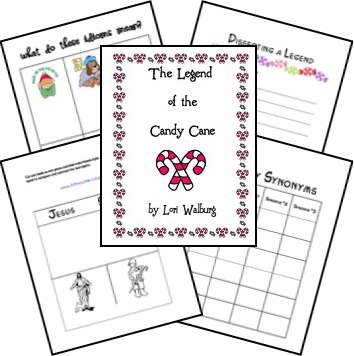
The Legend of the Candy Cane Free Unit Study and Lapbook


The Legend of the Candy Cane

Author: Lori Walburg
Illustrator: James Bernardin
ISBN:
0310212472
Summary:

A stranger arrives in town one dreary November and begins hammering and sawing away at his newly rented storefront. When a small girl offers her help, she's in for a childhood fantasy-come-true, as it turns out all the shelves and counters are being built for a candy shop. After offering young Lucy gumdrops and lollipops, Mr. Sonneman launches into the history of the candy cane. With his guidance, she discovers that the upturned candy is in the shape of a j--for Jesus. Right side up it looks like a shepherd's staff. And the red stripes? The blood of Christ from his terrible whipping. Lucy and Mr. Sonneman set out on a quest to share this story with everyone in town.

Unit Study prepared by Candace Crabtree and Celia Hartmann
Lapbook prepared by Tina Franks


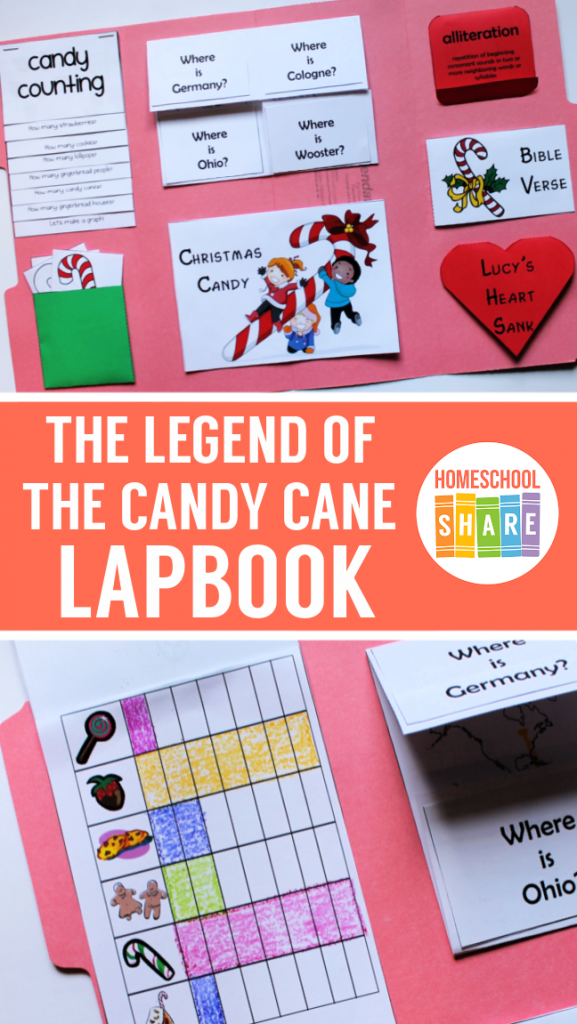
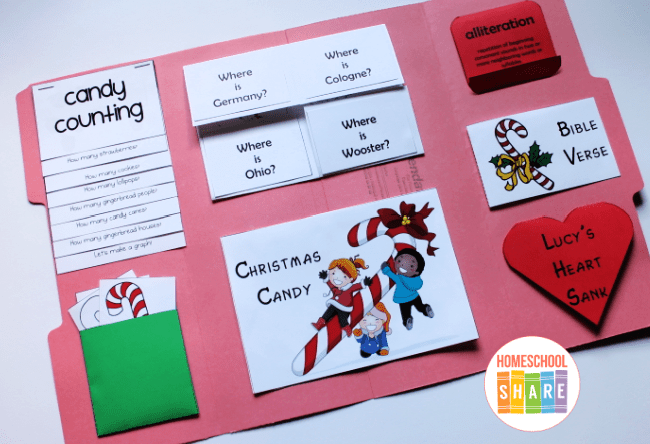
Lapbook
photos contributed by Aimee Guest


Candy Cane Symbolism
 
Legend Fact/Fiction File Folder
 
Lucy's Heart Sank
 
Compare/Contrast Jesus to Shepherd
 
Vocabulary Flap
 
Psalm 23 Copywork Page and Pocket
 
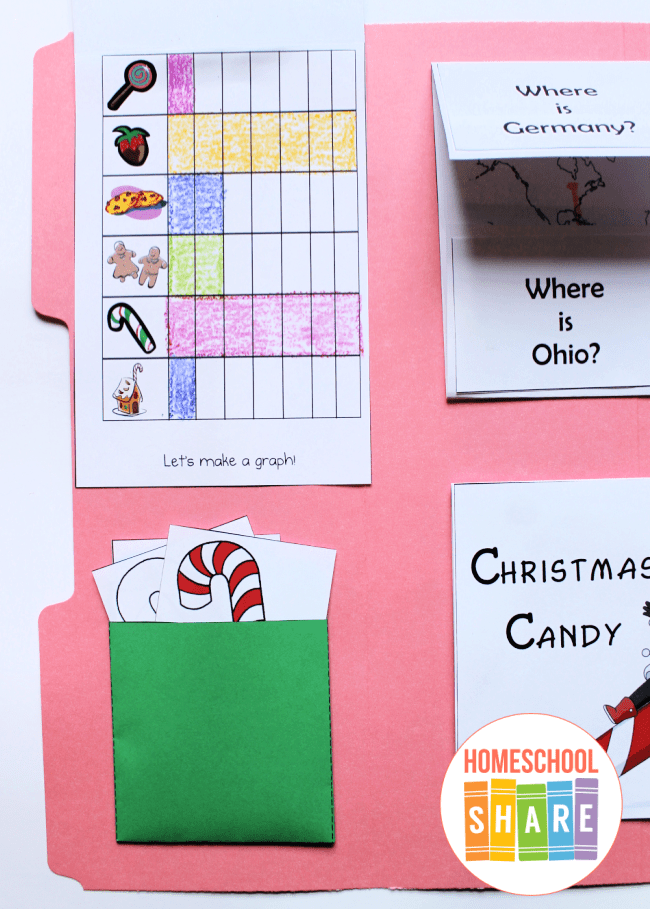
Candy Layer Book (with graph)
 
Dozens Petal Book
 
Isaiah 53:5 Simple Fold
 
Alliteration Matchbook
 
Candy Cane Alphabet Matching
 
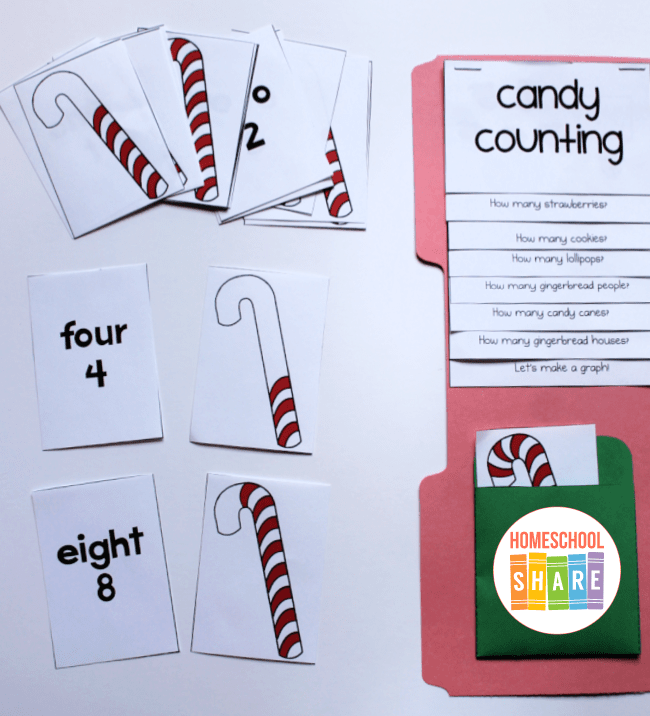
Size Cards and Pocketbook
 
J is for... (primary)
J is for (HWOT)


Cover (black/white)
Cover (color)


Christmas Candy Rhyme Glue Pictures
Christmas Candy Rhyme HWOT Trace
Christmas Candy Primary Trace
Christmas Candy Primary Copywork
Christmas Candy HWOT Copywork
 
Indiana Facts Fan
 
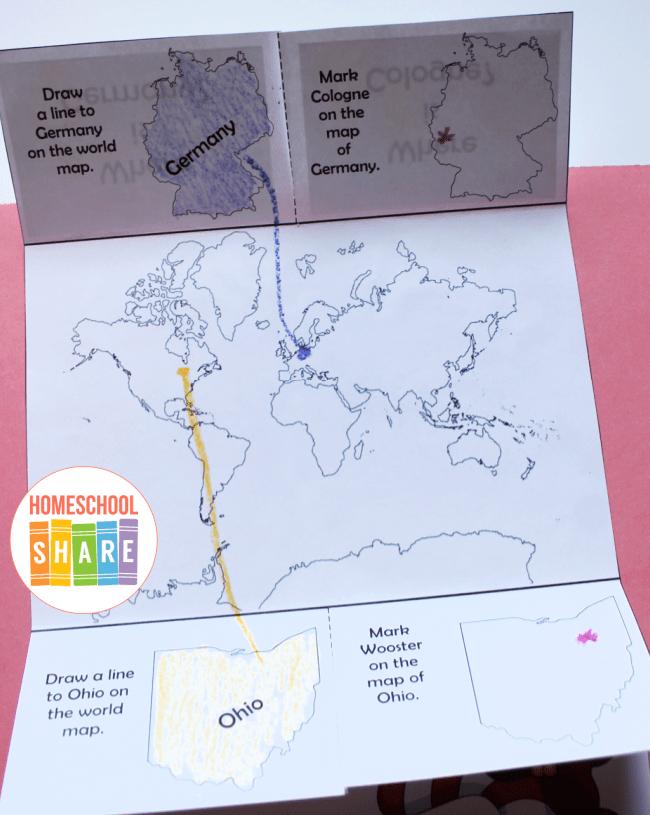
World Map Book
 
Occupations Matching Game with Pocket


Bible

“By His stripes we are healed.” Isaiah 53:5.  Discuss this verse, what does it mean? What were Jesus’ stripes?  Depending on how in depth you’d like to go, possibly read all of Isaiah 53 this week and discuss.

Also, read from Luke or just discuss the shepherd’s role in the Christmas story, as the first to find out about Jesus’ birth.

You may wish to also read and discuss John 10:11 and 14 - 18

John 10:11 
I am the good shepherd: the good shepherd giveth his life for the sheep.

John 10:14-18  I am the good shepherd, and know my sheep, and am known of mine.
 As the Father knoweth me, even so know I the Father: and I lay down my life for the sheep.
 And other sheep I have, which are not of this fold: them also I must bring, and they shall hear my voice; and there shall be one fold, and  
 one shepherd.

 Therefore doth my Father love me, because I lay down my life, that I might take it again.
 No man taketh it from me, but I lay it down of myself. I have power to lay it down, and I have power to take it again. This commandment have I received of my Father.

Help your child understand that Jesus chose to die for us!  He truly is our Good Shepherd, choosing to die for us so that we might have a way to live eternally with God.

Mom, perhaps you would like to do a Bible study of Psalm 23 this week.  Here are just a few on-line ones.
 
http://www.jesusplusnothing.com/studies/online/psalm23.htm
http://www.ccel.org/contrib/exec_outlines/psa/psa_23.htm
http://lurasbookcase.com/valv1.shtml
 

Social Studies

Social Studies/Bible -- Shepherd
Take a candy cane  and turn it right side up and ask your child what it looks like -- a shepherd's staff or crook.   Show him the picture in the book of the shepherds in the field and point to the staff.  The occupation of shepherd has been around thousands of years, starting with Abel the son of Adam and Eve.  Farmers were unable to tend large flocks of animals and do the planting and harvesting, so some men became caretakers of the animals.  Shepherds take care of sheep.  You may have read about several shepherds in the Bible......Moses, King David, prophet Amos, and of course the ones mentioned the story, the shepherds who watched over their flocks and to whom the angels announced the birth of Jesus Christ.

Now, sheep are not very smart animals, and they have a tendency to wander and to get into trouble.  Shepherds lead the sheep to grassy places to eat and waters to drink.  They protect them, sometimes using their staff to hook a sheep that  has fallen over cliff.  Humans may be smarter but we too tend to wander from the path that God would have us walk or get into places we shouldn't.  God sent us a Good Shepherd to watch over us and take care of us, and that Shepherd was His son Jesus Christ.  And if we follow Jesus' ways, then one day we will live forever with Him.


Read Psalm 23 together and discuss how the Lord is our shepherd!  David wrote this psalm, yes the very same little shepherd boy who defeated the giant Goliath and later became the King.

 
The LORD is my shepherd; I shall not want.
   He maketh me to lie down in green pastures:
he leadeth me beside the still waters.
   He restoreth my soul:
he leadeth me in the paths of righteousness for his name's sake.

Yea, though I walk through the valley of the shadow of death,
   I will fear no evil: for thou art with me;
thy rod and thy staff they comfort me.

   Thou preparest a table before me in the presence of mine enemies:
thou anointest my head with oil;
   my cup runneth over.

Surely goodness and mercy shall follow me all the days of my life:
   and I will dwell in the house of the LORD for ever.
 

Perhaps help your student to memorize this passage this week or have him write it out in his best handwriting.

A great go-along would be W. Phillip Keller's A Child's Look at the Twenty-Third Psalm.  Or you could read this simplified explanation of the 23rd Psalm with your child to give him a better understanding.

Choose an artwork illustrating the Good Shepherd to print out and display this week (or add to your lapbook).   Possibilities:

 
Bernhard Plockhorst's The Good Shepherd
Warner Sallman's The Good Shepherd
Simon Dewey's The Lord is My Shepherd
Greg Olsen's The Good Shepherd
Del Parson's The Lost Lamb
Margaret Tarrant's The Loving Shepherd


Social Studies -- Occupations
In our story, the mayor hoped the stranger would be a doctor, the ladies hoped he would be a tailor, and the farmers had hoped he would be a trader.  The stranger turned out to be the owner of a candy store.  Discuss any of the occupations that might be of interest to your student or that your student has not previously studied.  
 

Geography -- Cologne, Germany; Wooster, Ohio; and Indiana
Read the author's note History of the Candy Cane at the end of the book.  You could choose to learn about Cologne, Germany; Wooster, Ohio; or Indiana.  Or perhaps all three, since each played a role in the making of the candy cane as we know it today.  Make three story disks and connect using red and white variegated yarn or a strand of red and a strand of white twisted together.

Cologne, Germany:    A choirmaster reportedly bent white sugar sticks into the shape of a shepherd's staff and gave them to the children during service to help keep them quiet and attentive.   Cologne is the fourth largest city in Germany, home to about a million people.  It is one of the oldest cities in Germany, having been founded by the Romans in 50 A.D.  One thing Cologne is famous for is its Cologne Cathedral, a beautiful Gothic church that took over 600 years to complete!  Help your student locate Cologne on a map or globe.  It is in the middle of the western half of Germany. Point out the River Rhine.  
 
Enchanted Learning's Outline map of Germany (members only)
Enchanted Learning's Flag to color (members only)
About.com Geography's Outline map of Germany
 

Wooster, Ohio:  In 1847, August Imgard, a German-Swedish immigrant, brought the candy cane to America to his home in Wooster, Ohio and decorated his spruce tree with them.  Wooster is a town of 25,000 people in northeastern Ohio.  The city was founded in 1796 and named for a Revolutionary War hero, General David Wooster.  It is largely an agricultural area.  Locate Ohio on a globe or map.
 
Enchanted Learning's Ohio facts, maps, and flag
 

Indiana was the 19th stated admitted to the Union.  The word Indiana means "Land of the Indians."  From about  100 to 400 AD, it was the home to the Hopewell culture of Native Americans.  Later it became home to the Miami and Shawnee Nations.  It is now home to over 6 million people, many of whom are of German heritage.  People who live in Indiana are called Hoosiers.  If your child previously located Ohio, tell him that Indiana lies directly west of Ohio and have him point to it on the map.  
 
Enchanted Learning's Indiana facts, maps, and flag
 

Language Arts

Letter Recognition: J
Turn a candy cane upside down and ask child what letter it is. You can practice handwriting J’s this week as well.

Vocabulary
    lumber - the new man in town was using new lumber to build his store
    tailor - the ladies in town were hoping that the new store would be a tailor shop, for new dresses
    gleaming - the candy was gleaming in the new jars as Lucy was helping fill them
    pure - the white part of a candy cane reminds us that Jesus blood washes away our sins and makes us pure.
    invitation - we get invitations to parties, but what kind of invitations are John and Lucy giving out with the candy canes?
    misery - sharing about Jesus misery in His death tells us what the stripes on the candy cane are for
    confections- the big word on the box that Lucy is told to open. 
    Lucy's "heart sank" discuss what this means... she was disappointed!

Poetry
Read and act out this poem with your child
(taken from www.theteachersroom.com)

Christmas Candy

I took a lick of my peppermint stick
(Pretend to lick candy.)
And was it ever yummy!
(Lick lips.)
It used to be on my Christmas tree.
(Form tree shape with hands.)
Now, it's in my tummy!
(Rub stomach) 

Genre: Legends
Discuss the word legend with your student.  A legend is
an unverified story handed down from earlier times, especially one popularly believed to be historical.  The Legend of the Candy Cane may or may not be true.  After you've read the story a few times with your student, you may want to read this information about candy canes.  Determine which aspects of the legend are based on sure historical fact and which aspects may not (or may!) be true, but can't be validated.

If you want to expose your student to other Christmas legends, you may also want to read The Legend of the Christmas Tree, or Legend of the Christmas Stocking both by Rick Osborne. 

Your older student may want to try his hand at legend writing.  Help him think of another Christmas item (Legend of ________ ) to write about. (Of course, it wouldn't have to be a Christmas item if he wanted to do something else.) If you are really ambitious, try to find out the actual historical beginning of the item after he completes his story.

Language Arts -- Alliteration
After you've read the story a couple times, and if your student has already studied alliteration, ask him if he can think of an example of alliteration from the story. On the third and fourth pages of the story, it talks about how the people waited, watched, wondered, and wished.  

Language Arts -- Invitations
This week, have your student practice writing an invitation.  Perhaps he could invite someone to church on Sunday or to your church's Christmas program. Discuss the things that should be included in an invitation:   the event, the date, the time, the place, whether or not an RSVP is needed, etc.


Applied Math

Counting
On various pages count the different kinds of candy.

Candy Cane Manipulatives
Make some candy canes by drawing on paper (or make some to cut out).  On each candy cane put a different amount of stripes. For preschoolers you could just have them count the stripes on each candy cane and write the number underneath. For K-1 you could put 2 candy canes together and have them add the stripes together for addition practice.

Addition and Subtraction Fun
For a fun math lesson, purchase several types of candy mentioned in book that your child has not tried before. Practice counting/adding/subtracting with the candy and then do a taste test.

Graphing
If you wish, you could get varying amounts of different types of candy (4 gumdrops, 5 suckers, 3 lemon drops, 4 peppermints, etc.) and graph the candy!

Cooking
One day for math you can bake together! There are a lot of recipes that use candy canes! I thought these looked especially fun and yummy for children. Feel free to use any recipe you wish. Allow your child to help you follow the recipe. (And have fun crushing the candy canes!)
See recipes in the Just for Fun section.

Math -- Dozens
[There] were dozens and dozens of barrels and crates.  Use this opportunity to review how many are in a dozen and/or skip counting by 12s.  

Math -- Candy Store
Locate several clear small plastic jars/containers.  Put inside different candies or other small colorful items to represent candy (e.g., marbles could be jawbreakers, etc.).  Price each jar.   Allow your student to play store, taking turns being the owner (who must add up the total purchase and make change) and being the customer (who must determine if he has enough money to buy various candies and count out change to the owner.)


Science

Weather
Read first page of story and discuss what type of weather would be described by “dreary evening.” Then, read further on the next page where it tells us that the days are short and gray, the nights are long and dark. Discuss weather patterns of the different seasons; how it gets darker earlier in the winter time.

Read on towards the end of the book where there is a blizzard in December. Discuss what a blizzard is with your child. Do you get blizzards where you live?


Art

Medium:  Acrylic and Colored Pencil
The artwork in this book was done with a combination of acrylic and colored pencils.  You may want to allow your student to experiment with one (or a combination) of these media this week.

Artist Study:  Norman Rockwell
One of the reviews for this book states that the illustrations are reminiscent of Norman Rockwell.  Who was Normal Rockwell?  Encourage your older student to research Rockwell and his work.  Compare Rockwell's works to the pictures for this book done by
James Bernardin. 


Craft Ideas

Beaded Candy Canes
Make beaded candy canes on a pipe cleaner.  Using floral wire, shape a candy cane.  Use pretty beads to make ornaments shaped like candy canes. You can use all different colors!
 

Paper Candy Cane
This idea really could be adapted to your child’s ability level.

Materials:
Green construction paper
1 x 1 red squares
1 x 1 white square
glitter

This is a quick and easy art project that the children always love! 
Ahead of time cut some 1 x 1 inch squares of red and white paper. 
Cut green construction paper in half and draw a candy cane shape on it (I always draw one on each side).  The children put glue along the candy cane line and then stick on their red and white squares in a pattern.  When dry, hang from the ceiling.


Just For Fun 

Have a candy cane party! While you read the story with friends, enjoy hot cocoa, and give everyone a mini-candy cane to put in their hot cocoa for mint hot chocolate! Share the story of the candy cane with family and friends.

Play Candyland!

Find as many peppermint flavored foods as you can, and of course, taste test them all! Peppermint/candy cane ice cream, peppermint cake, peppermint candy, peppermint fudge, etc.

I found a coloring book on clearance at the Christian book store that goes with the book, the Legend of the Candy Cane – each page tells a part of the story. Very cute!

Make peppermint playdough! Here is a recipe:

Peppermint Playdough
2 cups water
2 cups flour
1 cup salt
4 teaspoons cream of tartar
4 tablespoons oil
4 tablespoons peppermint extract
glitter (optional, for sparkly playdough)

Mix all ingredients in a heavy saucepan. Cook over medium heat, stirring constantly with a wooden spoon, until mixture thickens and pulls away from the sides of the pan. Form dough into a ball, sprinkle with glitter, place on waxed paper, and cool completely.  Store in Ziploc baggies.

Recipes

Mint Chocolate Truffle Cookies

6 squares  Semi-Sweet Baking Chocolate
3/4 cup (1-1/2 sticks) butter
1 cup sugar
2 eggs
1-3/4 cups flour
1/2 tsp. Baking Powder
1/3 cup crushed candy cane

Directions:
Preheat oven to 350°F. Microwave chocolate and butter in large microwaveable bowl on HIGH 2 min. or until butter is melted. Stir until chocolate is completely melted. Add sugar; mix well. Add eggs, one at a time, mixing until well blended after each addition. Add combined flour and baking powder; mix well. (Dough will be very soft.) Cover and refrigerate at least 2 hours or up to 24 hours.

Roll heaping teaspoonfuls of dough into 1-inch balls. Place, 2 inches apart, on greased baking sheets.

Bake 10 to 12 min. or until tops are set. (Do not over bake) Immediately sprinkle with crushed candy canes. Cool 1 minute on baking sheets. Remove to wire racks; cool completely.
 

Candy Cane Milkshake

(adapted from allrecipes.com)

3 scoops vanilla ice cream
1 ½ cups milk (more or less for your taste)
1 candy cane

In a blender, combine all ingredients. Blend until smooth. (You may want to crush the candy cane before putting it in the blender.)
 

Make Your Own Candy Canes!
1 cup sugar
1/4 cup light corn syrup
1/4 cup water
1/8 tsp. cream of tartar
4 drops oil of peppermint or other flavoring
4 drops red or green food coloring

Grease a hard surface.

Simmer the sugar with the corn syrup, water and cream of tartar until the mix reaches a soft crack stage or about 280 degrees on a candy thermometer. Remove from the heat and add the flavoring.

Divide the syrup in half. Add food coloring to one half; pour out separately onto the greased surfaces. Cool for 1 to 2 minutes. Pull each half separately; roll into 1/2" thick ropes. Twist colored batch around the white batch pulling until the colors adhere. Cut with scissors into 6" long lengths; bend to crook one end.


Resources

Websites

Candy Cane Cookies

Take a tour of the Spangler Candy Cane Factory

Read more about the history and symbolism of the candy cane

Candy Cane Jumping

How Candy Canes are made

Library List

The "J" Is For Jesus by Alice Joyce Davidson

J Is for Jesus : The Sweetest Story Ever Told by Crystal Bowman

The Candymaker's Gift : The Legend of the Candy Cane by David Haidel

The Legend of the Christmas Tree by Rick Osborne.

The Legend of the Christmas Stocking
by Rick Osborne. 
 

Add even more to your Christmas Unit Study
Hands of A Child Symbols of Christmas Lapbook
Christmas Cheer Project Pack
Amanda Bennett Christmas Unit Study
Amanda Bennett Christmas Notebook Pages
Christmas Games Lapbook
Celebrating the Season: Our Christmas Copy Work and Activity Book


Materials and information on this website belong to the original composers. It may be used for your own personal and school use. 

Material may not be used for resale © 2005-07 HSS