| about us |
what's new
|
unit studies
|
unit study helps |
hss resources
|
fiar resources | indexes | lapbooking |
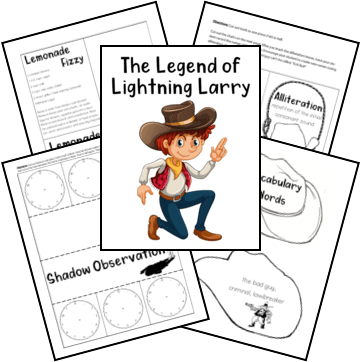
The Legend of Lightning Larry
|
Author:
Aaron Shephard Illustrator: by Toni Goffe ISBN: 0938497278 Summary: This is a book about a nice Cowboy who is constantly provoked to fights by outlaws. In the gunfights, his pistol shoots lightning bolts of love that hit the bad guys hearts. Once struck they turn from their sinister ways and help Larry fight against evil. |
Unit Study prepared by Michelle Light
Lapbook Component by Ami Brainerd
LAPBOOK COMPONENT
*created
by Breezy Tulip
**you could use this for a variety of things-- a recorded narration, a Bible
verse, the alphabetical order list (in language arts lessons), information about
a famous cowboy, etc.
***see assembly directions in lesson ~ found under SCIENCE
BIBLE &
CHARACTER
Bible Study: Paul's
Conversion
Read the story of Paul’s conversion (Acts 9). God’s blinding light could be paralleled to
Larry’s bolts of light. Discuss Paul’s attitude and change of heart.
Good vs. Evil
Do not be overcome by evil, but overcome evil with good.
Romans 12:21
Lapbook component:
Romans 12:21 Boot Shape Book (boot
created by Breezy Tulip)
When Larry is faced with opposition from those that wish to do
evil. He overcomes it. He shoots his bolts of light (just like Jesus’ love)
into the evil gang members’ hearts. The love in turn transforms them into
loving, peaceful citizens that care for others. Discuss with your child how
Jesus has done this same thing in our hearts.
You can also discuss good vs. evil as you do the following:
Make
two columns: “Evil Deeds” & “Good Deeds”
List under each heading what the outlaws did when they were evil and then what
they did when they were good. You could include Paul’s evil vs. good deeds from
the Bible lesson as well. This lesson could lead into even further
discussion of sin and righteousness as you see fit for your
student.
Possible Memory Verses
Proverbs 15:1 A soft
answer turns away wrath.
Matthew 5:9 Blessed are the
peacemakers.
James 3:18 Peacemakers who sow
in peace raise a harvest of righteousness.
LANGUAGE ARTS
Author’s Website-
The story is available on the author's website, but the
illustrations are great, so if it is available at your library --get it!
You can also hear the story in the author’s voice on this website. This was
a fun treat for the kids.
Tall
Tales
Most
tall tales have some elements of truth but much has been exaggerated. You may
wish to read some other tall tales with your student. (Paul Bunyan, John Henry,
Davy Crockett). While Davy Crockett existed, many stories about him are not
true. Lightning Larry is not a real person but an imaginary person the author
has made up. Legends are stories that are passed down from one generation to
another.
Tall Tales have various characteristics (see list below). Discuss the
characteristics of tall tales with your student. Which ones are noted in
the story? You may wish to read some other tall tales with your student to
compare to The Legend of Lightning Larry and note which characteristics
are found in those tall tales, too.
Lapbook component:
Tall Tales Tri-fold
Tall Tale Characteristics (print
worksheet activity)
The main character can accomplish great feats using strength, skill, or wits
The main character is helped by a powerful object or animal
The main character has super-human abilities
The author uses exaggerations
The setting of the story begins with the hero as a child
The plot of the story is humorous (funny) and impossible
The main character has one or more companions (i.e. Johnny Appleseed's animals)
The story includes lots of action
The main character solves a problem, defeats villains, or overcomes an obstacle
The main character dies or disappears at the end
Other Tall Tales to Read
Johnny Appleseed retold by Steven Kellogg
Paul Bunyan retold by Steven Kellogg
Paul Bunyan and Other Tales by Jane Mason
Pecos Bill retold by Steven Kellogg
Mike Fink retold by Steven Kellogg
American Tall Tales by Mary Pope Osborne
You may also wish to discuss with your student that stories in the Bible are
credible (true). Stories like David and Goliath, Daniel in the Lions Den, Noah,
Moses, Jonah, etc. are all real stories that include miracles (not magic)
through the power of God and they are not made up from men's
exaggeration but
have been given to us by God.
Alliteration
The
Title of the Book is an Alliteration (same initial consonant sound Legend
Lightning Larry). Does your student
think this is a good title? The next time your student writes a story,
encourage him to use alliteration in the title.
Adjectives
Adjectives are
words that describe nouns. The tall grass, the blue sky, the
wild pig.
Discuss the outlaws names and the meanings. Discuss the adjectives that
describe each character.
Go-along book for learning about
adjectives: Many Luscious Lollipops by Ruth Heller
Dictionary
Skills/Adjectives/Alliteration
Make up new names for your outlaws: Make two lists. One titled
“Bad or Old Names” the other titled “New or Good Names”. List the old names and
then grab a dictionary and see if you can give the outlaws new names to go along
with their new hearts. If your child is too young to look it up themselves-show
them how to use a children’s dictionary and read through some words that
coordinate with that letter and let them choose a new adjective: Example: Moldy
Mike could now be Merciful Mike, or Magnificent Mike. Have your child make up or
choose an alliterated name to describe him or herself. Example-- Likable Lexi,
Extraordinary Elijah, Quiet Quinton, etc. Lapbook Component: Alliteration Minit Book
Onomatopoeia
If you have discussed onomatopoeia before, see if your student can find an
example in this story (zing).
Lapbook Component:
Onomatopoeia Flap
Vocabulary
commotion-
noisy excitement and confusion
scowl- to make a
frowning expression
ferocious- mean, angry, wild or threatening in appearance
shuddered- to tremble with fear or horror
plunked- to drop or set down suddenly
traitor- one who is unfaithful
puzzled- confused; someone who doesn't understand
saloon- a place
of business for the sale of drinks, usually alcoholic
showdown- time to show who is the best
draw- reach for your gun and bring it out
outlaw- the "bad guy"; criminal, lawbreaker
Lapbook component:
Vocabulary Shape Book
(hat created by Breezy Tulip)
Alphabetical
Order
Alphabetize
the names of the characters in the story.
SOCIAL STUDIES
Geography Detective
Perhaps your child could become a detective and uncover clues to see if the
author may have had a particular state in mind when he decided to name this
town. They could write clues and facts to go with their theory. (Cottonmouth
snakes are a big clue!) Your student may even want to help you write a letter to
the author (use his
website)
asking what state this story is set in.
Map Making
Have your child draw a map or build a Lego city of Brimstone. Designate the bank
and the saloon, the Okey-Dokey Corral, and other places that may exist in a town
(a general store, a jail, etc.) Many of these old towns only consisted of one or two
streets where all the businesses were. Discuss what kinds of stores and businesses would be
important to a town in those days.
History:
The Old West
Discuss the details in the text and in the illustrations that clue us in as
to the setting of this story (cowboys, disputes being settled with guns, the
clothes of the characters, the desert looking surrounding on the first page, the
use of the word outlaws, etc.
As the
West was being discovered, some new towns were
springing up. By 1849 80,000 people from all over the globe had arrived in
California for the “Gold Rush.” Owning and carrying guns in
that day were common. Disputes were often settled with a gunfight because
there was little to no local law enforcement throughout the Old West. The
roots of the Old West were grown in greed, adventure, and survival; sometimes it
is referred to as the WILD West. Can your student guess why?
The American Old West comprises the history, myths, legends, stories, beliefs
and cultural meanings that collected around the Western United States in the
19th century.
History:
Past vs. Present
Look at the towns, the people’s dress, the buildings, the modes of
transportation, lighting used, etc. Compare them to present day
things.
Lapbook Component:
Past/Present Strip Book
Culture: Cowboy Clothes
Have children draw or trace
(or print) a picture of Lightning Larry.
Label the clothing.
Chaps-are made from
leather-hides-to protect the horse rider from getting chapped legs due to riding
all the time. (Discuss with your child what might happen if chaps were not
available.)
Spurs: metal spikes that were mounted to boots -used to help
make the horses go.
Holster- a special belt and leather pouch to hold a
gun.
Bandana- worn around the neck as a neckerchief
Cowboy Boots
Cowboy Hat- also known as a Stetson
SCIENCE
The Cottonmouth Snake
The local saloon was named after the cotton-mouth
snake. Also known as the Water Moccasin. The cotton mouth is a poisonous snake.
In abundance in Texas-especially around rivers, lakes and streams. They are
found in the south eastern states and as far west as mid-Texas, and as far north
as Southern Illinois. Thought to be an aggressive snake, however it does not
chase but will stand its ground. When scared it will open its mouth showing its
inner white lining, hence the name cottonmouth. It's bite is more lethal than
the copperhead.
More
about the Cottonmouth Snake
Lapbook Component:
Cottonmouth
Snake Layer Book
Shadows
and Telling Time
Discuss the absence of clocks and how the sun determined the meeting time
(high noon). How did the cowboys
determine when to do things? They were dependent on the sun (Where is the sun in the sky at
"high noon"?).
Shadow Experiment:
Take a small object (such as a teacup outside) and place it on a posterboard.
Let your student trace around the shadow (if you don't have a posterboard, you
can set the object on pavement or on the sidewalk and use sidewalk chalk).
Go out every hour and trace the shadow again. What happens? Where is
the shadow at 8 am? 10 am? Noon? 2 pm? etc.
You can log your student's observations in this minit book:
Shadow Observation Flap Book
Have your student write the time (of his observation) on the clock and draw the
object and its shadow under the flap.
*To assemble the shadow observation book, cut it out as one piece. Fold in
half. Unfold. Fold the left side under. Fold the right side
under. Turn the book over and cut on the lines between the clocks
(creating six flaps). Fold in half again. "Shadow Observation"
should be your front cover.
APPLIED MATH
Ten
(Ten
Paces) The story mentions a gunfight. (You can view these on many of the old
movies). The fighters meet in the center of town. They stand back to back and
walk 10 paces forward each-then they turn around and draw their guns.. How many
paces apart in distance are they now? (20) What if they continue on for 10 more
paces? Practice this with your child. Counting the steps and turning around and
figuring the math.
Applied Math:
Currency
Play Bank.
Have your student be the banker and convert the currency from coins to
dollars or from dollars to coins.
Counting-Grouping
Count
any number of objects on the pages. Candles in chandelier, etc. You could begin
skip counting or grouping with your younger child.
ART
Drawing Facial Expressions
Look
at the illustrations of the people’s faces. Can your student draw faces
similar to those in the story? Encourage your student to try different
expressions- a mean look (scowl); a
happy face (after conversion via lightning bolt!)
Humor in Art
The details in the illustrations are so funny! If your student hasn't
noticed any by the 3rd or 4th day, you may want to point out some of Toni
Goffe's funny pictures.
Notice the page where Curt is going to "fight" Larry. Look at the
chandelier!
What about when Stinky Steve is robbing the 79th National Savings and Loan?
(People are holding their noses!) When he brings the money back, even the
cat has a clothespin on her nose!
One illustration shows a dog waiting for a drop of lemonade (by the band).
What other funny things can your student find? Log all the funny details
in this printable
Humor in Art Matchbook.
JUST FOR FUN
Videos
Western Themed shows for kids
Veggie Tales- Little Joe
-Western Theme about forgiveness.
An American Tale-Fievel Goes
West
The Apple Dumpling Gang
Recipes
Lemonade
Larry’s favorite
drink-real freshly squeezed lemonade. Squeeze a lemon into a glass. Add water
and sugar to taste. Add ice to make it good and cold. Enjoy!
Lapbook Component:
Lemonade Recipe Pocket with
Recipes (Make lots of different lemonades this week! Which one
does your family like the best?)
Cowboy Delight
Ingredients:
· 1/2 pound bacon, cut into 1 inch pieces
· 1/2 pound ground beef
· 1/2 cup diced green bell pepper
· 1/2 cup chopped onion
· 1 (1.25 ounce) package chili seasoning mix
· 1 (14.5 ounce) can canned peeled and diced tomatoes
· 1 (15 ounce) can baked beans
Directions:
In a large skillet over medium heat, fry bacon pieces until browned.
Crumble the ground beef into the skillet with the bacon, and stir in the
green pepper and onion. Continue to cook until the beef is no longer
pink. Drain off any excess grease. Stir in the chili seasoning mix until
the meat is coated.
Add the tomatoes and beans to the skillet, mix well, and simmer for 15
to 20 minutes.
RESOURCES
Library List
Armadillo Rodeo
by Jan Brett (another HSS Unit)
Cowboy Small by Lois Lenski
Jalapeno Hal by Jo Harper
Little Red Cowboy Hat by Susan Lowell
Calico the Wonder Horse, or the Saga of Stewy Stinker by Virginia Lee
Burton
Deputy Harvey and the Ant Cow Caper by Brad Sneed
You Wouldn't Want to Live in a Wild West Town! by Peter Hicks
Rodeo Ron and His Milkshake Cows by Rowan Clifford
I Want To Be A Cowboy by Dan Liebman
Cowboys and Cowgirls by Gail Gibbons
Cowboy Dreams by Kathi Appelt
Billy Blaze books by
C. W. Anderson (HSS has a unit for the first in the series,
Billy and Blaze)
Cowboy Country by Ann Herbert Scott
Young Cowboy by Will James
Cowboy Andy by Edna Walker Chandler
Cowboy Up! by Larry Dane Brimner *reader
Why Cowboys Sleep With Their Boots On by Laurie Lazzaro Knowlton
Why Cowboys Need a Brand by Laurie Lazzaro Knowlton
The Toughest Cowboy: or How the Wild West Was Tamed by John Frank
The Dirty Cowboy by Amy Timberlake
Lasso Lou and Cowboy McCoy by Barbara Larmon Failing
MORE LEARNING OPPORTUNITIES
Story Writing
Activity:
Ideas for your child
to write his own cowboy story
If your student does this, you could
make a pocket to store the story in for her lapbook.
Science: Snakes
If your older student is interested, have him research the snakes that live
in your neck of the woods
Science: Desert Animals
Do further research on desert animals, plants, insects and birds. Another common
insect of the southwestern area of the US is the scorpion.
Science: Brimstone
The
name of the town is Brimstone. The word brimstone means sulfur. Your child could
look up the word and study more about Brimstone. There are also many Bible
references to brimstone associated with judgment. Why do you think this is so?
Legendary Lawmen
The
story mentions Wild Bill Hickock and Wyatte Earp. Your older students can do
further study to find out who are these people and why they are mentioned in
this story.
History
Study
more about banking and the
Savings and Loans Industry.
Clothing Design (occupation tie-in)
Let your student be a fashion designer! Trace over or draw clothing and
design new chaps, new boots, a new shirt , new handkerchief for Larry. perhaps 1
for every day of the week. Design, new dresses and hats for the ladies.
Materials and information on this website belong to the original composers. It may be used for your own personal and school use.
Material may not be used for resale. © 2005-07 HSS