| about us |
what's new
|
unit studies
|
unit study helps |
fiar resources
|
indexes | lapbooking |
| Author/Illustrator:
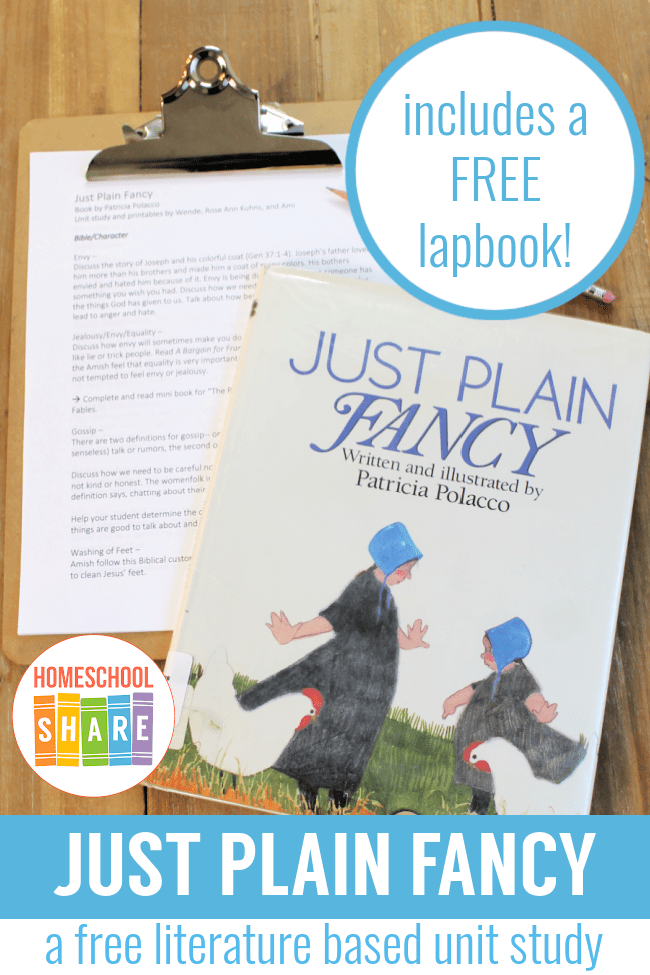
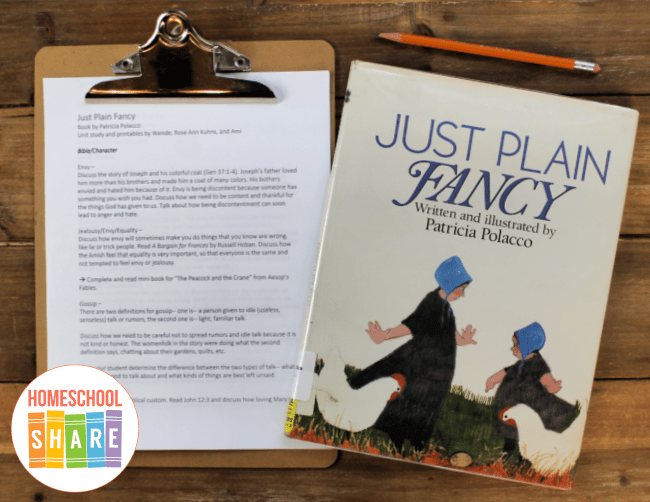
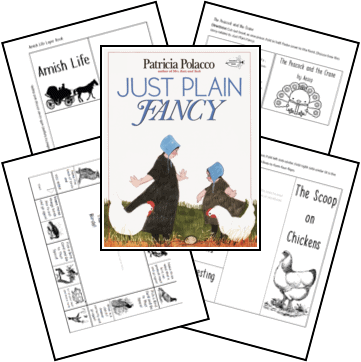
Patricia Polacco ISBN:0440409373 Summary: Naomi and Ruth are sisters who live on a farm in Pennyslvania's Amish country, where people take pride in their uncomplicated lives. But Naomi complains that everything in her life--from her clothes to her chickens--is plain. The girl longs for "something fancy." When she and Ruth find an unusual egg by the side of the road, they place it in their hen's nest, hoping it will hatch. It does, and the bird that emerges is obviously not a garden-variety chick. The sisters name it "Fancy," and keep its existence a secret from the grownups, who they fear will shun it. On the day the elders of the community have gathered for a working bee, Fancy breaks out of the henhouse and spreads its feathers in front of the group. By this time perceptive young readers will have gathered that Fancy is a peacock--and Polacco's pictures reveal it to be a magnificent one at that. Naomi is praised for raising such a beautiful bird, and learns that some kinds of "fancy" are acceptable. Unit prepared by Wende and Rose Ann Kuhns Lapbook by Rose Ann Kuhns |
Envy – Discuss the story of Joseph and his colorful coat (Gen 37:1-4). Joseph’s father loved him than his brothers and made him coat of many colors. His bothers envied and hated him because of it. Envy is being discontent because someone has something you wish you had. Discuss how we need to be content and thankful for the things God has given to us. Talk about how being discontentment can soon lead to anger and hate.
Jealousy/Envy/Equality - Discuss how envy will sometimes make you do things that you know are wrong, like lie or trick people. Read A Bargain for Frances by Russell Hoban. Discuss how the Amish feel that equality is very important, so that everyone is the same and not tempted to feel envy or jealousy.
Go along - The Peacock and the Crane from Aesop’s Fables
Washing of Feet – Amish follow this Biblical custom. Read John 12:3 and discuss how loving Mary was to clean Jesus’ feet. Coloring page to go with the bible verse
Responsibility –Discuss the responsibilities Amish children have such as Naomi’s responsibility is to take care of the chickens. The sisters also hung wash, served food, poured lemonade, and threaded needles for the women. Naomi got her cap for being responsible. Are you responsible? What do you do to help your family?
Pennsylvania – Can you find any clues as to where this story takes place? Look at the back of the delivery truck. Study Pennsylvania with your child. Pennsylvania is the thirty-third largest state, located in the northeastern part of the country. Pennsylvania, meaning “Penn’s Woods” was named after William Penn, who was given the land by the King of England in 1681 for a debt that was owed to his father, Admiral William Penn. Pennsylvania is known for its history during the Revolutionary War, with the nation’s capital being in Philadelphia. Pennsylvania was the second state (actually a commonwealth) admitted into the union in 1787. Pennsylvania’s outstanding industrial achievements were in iron and steel. Explore the state symbols and why the state adopted these symbols. Especially be sure to mention that the state tree is the eastern hemlock. Possible topics for discussion of Pennsylvania history are the Liberty Bell located in Philadelphia, Lancaster County, Hershey Chocolate Factory, Groundhog Day originating in Punxsutawney, or Gettysburg, the sight of the civil war battle and Gettysburg Address. Famous people from Pennsylvania include Benjamin Franklin, Daniel Boone, John James Audubon, and James Buchanan.
State Flower and Bird Coloring Page
Information and coloring pages can be downloaded from: http://www.enchantedlearning.com/usa/states/pennsylvania
Go Along Books:
The Folks in the Valley; A Pennsylvania Dutch ABC by Jim Aylesworth
Seeds of a Nation - Pennsylvania by Margaret Coull Phillips
Amish –
In the 18th century Anabaptists were persecuted because of their
religious beliefs and began migrating from Germany to America. The first
immigrants came to Berks County PA, but because of land issues moved to
Lancaster County PA. The Amish get their name from Jacob Amman when he left the
Swiss Anabaptists because he felt they were drifting away from their teachings
especially the one to shun those who have disobeyed the rules of the church. The
group was formed in 1693. Amish people have scattered over the eastern part of
the US and Canada. There are now 3 groups of Amish- Old Order Amish, Beachy
Amish and New Order Amish. Old Order Amish still live a lot like Jacob Amman
would have lived; without electricity and a simple lifestyle. Beachy Amish and
New Order Amish do not have nearly as strict church rules; some even have
electricity and drive cars.
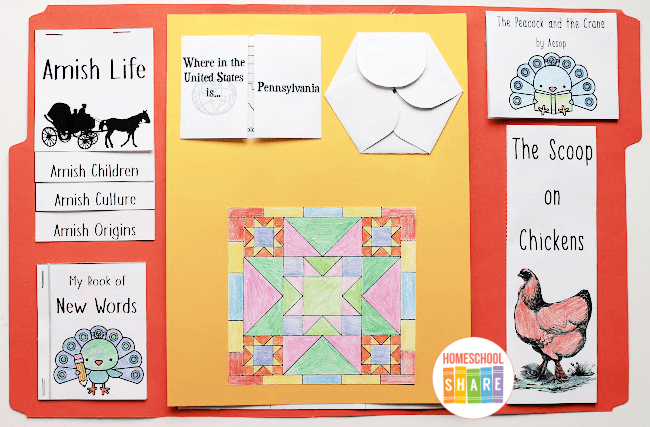
Amish Children-- Amish boys and girls each have their chores to do each day, but they still have time to play. Small girls have rag dolls, which are made from cloth and do not have a face, as graven images are against their belief (Exodus 20). Boys usually play outdoors sports like baseball and volleyball. They also have swing sets and play board games. They usually only go to school until 8th grade. Then the girls learn how to keep house and the boys learn how make a living. Discuss how Amish children still face the same temptations as we do. (Sharing toys, being honest, doing their chores right, etc.)
Culture
–The Amish
believe in the simple life and being separate from the world. Electricity is
viewed as being connected to or relying on the world for something and that goes
against their rule for living a separate life. They can use batteries and
generators to run some of their tools for their work. They use horse and mules
to pull their farm equipment. They will not drive cars but will hire someone to
take them to places they can’t easily take their horse and buggy.
More Information about the Amish Life
Science –
Birds –
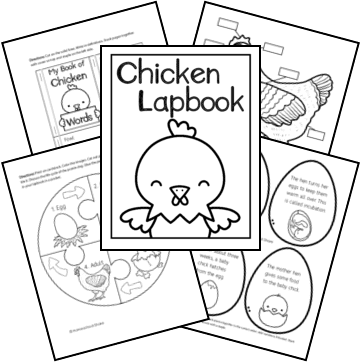
The life cycle of a bird is simple in comparison to some other animals: egg,
chick and adult. The male and female bird mate, and the eggs are fertilized as
they meet with the sperm. Fertilized eggs can be laid for up to two weeks after
mating. Most birds lay one egg a day and when they have laid their clutch; they
start to incubate them. Incubation time varies among the different birds-- from
10 days for the cowbird up to 80 days for the albatross. Sparrows, thrushes, and
robins incubate for 11-15 days; while chickens incubate for 21 days. During
incubation the mother turns the eggs once or twice a day to evenly heat them and
to keep the membranes of the embryo from sticking to the side of the egg.
Birds eat nuts, seeds, insect, berries, tree sap, flower nectar. The different
types of bills tell you what kind of food the bird eats.
Birds have bones specially designed for flight. They are lightweight yet strong.
They have four types of feathers; down, body, wing and tail feathers. Down
feathers are soft and close to the body and help kept he bird warm. Body
feathers lie smoothly over the down feathers and are oily and waterproof. Wing
feathers are the long feathers which help the bird to fly. Tail feathers help to
steer the bird as it flies and helps balance it on the ground. Adult birds molt
at least once a year. Molting is the replacement of feathers; a bird never loses
all of its feathers at once-- it happens over a period of time.
The difference between birds and fowls is that fowls are often grown for eating
their meat or for their eggs. Birds are not usually eaten. They are enjoyed for
their songs and the fact they eat harmful bugs and insects.
Peacocks
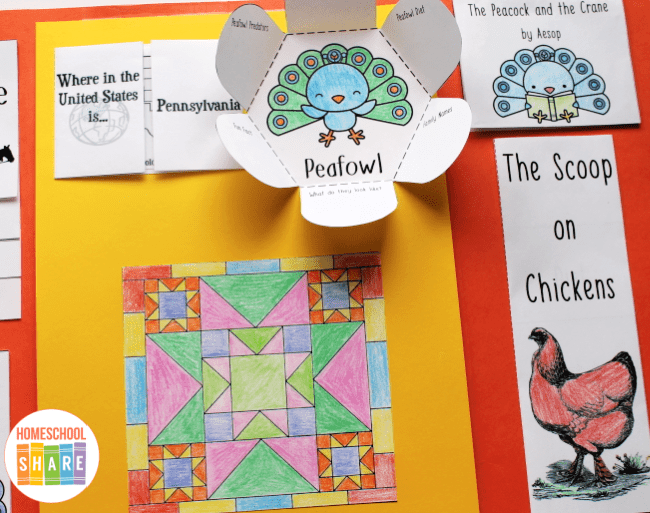
-- Peafowl is
the term to refer to both male and female. Peacocks are male and Peahens are the
female and peachicks are the young. There are two species of Peafowl; the Indian
peafowl (Pavo cristatus) from India, often called Blue peafowl and the Green
peafowl (Pavo muticus) which lives farther east in Burma, Thailand, Indo China,
Malaya and Java. The India Blue peafowl is the one most often found across
America. Peafowl are in the pheasant family and are easy to keep and hearty.
Peafowl are
omnivorous and eat plant parts, flower petals, seed heads, insects and other
arthropods, reptiles, and amphibians.
When many people think of a peacock, the first thing that comes to mind is the
beautiful colors of this bird’s feathers. Blue, green, gold, and the appearance
of what looks like an eye, right in the center of some of the feathers, are the
trademarks of this bird. They also have a crest, or crown, on top their head,
making them appear even more regal than they already do. The beak is (on
average) an inch long in a full-grown bird. Reaching heights of over three feet,
an adult peacock’s ‘train’ of tail feathers can be sixty inches in length. A
peacock does not come into this full glory of feathers until he is about three
years old. (sources-- wikipedia and essortment)
Language Arts –
Foreshadowing – Look at the picture adjacent to title page. What is happening? What do you think might happen in this story? What does “exotic”, written on the egg cartons, mean?
Vocabulary –
Shunned - means to avoid deliberately, to keep away from, take pains to avoid (Amish shun (expel) their people that have disobeyed the rules of their church.)
Ordnung – is a German word for order. For the Amish it is a set of rules, often unwritten, that they live their lives by. It is how they should act, what they are allowed or not allowed to do. Each church has its own Ordnung.
Botherment – a mixture of feelings-- worry, troubled, sadness, uncertainty
Frolic – means a work gathering, usually to build a barn that was burned or any other big work project that needed more people than just your family.
Organdy – a fine, thin yet stiff muslin white in color that Amish ladies use for their caps
Miracle – an event that cannot be explained by any known law of nature, something so rare or unusual it seems like a miracle
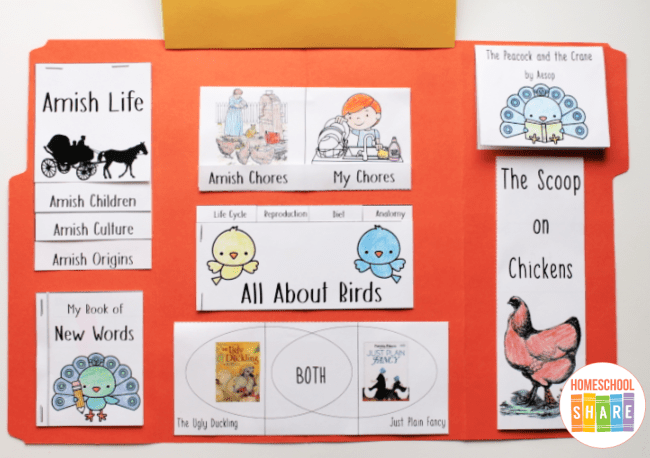
Comparing Works –Read the classic story of The Ugly Duckling by Hans Christian Andersen. Does it remind your student of Just Plain Fancy? How is The Ugly Duckling different? Discuss the similarities and differences as well as the moral of the story(ies).
Math –
Phone Number – On the back of the delivery truck you can see the beginning of a phone number. With your youngest children, help them to memorize their phone number this week.
Art –
Quilting--
Quilts often
reflect the quiet lifestyle of the Amish -- the soft, muted colors used in the
different designs. Generally solid colors are used in their quilts, and then
they are stitched with elaborate designs. They have quiltings where a group of
women and girls gather for the day and hand quilt a quilt. It is a social time
where younger ones learn to perfect their skills and also learn values from the
older ones. Quilts are given has wedding gifts and for other important events.
Try to quilt:
Take two pieces
of plain light colored cotton material about 12-18 inches square. Using a pencil
lightly draw a simple design (heart, circle, Letter initial) on one of the
squares. Put thin quilt batting between the materials and put between an
embroidery hoops. Tighten the material in the hoop. Using white cotton thread
and needle stitch up and down making small even running stitches.
This website has detailed instructions and pictures for hand quilting.
Another idea is
to use colored construction paper and cut it into shapes (squares, stars,
rectangles, and triangles) and make a quilt design of your own.
This is a link to a picture of an Amish quilt called Trip around the World
Katy’s Gift, an Amish story by Keith Bowen
The Ugly Duckling by Hans Christian Anderson
A Bargain for Frances by Russell Hoban
Just Like Mama by Beverly Lewis
The Folks in the Valley; A Pennsylvania Dutch ABC by Jim Aylesworth
Seeds of a Nation
- Pennsylvania
by Margaret Coull Phillips