| about us |
what's new
|
unit studies
|
unit study helps |
fiar resources
|
indexes | lapbooking |
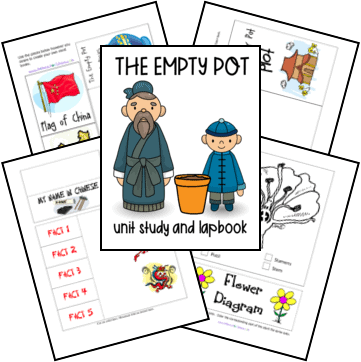
The Empty Pot
| Author: Demi ISBN: 0805049002 Summary: When the Chinese emperor proclaims that his successor will be the child who grows the most beautiful flowers from the seeds the emperor distributes, Ping is overjoyed. Like the emperor, he loves flowers and anything he plants bursts into bloom. But the emperor's seed will not grow, despite months of loving care, and Ping goes before the emperor carrying only his empty pot. The emperor ignores the beautiful blossoms brought by the other children and chooses Ping, revealing that the seeds he handed out had been cooked and could not grow. Level 3 Lapbook created by Ami Brainerd |
Templates
Bible and Character
Memory Verse
Proverbs 12:22 -
Lying lips are abomination to the LORD: but they that deal truly are his
delight.
Memory Verse Lip Shape Book
Social Studies
Geography- China
The Empty Pot is set in China, a large country located in Asia.
Find China on your map together. Can your student find Bejing, the capital
city?
As you read this story together, your student may notice some of the Asian
architecture. The emperor's house is a pagoda.
Pagodas are a building in Chinese architecture that look like a tower made from
stacked boxes or octagons. It is large at the base and gets smaller at the top.
They were originally built as part of a temple compound (usually Buddhist) but
most of them today are historic landmarks. Most cities will have at least one
old pagoda of which the residents are very proud. The Wild Goose Pagoda in Xian
(where the Terracotta Warriors are buried) is a famous pagoda dating to the Tang
dynasty.
China is also known for a much, much larger piece of architecture-- its great wall that was built about 2,000 years ago to keep
out invaders from the north. It was built by Qin Shi Huangdi, the first
emperor of China during the Qin Dynasty.
The wall stretches for over 1,500 miles and is made of bricks, rocks, and
packed earth. It stretches across the mountains of northern China, from
the Jiayu Pass in the west to the mouth of the Yalu River in the east.
Most people think of rice when they think of China. It has been grown in
southern China for a very long time (archaeologists have found evidence dating
back to 5000 B.C.). Chinese farmers probably invented the rice paddy.
Your student can watch this video of rice being harvested.
Rice is usually boiled in water or steamed. It can be eaten alone or with
just about anything! Some people add sauces, some add vegetables, some add
meat, and some add a combination of the three. Rice can also be made
into noodles; it is a good source of carbohydrates and gives you energy!
An animal native to the bamboo forests in the mountains of China is the beloved
Giant Panda. The people of China have always believed that this was
a special animal. It is said that ancient emperors kept giant pandas as pets!
Two thousand year old books have been found in China that show giant pandas with
magical powers; people thought they could ward off evil and disasters.
Today, the bears are a symbol of peace and good luck. Pandas are called
"large bear-cats" by the Chinese and were not known to those living outside of
China until 1916. The first westerner to observe one in the wild was
Hugo Weigold from Germany. If your student wants to learn more about
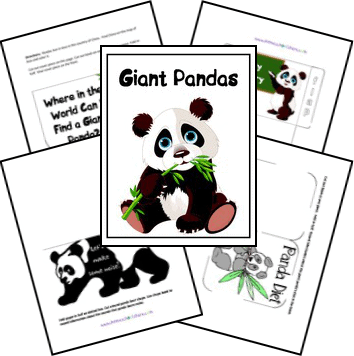
this animal, check out this Giant Panda
Lapbook.
If you were to visit China today, you would find statues of Buddha, a religious
figure. Buddhism was founded by an Indian prince (who called himself
Buddha). He taught his people the Four Noble Truths, and an
Eightfold Path. He also taught the people to use meditation. After
his death, his followers came to China from India around 400 AD to spread
his teachings which were generally popular and accepted. The
religion of China is complex and there are many other elements included (not
just Buddhism), but Buddhism is still practiced.
In 1404 Emperor Yong Le ordered that a new capital be built. He named it
Beijing. Beijing was one of the most elaborate cities in the world and
deep inside there was a smaller city, surrounded by walls and a mote. This
was known as the Forbidden City and was the home to the Emperor and the royal
family; it is the world's largest palace complex consisting of 800 buildings
and 9,000 rooms. The construction for the Forbidden City began in 1406 and took
about one million workers 14 years to complete!
What Would I
Find in China? Flag Book.
Read other books about China together. Record fast facts in the flap book.
Search the internet to find how to write your student's name in Chinese.
Let him write it inside the name fold.
My Name in
Chinese & China Facts
History- Emperors
The word emperor is a general word for a ruler having total control of a
country or region. Throughout history, various places have had (and
still have) different names for rulers. Introduce your student to some of
these names- president, king/queen, emperor, czar, dictator. Also
explain to your student that different kinds of rulers have different amounts of
power.
Emperor Flap
Language Arts
Main Character
Discuss Ping as the main character. After reading the book, how would
your student describe him? (young, Chinese, boy, good at growing things,
honest, etc.). Write one sentence (or phrase) in each square on the
character web to describe
Ping.
Plot
Review the parts of a story with your student (you can use the questions on
the flap book to aid in discussing
the different parts of plot). Write the examples from The Empty Pot
under the flaps.
Copywork
Use the following quotes for copywork this week:
"Honesty is the best policy." --Abraham Lincoln
"Thou shall not lie." --Exodus 20:16
"No legacy is so rich as
honesty." --William Shakespeare
"A half truth is a whole lie." --Yiddish Proverb
Copywork Pages
Creative Writing
Write your own royal decree announcing the emperor's decision.
Use additional pages as needed.
Vocabulary
Use the flowers and pots for a matching activity.
Vocabulary Pots and Flowers
Science
Parts of a Flower
Many plants are made up of four parts- flowers, leaves, roots, and stems.
Here are the basic parts of a flower:
Stems keep the plant upright. Leaves and flowers grow on the stems.
Sepals are small leaves that are found under the flower.
Inside a flower you will find all kinds of things!
Petals are brightly colored leaves. They are easy to spot and the
reason we love to look at flowers!
The middle has long tubes called stamens. Stamens have two parts-
the anther and the filament. Can your student find any pollen on the
stamens?
Plant use this pollen to make seeds. The pistil is the inner
middle of the flower. It is the seed producing part and usually consists
of a stigma, style, and ovary.
Flower
Diagram
Experiment- Cooked/Uncooked Seed
Take two fast sprouting seeds (radishes may be best) and cook one. Plant
both in glass jars so you can really observe what is happening. Keep
record of each plant on day 1, day 10, and day 20 using the flap book provided.
Science
Experiment
Additional Gardening Activities
Add a fun gardening project to do with your students this week!
Table Top Garden
photos by Candace Crabtree

Buy some root vegetables (carrot, turnip, yam, parsnip, rutabaga, radish,
etc.). Try to pick vegetables that already have a bit of green at the top,
if possible Cut off the tops and place them in water; you may need
to use toothpicks to prop the veggies. Check the veggies every few days
and record what you find (use photos and dictation/writing or let your student
draw his own pictures). Make sure the bottoms of the vegetables stay
submerged in water.

Pocket Plot
Grow a mini-garden!
Take a clean lid (peanut butter jar lid would work) and lay damp tissue in the
jar. Plant mustard seeds and cress seeds on the tissue. Don't plant
the entire tissue. Cover them with a piece of black paper and take a peek
at them every day (be sure to keep the tissue damp). Once you see little
shoots coming up, take the cover off. Let them grow. Add little
rocks and toys (small animals), etc. to your pocket garden. Water it
regularly!
Applied Math
Calendar Skills
The emperor gave the children one year to tend their seeds. How long is
one year?
1 year is the same as
4 seasons
12 months
52 weeks
365 days
One Year
Layer Book
Division
Turn to the page with the children all lined up in an "s". Ask your child how
many he thinks are in line. It would take some time to count all the children
one by one. Show him how it is quicker to skip count. Start with twos, skipping
every other child and skip counting by twos. That only took half the time to
count! Now skip count by threes, then fours, and so on. If your child is ready,
you could also introduce the concept of dividing. If you divide all the children
up into groups of two, how many groups are there? Are there any remainders? How
many groups of three? Any remainders? How about groups of four? Do this until
you can find groups with no remainders. (There are 52 children so you could get
26 groups of 2, 13 groups of 4, 4 groups of 13, or 2 groups of 26).
Art
lessons by Wende
Still Life
Turn to the two pages showing Ping in the center, surrounded by all the
beautiful pots, vases, and other containers. Examine the shapes of all the
containers with your child. When someone paints a picture of something that does
not move, such as a table, fruit, or flowers, it is called a still life. Help
your child to pick a lovely pot, vase, or other container from around your home
and set it on a table. Have your child draw a still life picture of the
container. Show him, by pointing out the details in Demi's illustrations, how to
make the object look three dimensional (having height, width, and depth). When
your child gets the still life looking in the way he likes, outline it with a
fine tip black pen, and paint it with soft watercolors just as Demi did.
Circular Art
All of the illustrations in this story are done within circular shapes. When
doing art in this way, some planning and thinking ahead is necessary to make
sure you fit everything you want within the shape. Draw a circle. Have your
child draw a scene, such as a playground, farm, or zoo scene, within the circle.
Explain that the picture should be balanced, with equal parts of the circle
filled or empty. Encourage your child to add details such as birds, leaves, or
flowers to balance the picture just as Demi did. Ask your child if it was hard
to keep all of his picture within the circle.
Drawing from a Model
Demi did a wonderful job of illustrating joyful children at play. They are in
all kinds of positions, doing headstands, running, jumping, and doing
cartwheels. It is likely that Demi watched children in action to properly
illustrate how they look. She may have even had children pose for her to catch
them in action. Take turns with your child, posing in fun or even silly
positions, while the other person draws. Who could hold the position longest?
Who drew the most playful looking pose?