| about us |
what's new
|
unit studies
|
unit study helps |
fiar resources
|
indexes | lapbooking |
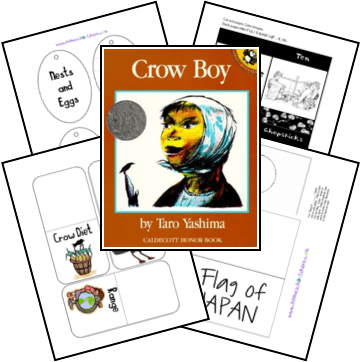
Crow Boy
| Author:
Taro Yashima ISBN: 014050172X Summary: In a small Japanese village, Chibi is an outcast at school because he is different from the other children. However, at the beginning of his sixth grade year, he has Mr. Isobe for a teacher. Mr. Isobe saw something special in Chibi, and he helped him show that gift to others. Unit Study Prepared by Casey Kelley |
SOCIAL STUDIES
Geography: Japan
The name Japan means "the sun" and Japan is also referred to as “the land of
the rising sun”. The Japanese flag is a red circle (sun) on a white background.
Have students use red and white construction paper to make a Japanese flag.
The country of Japan is made up of over three thousand islands. Many of these islands are mountainous and some are volcanic. Japan’s highest peak is a volcano called Mount Fuji. Have your students research how islands are formed.
In the book, Crow Boy the story takes place in a village in Japan. A village is a small community of perhaps 5 to 30 families that settled in a rural area. In Japan, villages are often farm or fishing communities. You’re older students can research Japanese villages and create their own on paper.
Even
though Japan is relatively short on real estate, it has the world’s tenth largest
population with about 128 million people. People in Japan have to get use to
living very close together.
Outline Map of Japan from World Atlas
Japan Flag Minit
Book
Where is Japan?
Japanese Culture
Food:
In Japan, people eat their food with chopsticks. They also have different dinner
etiquette. For example it’s considered very rude to ever point with your
chopsticks or leave your chopsticks sticking up in your bowl of rice or other
food. You should never use your chopsticks to stab or skewer food. When serving
food from a common platter, you should use to opposite ends of the chopstick
than what you put in your mouth. It’s also considered good manners to pick up a
bowl of rice and hold it right below your mouth so the rice doesn’t fall in your
lap. Making slurping sounds when eating soup or drinking something is a
compliment to the chef.
Buy
inexpensive chopsticks for your students to try using them. Have them practice
using the chopsticks by picking up cotton balls before they try eating with
them. When ready, give your student a small bowl of sticky rice to try.
Clothing: Visit
Making Friends and print out
a Japanese paper dolls. On the page are two traditional Japanese outfits; the
kimono (kee-mo-no) and the gi (gee). The word
kimono simply means things to wear. Both
women and men wear the kimono. Kimono
are very rarely worn as every day clothing today. Sometimes if one travels to a
rural area in Japan or a smaller island like Okinawa, you will see the kimono
worn by elders. A Japanese woman usually owns only one kimono in her lifetime.
It’s a special kimono worn for the coming of age ceremony on her 19th birthday.
Kimono are still popular in wedding ceremonies, but are typically rented. The
traditional shoe worn with a kimono is a pair of geta sandal. They look very
similar to American flip-flops. The Japanese also have special socks to wear
with their geta sandals. They're called tabi socks. The socks are kind of like
mittens for feet. The big toe is separate from the rest of the toes to make
wearing sandals easier. The
white pants and shirt set found on the page is called a gi. Gis are typically
worn in a dojo when practicing martial arts such as karate.
Chop: A chop is a personal seal and is sometimes used as a signature. Chops are often found on scrolls, screens and official documents. Traditionally, they are usually carved in soft stone, bone, or wood and are made of symbols that say something about the owner or are things important to them. When an artist was done creating his work of art, he would dip is chop in red ink and stamp it onto the piece.
Have
your students create their own chop by carving it into a small block of craft
foam or a gum eraser. For younger students, you may want to have them draw a
simple design on paper and then transfer it to the chop and carve it yourself.
Or you can use a ready made stamp from the store that has a picture that has
meaning to the child. Be sure to remember to carve the design in reverse so it
shows up correctly when stamped. Once you have the chop, your student is ready
to use a red ink pad to stamp away.
Writing: The teacher liked Chibi's writing. How do the letters look
different than the way your student's letters look? Japanese writing is
different (and beautiful!). If you student is interested, let him watch
this video demonstrating some Japanese calligraphy. You can
also print this
Japanese Numbers book and use it in your lapbook or notebook.
Human
Relationships: Making Fun of Others
The children in the story make fun of Chibi by calling him names like
slowpoke and stupid. This is so unkind. Discuss name calling with
your student and why she should not participate in it. Also discuss how
she should react if someone makes fun of her.
Human
Relationships: Recognizing talents in other people
Mr. Isobe saw something special in Crow Boy-- something that none of
the other teachers or students saw. What was it? Something good!
Crow Boy wasn't weird or stupid. He was smart and special. Encourage
your students to think of family members, friends, and other people they know.
What talents do each of these people possess? What makes each person
special?
LANGUAGE ARTS
Vocabulary
forlorn - lonely and sad
trudging - to walk laboriously or wearily along or over
honored - high respect, as that shown for special merit; esteem
graduation - the successful completion of a program of study
attendance - the frequency with which a person is present
imitate- to copy exactly
Prepared Crossword Puzzle
Discussion Questions/Writing Prompts
How do you think Crow Boy felt when his classmates made fun of him? How do
you think he felt when they gave him the nickname Crow Boy?
If you were Crow Boy, how would you have liked to been treated?
What lesson do you think Crow Boy’s classmates learned?
Aesop's fable: The Crow and the Pitcher
After you study crows this week, you may want to read this story together
which shows that humans have regarded crows as an intelligent bird for a long
time.
Read the fable on-line
ART
Mixed Media
Yashima
used crayon, ink, pencil, and tempra to illustrate this book. Can your
student pick out the various mediums in the pictures? ("Do you see where
the crayon is use? The ink? Pencil?"). Discuss
that when illustrators combine mediums, we call this mixed medium. After
studying the illustrations together, go to your art supply cabinet and let your
student choose two (or more) different mediums to combine to create a picture of
his own.
Black and White
drawings
Just for fun, let your student try a black and white drawing like Chibi.
Does he like it or would he rather add color? Discuss these things.
Look at other books you may own that only have black and white drawings.
Would your student add color to them or leave them black and white? Why?
Japanese Artist Study
Katsushika Hokusai lived September 23, 1760 until April 18, 1849. He was a
Japanese painter and printmaker from the Edo Period and is most famous for his
series of woodblock prints called "Thirty-Six Views of Mount Fuji". One of the
views, "The Great Wave Off Kanagawa," has become most popular and is studied by
art students all over the world.
Hokusai was born in what is now called Tokyo, Japan. During his life, Hokusai produced tens of thousands of prints, paintings, and illustrations. Hokusai's themes were usually the Japanese countryside, the people and legends. Many years later, Hokusai’s prints influenced other great artist like van Gogh, Monet, Degas, and Toulouse-Lautrec.
Activity-- you may consider trying woodblock prints with your students.
How to make woodblocking prints:
1.) Start with a rough sketch of what you would like your finished print to look like. You might look up examples of other woodblocking prints online to get some ideas.
2.) Once you have your design sketched out, start making your drawing for the key block. This is bed done on tracing paper.
3.) Sandwich a piece of carbon paper between your drawing and your block of wood. Typically, a Japanese artist would use a block made of wild cherry, but any block of soft wood will due. Make sure to place your sketch face down so it will come out right when printed. (This is why doing your drawing on tracing paper is a good idea. You can turn the paper over and still see your lines to trace them.) Using a pen or stylist, trace over your design to transfer your drawing onto the block of wood.
4.) After you have transferred your design to the wood, remove the drawing paper and carbon paper. Using very fine carving tools (or plain nails from the hardware store) start carving your design into your key block.
5.) When you have completed your carving, now you can test your design. Using an ink pad or ink roller, ink the carved side of your wood block. Be sure to apply the ink evenly. While the ink is still wet, place onto a piece of scrap paper. Press down evenly and lift your key block straight up (so not to smudge the design). Then allow your impression to dry. Evaluate your design and make adjustments to your carving as necessary.
6.) Repeat step 5 until you are happy with the results. Then stamp your design onto your final project this can be canvas, paper, cloth, etc. Color in with colored pencils, paint, or leave in black and white.
*Note- For younger students you may try letting them carve on something softer like a Styrofoam meat tray.
Japanese Garden (design
project)
The Japanese place great value on their gardens. Garden designers are considered
artist. Gardens are typically represent a miniature world. Since space is rare
many gardens are sculptured to represent a miniature world. Items placed in the
garden represent larger landforms. Rocks for example symbolize mountains; trees
represent forests and so on.
Make your own miniature Japanese garden. You can find many attractive containers are your local gardening or home improvement store. Look for a container that is long and doesn’t have very high walls such as a large saucer for a terra cotta pot. You can research plants that typically grow in Japan and see if they are available in your area. If not, any plants will do, just remember this is suppose to be a miniature world so small plants are best to work with. Once you have your container and plants all you need now is rocks and pebbles and any other embellishments you might want to add such as sand for a beach or desert perhaps. While you’re at the store you might also look for decorative bamboo. They have become very popular over the last few years. These plants have been bent to grow into decorative patterns.
If your student is feeling particularly creative you might try experimenting aluminum foil or other plastic containers to add water features. Or you might try adding small pebble painted blue (such as fish tank gravel) to represent the water features instead.
This is
a great time to introduce younger students to what makes plants grow and
different land features. Older students might enjoy researching Japan’s land
features and using the miniature garden for making a replica of the country.
SCIENCE
Crows
Discuss the following information with your student. You may also want
to check out some library books about crows. Be sure to watch the video
clips below as your student will really get an understanding for just how smart
this bird is! After you finish learning about crows, you may want to have
your student record what he's learned in this Crow
Tab book (to include in your lapbook).
Anatomy:
Crows comprise the genus Corus. These birds are usually black with
black beaks and black legs, some have white, brown, or gray coloring in addition
to their black. The common crow is approximately 8-12 inches long.
Diet:
Crows will eat just about anything (they are omnivorous eating plants and
animals). Their diets include worms, insects, road kill, mice, berries,
crops, (especially corn), the eggs of other birds, and anything else they
can find (even fast-food!). An adult crow needs 11 ounces of food
each day.
Despite their bad reputation for eating crops, crows also eat a number of pests
which are harmful to those same crops, including cutworms, wireworms,
grasshoppers and even noxious weeds.
Range:
The 40 some members of this genus can be
found just about anywhere in the world (except Antarctica, New Zealand, and
South America). They thrive in mountains, woodlands, across plains
and farmers' fields, and throughout urban areas.
Nesting Habits
Crows build bulky nests out of twigs and line them with bark, grass, and/or
small roots. The female lays the eggs in the nest (usually 4-7) and the
male helps with the incubation. Once the eggs hatch, the baby birds remain in
the nest for 6-8 weeks while their parents bring them food.
Intelligence:
Crows (and ravens) may be the most intelligent of all
birds. These videos will let you and your student see just how smart
the crow is!
Crow Photographs
Five Senses
Chibi uses his five senses to explore the world around him. Review
the five senses and discuss how we use each one. Can your student recall
examples from the story of how Chibi uses his sense? (sight-- the desk,
the patch on a boy's shirt; hearing- he closed his eyes and listened on the
playground; touch- insects and grubs). Consider taking your student
outside this week. Go on a sense walk (you may want to do different walks
on different days). You could go for a listening walk. What do you
hear? Birds? Can you mimic their calls? You could also go on a
touching walk (you may need to learn about a few poisonous plants in your area
first) or a looking walk; you could even go on a smelling walk. Enjoy
nature together as you teach your student to really observe the world God has
made.
Day/Night
Japan is on the other side of the world. Students can learn about the sun and
the moon. Asia, including Japan, is located in the Eastern Hemisphere. We are
located in the Western Hemisphere. When the Eastern Hemisphere is experiencing
daylight the Western Hemisphere is experiencing darkness. Locate Japan on the
globe. Using a flashlight, show that when we have daytime, Japan has nighttime.
MATH
Estimation
Use a bag of rice to introduce estimation and how to use a scale. Prepare
small cups with the following quantities of rice a head of time; 10, 20, 50,
100, 200, 500, 1,000 (if you’re feeling ambitious). Show your student 10 pieces
of rice and ask them to count the grains in the pile. After your student has
come up with the correct number of grains, then explain to them that now they
know what 10 pieces of rice look like. Ask if using that information can they
make an estimation of how grains are in the next cup. After they have guessed
count with them the number of grains (20). Then repeat the procedure. Once you
have gone through all of the pre-measured cups, you might encourage your child
to grab a small handful of rice on their own and then both of you can make a
game of take turns guessing how many grains are in the new pile. Count the
grains of rice with your child and see who was the closest.
Measure out rice into small sandwich baggies (you may want to pre-measure the bags before hand so you get even round numbered weight). Using a scale, let your child measure the smallest bag and record the weight. If your student is already comfortable using a scale, you may try using the bags in a similar fashion to the activity above to expand on estimation. You can also use the bags and a balance scale to have your student see what pairs of bags would equal the first bag placed in the scale. For example if you place a 10 oz. bag in the first half of the scale, your student would have to place two 5 oz. bags in the second half for the scale to equal out.
Time
Zones
Have your older students research time zones. Then have them figure out how many
hours apart your time zone is from Tokyo, Japan. Make up a worksheet of
different times and have them write down what time it would be in Japan. For
example, if it’s noon here, what time is it in Tokyo?
Abacus
There is an abacus in the classroom in this story. What is an abacus?
An abacus is a manual aid to calculating that consists of beads or disks that
can be moved up and down on a series of sticks or strings within a usually
wooden frame. The abacus itself doesn't calculate; it's simply a device for
helping a human being to calculate by remembering what has been counted.
Make your own
abacus
JUST FOR FUN
Cooking: Rice Balls
1. Boil
the rice in a rice-cooker.
2. Put a little salt into a glass of water until it tastes salty, and prepare
the stuffing of rice balls --- pickled plums("umeboshi"), cod roe or salmon, a
piece of fruit.
3. Cool the boiled rice until you can handle it (but not too cool. The rice
won't become a 'ball' if you cool it too much).
4. Take small handful of the boiled rice with your two hands. (It's a good idea
to wet your hands so the rice won't stick.)
5. Put the stuffing in the center of the boiled rice.
6. Grip the boiled rice in your hands forcefully with the fingers of the left
hand, and the middle finger and the third finger of the right hand, and the
palms of the two hands and squeeze several times.
7. Finally, wrap it with a piece of strip nori (found in most ethnic aisles of
the grocery store).
Rice is one of the most universal foods on the planet. Nearly every culture on the planet has its own unique rice dishes. Research rice dishes from other countries and make a cookbook that includes recipes from countries from all over the world. This is a great time to bring up that even though, we may have many differences, we are still very similar at the same time.
Origami
Origami literally means "folding paper” and is the art of paper folding. There
are many books and free resources on the internet available with patterns and
techniques for making origami. Find a few suitable patterns for your student’s
level and make a mobile from the finished product.
RESOURCES
Library List (other books set in Japan)
Basho and the Fox Tim Myers
Yoko by Rosemary Wells
How My Parents Learned to Eat by Ina R. Friedman
Grass Sandals by Dawnine Spivak
Grandfather's Journey by Allen Say
A Pair of Red Clogs by
Masako Matsuno
Taro and the Tofu by
Masako Matsuno
Little Oh by
Laura
Krauss Milmed
Helpful
Links:
http://web-japan.org/kidsweb/
This is
a very well done site that contains a large amount of information about Japan
and is geared toward elementary aged students.