| about us |
what's new
|
unit studies
|
unit study helps |
fiar resources
|
indexes | lapbooking |
Cranberry Valentine
|
|
Author: Wende and Harry Devlin Illustrator: ISBN: 0027292002 Summary: Mr. Whiskers has never been the recipient of a valentine before, and he is scared and bewildered. His young friend Maggie and her grandmother help him to discover the identity of his secret admirer and enjoy a happy Valentine's Day after all. |
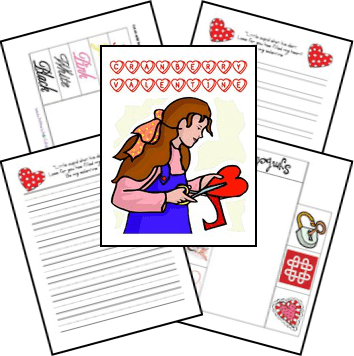
Lapbook Templates
| Social Studies |
|---|
|
Valentine's Day Symbols and Meanings |
You can see
some of these symbols in the Valentines Mr. Whiskers received from his
secret admirers. Some Valentine’s Day symbols include heart, cupid, rose flower, love knot, key & lock, lovebirds and doves. Heart The red heart is a symbol for love. Centuries ago, people did not know that the heart pumps blood through the circulatory system. However, they did know that the heart beats faster when a person is excited or upset. For this reason they believed that the heart was the center of our feelings. This idea remains today in certain sayings, such as, "It does my heart good," or "I'm broken-hearted," or "sick at heart." Cupid Cupid, the mischievous son of the Goddess of Love, Venus, is supposedly responsible for people falling in love. According to the myths, anyone being hit by Cupid's arrow falls in love with the first person he/she sees. Ribbons Ribbons, laces and frills as perfect Valentine symbols have been used since the ancient times of knights and nobles who used to wear the scarf adorned with ribbons, laces and frills specially prepared by their beloveds. Key or lock In Wales wooden love spoons were carved and given as gifts on February 14th. Hearts, keys and keyholes were favorite decorations on the spoons. The decoration meant, "You unlock my heart!" Rose Rose is one of the most popular flower and one of the most powerful symbol of Valentine's Day. The rose is found in many different colors and each of these colors has a different meaning. Red Roses - Love and passion Yellow Roses - Friendship White Roses - True love and purity of the mind Pink Roses - Friendship or Sweetheart Black Roses – Farewell Love Knots The symbol of Love Knots traces its origin to early Arab traditions. Young Muslim women living in strict orthodox households used to send secret messages to young men through the woven knots of a carpet. Love Birds and Doves It was believed that on this romantic day, birds found their mates. This belief is still cherished by love struck people all over the world. The lovebirds have come to signify that belief. It is said that the lovebirds can't live without their mates. The dove signifies purity, meekness and innocence. |
Post Office |
Mr. Whiskers
picked up three valentines at the post office. The post office is a
place that takes mail sorts it out and delivers it to the address on the
letter or package. After you write a letter, and address the envelope,
you will need to buy a stamp. A stamp pays for the delivery of the
letter. If you were mailing a heavy package or letter it might take more
than one stamp. Every country uses stamps for letters. Stamp collecting
is the most popular hobby in the world. The post office comes out with
new stamps every year. Carriers pick up the mail from your home mailboxes and the blue mailboxes on the street. They put it in big mail hampers, and then they are wheeled onto a truck. The truck goes to a bigger post office. At the big post office, the mail is sorted; and bar codes and post marks are added by sorting machines. These machines also put wavy lines on the stamp so it can’t be used again. The mail is sorted by zip code and put on the post office nearest the zip code. Carriers put the mail into slots for the people on their delivery routes. Each house has its own slot. The mail is then driven or carried by a mail carrier to your house. |
|
Weblinks: |
| Lots of activities at the Postal Museum |
| Lots of pintables (in the curriculum guide) |
| Resource center for the United States Postal Service |
| Fun and interesting facts |
Language Arts |
|---|
|
Creative Writing |
If you decide to make your own Valentine’s this week (like Maggie), make rhyming messages like the one Mr. Whiskers received (“Little cupid shot his dart/love for you has filled my heart.”) |
Vocabulary |
|
Wistful- feeling or showing a timid desire Fury- wild and dangerous force; anger Frothy- bubbles formed in or on a liquid Revolting- to feel disgust or shock Hesitated- to stop or pause because of uncertainty or indecision Satin- a fabric (as of silk) with smooth shiny face and dull back Sputtered- to speak or utter hastily or explosively in confusion or excitement Beam(ed)-
to smile with joy |
| Addressing a Letter |
Mr. Whiskers
received three Valentine’s from the Post Office. Talk to your student
about addressing a letter. Address and send a letter or a valentine. Younger students: Younger students can practice learning their own address. It would be really fun if someone sent your child a letter or card in the mail this week. "How to Address an Envelope" Song by Amy Hodel (sung to the tune of Darling Clementine) On the first line, on the first line, on the first line goes the name. On the second line goes the house number and the street name together. On the third line, on the third line, goes the city, state, and zip. This is how we address an envelope and that is it! (From about.com) ADDRESS: This is the name and address of the person you are sending the letter to. On separate lines write: •Recipient's Full Name •Street Address •City, State and Zip Code RETURN ADDRESS: This is the information about the sender of the letter. In the top left corner on separate lines write: •Your full name •Your Street Address •Your City, State and Zip Code STAMP: In the top right corner of the envelope you place a postage stamp. This pays for the delivery of the letter. |
|
Weblinks: |
| Envelope Template |
| Example of an Addressed Envelope |
| Stationary for letter writing from the Postal Museum |
Listmaking |
At the end
of the story, Mr. Whiskers can’t wait until the next Valentine’s Day.
What are some of the holidays that Mr. Whiskers could celebrate until
the next Valentine’s Day? Have the student make a list of holidays, and what month they are in. Here is a basic list to get you started. •New Year's Day -- January •Martin Luther King, Jr. Day -- January •Presidents Day (Washington's Birthday) -- February •Memorial Day -- May •Independence Day -- July •Labor Day -- September •Columbus Day -- October •Veterans Day -- November •Thanksgiving -- November •Christmas -- December Older children can research to find out what holidays are public holidays (also known as bank holidays) according to the government, and which are considered observances. Older students can also research a lesser known observance. The list above is a list of bank holidays. Here is a list of some observances: •Carl Garner Federal Lands Cleanup Day (First Saturday after Labor Day) •Child Health Day •Constitution Day and Citizenship Day (September 17) •Columbus Day •Father's Day (Third Sunday in June) •Flag Day (June 14) •Gold Star Mother's Day (Last Sunday in September) •Loyalty Day (May 1) •Memorial Day •Mother's Day (Second Sunday in May) •National Aviation Day (August 19) •National Day of Prayer (First Thursday in May) •National Grandparents' Day (First Sunday after Labor Day) •National Pearl Harbor Remembrance Day (December 7) •Parents' Day (Fourth Sunday in July) •Peace Officers Memorial Day (May 15) •Thomas Jefferson's birthday (April 13) •Wright Brothers Day (December 17) •Patriot Day (September 11) |
Art |
|---|
|
Cross Hatching |
Cross
hatching is a method of line drawing that describes light and shadow,
and is created by the density of the crossed lines. Some examples of
cross hatching in Cranberry Valentine are: Mr. Whiskers suit, Grandma’s
dress, Maggie’s pantyhose, and Seth’s bowtie. The artist used cross
hatching to make things look darker and also to make patterns in the
clothing. In the picture with Grandma holding the chocolates, the artist
leaves open spaces on her dress to indicate a white apron. Older students can draw a picture, and use different types of cross hatching as shading. Younger students can practice cross hatching by making x's on a page, or looking at material to see if they see a cross hatching pattern like Mr. Whiskers suit. |
| Weblinks: |
| Examples of Cross Hatching |
| More Examples |
Make Valentine Cards |
At the beginning of the story Maggie made Valentine’s with ribbon, lace, and pink hearts. You can make your own Valentine’s to give to friends or family. You could use some of the symbols in the social studies lesson for inspiration. |
|
Weblinks: |
| Valentine Ideas |
| Valentine's Crafts at Enchanted Learning |
| Applied Math |
|---|
|
Calendar Skills |
The book
starts out one week before Valentine’s Day. What day would that be?
(Look at a calendar with your student if you need to, to determine the
answer). Put the things that happened throughout the week in Cranberry
Thanksgiving on the calendar. •Maggie makes Valentines cards one week before Valentine’s Day. •Two days later Mr. Whiskers receives his first Valentines. •Mr. Whiskers receives 3 more Valentines the next day. •He goes to the General Store where Seth tells him the lady in the green coat was looking for him yesterday. Days in a Year Mr. Whiskers can’t wait until the next Valentine’s Day. How many days does he have to wait? (365—discuss the number of days in one year; with your older student you may want to break it down month by month and add it up to see if you have 365 total.) |
Valentine Math |
Use the
following problems with your student to reinforce math skills this week. Mr. Whiskers got 1 Valentine, and then the next day he receives 3 more Valentines. How many is that total? Maggie makes 5 Valentines for her friends and 1 for Grandma. How many Valentines did Maggie make? On the front of one of Mr. Whiskers Valentines, it has 2 birds and 3 hearts. How many items are on the Valentine? On the back of one Mr. Whisker’s Valentines it has 4 flowers and 1cupid. How many items are on the Valentine? The Valentine that Seth reads has 3 large hearts and 1 small heart. How many hearts are there total? Younger students How many hearts are in the book? How many buttons are on Grandma’s coat? Mr. Whiskers coat? Lady with the green coats coat? How many mops are in the closet with Mr. Whiskers? How many ladies are in the sewing circle? On the last page is a Valentines Day card with Mr. Whisker’s hat on it. How many roses make up that Valentine? |
| Science |
|---|
|
Blushing (originally written by Wende for Popcorn at the Palace) |
Sometimes when we are in a situation that is embarrassing or uncomfortable, we blush. Ask your child if he can recall a time when he blushed. Blushing causes your face, ears, and neck to turn red, and sometimes you get a tingle over your body. Young people blush more often than older people. When you blush, your heart rate goes up and you start to breath faster. The blood vessels that go to your face open up (dilate) so more blood than usual flows to your face, changing it to a red color. Blushing is a normal, involuntary action that happens to everyone at one time or another. |
Anatomy: The Human Heart |
The heart is
a muscle that pumps (or pushes) blood through the body. It is located
just the left middle of your chest, and it is about the size of your own
fist. (Have student make a fist to visualize about how large his heart
is). Even though it's a muscle, it's different than other muscles in the body like the ones in our arms and legs. Have your student hold his arm out to the side and feel his muscle. Then, tell him to flex or tighten the muscle. How does it feel now? The same or different? Did he have to think in order to flex? The heart works without us doing anything! "It is a smooth muscle that flexes and relaxes on its own, even while we are sleeping." Does your student know what sound the heart makes? What makes that "lub-dub" sound? Make a stethoscope by doing the following so that your student can listen to a heartbeat: *cut off the top section of a 2-liter bottle *attach a rubber tube to the mouth of the bottle (a cardboard paper-towel tube could be used, but it is not as effective for hearing the heart) After your student listens to a heartbeat, show him how to feel his heartbeat by placing his first two fingers on the inside of his wrists (or front of the neck). |
|
Weblinks: |
| Information Source |
| Lesson plans (K-6) |
| Interactive Heart Website |
| Rabbit Trails |
|---|
|
Learn more
about perfume! http://www.enotes.com/how-products-encyclopedia/perfume Make your own perfume Ratio |
Just for Fun
Make the Cranberry Upside-Down Cake recipe at the end of the book.
Make some chocolates together (using candy molds) and give them away for
Valentine’s Day.
Be someone’s secret admirer for the week before Valentine’s Day! Your entire family may want to choose one person (like the sewing circle did) to send secret valentine’s to. You may even want to send small gifts! On Valentine’s Day you can reveal the mystery!