Google
 
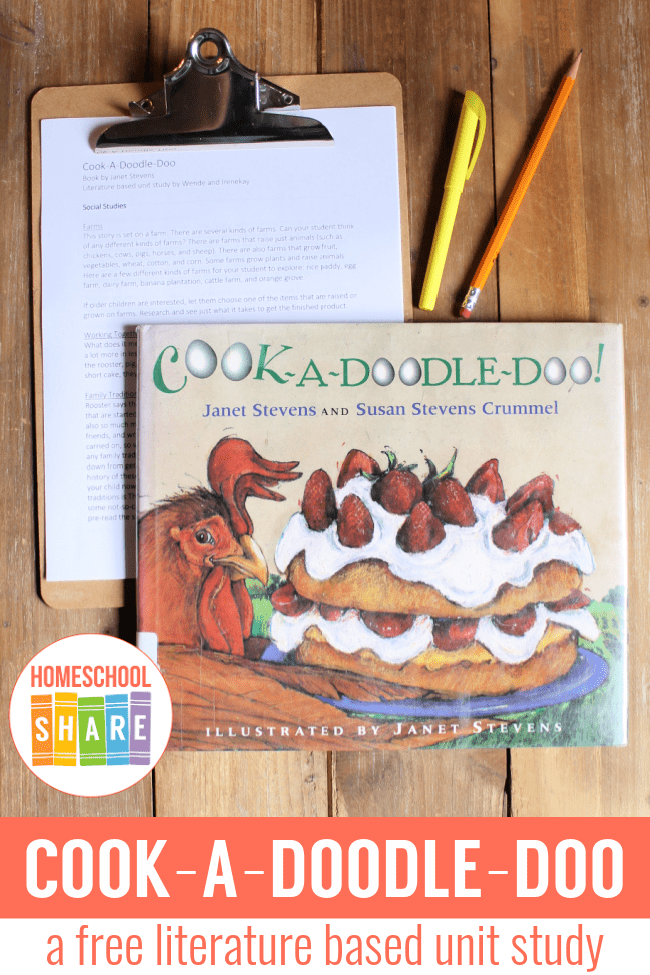
Cook-A-Doodle-Doo

Cook-A-Doodle-Doo


Author:  Janet Stevens
Illustrator: Susan Stevens Crummel
ISBN: 0152056580
Summary:
Rooster, tired of pecking for chicken feed, remembers that his famous great-grandmother (the Little Red Hen) wrote a cookbook, and in it he finds the recipe. Turtle, Iguana and Pig volunteer to help.


Lessons prepared by Wende and Irenekay


Social Studies


Farms
This story is set on a farm. There are several kinds of farms. Can your student think of any different kinds of farms?  There are farms that raise just animals (such as chickens, cows, pigs, horses, and sheep).  There are also farms that grow fruit, vegetables, wheat, cotton, and corn.  Some farms grow plants and raise animals.   Here are a few different kinds of farms for your student to explore:  rice paddy, egg farm, dairy farm, banana plantation, cattle farm, and orange grove. 
 

If older children are interested, let them choose one of the items that are raised or grown on farms.  Research and see just what it takes to get the finished product.


Working Together
What does it mean to work together? When we work together we can accomplish a lot more in less time than if we just tried to do everything by ourselves.  Just like the rooster, pig, turtle and iguana, when they were finished baking the strawberry short cake, they realized that by working together they could bake a lot more.


Family Traditions
Rooster says that cooking is in his blood, and that it is a family tradition. Traditions that are started during childhood are experiences that are fondly remembered, but also so much more. They can shape our character, bind together families and friends, and write the chapters of our family history books. As long as traditions are carried on, so will the joy and laughter of those experiencing them. Do you have any family traditions? Is there a skill, an event, or possibly a story that is handed down from generation to generation? Chances are good that you do. Discuss the history of these traditions with your child. If not, start a memorable tradition with your child now. A wonderful teacher resource for ideas on ways to start family traditions is The Book of American Traditions by Emily Jenkins. *Note* There are some not-so-child-friendly traditions mentioned in the book, so you may want to pre-read the stories of traditions before you share with your child.


Patience
In the story, who has a hard time waiting for the strawberry short cake?  When we have a hard time waiting for something, and we keep bothering someone about it, we are being impatient.  Patience is being able to wait.  Read and discuss  Proverbs 16:32

“Better a patient man than a warrior, a man who controls his temper than one who takes a city”


Although one who practices patience and self control receives far less attention than a warrior who takes a city, he accomplishes better things.


Science


Animals in the Story
A rooster is an adult male domestic chicken. Roosters crow to assure his flock that all is well; he also crows to show other roosters what he thinks of himself and of them. The rooster also has other notes; he will question you as you approach him and his flock and he will give a warning note when he sees a hawk. Roosters are considered barn yard fowl. (Fowl is a bird)

Rooster Printout


A pig is a swine. One of the most interesting things about a pig is his nose. It is sensitive enough to select grain from a chaff, and yet it is strong enough to root up the ground in search for food. Root is a pig word that it describes the pig digging for roots. Did you know the pigs nose is almost as remarkable as the elephants trunk?

Pig Printout

Free Pig Lapbook from HSS


There are several different kinds of turtles-- the mud turtle, the painted turtle, the chicken turtle, and the box turtle. Turtles swallow air to breath. What kind of turtle do you think is in the story? I think it might be a box turtle. A box turtle lives on land only and feeds upon berries, tender vegetation and insects. When it is attacked it draws into the shell and closes both front and back doors and is very safe from anything that might want to harm it.

Turtle Printout


Iguana’s are reptiles and have a leathery skin. It helps prevent it from drying up.

Iguana Printout


Food Sources
Discuss the sources of various foods mentioned throughout the story.


Read the side notes about flour. Flour comes from wheat grains that have been ground into a fine powder. Discuss the different types of flour and look for them at the supermarket including all purpose, cake flour, bread flour, whole wheat, and organic.


Sugar is a sweetener that comes from sugar cane plants.
 

Baking Powder is a powder that consists of a carbonate, and acid and a starch and that makes the dough rise in baking cakes and biscuits.


Salt is a white crystalline substance that contains sodium and chlorine and is used in seasoning foods.


Read the side notes about butter. Butter comes from churning the fatty part of a cow’s milk.


Most of the eggs we eat come from hens. Sometimes people eat turkey or duck eggs.  Eggs are either white or brown.


Milk comes from female mammals. We usually drink the milk of cows, and sometimes goats, in which most, if not all, the fat has been removed.


Strawberries are a fruit that come from plants. Unlike most fruits, the seeds are found on the outside of the fruit.


Whipping Cream also comes from the milk of cows, but, unlike milk, the fat content is left in this product.


Language Arts


Abbreviations
An abbreviation is the shortened form of a word or phrase. Abbreviations are sometimes used for common words or names, and most are followed by a period. In this story, the author of The Joy of Cooking Alone has abbreviated her name, using only the first initials of her first and middle names. Can your child figure out the first and middle name? Little Red Hen wrote the book Rooster was reading! Have your child practice writing his own initials.


Homonyms/Homographs/Homophones

In this story, many of the characters makes mistakes because they misunderstood the directions. Sometimes words that are spelled or pronounced the same have different meanings, and it is important to understand the meanings of words.  


Homographs are words that are spelled alike but are different in meaning or pronunciation. Examples from the story include:

Tea spoon a small spoon for stirring beverages.
Teaspoon a unit of measure equal to 1/6 fluid oz.


Homonyms are words spelled and pronounced alike but different in meaning. Examples from the story include:
Beat- as to mix together.
Beat- as in a rhythmic sound.

and
Cut as in to stop. (ex. Making a movie and they want to stop taping
they usually say cut.)
Cut when you use scissors or a knife to divide things apart.

Homophones are words pronounced alike but different in meaning or spelling. Examples from the story include:
Flour- something you bake with.
Flower- something that you grow and smell.


Can your child find any other homonyms, homographs, or homophones in the story?


Process Writing
This book goes through the process of making a strawberry shortcake. If the words are not chosen carefully to describe the process, just as in this story, there can be confusion. Have your child make an itemized list of the functions in the order they should be performed. Such as

Step 1:

Step 2:

Step 3:

Etc.

Another way to write out a process is in paragraph form, using words such as “first”, “second”, “next”, and “lastly”. After your child has written out (or dictated to you ) his process, have him give it to somebody to work through. Did he leave anything out? Was the person carrying out the process at all confused? Have him fix any errors and try again.


Traditional Folk Tales
Is your child familiar with the story of The Little Red Hen? Obtain a copy and read at least one version throughout the week. The Little Red Hen is a traditional folk tale. Folk tales are stories that are told rather than read; they are passed down from one generation to another generation, or as the story says, “from chicken to chicken”. Maybe your child has played “Whisper Down the Lane” before. If not play this game to demonstrate how a story can change, sometimes only slightly and sometimes not, as it is told and retold again. As folktales are passed down, the stories take on characteristics of the time and place in which they are told, as well as the personality of the person telling the tale. Folk tales often have timeless themes or morals, such as sharing, compassion, being gullible, etc. Can your child identify the moral of Little Red Hen? If you don’t work, you don’t eat. How about in Cook-a-Doodle-Doo? Try and try again, or practice makes perfect. Discuss the similarities and differences between Cook-a-Doodle-Doo and The Little Red Hen.


Parts of a Story
Most stories include the same basic components: characters (who the story is about), setting (where the story takes place), conflict (problems between characters), and a solution (also called the denouement, it is how the characters solved the problems). Ask your child to identify all the parts of this story.


Math


Calendar Skills
 “Day after day- year after year-” Review the days of the week, months of the year and how many days in a year with your youngest students.


Measurement
Iguana tried to measure the flour with a tool called a ruler. Many things can be measured with a ruler, but flour isn’t one of them. Discuss how you can measure height, length and width with a ruler, and the meanings of the quarter inch, half inch, and inch markings. How many inches in a foot (abbreviated ‘ )? How many feet in a yard? When the objects we measure are shorter than a foot, we use inches (abbreviated “). If the object is over a foot, we use both feet and inches. If something is bigger than a foot, it is helpful to measure it with a tape measure or a yardstick. Have your child practice measuring various objects with a ruler, tape measure and a yardstick.


Fractions
Cooking gives children a wonderful opportunity to work with fractions in a fun way. As you read through the story, point out the numeric fractions, explaining that they show parts of a whole. The bottom number called the denominator, shows the whole. The top number, called the numerator, shows the part. Have your child play with your measuring cups and measuring spoons, in a bucket of flour or water. How many ¼ cups does it take to fill up a ½ cup? How about 1 cup? How many 1/8 teaspoons makes 1 teaspoon? Sometimes the best and most memorable learning comes through a child’s own discoveries.


Temperatures
Rooster’s cookbook said to heat the oven to 450 degrees. Read the side notes about oven temperature to your child. Discuss Fahrenheit temperatures and how they relate to cooking. What is the hottest temperature your oven goes to? What is the lowest? Let your child watch an oven thermometer temperature climb as you heat it up to 450 degrees.


Art


Cake Decorating
The presentation of food is an art form in itself. Would you want to eat a cake that was all mashed together or had fallen on the floor? Well, maybe if you were a pot bellied pig. But generally speaking, the more beautiful food is to the eye, the more inviting it is to eat. Have your child take some real pride in his masterpiece as you help him assemble the strawberry shortcake. Spread the cream evenly, place the strawberries in a balanced manner, and serve it on pretty plates. If possible, take a trip to a bakery where he can witness the art of cake decorating first hand.


Additional Resources and Ideas

Links

Online Interactive Games


For Fun


Easy Strawberry Smoothie

1 Tub of sliced strawberries in own syrup

Enough orange juice to pour out of blender.

You can also add some bananas if you would like.

Mix all in blender. Pour in sundae glasses and add some cool whip to the top and enjoy.


If you have a child who wants to learn more about farms, I recommend the Evan Moor Farmers Feed Us Theme Pocket found in June Theme Pockets (which also includes artists and rainforest).