| about us |
what's new
|
unit studies
|
unit study helps |
fiar resources
|
indexes | lapbooking |
Cloudy
With a Chance of Meatballs
|
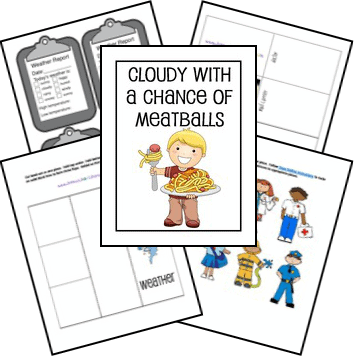
Author: Judi Barrett Unit and lapbook prepared by Lisa Martin |
Lapbook
Components
Social Studies
Community Helpers -
There are many
people that work together to make the community function smoothly, called
community helpers, such as the mayor, doctors, police and firefighters, as well
as the storeowners, transportation workers, and sanitation workers. Make a list
of community helpers referred to in the book. Have your child brainstorm other
community helpers to add to the list. You could have your child draw a picture
or write a letter to a community helper to thank him or her for their service to
others.
Community Helpers
Hotdog Book
Hotdog Book Folding Instructions
Map Skills (Chewandswallow) -
Have your child make a pretend map using the description at the beginning of the book, including oceans, deserts and mountains. Make sure he adds a compass rose (North, South, East, West) and labels the town of Chewandswallow. Make a story disk (maybe with a meatball on it) and place it on your map. You could also let your child make a small map of Chewandswallow for your lapbook.
Map of Chewandswallow Matchbook
Sanitation Department & Recycling
In
this book the sanitation department has to work really hard to keep up with the
leftovers. How do you get rid of your garbage? Does your student know where it
goes?
Most trash goes to a special kind of dump called a landfill. At the landfill
garbage trucks bring in big loads of trash from the city and they dump it in
piles. Then bulldozers spread out the trash with their scrapers. Next
compactors with large spiky wheels move back and forth over it – mashing it
flat. After it is smashed flat, trucks come in and spread soil over the trash.
The landfill is built layer upon layer—waste, dirt, waste, dirt—until it is a
small hill. Then a new landfill has to be found.
The garbage never stops. There is always trash to be taken somewhere. The
average person creates about four pounds of trash each day! YUCK! That’s a
lot of garbage. Most people could recycle about half of their trash if they
were willing to try. Recycling is when you reuse something or turn trash into
something new.
Here are a few places that recycle various materials:
Paper Mill – chop up old newspapers and turn them into new paper
Aluminum Factories – take old cans and foil and melt it down to make new cans
and foil
Glass Bottle Factories- glass is ground up and melted to make new glass bottles
and jars
Plastic Factories- plastic is chopped up, melted, and poured into molds to make
new things such as park benches and flower pots
If you have the opportunity, visit a land fill and a recycling plant. Think
about ways you can stop throwing so much stuff away that will be hauled to
landfills (recycle more, take things to Good Will, start using cloth bags at the
grocery instead of plastic, make a compost pile as mentioned in the story- “the
rest of the food was put back into the earth…”).
How Can I Help? Simple Fold
Food
Sources--
Where does our food come from? We know it doesn’t rain down from the sky, but
does your student understand that food doesn’t really “come from” the grocery
store?
Food comes from farms. Farmers play an important role in feeding the world;
they take care of animals and grow plants until it is time to have it
processed. After it’s processed, it’s ready to eat. Farmers sell their
products to stores where you can go and purchase them.
Discuss various kinds of farms with your student—dairy farm, egg farm, cattle
ranch, rice paddy, orange grove, banana plantation, etc. What grows in your
area?
Think about the foods you’ve eaten today. Can your student determine what was
grown to make each food?
Learn how wheat gets from the farm to the table with this
Virtual Field Trip.
A younger student may enjoy learning the song
“Oats, Peas, Beans, and Barley Grow.”
Language Arts
Look up the suggested words in the dictionary with your child (or select your own words from the story). You can use the vocabulary lapbook component if you’d like.
Abandon – to give up or desert
Drizzle – to rain steadily in fine drops
Gradual – moving or changing slowly
Occasional – appearing now and then
Prediction – making known beforehand
Sanitation – the removal of unhealthy things
Stale – having lost freshness
Survival – the act of remaining alive
Temporary – for a short time
Violent – severe; harsh
A tall tale is a
story that contains humor and elements which are exaggerated or hard to
believe. Discuss with your child how this story fits the definition of “tall
tale” and give specific examples.
Compound Words--
There are lots of examples of compound words found throughout this story:
meatball, pancake, breakfast, everyone, schoolhouse, leftovers, townspeople,
northwest, sidewalks, overcooked, downpour, etc.
Compound Words Cards &
Pocket
Titles--
Other than the cover of the book, the title is usually the first thing we
notice. Catchy and clever titles are likely to draw in readers.
Titles are short, so every word counts. Authors often use puns, alliteration,
and wit to make their titles stand out.
What does your
student think about the title of this book? Is it interesting? How it is
clever?
This book also shows an illustration of a newspaper headline – “Spaghetti Ties
up Town.” Is this clever or funny? Would your student want to read the article
based on the title?
Newspaper Writing--
Have your student write a newspaper article for one of the extreme weather
events in the story. Look at examples of newspaper articles in your local
newspaper. Make special notice of the titles (see previous lesson); read
titles to your student and ask him if he would like to hear the rest of the
article based on the title.
Choose one example of extreme weather mentioned in the story. Using the five
W’s (Who? What? Where? When? and Why?) as a guide, have your student brainstorm
or pre-write some ideas for a newspaper article. Write up the article and
include a good, attention-grabbing headline.
5 W's Book (younger
student)
Newspaper Article
Pocket (for your older student to store his article)
There are so many ways to encourage your child to write using this book as a springboard. Choose the option(s) most appropriate to your child’s ability:
Art
Look at the illustrations on the page beginning “The people could watch . . . “ as well as the adjoining page. Discuss with your child how the illustrator uses details of the illustrations in a humorous way.
Discuss with your child: How does the illustrator use color to help develop the story? What do you notice about the use of black and white and color?
After looking at photographs of different types of clouds, have your child create cloud artwork. Your younger child may enjoy just putting white paint on blue paper, while an older child might enjoy copying a particular cloud type. Explore different media (tempera paint and oil pastels both work really well for this).
Practice measuring with a ruler or yardstick. Measure 15 inches (like the drifts of cream cheese and jelly sandwiches). What in your house is 15 inches high/long? Compare to things bigger or smaller.
Discuss healthy food choices, including the five food groups (grains, fruits, vegetables, dairy, meat and beans). You can include in your discussion any particular choices your family makes regarding healthy eating (trying to eat mostly whole-grains, not eating meat, etc.).
Ask your child to analyze the day’s meals as written in the book (breakfast, lunch and dinner). Are the meals healthy? If not, what could be changed?
Talk about what
different foods do for your body. Your older child may enjoy researching the
effects of different foods on the body. For younger children, you could use a
simple explanation like this:
GRAINS give you energy (have your child run in place really fast)
VEGETABLES help you see (point to eyes)
FRUITS help you heal
MEAT AND BEANS give you strong muscles (make a muscle)
DAIRY helps you have strong teeth and bones (point to teeth)
Snow –
Wind –
What causes the wind? Air is made of tiny particles called molecules. As these molecules heat up, they expand, move faster, and spread out. When the molecules get cool, they contract, move slower, and stay together. So as the sun warms the air, the air rises. The cold air rushes in to take the place of the warm air. We feel this movement of air as wind. For further research, study the Beaufort Wind Scale to see what constitutes a fair breeze, moderate gale, or storm winds.
Clouds are an important part of the water cycle, in which the tiny water particles in the air are trapped together. Clouds bring moisture to the earth in the form of rain, sleet or snow. There are four kinds of clouds. Stratus clouds form in layers when air is forced to rise when passing over mountains. Cirrus clouds look like feathery wisps, formed very high in the atmosphere and are often formed of ice crystals. Cumulus clouds are the big puffy clouds that carry the most moisture. When many cumulus clouds gather together they form the dark, rain-bearing cumulonimbus clouds. Pick out the four kinds of clouds in the illustrations of the book.
Hurricanes –
Hurricanes are powerful, whirling storms. They form over the warm oceans close to the equator and can travel hundreds of miles. As the sun heats up the seas, warm water vapor rises into the air forming large thunderclouds. Wind causes the masses of clouds to whirl strongly. The hurricanes move across the ocean creating huge waves that can crash on the shore. Often times, the hurricane never makes it to land. When they do come to land, they bring high, destructive winds and heavy rains.
Tornado – (lesson by Rose Ann)
How is a tornado formed? Tornadoes start deep within vast thunderclouds, where a column of strongly rising warm air is set spinning by high winds streaming through the cloud's top. As air is sucked into this swirling column it spins very fast, stretching thousands of feet up and down through the cloud, with a corkscrewing funnel descending from the cloud's base-the tornado.
Some danger signs to look for include dark, often greenish sky, large hail, large, dark, low-lying cloud (particularly if rotating), and/or loud roar, similar to a freight train.
Tornado info found here.
Make a list of all the weather-related words in the book. Define unknown terms.
Talk about different types of weather and precipitation. Look for examples in current events (using news stories or the Weather Channel). You can have your child make a Wild Weather lapbook component if he wants to research extreme weather more in depth.
Have your child research a weather-related disaster that caused people to have to move and answer the following questions: What happened? Where did it happen? How large an area was affected?
Have your child find the weather forecast out of a newspaper, from the Internet, television, or radio. What weather vocabulary do the weather forecast and the book have in common?
Water Cycle –
The water cycle involves evaporation, condensation, precipitation, and collection of water. Define each of the words and show how they follow one another as a cycle. Here is a simple experiment to illustrate the water cycle. Materials needed: a teakettle with water in it, a metal cookie sheet, and a stove. Before doing the experiment, place the cookie sheet in the freezer for at least one hour. When you are ready to begin, show your child that the teakettle contains water. Place the teakettle on the stove and heat it to boiling. Talk about evaporation (liquid water changes to water vapor). Once the water is boiling, take the cookie sheet out of the freezer and hold it at an angle in the steam. The water vapor will condense as it hits the cold metal (condensation). As more and more water vapor condenses, the water drops will run down the metal cookie sheet and drip off the cookie sheet (precipitation). If you wanted, you could place a plastic container underneath the water drops for collection.
Bible
Memory verse: “Taste and see that the Lord is good; blessed is the man who takes refuge in Him.” (Psalm 34:8)
The people of Chewandswallow came to a place where they needed a refuge from the extreme weather they were experiencing. Talk with your child about what it means that the Lord is our “refuge”; share personal examples of how He has cared for you and how you have experienced “tastes” of His goodness in your life.
Have your child
copy this verse for copywork. (If desired, you can place it in the
Bible verse pocket of your lapbook.)
Bible Story- Manna From Heaven
In the Bible, there was a time when food really did rain from the sky! Read
Exodus 16 with your students. Be sure to discuss thankfulness and
complaining. You may even want to mention that we need to be thankful for the
foods we do have to eat even when they aren’t our favorites.
Just For Fun
Make a “favorite foods” collage – using pictures from magazines or the Internet.
Make a diorama of a favorite part of the book (you can use play food to be the “giant food”).
Have your child help plan a day’s (or a week’s) menu – looking for balanced, healthy and affordable choices. You could also have your child help you shop for and/or prepare the menu.
Any cooking
project could fit into this unit – maybe make giant meatballs or pancakes
together!
Make a house of stale bread and peanut butter. Serve it to your outdoor
critters when you are finished.
Resources
Library List
Clouds by Ted O’Hare, copyright 2003
e.guides Weather by John Woodward, copyright 2007
Eyewitness Hurricane and Tornado, published by DK Publishing Inc. copyright 2000, 2004
Eyewitness Weather, published by DK Publishing, Inc. copyright 1991, 2004, 2007
Flash, Crash, Rumble and Roll by Franklyn M. Branley, copyright 1964, 1985
Good Enough to Eat: A Kid’s Guide to Food and Nutrition by Lizzy Rockwell, copyright 1999
Little Cloud by Eric Carle, coyright 1996
The Magic School Bus Inside a Hurricane, by Joanna Cole, copyright 1995
The Man Who Named the Clouds by Julie Hannah and Joan Holub, copyright 2006
Pickles to Pittsburgh by Judi Barrett, copyright 1997
Rain and Hail by Franklyn M. Branley, copyright 1963, 1983
Storms! By the editors of TIME For Kids, copyright 2006
The Weather Sky by Bruce McMillan copyright 1991
Weather Words and What They Mean by Gail Gibbons, copyright 1990
What a Wonderful Day to Be a Cow by Carolyn Lesser, copyright 1995
What Will the Weather Be? By Lynda DeWitt, copyright 1991
Why Is It Windy? By Judith Williams, copyright 2005 Enslow Publishers
Websites
Some resources online that discuss healthy food choices for children are:
http://www.mypyramid.gov/kids/index.html
http://kidshealth.org/kid/stay_healthy/food/pyramid.html
http://www.enchantedlearning.com/themes/food/pyramid.shtml
Weather websites:
http://eo.ucar.edu/kids/index.html
http://www.wildwildweather.com/index.html
http://www.urbanext.uiuc.edu/kalani/index.cfm