| about us |
what's new
|
unit studies
|
unit study helps |
hss resources
|
fiar resources | indexes | lapbooking |
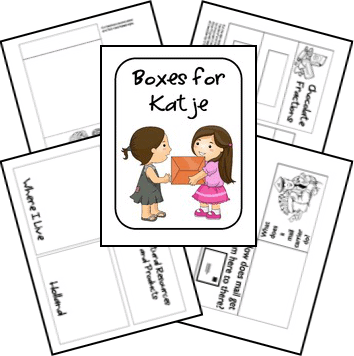
Boxes for Katje
| Author: Candace Fleming Illustrator: Stacey Dressen-McQueen Summary: After a young Dutch girl writes to her new American friend in thanks for the care package sent after World War II, she begins to receive increasingly larger boxes. ISBN: 0-374-30922-1. |
Literature Based Unit Study written by Ami Brainerd and Celia Hartmann
LAPBOOK COMPONENT
Where is The Netherlands?
Symbols of the Netherlands Tab Book
Where is Indiana?
Generosity Matchbook
include Bible verse, definition, examples from the story, etc.
Mail Carrier/Mail from here to there 3/4
Book
Listmaking Book
*assembly* fold in half (on dotted line) and cut the oval shape out (except
on the fold)
Friendly Letter Sheet (to go in an
envelope)
Friendly Letter Sheet (blank
for an older student)
Vocabulary Cards
Vocabulary Pocket
Chocolate Bar Fractions Accordion
Book
Seasons Sorting Cards and Pocket
Bulbs Pocket Book
use this book for your student to place information she has learned about
bulbs, the sequence cards, the cross-section of a bulb, the information from
Enchanted Learning, etc.
Natural Resources Layer Book
help your student research to find the answers to what natural
resources/products grow in the three areas; younger students may want to
simply draw pictures
*assembly* Cut out pages. Place in order smallest to
largest with the smallest on top. Staple at the top of the book.
Cover Ideas
Use one of your art projects from this week on the front (or back) cover.
You could also use this tulip for
the front cover.
Geography: Holland (and Indiana)
Mention to your student that Holland is also known as The Netherlands; the
people are known as Dutch. To help your student's understanding of
this, you can relate it to your own country. For example, if you live
in the U.S.--"We live in the United States which is also known as America;
the people are known as Americans."
If you want to make a flag of Holland,
it would be a simple project for your student. It is similar to other
European flags with three horizontal stripes of color (red, white, and
blue). You could use construction paper, paint, or another
medium to make a replica.
You may want to make two story disks (one for Holland and one for Indiana--
maybe a box of tulips and a box of sugar). Find Holland on a map or
globe and place your story disk. Locate Indiana on map and place the
other disk; you may want to put yarn between the two countries to symbolize
the packages and letters that traveled back and forth. If you have a
laminated map, you can use a dry erase marker to draw a line between the two
countries (test this on a small spot first!). Tell your student that
boxes were sent to Europe (which includes the country of Holland) from all
over the United States (not just Indiana) in order to help those who needed
food and supplies.
Map of Holland
Map Outline
of Indiana
Indiana State Flower/Bird Coloring
Page
Lapbook Component:
Where is The Netherlands?,
Symbols of the Netherlands Tab Book,
Where is Indiana?
Social Studies: Occupations (Postal Worker)
Do you know what your student wants to be when
she grows up? You can have a conversation about occupations.
What occupations are mentioned in this book (doctor, teacher, and especially
postal worker). If your child is interested, take a field trip to the
post office for a up close look at what postal workers do all day.
You could also discuss the methods of mail delivery. In the story, Postman
Kleinhoote used his bike and sleds. Discuss how mail is brought to your
house. Can your student guess other ways mail is delivered? Airplane,
boat, and train might be ways he will guess. Does he know that sometimes
animals are used? If he's studied the Pony Express in the past, he may
think of that method. But other animals have been also been used....camels,
dogs, pigeons, even reindeer!
If you have old magazines, perhaps your student would enjoy making a collage
of ways mail has been delivered over the years.
Lapbook Component: Mail
Carrier/Mail from here to there 3/4 Book
History: Post-WWII Europe
You may want to read the author's notes "A
True Story About Boxes" on the last page of the book. If you have
studied war (They Were Strong and Good, All Those Secrets of the World,
etc.) with your student in the past, mention that WWII involved many parts
of the world, many countries. This may be too sensitive of a topic to
talk to your student about, but if you think they are mature enough, you can
discuss the devastation of war. War is never nice, neat, and pretty,
but it does lead to liberty. Your student may feel sorry for the
people in Holland because of the little that they have, but a little plus
freedom equals a lot.
Bible: Character Building - Generosity
Discuss generosity with your student (you may
want to say the word together a few times). Being generous is giving,
but not just giving...giving LOTS! How were the people in
Indiana generous to the people in Holland? How can we be
generous?
The Bible tells us that we are to be cheerful givers
and to use the gifts God has given us....if we are a person who can give,
then we should do so with gladness and graciousness. Paul tells us in
2 Corinthians 9:6-8: "...He who sows sparingly will also reap sparingly, and
he who sows bountifully will also reap bountifully. So let each one give as
he purposes in his heart, not grudgingly or of necessity; for God loves a
cheerful giver. And God is able to make all grace abound toward you, that
you, always having all sufficiency in all things, may have an abundance for
every good work." Explain to your student how Katje sowed
bountifully. How did she reap bountifully?
Lapbook Component: Generosity
Matchbook
For a practical application of generosity, see the link below to Samaritan's purse.
Language Arts: List Making
After reading the book, let your student try to make a list of
everything she can remember that Rosie (and her friends) in Indiana sent to
Katje in Holland. Once your student has finished, check the book to
see how many items she remembered. If your student would like, allow
her to make her own list of what she would've sent to Holland.
Lapbook Component: Listmaking Book
*assembly* fold in half (on dotted line) and cut the oval shape out (except
on the fold)
Language Arts: Vocabulary
urged-- to move to action; Katje's mother urged her to open the
box.
luxury-- something expensive or hard to obtain; Smooth soap was a
luxury for Katje.
savored--to taste or smell with pleasure; The chocolate taste was
savored.
sparingly--to use with restraint (slowly, carefully); The people in
Holland ate sparingly from their cupboards.
precious-- of high cost or worth, valuable; Sugar was impossible to
find in Holland; it was precious.
Lapbook Component:
Vocabulary Cards,
Vocabulary Pocket
Language Arts: Letter Writing
An older child might enjoy writing (or a younger child might enjoy narrating
for you to write) a letter to someone.
There are five main parts to a friendly letter.
1. Heading
The heading gives the date that the letter was written as well as the complete
address of the person who is writing the letter.
2. Greeting
The greeting tells to whom the letter is written. The most common greeting
is "Dear __________". It is considered impolite to use only the
person's name as a greeting.
3. Body
The body is the letter itself.
4. Closing
The closing is a polite way to say goodbye. (Sincerely, Sincerely Yours,
etc.)
5. Signature
The signature is the name of the writer.
Lapbook Component:
Friendly Letter Sheet (to go in an
envelope)
Friendly Letter Sheet (blank
for an older student)
Math: Story Problems
1. Katje received four bags of sugar in one of the boxes.
One bag went to the post man. Another bag went to the de Land family.
How many bags did that leave for Katje and her family?
2. Mr. and Mrs. de Land have five children. How many people are
in the de Land family?
3. Katje split the chocolate bar; she ate a piece, Postman Kleinhoonte
ate a piece, and her mother ate a piece. How many pieces in all?
*You can also use this to introduce thirds in fractions. Take a piece
of chocolate and break it into three. Show your child 1/3, 2/3, and
3/3 (which equals 1 whole piece). You can make up more math problems.
How much candy did Katje give away? (2/3). How much did Katje keep?
(1/3). Did she keep more for herself or give away more? (gave away
more because 2/3 is larger than 1/3). Extend the lessons
on fractions with this lapbook component:
Chocolate Bar Fractions Accordion
Book
Math/Science: Weight
"So big I could not bring it on my bicycle...A big, heavy box from
America!"
Discuss with your student that heavy can mean difficult to lift. You
can find items around the house that are easy to lift and too heavy to lift.
Explain that heavy items weigh more. You can also let your student
choose some smaller items from around the house. Pair the items up (by
ones that are similar in weight) and have your student try to guess which
item is heavier. Weigh them on the appropriate scales (depending on
the items you may need to use kitchen, postage, or bathroom scales).
If you decide to go to the post office for a field trip, ask them to weigh some different items (or pre-made boxes) to find out the weight and cost of postage to Holland on each particular box. Explain to your student that usually the heavier the box, the higher the postage (or cost to send it).
Science: Seasons
This book takes the readers through all four seasons in Holland.
Make a list with your student of the characteristics of each season as noted
in the book. Then, discuss what the four seasons are like where you
live. A picture book that may add to your study of seasons-- Four
Seasons Makes a Year by Anne Rockwell.
Lapbook Component: Seasons Sorting
Cards and Pocket
Science: Natural Resources and
Products
Explain to your student that certain resources and products grow/are found in certain
areas. For instance, we know from the story that we would
find cabbage growing in Holland. What other natural resource would we
find in Holland? (tulips!). Indiana has natural resources, too.
Corn grows heartily and happily in the vast fields in Indiana. What
grows naturally in your area? You may want to find a children's atlas
that depicts natural resources and look at it together and discuss.
Where would you find bananas growing? Wheat? Coconuts?
(the list could go on and on! Maybe yours will!)
Some helpful books to find out what resources are found all over the world--
Usborne Children's Picture Atlas (shows plants/animals), The Kingfisher
First Picture Atlas (plants/animals)
Lapbook Component: Natural
Resources Layer Book
help your student research to find the answers to what natural
resources/products grow in the three areas; younger students may want to
simply draw pictures
*assembly* Cut out pages. Place in order smallest to
largest with the smallest on top. Staple at the top of the book.
Science: Tulips
In the final two pages of the story ("And so one sun-bright morning..."), if
you look at the bottom of the left page moving right and up, you will see
the progression of a tulip bulb. Your student is probably familiar with
seeds and how things grow from seeds, but does he know what a bulb is?
Explain that tulips grow from bulbs. A bulb is a pre-packaged
plant including the food it needs to grow. If you
slice a bulb, you can see the parts of
a plant (you may wish to do this with a bulb for a hands-on experience).
Tunicate bulbs can have a papery covering (like an onion). Other bulbs, scaly bulbs (like lily bulbs), don't have paper coverings. If you have access to many types of bulbs, let your student sort them into two piles-- tunicate and scaly. You could also make a chart by using pictures of bulbs you find online.
Bulb Anatomy
Bulb Sequence Cards
Art: Perspective
Perspective creates feelings of depth in a picture. Three basic
ways to create depth are line, size, and overlapping; all three give the
picture dimensions. The art in Boxes for Katje does not show
much depth, therefore, it is flat (it is not three dimensional).
Compare the illustrations in Boxes for Katje to another book you have
(that has three dimensional art). Even though the pictures Stacy Dressen
McQueen has created are flat, she has created a sense of perspective through
the use of layering. Overlapping images creates an illusion of
depth. Look at the page that says, "Sugar, sugar, sugar" with
your student. Which images seem to be closer? Which ones seem to
be farther away? Note that the little girl in the pink dress with bare
feet appears to be closer than the man holding the baby because she overlaps
him-- her arm and her leg are layered on top of him.
Your artist can try this technique in a few different ways. He can cut
pictures from old magazines and layer them on top of each other then draw a
picture based on his cut/paste collage. Your student could also
draw pictures, then cut them out and overlap (paste) them on a separate
sheet of paper. Your younger student may just want to complete the
magazine collage mentioned above. Remind your student to vary size and
shape.
Art: Artist Study -- Matisse
Stacy Dressen McQueen's uses flattened forms (as discussed in Art:
Perspective), bright colors, and fanciful patterns. Look back through
Boxes for Katje for examples of each. A famous artist who used
a similar techniques was Henry Matisse. Matisse and McQueen both layer
pattern and color. This is noted in every page of Boxes for Katje
(pattern-- bricks, clothes, walls, floors, etc.; colors are layered-- blue
on brown, red on blue, etc.). These traits are also noted in many of
Matisse's paintings.
In Boxes for Katje, illustrations look like they were cut out and
glued to the paper, but they weren't. McQueen achieves this effect by
painting a small white outline around the outside of many figures.
This is one difference between McQueen and Matisse; Matisse really did cut
and paste his artwork. Your student can learn more about Matisse
and view some kid-friendly Matisse work here
http://www.artbma.org/education/matisse_kids_frame.html as well as play
a game.
After viewing Matisse's work, let your student try to mock the work of
Matisse and McQueen by using flattened forms, bright colors, and whimsical
patterns. Your student will need to create (paint, draw,
crayon) some patterns on paper (or you will need to get a book of wallpaper
samples). Then, let your student draw a picture in pencil. Cut
out patterns to match the pencil drawing and paste them in. After your
student is finished adding patterns, let him color or paint the rest of the
picture. Encourage your student to use some overlapping for
perspective.
Matisse Links (extra projects)
http://www.trschools.com/staff/d/kdefibaugh/lp19.html
http://www.princetonol.com/groups/iad/lessons/elem/elem33.html
JUST FOR FUN
Coloring Pages
http://www.enchantedlearning.com/artists/vangogh/coloring/flowerbeds.shtml
http://www.kidzone.ws/geography/usa/indiana/cardinal2.htm
http://www.friendsacrossamerica.com/colorstateinbirdflower.html
http://www.abcteach.com/Activities/tulipeasy.htm
#1 If it’s fall, plant tulips to enjoy in the Spring
#2 If it’s winter, line a lightweight jacket with newspaper and go outside a few minutes....Did you keep warm?
#3 Wash your hands with Lava soap (or other rough soap, perhaps one with walnuts?).....note the roughness, the smell. Now wash your hands with a smooth, pleasant-scented bar of soap.
#4 Eat nothing chocolate the week of rowing. Buy a Hershey bar for the last day.....smell the aroma, savor the taste, and most of all...share it!
#5 If you’re really brave, eat nothing but boiled cabbages and potatoes the first four days of rowing! Dream of meat and bread! Savor a traditional meal with all the trimmings the final day of rowing.
#6 Send a package to someone elderly, in the military, and less fortunate child. If the story is rowed around October/early November, a shoebox could be made up for a child http://www.samaritanspurse.org/index.asp?section=Operation+Christmas+Child
#7 Ride bikes and pretend to be Postman
Kleinhoonte.
Recipe: Dutch Ice Box Cookies
1 cup margarine
2 cups white sugar
1 cup sour cream
4 cups flour
1 tsp. cinnamon
1 tsp. nutmeg
1/2 tsp. cloves
1 tsp. baking soda
1/4 cup chopped nuts
1/4 tsp. salt
Cream the margarine and sugar. Stir in the sour cream, flour, spices,
baking soda, salt, and nuts. Mix well and put in the refrigerator for
3-4 hours. Preheat oven to 375. Form dough into a ball and roll
out flat on lightly floured surface. Cut into shapes with cookie
cutters (or use traditional circles). Bake for 10 minutes.
Even More Learning!
History: Children’s Aid Society
Founded in 1853, the Children's Aid Society is still alive. You
can find their website at
http://www.childrensaidsociety.org/ .
Rabbit Trails: Tulips, Chocolate, Sugar, Holland, Indiana, Soap-making, Sharing, Post-office, WWII, Seasons
You may also want to discuss how Katje reacts when she gets the first package. She rubs her fingers over the letters USA and whispers "The land of plenty." She does this so reverently, so in awe of getting something from America. Can children understand what our country means.........the freedoms we have that they don't, the money we have, the things we have? We are so blessed and our children take it for granted without even knowing! How can we even explain?