Google
 
Billy and Blaze

Billy and Blaze
Author: C.W. Anderson
ISBN: 0689716087
Summary: A little boy who loves horses gets a special birthday present.

Literature Based Unit Study by Heidi Jasper
Lapbook by Ami Brainerd

Lapbook/Notebook Resources

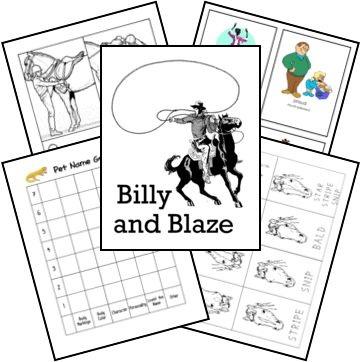
Billy and Blaze Notebook or Lapbook Cover.

Phil. 3:13-14  Matchbook

Pet Names Survey Chart
you can make this into a simple fold for your lapbook, if desired

Kentucky Shape Book

Prepared Vocabulary Cards and Pocket

Pony Care Notebooking Page
you can make this into a minit book for your lapbook, if desired

Mounting Sequence Cards & Pocketbook

Facial Markings Hot Dog Book Template (follow these instructions)
choose which page you'd like before you print; one has HWOT outline letters and the other one is blank for your student to write in

Horse Breeds Flag Book Template (follow these instructions)
I used this as part of the lesson to help my student understand that ponies are not baby horses; we learned a little about each breed

Sample Lapbook Pictures


Social Studies 
 
Time Period
Use clues to determine the time period of the story
-clothing
-hairstyles
-camera
-furniture
-use of a plow horse
Was it 100 years ago?  50 years ago?  Find a book on that time period in the library to learn more about life 50 years ago.
 
 
Reward for a Job Well Done
Has your child ever received an award? Did he have to work hard for it?  What are some of the things he had to do?  Has your child ever worked hard for an award but not won it?  Discuss those feelings as well.   

Bible verses about rewards:
I Cor. 9:24-27
Phil. 3:13-14  Matchbook
Matt. 16:27

Phil. 3:13-14  Matchbook
 
Pet Names (this includes some math, too)
How does Billy choose names for his pets?  How do you? (If you have read the Before FIAR titles The Little Rabbit and Jenny's Surprise Summer, you could review how these characters picked names for their pets.)  Let your student survey (we usually make phone calls) family and friends.  How did they decide on a pet name?
Use the
Prepared Survey Chart to record the results.  If someone has more than one pet (a bird and two dogs) make sure to record each pet as a separate entry.
Pet named for color
Pet named for body markings
Pet named for personality
Pet named for character (television, movie, book, etc.)
Pet named just because you loved the name!
Other

Birthday Traditions
Why do we celebrate birthdays?  Discuss the different birthday traditions you share in your family. 

Geography
This story doesn't reveal it's exact setting.  If you'd like to study some geography this week, you may want to choose the state of Kentucky.   Kentucky has many different horse shows; the Kentucky State Fair hosts the World Championship Horse Show; this prestigious event attracts over 2,000 horses and people from all over the country and the world, awarding more than $1 million in premiums.  In another Billy and Blaze book, Blaze and the Spotted Gray Pony, there are many horse farms which are also found in Kentucky.

Kentucky Shape Book (for your Lapbook or Notebook)

Kentucky state flag
Kentucky state map
state bird (Cardinal) activity worksheet
state flower (Goldenrod) activity worksheet
state bird and state flower coloring page

Language Arts

Classic Story: 1936 Classic
A classic is a book that has survived the test of time.  You may want to explain this to your student by making (or using what you already have) a time line.  Let your student place your date of birth, his date of birth, and the "birth" of this book on the line.   The visual representation will help him understand what a classic is.  Mention other classics you have read/rowed; you may even want to place them on the time line as well.  Time-Line to Print from FIAR Circle
 
Point of View
This story is written in 3rd person.  Someone else is telling the story using words like "he, she, his, etc."  Find a book written in the 1st person point of view and compare.
 
Descriptive words: Adjectives
Words that help describe an object (telling us more about that object) are called adjectives, they tell us more about an object.  Look at page 6.  Listen for the descriptive words about the pony (beautiful, bay, four white, white)  These words help you to picture the object in your mind.
Pick an item.  Make a list of describing words for it.

Go-along book for learning about adjectives: Many Luscious Lollipops by Ruth Heller

Vocabulary
Prepared Vocabulary Cards
prancing- to walk or move about in a lively and proud manner
proud- much pleased
stable- a building in which domestic animals are sheltered and fed
galloping- running fast
limped- to go slowly or with difficulty
bridle- device for controlling a horse made up of a set of straps enclosing the head, a bit, and a pair of reins
gaily- in a happy or lively way
 

Art

Medium: Black Ink
Practice drawing with black ink. Make a picture of your pet (real or desired) and yourself.
 
Crosshatching
Crosshatching is a technique of crisscrossing lines of ink to create depth, shading, or texture.
Look at the wide variety in the book (Billy's curly hair vs. his shorts, Blaze's hair vs. Rex's hair, the curtains vs. the table cloth, trees vs. grass,  etc.  Encourage your student to add some crosshatching to her black ink drawing.
 
Detail
Can you find hidden animals in the woods on pages 18-19?
 

Math

Measurement- Hands
How to measure a horse or pony.  A "hand" is equal to 4 inches.  A horse/pony is measured from the ground to the top of his withers (shoulders).  So a pony that is 40 inches high is said to be 10 hands high.  Practice counting by 4s.  How many inches tall would a 15 hands horse be?  A 17 hands horse?  An 8 hands high pony? 
 
Measurement- Dog Years
Conventional Wisdom says 1 human year is equal to 7 dog years.  So a dog that is 2 years old is considered to be 14 dog years old.  Practice counting by 7s.  How old is a 5 year old dog?  A 10 year old dog?
 

Science
 
Ponies and Horses
A pony is NOT a baby horse.  It is entirely fully grown.  Ponies are equine breeds that are less than 14.2 hands high (57 inches). 

Horse Anatomy - the first picture shows the different "points" of a horse. 
Horse Print-out from Enchanted Learning

 
Pony Care
Pony Care Notebooking Page
1. Ponies need a field with plenty of short juicy grass to eat (or plenty of hay in a stable)
2. Ponies are tough, but they need some sort of accessible shelter (shade from the sun and bad weather); they also need shelter on cold winter nights
3. Ponies need a trough of fresh, clean water every day
4. A pony needs company; it's best to keep it with a donkey or another pony
5.  If a pony is kept in a stable, the stable needs cleaned twice daily.  The pony will need taken out of the stable each day for at least two hours of exercise.

Your older student may be interested in researching different breeds of ponies-- Shetland Pony, Welsh Mountain Pony, and Chincoteague Pony will get him started.  He may also want to learn more about The Pony Express. 

Just for fun--
Mounting Sequence Cards


Horses- Facial Markings
Horses have are unique just like people.  Ask your student to recall how Blaze got his name.  Tell him that there are other facial markings as well. 
 
Blaze - a wide white stripe down the center of the face
Star - a white patch between the eyes
Snip - a white patch between the nostrils
Stripe - a long narrow white strip down the center of the face

Facial Markings Hot Dog Book Template (follow these instructions)
choose which page you'd like before you print; one has HWOT outline letters and the other one is blank for your student to write in

 
Dogs- German Shepherd
Rex is a German Shepherd breed.  Why are there different kinds of dogs?

God created all kinds of living things with the ability for variations when genetic information is rearranged.  You can explain this to your student by mentioning the differences from sibling to sibling (or the differences from your own brothers and sisters).  One may have freckles...one may not; one may have blonde hair...one may have brown.  These variations are possible even though you come from the same two people (the same genes).   The variations are basically limited to what is available in the created genes.  It's not possible for two humans to give birth to a pig; it's also not possible for two dogs to mate and give birth to an animal that isn't a dog.  genetic capacity for variation by the rearranging of the genetic information, the genes, through the reproductive process.

Things reproduce according to their kind, just like the Bible says (Genesis 1:11,12,21,24,25).  Within that, one species can have variations.  If you have the opportunity, check out a book about dogs and look at all the variations!  Isn't God creative?  However, note with your student, that they are all STILL dogs.  Dogs aren't evolving into anything but dogs!  
 

German Shepherd Printout
Other Dog Print-outs at Enchanted Learning


Your student may want to make a minit book for his lapbook or notebook on different breeds of dogs.

Caring for an Injured Animal (information from The Wildlife Center of Virginia)
What should your student do if she finds an injured animal?

If you find a sick or injured wild animal, or a baby animal in need of intervention, please contact the a licensed wildlife rehabilitator in your area as soon as possible. Special care should be taken in dealing with high-risk rabies species - raccoons, skunks, foxes, bats and groundhogs.  You should wear heavy leather gloves when handling; try to get the animal to move into a box or crate on its own.

To provide temporary shelter for a sick, injured or orphaned animal: keep the patient warm and dry (a box with a cloth/towel in the bottom and a lid) and keep the patient in a quiet place. A heating pad underneath the box may be used to help keep the patient warm (put the pad on a low setting).  You shouldn't offer food or water to an animal unless advised to do so by a licensed wildlife rehabilitator.

Many times, if you find a baby animal, you should leave it alone; it's probably fine (unless it is obviously injured).  You can read more in the following links about whether or not to "rescue" a baby animal.

Caring for a Baby Bird
Caring for a Baby Deer
Caring for a Baby Opossum

Caring for a Baby Rabbit
Caring for a Baby Squirrel


Just for Fun

Field Trip Ideas
Plan a field trip to your local vet.

Plan a visit to the 4-H fair.  Watch a horse show, visit the barn and talk to someone about horse care, breeds, western vs. English riding, what you have to do to get a horse ready to show (training, clipping, hooves, currying, vaccines, braiding, etc), and parts of the horse and tack (saddle, bridle, halter, etc).


If your student enjoys this book, you may also want to read--
Blaze and the Gray Spotted Pony by C.W. Anderson
Blaze Shows the Way by C.W. Anderson
Blaze and Thunderbolt by C.W. Anderson
Blaze and the Lost Quarry by C.W. Anderson
Blaze and the Mountain Lion by C.W. Anderson