| about us |
what's new
|
unit studies
|
unit study helps |
hss resources
|
fiar resources | indexes | lapbooking |
Berlioz the Bear
Author/Illustrator: Jan Brett
ISBN:
0698113993
Literature Based Unit Study By: Ginger A.
This unit is designed for use in K-1st grades. Some extensions suitable for older children are listed at the end of the unit.
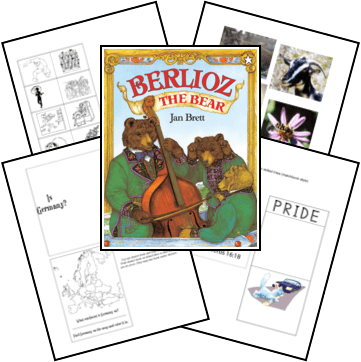
Lapbooking Component
Vocabulary Flap Book
Where is Germany
Germany Flag minit book
Onomatopoeia book (you may need to let your student listen
to some instruments on-line to do this book)
Real or Imaginary
Pride (Memory Verse) Matchbook
with HWOT letters for tracing
Animal Cards with HWOT letters
for tracing
Animal Cards Blank
*Animal Card Horse (this
is not in the original batch...sorry! There is a blank card and a HWOT
card; use whichever one you need to complete your set)
print the cards on cardstock
(the pictures will be fine on regular paper)
Let your student cut and paste the picture on to the appropriate card.
Write one fact (or more) about each animal on the back of each card.
Keep in a pocket in your lapbook. Use for animal classification
or story sequencing.
Musical Notes Tab Book
If you want to make a minit book of instruments,
print the Instrument Clip-Art.
The following are included (in
this order)-
woodwinds: clarinet, oboe, flute, bassoon, saxophone
strings: violin, double bass, guitar, harp
brass: tuba, trumpet, trombone
Help your student write the instrument word on each page of his book.
Language Arts
Real and Imaginary
Read the story aloud to the child. Discuss
real and imaginary elements in this story.
Illustrations Tell a Story
Study the illustrations. Notice how the
borders keep the story moving along as we anticipate the next event.
The animals are busy in the village square readying everything for the concert; at the end of the
book we see the animals in the border enjoying the dance. Your student
may want to narrate for you what the animals in the border are doing; this
is similar to a story within a story. If you have other Jan Brett
books, you may want to look at them and do the same activity.
Vocabulary
lurched- to jump forward
prancing- to walk or move about in a lively and proud manner
strained- to try one's hardest
"tune up"- a general adjustment to get everything in good
working order
lumbering- to move heavily or clumsily
dismay- to cause to
lose courage or to feel concern
hindquarters- the part of a four-footed animal behind the
attachment of the hind legs to the trunk
audience- a group that listens or watches (as at a play or
concert)
concert- a musical performance usually by several voices or
instruments or both
roared- to utter a long full loud sound
dedicated- to address as a compliment
encore- a demand made by an
audience for a repeat or an additional performance
Creative Writing
In all short stories, there is usually a conflict (a problem).
Discuss the problem in this story. How many attempts are there at
solving this problem? (discuss all the animals who tried to move that
mule!). Finally, the problem was solved because the bee flew out of
the bass and stung the mule. Can your student think of any other
possible endings to this story? Have your older student
write his own problem-solution story in which there are many attempts at
fixing the problem before the "real" solution.
Onomatopoeia
The two words buzz and zum are used throughout the story;
they are special words because they sound like what they are. These
words are called onomatopoetic words. Think of other instruments with
your student. Can you think of onomatopoetic words to describe the
instruments? (clank, clink, plink, hum, toot, etc.)
Adjectives
Turn to the next to the last page of the book.
Describe the scene-colors, animals, scenery etc. Also describe the mood
of the scene. Is it lively or somber? Exciting or boring? Help your
student think of strong adjectives to describe all of the above. You
may want to make a list (and include it in your notebook or lapbook).
Compare and Contrast
Compare the dancing scene in Berlioz
the Bear to the dancing scene in The Talking Eggs by Robert D.
San Souci. How are the illustrations alike? Contrast the two
scenes. How are the illustrations different?
Drama
This is a great story to act out. Make some stick puppets (see
science section for list of animals) with your student and have fun
retelling the story.
Using Alphabetical
Order and Compound Words -lesson on Jan Brett's website
Comprehension Questions I
Comprehension Questions II
Social Studies
Germany
Locate Germany on a globe. Make a story disk and place it there. Identify the capitol and surrounding countries. Locate the Danube River.
The Danube River is the second largest river in Europe.
German Flag
Germany Outline Map
German
Language Activities at Enchanted Learning
More About Germany-
lesson on Jan Brett's website
German foods are delicious. Sweet and sour
combinations are often used. German smoked pork, ham and sausages are highly
prized. Try this recipe that combines potatoes, apples and bacon.
Himmel Und Erde
[Heaven and Earth Potatoes, Apple and Bacon]
Ingredients
½ pound potatoes
water
½ t. salt
1 apple, peeled, cored and sliced
1 t. butter
¼ c. chopped onion
4 slices bacon, cut into 2” pieces
1. Put potatoes in a medium saucepan.
2. Add water to 1 ½ “ in pan.
3. Add salt.
4. Bring to boil over medium-high heat.
5. Reduce heat. Cover pan and cook for 10-15 minutes or until potatoes are tender.
6. Stir in apple slices. Continue cooking until apple is tender.
7. Put butter in small saucepan over medium heat.
8. Stir in onion. Cook until soft.
9. Add bacon. Cook until done.
10. Using a large spoon or fork, mash potatoes and apple slices until blended but lumpy.
11. Stir in bacon mixture.
12. Serve hot.
-from Cooking Up World History by Patricia C.
Marden and Suzanne I. Barchers.
Pride
Some of the animals seem very sure of themselves that they will be able to
pull the wagon. While there isn't anything wrong with having some
confidence, they seem very proud and boastful when you hear their rude words
to the other animals. Discuss some examples from the book. Are
all the animals proud? What does the Bible say about this kind of
pride?
Proverbs 16:18-19- "Pride goeth before destruction, and an haughty spirit
before a fall. Better it is to be of an humble spirit with the lowly, than
to divide the spoil with the proud."
Math
Telling Time
Berlioz looks at his watch in this story; they also mention when it
turns 8 o'clock and the chiming of the bell. You may want to
introduce, practice, or review different aspects of telling time. Clock
Worksheet
You could also create telling time word problems for your student.
Example-- "If Berlioz wanted to be at the village square by 7:30 and it is
now 8:00, how late is he?"
Count the Beats
Activity Page from Jan Brett
Science
Many various animals are listed in this story. You may want to
choose a few to learn more about this week:
bears
More about Bears at
Jan Brett's website
mule
rooster
tabby
cat
schnauzer (dog)
billy goat
horse
ox
Music
Instruments
Discuss different types of instruments and identify the instruments in
the Berlioz Orchestra. If your student isn't ready to identify the
instruments from the book, you may want to simply introduce different kinds
of instruments.
Stringed Instruments
Brass Instruments
Woodwind Instruments
Percussion Instruments
A great go-along book is Zin, Zin, Zin, A Violin!
Rhythm
Clap in time to a favorite song. Show
the child a sheet of music and explain that music can be read. Show your
student the treble cleft and the bass cleft. Explain quarter, half and whole notes.
Check out an Ella Jenkins tape from the library if you want to spend more
time on learning about rhythm.
Composer: Hector Louis Berlioz
Discuss with your student what a composer is. Tell your student
that the main character in this story was named for a famous composer--
Hector Louis Berlioz. If you can find a sample of his music to listen
to, let your student hear it and see what he thinks. You may also want
to mention some other famous composers.
Hector Louis Berlioz was born in 1803 and died in 1869. He was a
French Romantic composer best known for (December 11, 1803 – March 8, 1869)
the Symphonie fantastique, first performed in 1830, and for his
Grande Messe des Morts (Requiem) of 1837, with its tremendous resources
that include four antiphonal brass choirs. He also composed about 50 songs
for voice and piano.
More Music Activities
Listen to Goldberg Variations
[Harpsichord] by Bach. Look at a picture of a harpsichord from an
encyclopedia or library book. Make a stringed instrument by placing
rubber bands on a small box. Play along with the music.
Listen to On the
Beautiful Blue Danube by Strauss. Put on elegant dress-up clothes
and have a tea-party. Before or after the tea dance to the music –
elegantly.
[These two ideas are adapted from Introduction to
Classical Music by Marie Hazell]
Art
Draw
a bear following the directions at
Jan Brett's Website. You may want to let your student use charcoal
pencils if you have some on hand.
Ballet Painting
Let the child
choose a selection he likes for this activity. This is very messy, so work
outside and drape everything! Tape a large sheet of paper to the side of
your house or garden shed. Provide a variety of paint colors in separate
aluminum pie pans. Let the child listen to the music for a while before
beginning to paint. Help the child dip his feet into the paint and paint in
time to the music. You may need to help him balance. Encourage him to make
bold sweeping strokes with his feet. This doesn’t work as well if you put
the paper flat on the ground because the child will probably walk around and
make a footprint picture. Be forewarned some children are a little shy about
doing this type of project. On the other hand some end up using their hands,
feet, and elbows.
Other
Following Directions [Honey Bear
Sandwich]
The child will need: four slices of bread, jar of peanut butter, jar of honey, gingerbread man cookie cutter, one tablespoon, one teaspoon, small cereal bowl, mixing spoon, plastic knife, and small plate.
The parent will read the directions to the child. The child will work independently as much as possible.
Observe how well the child followed the
directions. Did he remember the steps in order?
Coloring Page
More Unit Extension Ideas
Check the Reading Rainbow Schedule for this book.
Ideas for older children
Compare the length of notes to a set of measuring cups. Find a way to visually explain the notes to a younger child using the measuring cups.
Choreograph some simple dance steps or hand motions to go with a music selection of your choice. Teach this to a younger child.
Research a famous composer.
Create a clapping song using quarter, half and
whole notes. Try substituting a percussion instrument for the hand claps.
Materials and information on this website belong to the
original composers. It may be used for your own personal and school use.
Material may not be used for resale.
© 2005-07 HSS