| about us |
what's new
|
unit studies
|
unit study helps |
fiar resources
|
indexes | lapbooking |
Atlantic
Unit Prepared by Aimee Guest
Lapbook by Ami
Photos by Stephanie West
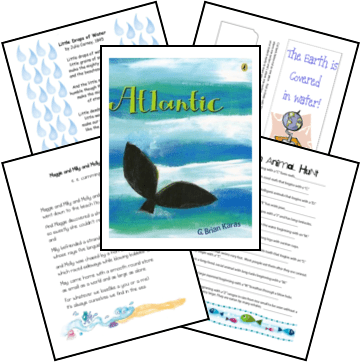
Lapbook
Templates
*Use one of the projects from your
art lessons as your lapbook cover
**Go
to
http://nces.ed.gov/nceskids/createagraph/ and make a pie graph that
represents the distribution of land and water. When you finish, print and
fold into thirds. Paste the title piece ("The Earth is Covered in Water")
to the front.
Printables from Other Websites
Note: Different sources present a different opinion on the number of oceans. Some sources leave the Antarctic off of the list.
printout of the world with fill-in blanks for the ocean names
Geography: Terms and other Sea Vocabulary
This book mentions many different types of bodies of water. Learn
the definitions and differences
bay- a small area of sea or lake partly enclosed by dry land (usually smaller
than a gulf)
gulf- a large inlet of ocean or sea that is partially surrounded by land
channel- a narrow passage of water connecting two larger bodies of water
sound- an arm of the sea, or ocean, forming a wide channel between an island and
the mainland; the ocean inlet is roughly parallel to the coast
iceberg- a large mass of land ice floating in the sea
continent-one
of the great divisions of land in the globe
inlet-a small arm of a
lake, sea, river
Ways
in Which the Sea is Used
1.
Natural Resources of the Ocean
Food (fish, seaweed, shrimps, oysters)
Pets
Oil and Gas
Medicines
Seashells (used for building materials and jewelry
a good go-along book would be This is the Sea that Feeds Us by Robert F.
Baldwin (note: some evolutionary content)
2.
Ocean Occupations
After you discuss the resources that come from the ocean, you may want to
discuss the jobs that are provided because of those resources.
Can your student think of different occupations that are a result of the ocean?
Discuss some of the following jobs, and ask your child which one he would like.
Fisherman-catch ocean creatures to sell
to people
Marine Geologist: study rock and the formation of the ocean floor
Diver-help find sunken treasures, repairing underwater equipment
Oceanographer: explore and study the ocean
Captain/Crew of ship
3. People Dependent on the Sea
The Inuit culture is a good example of a group of people whose lives are
heavily influenced by the sea. The food they eat (often caught by walking on
the floor of the sea under the ice), the materials they use to make their
clothes (seals as an example) are two examples. Check out the book Very First
Last Time by Jan Andrews (used in Five in Row Volume I book). Another book is
Ootah’s
Lucky Day by Peggy Perish.
Research Option: Explorers
The book makes a reference to explorers of the Atlantic.
The Vikings, the
Portuguese, and Christopher Columbus were the most famous among its early
explorers. Your older student may want to do some research to learn more
about these explorers.
LANGUAGE ARTS
Creative Writing
Ask you child to draw a sea creature. Then ask him to name the monster
and dictate a story about the creature as you write it down. (My daughter gets
into her story quickly, so I type the story into the computer instead of by
hand. You could also use a tape player and then type it later). An alternative
is to tell a story together. You start the story about the creature and after
one or two sentences you say “and then..” and your child takes a turn. Continue
in this pattern.
Poems about the Sea
The ocean claims that many poets have written about her. Here are some
poems to use for copywork this week (many written in the illustration of the
book).
After reading
some of the poems together, give your student a chance to write her own sea
poem. For special fun, let her read a poem (hers or one of the ones below)
into a microphone and record it.
Psalm 104:25-- So is this great and wide sea, wherein are things creeping innumerable, both small and great beasts.
Who can
number the sand of the sea, and the drops of rain, and the days of eternity? -
Ecclesiasticus. I, 2
The Walrus and the
Carpenter
maggie and milly
and molly and may
Little Drops of Water
My Lost Youth by
Longfellow
Alfred, Lord Tennyson Quote
I am he that walks with the tender and growing night, I call to the earth and sea half-held by the night.-- Walt Whitman
Listmaking
Make a
list of treasures you can find at the beach. After you and your child have
finished your list, read Out of the Ocean by Debra Frasier-and add more things
to your list.
Make a list of things you would pack to take for a day at the beach.
Personification
If you've already learned this literary device (the representation of a
thing or idea as a person or by the human form; giving something non-human,
human characteristics) with your student, ask him to find examples in the text.
How is the Atlantic Ocean personified?
Narrator and
Persona
The narrator is the speaker in a work of prose. The persona is the
speaker in a work of poetry; never to be confused with or assumed to be the
poet, the persona may be an animal, an inanimate object, or any conceivable
entity. The narrator of Mark Twain's novel The Adventures of Huckleberry Finn,
for example, is Huckleberry Finn. Who is the narrator of this book? Discuss
how having the Atlantic Ocean talk to the reader makes the book exciting and
interesting. Encourage your student to try to write a poem or story with
an object as the narrator or persona.
Poetic Repetition
This book reads like a poem. The author has used many poetic devices
throughout. One of these is repetition. Note the page that starts, "First I was
discovered..." Discovered is the first of many -ed words.
Does your student notice all the -ed words? Make a list with your student.
Using a list of -ed words gives the reader (and listeners) something pleasurable
to hear. Our ears like repetition. (words: discovered, conquered, crossed,
probed, charted, studied, dirtied)
Another example of repetition is the -ing words. Look together on the page that starts, "I am here day and night..." Can your student find the examples of repetition? What's being repeated? (-ing ending words). Make a list of these words-- heaving, raging, lying, scraping, putting, growing, shrinking, staying.
Vocabulary and Drama
Have your student act out the following
words-stretch, rub, slosh, floating, heaving, raging, lying still, scraping,
growing, shrinking, dancing, crash. Turn this into extra reading practice
by writing these words on index cards and place them in a bag. Then have
your child sound out the word before acting it out (sometimes with your help).
You should try playing along!
Dictionary Skills
Do this
fun fish
scavenger hunt for sea life at the Enchanted Learning online picture
dictionary.
ART
Mixed
Medium
If you've discussed medium with your student in the past, add to this
discussion by explaining what mixed medium is (using more than one type of
medium). Can your student determine what mediums Karas used to create the
illustrations? He used gouche, acrylic, and pencil. Determine where
he used paint and where he used pencil. In what details were both used?
Colors
of the Ocean
Atlantic says that artists have used cerulean, cobalt, and ultramarine to
capture her on paper. What other colors could one use when painting the ocean?
Look through your crayon box and pull out colors of the ocean.
Cerulean, cobalt, and ultramarine can be found at most craft stores in small
watercolor tubes. Consider getting these colors and invite your child to paint
an ocean scene.
Text and Painting
Look at the page that combines sea phrases and paint (shows the artist
at the easel) and talk about how layers make art more interesting. Stamp
out words with your child onto watercolor paper. Let them paint lightly
over them. Then let them cut out the words and paste them onto a new sheet
of paper to create a similar page. (You can also print out the poem your child
wrote and do a similar idea).
Colored Pencil
Karas loves to finish off his drawings with fine details in pencil.
Look through the book and find examples with your child. Then try that
technique with any of the above projects you have completed.
Illustration Studies
Look at the first two page spread. What does your student think the
white dots are? (rain drops, fish, or ?) Encourage your student to create his
own painting of the ocean.
Look at the two page spread -- "my fingers spread out..." What's in the water? Can your student create a similar work of art? (Maybe a sky filled with birds and insects, or maybe another sea filled with creatures.) Let your younger student make a replica by stamping shapes in an ocean. Create a fish stamp by cutting the shape into a potato, by cutting a sponge into fish shape, or by taking a piece of cardboard and gluing the outline of the fish shape with thick string. Dip any of these into paint and let your student create a similar page.
Look at the page that says, "I am the blue water"-- can your student find the sun and the reflection of the sun? How did Karas portray the reflection? (using more blue/white dots and putting them closer together) If you student would like, let her try to imitate this technique.
Viewpoint
Look at the page that says, "Seagulls sing to me..." From what vantage
point do you view this picture? Can your student look over his toes and draw a
picture?
APPLIED MATH
Sorting
Place many different kinds of
shells out and let you child sort them into groups. He might sort them by size,
and then you can say “Is there another way you can place them into groups?”. He
might think of sorting by color, by similar look and pattern, by broken and
whole shells, etc.
Counting--
Goldfish Fun
What you’ll need: A muffin tin, a piece of paper torn into 6-12 small
pieces (depending on the size of the pan), paper clips (as many as their will be
players), goldfish
Write numbers on small pieces of paper. Place one number face down in each cup of a muffin tin. (determine what the numbers should be based on the numbers your child needs to practice with-maybe he always skips the number 15 when he counts, maybe he needs to practice 1-10). Give your child a paper clip. Have your child throw the paper clip into one of the cups. Let him take out the number and then count out the right amount of goldfish to match the number-then place them in the fish bowl (the muffin cup). Tell your child to place the appropriate number of Goldfish crackers into each "fish bowl" (the holes in the muffin tin). Let him play until he is done then enjoy your goldfish snack (see the goldfish snack idea in the snack section)
Counting and Estimation
What you’ll need:
see shells, a container
Have your child guess how many shells it will take to fill the container. Count the number of seashells it takes to fill the container. Was your child close?
Extension Lesson: Geometric Shapes
Note: You need the book, Sea Shapes to complete this lesson.
The book, Sea Shapes, uses sea life to teach all of the major geometric
shapes. Cut out a variety of shapes such as rectangles, squares, crescents, etc
and talk about them with your child. Then let your child make a sea life
collage.
Option for older students: Latitude/Longitude
Older students may enjoy learning more about latitude and longitude.
SCIENCE
Why is the Sea Salty?
Why is the sea salty? Rivers wash salty minerals from the rocks into the
sea. Some salts are used by animals to build their shells. It makes swimming
easier because the salt helps the swimmer float. (excerpt from The Usborne
Children's Encyclopedia)
Getting Salt out of Saltwater
What you need: a measuring cup, 2 tbs salt, art brush, sheet of black construction paper, blow dryer.
1. Fill the measuring cup 1/4 full and
then add the salt to the cup. Stir well.
2. Swish the brush around in the cup, making sure to get plenty of salt on the
brush.
3. Use the brush to cover the surface of the black paper, rewetting the brush
often.
4. Blow-dry the paper, you will see clear, box-shaped crystal stuck to the
paper.
Explain to your child that by heating the water you changed the water into gas, and only the salt was left.
Shape of Water
Atlantic says, "my shape changes..." Does the shape of water really change?
Gather various glass dishes, jars, and bottles from around your house. Pour one
cup of water in each one and one cup of water on the ground. Does each cup of
water look the same now? What happens (water takes the shape of whatever kind
of container it is in)? Can water change to any shape? What items don't change
shape? What other items do?
Ocean Life
Take some time to learn more about the creatures of the ocean
mentioned in this book.
skates-
a very flat fish
related to sharks that has large and nearly triangular fins
whales-- tons of information and printables at
Enchanted
Learning
flying fish- found in all the major oceans of the world (mainly in the warm
waters of the Atlantic, Pacific, and Indian oceans). They are known for
their pectoral fins which enable the fish to take a short gliding flight through
the air (above the water's surface) in order to escape predators.
dolphins (see whales link above)
oysters-
Oyster Printable
A Swim Through the Sea by Kristin
Joy Pratt (note: some evolutionary content)
The Water
Cycle
Act out the water cycle. Have your child use just his body, or get out props,
such as a sheet for the ocean water, etc. Even my two-year liked being a part
of the water cycle! Read the following paragraph to your students as they
perform for you:
"The water splashes and crashes in the sea (children can lay down rolling on the ground) Then the sun heats the water ("ouch, ooh, ow" from the water) And it turns into gas and rises into the sky (children slowly rise to standing and onto tippy toes) The water droplets collide together, growing bigger until they form a cloud (bouncing against each other and then open their arms up high and wide and drift back and forth like clouds) Then the water droplets get VERY heavy and fall as rain w-a-y down, back into the ocean" (droop as if they're filled with soaking water and then fall to the ground and become waves again)
See Enchanted Learning to find printouts of the Water Cycle
Pollution: Dangers to the Ocean
Sadly, Atlantic admits that people have
dirtied her. Do this simple activity with your student to reinforce the
importance of keeping the ocean clean.
What you’ll need: Plastic objects, a bag
Place several plastic objects, such as a garbage bag food bag, wrappings from a
food item, toy car, or a drinking straw. As you child pulls out each object,
ask him how the object might harm the ocean and ocean life.
Sea Creature Fun
How does an octopus move?
Inflate a balloon and hold onto the mouth of the balloon without tying it. Release the balloon. The balloon will move as it deflates. The balloon jets through the air in a similar manner as the octopus jets through the water. First the octopus sucks in water, and then squirts it out through the opening under its head. The force of the water leaving the octopus moves the animal forward.
How does a jellyfish move?
Jellyfish can open and close their bodies, much like an umbrella. As they open
their bodies, they fill with water, as they close, the water is pushed out.
Demonstrate this for your child using an umbrella with 18-inch strips of ribbon
tied to each point of the umbrella. Watch the movement of the ribbon as you
open and close your “jellyfish”.
Research Options (Shells, Erosion, Tides)
If your older student is interested in shells, let him check out books
from the library to find the answers to the following questions--
What is a shell? Who Lives in a shell? Can you really hear the ocean in a
shell?
Atlantic
mentions that she's "scraping away at some land and putting it somewhere else
bit by bit..." Does your student know what this process is called?
(erosion) Let your older student
do some research on erosion-- how it works, what the effects are, different
kinds, etc.
The alternative rise and fall of the surface of oceans, seas, and the
bays, rivers, etc, connected with them, caused by the attraction of the moon and
the sun. The tide occurs twice in twenty-four hours. Check out the book,
One Small Place by the Sea, by Barbara Brehner, for a further look into the
sea life of tide pools. Let your older student learn more about spring tides and
neap tides.
This website will help you understand more about tides
BIBLE
Memory Verse
Psalm
104:25-- So is this great and wide sea, wherein are things creeping innumerable,
both small and great beasts.
Bible Stories
Choose one or more of these stories to read and discuss this week:
The Story of Jonah (Jonah)
God Created the Oceans (Genesis)
The Sea is stilled (Matthew 8:23-25)
Jesus walks on water (Matthew 14:22-33)
Jesus performs a miracle with the fishermen’s nets (Luke 5:1-11)
JUST FOR FUN ACTIVITIES
Play Beach
Purchase shells from a craft store (or bring them back from a field trip to
the beach!). Pour brown sugar (the sand) in a large metal baking sheet. Add
the shells. Let your child play. He can make sandcastles using measuring cups
and other kitchen containers. You can always substitute real sand, but you will
have to wet it to make it hold its shape from the containers.
Make a Boat
Gather cardboard boxes and toilet paper rolls (raisin box, pasta boxes etc)
and other household disposables and let your child glue them together to make a
boat. See if it floats.
Play the reading rainbow game:
build an ocean
habitat
Learn more about the author--
http://www.gbriankaras.com
Fun Ocean
Snacks
1. Fish
Tank-Make blue Jell-O as directed. About half way through the time it takes for
the Jell-O to set, drop gummy fish into the Jell-O. This looks great in a clear
container.
2. Go fishing: Have your kids “fish” for goldfish from their plate with pretzel sticks dipped in peanut butter.
3. Under The Sea Lunch:
Octopus: Octopus Hot Dog
Sea Shells Sprinkled with Fish Food: Shell macaroni with Parmesan cheese.
Golden nuggets Lost from a Treasure Ship: Cut corn
Giant Whale: Pear half with carrot fins and a raisin eye
Murky Bottom Sea Water: Chocolate milk
Craft idea: Sandpaper Prints
You will need:
* crayons
* coarse sandpaper
* art paper
* newspaper
* iron
* construction paper or tagboard
Directions:
1. Use crayons to draw and color a design on a sheet of coarse sandpaper. Press
hard and color thoroughly as you work.
2. Place the decorated sandpaper face down on a sheet of art paper the same size
or larger. Place several layers of newsprint under the art paper. Place another
sheet of newsprint on the sandpaper to protect your iron.
3. An adult can then press the papers with a warm iron to transfer the crayon
drawings to the art paper.
4. For display, have your child glue the sandpaper and the print to a large
sheet of construction paper or tag board. It will really show off the great work
of art.
Fun Ocean Songs and Finger Plays
My Fishy Song -
sung to "The More We Get Together"
If
I could be a fishy,
A fishy, a fishy
If I could be a fishy
What kind would I be?
A swordfish, a guppy,
A goldfish, a molly,
If I could be a fishy,
I would be a (child fills in the blank)
Ocean Shell
I found a great big shell one day.
(cup hands as if holding large shell)
Upon the ocean floor.
(Pick it up from the floor)
I held it close up to my ear.
(hand cupped to ear)
I heard the ocean roar!
I found a tiny shell one day
(pretend to roll shell between fingers)
Upon the ocean sand.
The waves had worn it nice and smooth.
It felt nice in my hand.
(Place little shell in palm of other hand)
LIBRARY LIST
Poetry Books about the Ocean (I have not pre-read these books)
Creatures of the Deep by Lione Bender
Sea Poems by John Foster
Twelve Days of Summer by Elizabeth Donell
The Random House Book of Poetry for Children by Jack Prelutsky
The Mermaid and Other Sea Poems by Sophie Windham
All the Small Poems by Valerie Worth
Water Cycle
Follow the Water from Brook to Ocean (Let's Read and Find Out
Science Book) by Arthur Dorros
A Raindrop's Journey by Mark Graber
Water Dance by Thomas Locker
Seashore
Life
A Walk By The Seashore by Caroline Arnold
Other Books (mentioned throughout the unit)
This is the
Sea that Feeds Us by Robert F. Baldwin
Very First
Last Time by Jan Andrews
Ootah’s
Lucky Day by Peggy Perish
Sea Shapes
A Swim Through the Sea by Kristin Joy Pratt
Suggested Chapter Book Go-Along
Dolphin Adventure
Video
Reading Rainbow, Ocean Life.
Resources used to create this unit
study:
Jan Vancleave’s Find and Play about Science Series
www.libsci.sc.edu/miller/ocen/htm
http://www.stepbystepcc.com/daycare.html