Google
 
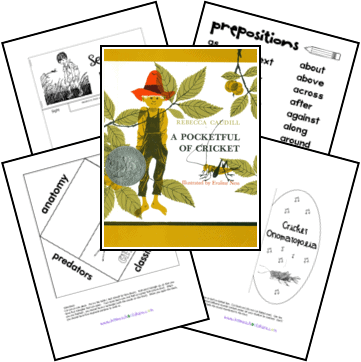
A Pocketful of Cricket


A Pocketful of Cricket

Author: Rebecca Caudill

Illustrator: Evaline Ness

Summary: A boy takes his pet cricket to school where it first disturbs the class with its chirping, but then becomes the show-and-tell attraction.

ISBN: 0805075240

Literature Based Unit Study by Mary Machado
Lapbook by Ami Brainerd


Lapbook

Pets Layered Book

Courage Book (for Bible verses and/or quotes)

Sensory Imagery Tab Book

Cricket Onomatopoeia Book

New Words Flap Book
Assembly:
Cut out the rectangle on the first page and fold in half; set aside.   Cut out rectangle on second page and fold in half.  Cut on the dotted lines to form 10 strips.  Let your student write the words (on the outside of the strip) and definitions (on the inside) OR let your student cut and paste the words and definitions on the third page of the file and paste them on/in the book.  After your student is finished with the words and definitions, place inside large folded rectangle (that will be your cover) and glue the back down).  The cover helps protect the flaps. 

Prepositions Pocket Book

Nature Scavenger Hunt Pocket and Stationary
Take your students on a nature walk!  Before you go let your student make a checklist (on the stationary) of what he'd like to see, what Jay found, or items he thinks he may find.  As you go about your way, let him check them off.  You may want to skip that altogether and simply let him write down what he finds as you go.   When you get home, let him fold up the list and put it in the prepared pocket. 
*your younger student may want to use some of the forms found here

Crickets Envelope Book

Insects vs. Spiders Venn Diagram
*this is not a lesson found in this unit, but it would be a good one for you to research with your student; learn what's different and what's similar about these creatures

Story Colors Fan


Social Studies
 

Pets
People often keep animals as pets.  Have your student name some animals that are commonly kept as pets.  Discuss with student the reasons that people keep pets (companionship, security, enjoyment). Having a pet also requires responsibility.  Pet owners have to take care of their pets.  What are some of the things people need to do for their pets?  How did Jay take care of his cricket that he was keeping? 
Lapbook Component:
Pets Layered Book


Show and Tell

“Show-and-tell” is the process of showing an audience something and telling them about it and is usually done in a classroom.  Show-and-tell is a technique for teaching young children the skills of public speaking.  Since home educated students might not be familiar with “show-and-tell” explain the activity to them.  Have the student choose something they would like to show and share about to a group of friends or siblings.


Collections

Jay collected many items that he found while he was walking home. People enjoy collecting items that are important of interesting to them.  They may also collect them because they are valuable. Talk about some things that are commonly collected (sports cards, stamps, coins, dolls, rocks).  Find out about some unusual collections (barbed wire, rubber bands, locks of celebrity hair). Does your student have a collection?  Have them share why they like collecting what they collect.


Character Study: Overcoming Anxiety & Having Courage

It is common to be nervous or have anxiety when you are doing something for the first time.

Jay is going to be going to school for the first time.  What parts of the story give you a sense that he is thinking about it and possibly having anxiety.

-Jay looked a long time at the schoolhouse.

-“How many days till I go to school?” asked Jay.

-Jay waited until all the other boys and girls had got off the bus.

-He stood wondering where to go.


Do you think Jay was nervous/unsure about going to school for the first time? Why might he be nervous?  What makes you think that? What helped Jay to overcome his feelings and have courage? Why do you think Jay brought Cricket with him?

Think about a time when you were doing something for the first time.  How did you feel about it?  What helped you to overcome your feelings?

Lapbook Component: Courage Book (for Bible verses and/or quotes)


Language Arts
 

Sensory Imagery

The story is full of words that help us experience the book through a variety of senses (examples: the beans felt cool, heard an owl hooting, saw a gray goose feather).  Make a list of all the things Jay saw, heard, tasted, felt and smelled as he explored the countryside on his walk.  The list can be general or divided into categories by each sense.
Lapbook Component:
Sensory Imagery Tab Book


Onomatopoeia

In the book the cricket makes a noise, “chee” when he fiddles. This is an example of onomatopoeia.  Onomatopoeia is a word or a grouping of words that imitates the sound it is describing, such as "bang," "click," "buzz," "pop," or "zing."  Have the student think of other words that imitate sounds.  This page includes more examples of onomatopoeia by category.
Lapbook Component:
Cricket Onomatopoeia Book


Prepositions

A preposition is a word that shows the relationship of one word in a sentence to another word. Prepositions tell:

1) where something is located

2) where something is going

3) when something happens

4) the relationship between a noun and another word in a sentence

A list of prepositions can be found online.  The text of A Pocketful of Cricket is rich with prepositions. After you review common prepositions have your student identify them as you read through the story. 


Prepositions game – give your student prepositional phrases that can be demonstrated and have the student demonstrate them.  For example say “under the table” and they would have to get under the table.  “Near the window” and they would stand in the vicinity of the window.

Lapbook Component:
Prepositions Pocket Book


Vocabulary

trudged – to walk slowly and with effort

rustling – making soft fluttering sounds

scuttled – running hastily

hollow – a valley

whittling – cutting small bits or pieces from wood with a knife

pasture – a field on which cows or other animals graze (eat grass)

hull – outer covering of a nut, grain, or other seed

tingled – a slight stinging feeling

dim – having little light

fiddling –  making a sound like a fiddle playing

Lapbook Component:
New Words Flap Book


Science


Crickets

Crickets are insects. Review with your student the identifying parts of an insect (6 legs, 3 body parts-head/thorax/abdomen).  The University of Illinois Extension website has an interactive review of insect characteristics.  Label the parts of the cricket on this page and color – coloring page. You may think crickets are an unusual pet, but they are popular pets and are considered good luck in Asia, especially China.  They are kept in cages.  Crickets are a fun insect to keep and observe for a time like Jay did.  Crickets Chirping (in add on books section) recommends tips for finding a cricket and making a habitat.


If you are doing this unit study in the summer or early fall you may have crickets nearby that you can observe and listen to.  This link to Insect Sound World has audio clip of lots of different crickets and cicadas (also named in the book). So if you don't have your own crickets where you are, you can hear them on the website - click on "Insect Sound". It's fun to compare the variations in sound.  Think of some other insects that make noises - like cicadas, click beetles, mosquitoes.  The US Department of Agriculture’s Bug Bytes site has recordings of numerous insects. 

You may want to check-out the cricket report forms and copywork pages on Homeschool Share's Animal Forms page.   

Lapbook Component:
Crickets Envelope Book

Temperature and Body Metabolism

In cold blooded animals (like insects) their activity level goes down as the temperature decreases.  It is possible to figure out the approximate temperature by counting the number of chirps in one minute.  For a specific formula see math section.


Nature Study

Jay experienced nature on his walk home from the pasture.  By getting out in nature and making observations and discoveries we develop a relationship with the world around us and with God. Nature study provides a foundation for studying other sciences—geology, biology, chemistry, physics, and astronomy can all be observed in nature.  Take your student on a nature walk and start to build a habit of regular nature study.  When we take time to observe nature our senses become more alert.   “If we give our children regular opportunities to get in touch with God's creation, a habit is formed which will be a source of delight throughout their lives.” – MacBeth Durham


Some possible activities for nature study:

-collect items as you walk

-use binoculars and hand lenses to get a closer view of animals or objects in nature

-keep a nature journal (where the student can draw pictures, write poems, add narrations, attach pressings)


Resources for Nature Study

MacBeth’s Opinion

One Small Square series

Keeping a Nature Journal – Clare Walker Leslie

Simply Charlotte Mason


Senses

There are five senses that help us experience the world around us – taste, touch, hearing, sight, and smell.  In the story Jay experiences nature around him through all his senses.  Help your student explore the different senses with some interactive lessons.  Neuroscience for Kids has a large selection of activities to find out more about each of the senses.


Sight: Place 10-15 items on a tray (example: key, button, paperclip, spoon, block).  Have your student look at the items for a short time.  Have the student then close eyes.  Remove one of the items from the tray.  When student opens eyes, have him look again and tell you which item is missing. Repeat.


Smell: You will need one 35 mm film canister with pinholes in the top for each of the following scented items you decide to use (use cotton balls for the liquid scents).


Onions, vanilla extract, cinnamon, rubbing alcohol, coffee beans, lemon, peppermint extract, mothballs, vinegar, oregano


Place the item or scented cotton ball in canister and cover. Pass around each canister and ask the student to smell it.  Ask him to describe the smell.  Have him try to guess what it is. 


Taste: The taste buds on our tongue determine what we are able to taste. There are 4 tastes that we can distinguish (salty, bitter, sour, sweet).  There is also a 5th taste, umami associated with detecting MSG.  It was long thought there was a “tongue map” and certain areas of the tongue being associated with detection of specific tastes.  Now it is known that each taste bud contains receptors for all 4 tastes. Have your student look at his tongue in the mirror.  Can you see the taste buds?  Taste a sample of each of the 4 foods (salty-salt, bitter-fresh parsley, sour-lemon, sweet-sugar). Describe each taste.


Touch: Using our sense of touch we can tell whether objects are cold, hot, smooth or rough. To demonstrate the different types of receptors in the skin, get some objects that are:

smooth (apple, magnet)

rough (sand paper, rock)

cold (ice,)

warm (a sun-warmed piece of metal)


Have your student close his eyes.  Bring out an object and have your student touch it.  Ask what it feels like.


Hearing: Have student close eyes.  Ring a bell to the side of the student.  Have him raise hand indicating which side the sound was heard on.  Move around room and repeat.


Math
 

Calculate Temperature from Cricket Chirps

As discussed in the science lesson, it is possible to get an estimate of the temperature using the chirping on crickets. Count the number of chirps in 15 seconds.  Then add 40.  This will be close to the temperature in degrees Fahrenheit.   For older students you can show them that the formula for this algebraic equation would look like this:

T = c + 40    (Where T = temperature and c = number of cricket chirps in 15 seconds)

Cricket Temperature Calculator - use the on-line calculator and compare answers.


Sorting

Jay decides the next items he will bring to school for show-and-tell are the beans he found.  The stripes on every bean were different from the stripes on every other bean.  Sorting items by finding their differences is a fun activity.  Using at least 3 different types of dried beans (examples: pinto, black, lima, kidney), take about 1/3 cup of each bean, mix together in a bowl, and have student sort out the beans into piles for each type. 


Art
 

Evangeline Ness
The illustrator, Evangeline Ness, is a Caldecott Medal winner for the book Sam, Bangs, and Moonshine (1964).  She also received Caldecott Honors for her work in this book.  Her style of illustration is very bright and bold and she uses a combination of woodcut, seriography, line drawing, and ink splattering. In this book Ms. Ness uses only green, gold, red, black/gray with white for the colors.  Choose a style or two that this illustrator used and produce a piece of art of your own.

Lapbook Component:
Story Colors Fan 
 

Seriography
Seriography is the print process similar to silk screening.  A template like a stencil is made and placed over a screen.  The material to be printed on is placed under the screen. Paint or ink is then brushed across the screen with a squeegee tool.  When the template is lifted there is an image only where the template allowed the ink to pass through so it produces a bold single color design.  By combining different templates/stencils you can get multiple colored designs. Instructions for making a silk screen project.  Here is a modified project that would be easier for a student to do at home.


Simple Silk Screen
Materials (tempura paint, stiff cardboard, wooden embroidery hoop, thin cotton organdy cloth, paper).  Cut a piece of material a little bigger than the hoop.  Catch the cloth between the hoops, tighten, pull edges of cloth until it’s tight like a drum.  Cut a 4 x 2 inch piece from the cardboard and wrap masking tape around on long end to make a squeegee.   Cu a design in a piece of paper.  Lay the cut paper stencil on a piece of construction paper.  Set the hoop screen down with the stretched cloth pushing down on the stencil.  Pour some paint into the hoop.  Gently pull the squeegee across the paint several times to spread all over the cloth, scraping away extra paint.  Lift the hoop up along with the stencil.  It leaves a silk screen print on the construction paper below.


Woodcut
Woodcut is a relief printing art technique where an image is carved into the surface of a block of wood.  The printing parts remain level with the surface while the non-printing parts are removed or carved out. The areas to show 'white' are cut away with a knife or chisel, leaving the characters or image to show in 'black' at the original surface level.  The surface is covered with ink by rolling over it with an ink-covered roller (brayer) leaving ink on the flat surface but not in the non-printing areas. The inked surface is pressed against a piece of paper, either manually or by running it through a press, to create an image on the paper.  Mary Azarian is a popular illustrator who uses woodcut illustrations.  This site lists other picture books illustrated with woodcuts.


“Woodblock” Printing Activity

Materials:

scratching utensil (example: blunt pencil, nail)
piece of balsa wood or Styrofoam tray bottom

printers ink or paint
paper


Using a pen-like object, students draw a design onto a piece of pressed Styrofoam or balsa wood.  Cover the impression with ink/paint using a brayer if available. Place your paper of choice on top.  Rub paper with wooden dowel or handle of wooden spoon to make sure ink is transferred evenly and firmly. Remove paper.

The resulting print is a negative image of the design.


Splatter paint
Lay a piece of paper on the bottom of a big box.  Place an object like a leaf or a letter cutout on the paper.  Dip an old toothbrush into paint, hold it down in the box, and rub thumb over the bristles to splatter the paint. When you remove the object or stencil you will have a splattered impression of the object.  You can also do this by using a paintbrush dipped in paint.  Hold brush above paper and flick the bristles with your fingers to add splattered effect over any picture.


Just for Fun
 

Make homemade butter and spread it on a piece of bread for a snack like Jay ate.  Fresh butter is easy to make and helps students understand butter’s connection to the farm. Glass jar butter is a fun project.  Pour heavy whipping cream into a cooled glass jar with a marble. Shake jar continually.  After about 10-15 minutes you won’t be able to hear the marble anymore because the cream has thickened.  Continue shaking for another 15+ minutes until the coating of butter comes off the sides of jar and you hear the marble again.  Separate the lump of butter from the buttermilk by straining. Enjoy the fresh butter.


Whittling: If the student is old enough and knows how to use a pocketknife safely have him practice the skill of whittling a piece of wood.  Basic whittling would be to just use a stick and whittle the end to sharpen it.  With a larger piece of wood a more detailed design could be whittled.


Visit a dairy farm
 

Go Along Books

Crickets

The Very Quiet Cricket

Chirping Crickets

The Cricket in Time Square  - read aloud chapter book


Prepositions

Under, Over, By the Clover: What is a Preposition?

Behind the Mask – A Book about Prepositions


Woodcuts

A Gardner’s Alphabet

Snowflake Bentley


Materials and information on this website belong to the original composers. It may be used for your own personal and school use. 
Material may not be used for resale
© 2005-07 HSS