| about us |
what's new
|
unit studies
|
unit study helps |
hss resources
|
fiar resources | indexes | lapbooking |
A House for Hermit Crab
Author/Illustrator: Eric Carle
ISBN:
0689848943
Summary: Hermit Crab moves out of his small
shell on the sea floor, in search of a new residence. When he finds a bigger
place, a sea anemone offers to move in with him; a starfish agrees to decorate
the joint. A snail and a sea urchin are employed for cleaning and protection, a
lantern fish for lighting and smooth pebbles are used for a wall. Hermit lives
happily for a while, until it is time to move again, to a still larger place.
Unit Study Prepared by Ami Brainerd
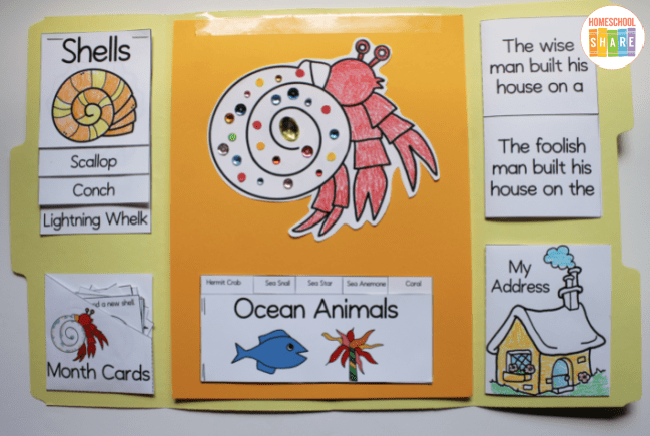
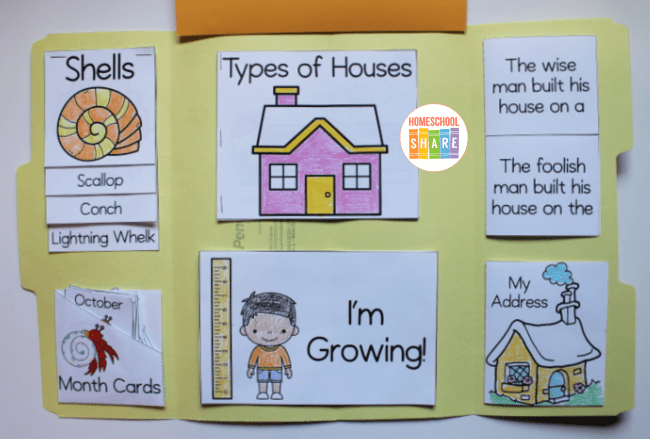
Lapbook Component
Different
Houses
(use this file to make your own book-- see
lapbook example)
My Address
Wise Man/Foolish Man
Flap Book
Prepared Vocabulary Cards (if you
want to include these in your lapbook, simply put them in a
pocket)
Seaweed Forest
(list adjectives inside)
Prepared Growth
Chart
Months Pocket
Month Cards
HWOT outline font
Month Cards
with traditional handwriting print
Blank Cards
Sea Creatures
Tab Book
Shells Layered
Book
Shells Layered Book with
HWOT letters
Social Studies
Different Types of Homes/Houses
A house is a place where someone (or something lives).
Discuss different types of animal houses with your young student.
A Hermit Crab lives in a shell. Where does a bear live? a bird? a
bee? a fox? (discuss other animals, too).
A fun book to read together would be Usborne's Animal Homes (a lift the
flap learner).
A fun project to do
together-- My House
Give your student a large sheet of white paper.
Brainstorm together about what the inside of your house looks like. How
many rooms (upstairs and down). Draw the frame of the house (it doesn't
have to be exact-- you may not be able to get every room in). Using
magazines and catalogs, find pictures of beds, toilets, stoves, tables, chairs,
carpet, curtains (you could also use scrap fabrics, sample carpets, and
sample wallpaper books for this!) and cut them out. Glue the pieces down
to resemble your house. Discuss your student's favorite room and what he
likes about his house. After you finish the project, take some time out to
pray and thank God for the shelter He has provided for you.
Your older student may enjoy learning more about the different kinds of houses
that people around the world live in. Some people live in huts, others
igloos, others tents! Read
A House is a House for Me by
Mary Ann Hoberman together and discuss all the different kinds of houses.
Lapbooking Component:
Different
Houses
(use this file to make your own book-- see
lapbook example)
More books you may want to check out
from the library
Houses and Homes by Ann Morris
Homes and Houses Then and Now (Usborne Flip Flaps)
This is My House by Arthur Dorros
Houses by Marcia Fries
This is My House by Richard Scarry
Homes Around the World by Bobbie Kalman
Your very young student may enjoy continuing the discussion on houses with a
reading of The Three Little Pigs (houses of straw, sticks, bricks)
Moving
Hermit Crab had to find a
new house. Has your student ever experienced moving into a new house?
What were some of Hermit's feelings (he felt safe/snug in his old shell; he was
frightened when he had to move out). Discuss feelings one may have when
having to move.
Learning Your Address
If you are discussing houses and homes (or moving) this week, it may be a
good time for your student to learn his address (if he hasn't already done
this).
Lapbooking Component--
My Address
Making Friends
How does the hermit crab make friends with all the sea creatures he meets?
He compliments them first and then asks for their help. Proverbs tells us that
if we want friends, we have to be friendly! You may want to discuss a time when
your student made a new friend. You may also want to memorize Proverbs 18:24a
this week. “A man that hath friends must shew himself friendly…”
Bible:
Luke 6: 47-49
You may want to read and discuss this passage of
Scripture with your student this week:
Whosoever cometh to me, and heareth my sayings, and doeth them, I will shew
you to whom he is like: He is like a man which built an house, and digged deep,
and laid the foundation on a rock: and when the flood arose, the stream beat
vehemently upon that house, and could not shake it: for it was founded upon a
rock. But he that heareth, and doeth not, is like a man that without a foundation
built an house upon the earth; against which the stream did beat vehemently, and
immediately it fell; and the ruin of that house was great.
Make a list of commands (sayings) that God has given us. Are we simply to
know His commands? No, we are to DO them. If we do His commands, we
are like the wise man. If we choose to ignore God's commands, we are like
the foolish man who did not have a foundation under his house. When the
storm came, his house was wiped away.
Lapbooking Component:
Wise Man/Foolish Man
Flap Book
Language Arts
Vocabulary
Prepared Crossword Puzzle
Prepared Vocabulary Cards (if you
want to include these in your lapbook, simply put them in a pocket)
plain- having no pattern or decoration
decorate- to make more attractive by adding something that is beautiful
gingerly- very cautious or careful
dim- not bright or clear, hard to see
murky- very dark, filled with fog
gloomy- total darkness
murmured- complained
tidy- well ordered and cared for, clean
prickly- covered with small sharp points or a sharp pointed part that sticks out
fierce- wild or threatening in appearance
gratefully- expressing thanks
Word Choice
If you student is ready, direct his attention to the different words Eric Carle used for each of the sea animals as they answer the crab. Instead of using “said” each time, he uses many different phrases for variety—
the sea anemone whispered
the sea star signaled
the coral creaked
the snail offered
the sea urchin answered
the lantern fish replied
(later, when the animals are speaking again, Carle only uses the word said once; he also uses murmured, complained, and cried)
Description
Look at the illustration of the
seaweed forest. The sea creatures use many different words to describe it—
dark, dim, gloomy,
murky, like nighttime.
What
other words can you and your student think of to describe the picture?
Lapbooking Component: Seaweed Forest
(list your adjectives inside)
Applied Math
Growing
“Little by little, over
the year, Hermit Crab had grown”
Print a copy of this Prepared Growth
Chart (it uses the twelve months, so you can tie it
in with the other math lesson). Record your student’s weight and height each
month for one year. If you have record of weight and height from other ages
(even when your student was born), make up some math problems using the data.
“When you were born you weighed about 9 pounds, now you weigh 42 pounds. How
much weight have you gained since birth?”
Months of the Year
All twelve months are mentioned throughout this story. Does your student
know the months of the year? Practice saying and writing them in order this
week.
Using a white piece of paper, draw twelve (or thirteen) boxes or divide it into
twelve (or thirteen) sections. In the top of each section have your
student write the name of a month (do this in order starting with January).
Have your student draw his own illustration (based on the happenings in the
story) for what happened each month--
January - Hermit Crab outgrew his shell
February- Found a new (plain) shell
March- Met the sea anemone
April- Met the starfish
May- Discovered some coral
June- Came to a group of snails
July- Came upon sea urchins
August- Wandered into a forest of seaweed
September- Found
the later fish
October- Approached the smooth pebbles
November- Outgrew his shell
December- Gave his shell
away to a smaller hermit crab
January (of the next year)- Found a new *larger* shell
Activity adapted from
www.ericcarle.com
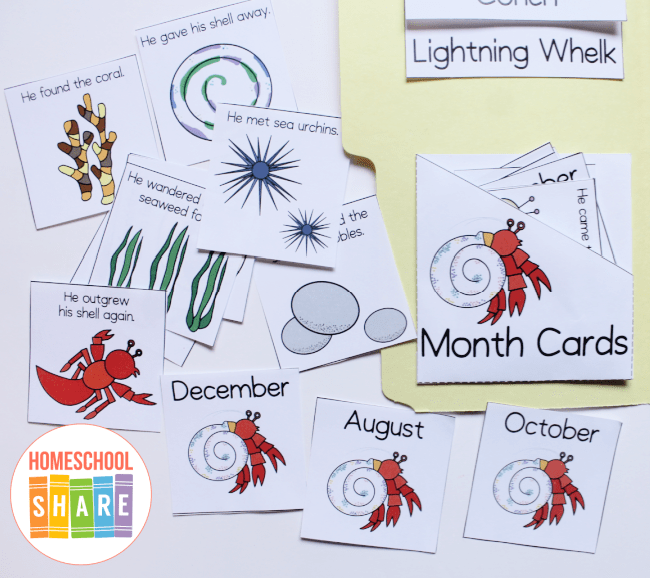
You can extend this lesson into handwriting (and a memory game). I made
these month cards
and let my son write in the words (HWOT font). Then, he cut
them out and put them in a
pocket in his lapbook. We use the cards for
review to see if he can put the months of the year in order. Print
the cards on cardstock if you have it handy.
Month Cards
with traditional handwriting print
Blank Cards
Science
Different Types of Crabs
Read the note by Eric Carle on the dedication page for some basic
information on Hermit Crabs.
Hermit Crabs have the word crab in their name, but they are not
considered true crabs.
True Crabs
True crabs have an exoskeleton—an
outer shell—that protects and provides support. They also have five pairs of
legs (ten total); one pair—the claws—are used for grasping. They use these legs
to walk sideways. (For a fun P.E. lesson this week, teach your child the crab
walk). Some crabs live in the ocean, and some crabs live on land. There are
about 4,500 different kinds (or species) of true crabs! Additionally, there
are about 500 different kinds of Hermit Crabs.
Hermit Crabs
Hermit Crabs also have ten legs. Even though they are considered crustaceans
(as are true crabs), they are different than a regular old crab. Hermit Crabs
do not have exoskeletons to protect their soft abdomens, they have to go
searching for “homes” (empty seashells) to serve this purpose.
Your older student may wish to do more research in order to compare/contrast
true crabs with hermit crabs (a Venn diagram may be a good way to record the
research).
Links and Fun Crab Stuff
Hermit Crab Printout
Crab Printout
Fiddler Crab
Horseshoe Crab Printout
Hermit Crab Maze Print-Out
Common Shells and Crustaceans Word Search
Crab Matching Print-Out
Ocean Life
There is a note at the end of the
book the main sea creatures mentioned. Here are some additional resources.
Your student could make a
booklet using the different Enchanted Learning Printouts/Coloring Pages listed
below.
Sea Anemones
Enchanted Learning Printout
Starfish
Coral
Enchanted Learning Information
Snail
Enchanted Learning Printout
Sea Urchin
Enchanted Learning Printout
Lantern fish
Enchanted Learning Printout
Sponges
Enchanted Learning Printout
Clown Fish
Enchanted Learning Printout
Simple Ocean Animals Word Find
Lapbooking Component
Sea Creatures
Tab Book
You may want to check-out the
ocean life (hermit crab, crab, starfish, eel, tropical fish, etc.) forms
and copywork pages on Homeschool Share's
Animal Forms page.
Sea Weed
Seaweed is not really a weed, but it is
algae. It
is found in the water, but it is not a true plant. Many kinds of seaweed
are edible and commonly found on the table in Asian countries. Seaweed is
rich in vitamins and iodine. Three main groups of seaweed are:
green, brown, and red.
Like other plants, seaweed use sunlight to produce food. However, they are
not considered true plants because they do not have roots, stalks, leaves,
flowers, or fruit. Instead of roots, seaweed have bases or finger-like
disks that enable them to stick to the roughness of rocks. These
finger-like discs are not like roots (which enable a plant to pick up
substances). This is not a problem for seaweed, though, because
seaweed gets all the minerals it needs directly from the sea water.
Your older student may enjoy learning that seaweed is actually found in all
types of our food. Look at labels of the food you buy to see if any of the
"seaweed" ingredients are listed:
Parts of Seaweed Booklet
from Highland Hitcho
Shells
This book is a great opportunity to discuss shells and their inhabitants.
We used a book What Lives in a Shell to discuss these things. We also had
a fun article in Your Big Backyard (July 2007) that helped us learn the
different kinds of shells.
Lapbooking Component:
Shells Layered
Book
Shells Layered Book with
HWOT letters
Art
Collage Style
Discuss the technique of collage with your student using the illustrations in the story. Try to make some collage type paintings like Eric Carle. Give your student a large piece of white paper. Use bright color tempera paint and cover the paper in the color of choice leaving texture (making the brush strokes noticeable) in the paint. Let your student do this with a few different colors using one color per piece of paper. Set aside paintings to dry. After the painting is dry, cut pieces from the paper to create a sea creature. Glue down the cut pieces on white paper.
You
could also replicate your student's favorite illustration from the story.
(Note: when we study Eric Carle books at our house, we usually replicate the
cover page.)
Here is a link that will help your student
Draw a Hermit Crab
Just for Fun
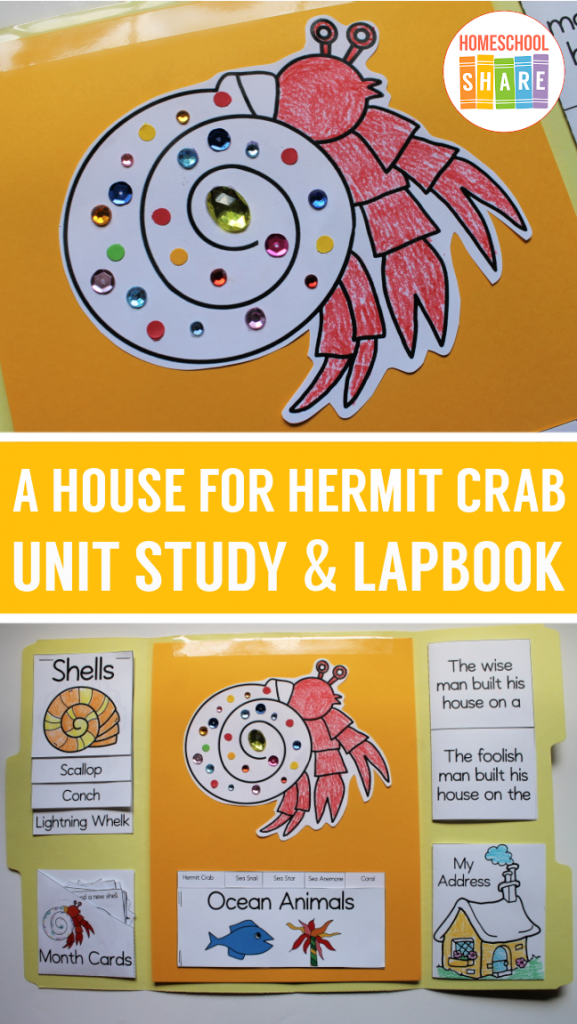
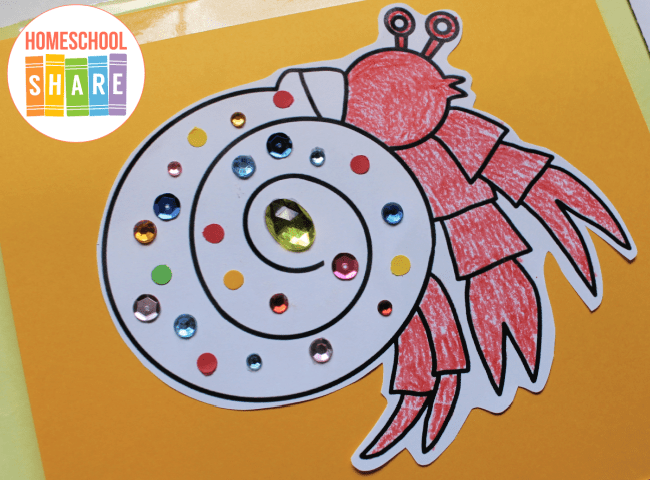
Decorate a Crab Shell
Have your student draw a shell for Hermit Crab (or draw one for him) and then
decorate with-- jewels, sequins, feathers, mosaic paper tiles, stickers, stamps,
dried pasta, whatever else you can think of! (You could put this on the
cover of your lapbook.)
Read another under-the-water adventure by Eric Carle—Mister Seahorse
Be adventurous and go to the pet store
to look at the Hermit Crabs (be warned! You just may come home with one!)
Cut and Paste Sea
Animals printable from Kizclub
House for Hermit Crab Puppet Patterns
Materials and information on this website belong to the
original composers. It may be used for your own personal and school use.
Material may not be used for resale.
© HSS
2005-2007