| about us |
what's new
|
unit studies
|
unit study helps |
fiar resources
|
indexes | lapbooking |
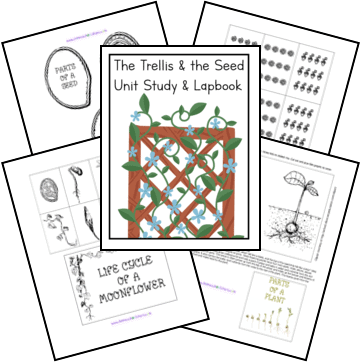
The Trellis and the Seed
Unit by Rose Ann, Celia, and Wende
|
Author: Jan Karon
|
Bible
Thesaurus
Moonflower by Peter and Jean Loewer
The Magic School Bus Goes to Seed by Joanna Cole
The Magic School Bus Plants Seeds by Patricia Rief
From Seed to Plant by Gail Gibbons
A Weed is a Seed by Ferida Wolff
Creation Day 3 -
Read Genesis 1:9-13 with your child. Plants were created on day 3 after water
and day and night were created. Plants need water and light to grow; God then
created animals and animals need plants to live and grow. Isn’t it wonderful how
God created everything to support and depend on each other to survive? You could
make a list of what God created on each day. Or, you could print out 2 sets of
Creation Flash Cards
and play games such as Go-Fish or Concentration. Store in
Pocket.
The
First Garden -
Adam and Eve were the first gardeners. And they did not have weeds to pull or
have to water their garden until they sinned. I often wondered-- what did they
do? Genesis 2:15 says Adam was put “into the garden of Eden to dress it and keep
it.” I think they praised God as they walked through the garden for all the
beautiful flowers, trees and bushes.
Bible Memory-
You may
want to memorize James 1:17 this week. Every good gift and every perfect gift
is from above…” James 1:17
Parable of the Sower -
A parable is a short story that has a moral, spiritual meaning. Mark 4:1-9 tells a story about a farmer who planted his fields. Some of the seed fell on stony earth and grew quickly but when the sun was hot it wilted because the roots couldn’t grow deeply and find water. Some seed fell among the weeds and it grew but the weeds soon choked it out. And some fell on good ground and grew very well and gave lots of harvest. Our hearts are like the soil—stony and hard or weedy-- to busy with “things” or open and ready to hear God’s Word. And like the good soil gave an abundant harvest: if we hear what God says to us and live it out in our life that’s how we can live in victory with Jesus. Discuss the importance of having soft hearts ready to hear what Jesus has to say to us. Review this parable using Parable of the Sower Envelope Book.
Planting Zones –
Not all plants grow in all areas. The United States is divided up into different planting zones, according to the climate. Locate your state on a United States Planting Zone map. (You will find planting zone maps on seed packets, or on the net) What zone are you in? What other states are in your zone?
Emotions –
The seed shows many different emotions. The seed was skeptical about amounting to anything. It was afraid to touch something (the trellis) that it had never touched before. It felt disappointed that other plants in the Nice Lady’s garden were blooming, but it wasn’t. And finally, if felt joy when finding out that it was a beautiful, fragrant Moonflower. Ask your child when he has experienced any of these feelings. Has he ever been unsure of his capabilities, and said, “I can’t”, only to prove to himself that he could? Has he ever been afraid to try something new? At one time or another we all experience disappointment when we see others getting the things we want. Discuss a time such as this with your child. And lastly, ask your child how it feels to experience the joy of reaching a goal, in spite of your own personal doubts. Record answers on Emotions Accordion Fold.
Seasons –
The Nice Lady received the seed at the end of summer; it sat in glass all winter, it was planted in spring, and it bloomed in summer. Discuss with your child the different seasons, and the months they fall under. Does your child know what causes the seasons? The earth takes 24 hours to spin on its axis, to create day and night. And it takes 365 days for the earth to rotate around the sun, to create a year. The seasons tell us how far the earth has traveled around the sun since the year began. What is your child’s favorite season? Why? Go outside and observe your surroundings, noting the changes specific to the seasons. Read this poem by Meish Goldish out loud to your children.
Seeds, Plant Parts and Life Cycle -
A seed is a little package of plant life. A seed coat protects the inside embryo, which is the baby plant. There is storage of food inside the seed around the embryo. Some seeds have a very hard coat, and it helps to soak the seed before planting. Explain to your child how not all seeds will grow though. They need air, plenty of water, and the right temperature and amount of light to begin to grow, or germinate.
What happened to the bottom of the seed, which felt like a tickle, and the top of the seed that felt like a kiss? After a seed germinates, the plant begins to grow. Most flowering plants have four main parts: roots, stems, leaves and flowers. The roots grow underground and hold a plant in place and take in water and nutrients from the soil for the plant to grow. The shoot or stem grows up from the top of the seed, and holds up the leaves and flowers of a plant. It also carries the water and nutrients from the roots to the rest of the plant. The leaves grow from the shoot and make food for the plant using a process called photosynthesis. It takes chlorophyll (which is the green in the leaves), sunlight, water and a gas called carbon dioxide to make glucose (a kind of sugar). This glucose is stored in the stems or roots of the plants. The leaves also give off oxygen, which is in the air we breathe. In vines like moonflowers, the vines will continue to grow, reaching for the sun. Buds then develop, and flowers form from the buds. The flowers contain the parts to make seeds, and then the process starts all over again.
Life Cycle of a Moonflower Fold
Simplified Parts of a Plant Fold for younger children
Flowers have four parts: The petals, which are the lovely blossom, we see easiest and it attracts bees, insects and birds to help with pollination. The pistils are the female reproductive part, which stores the egg cells. The stamens are the male reproductive part and they produce the pollen. Plants need to be pollinated to produce seeds and fruit. The fourth part is the sepals, which are small green leaf-like petals that surround the flower to protect a young flower.
Watch a video of a moonflower blooming here.
How Seeds Travel –
Seeds need space to root and
grow into mature plants or trees. They also need light to grow. Many seeds
fall to the ground below their parent plant and take root there. Sometimes
though, there's not enough light or space near the parent plant. So God
designed some seeds to travel to a different place, a place with more room to
grow. But if they have no legs to walk on, how then do the seeds travel?
Complete
How
Seeds Travel Side by Side
as you discuss each method.
Wind Dispersal (Anemochory)
Some seeds fly. Have you ever blown on a dandelion or opened up the pod of a
milkweed? They have silky threads that act as a parachute to allow the seed to
drift on the wind. These seeds often end up miles from their parent plant.
Other seeds have wings to help them fly. Have you ever seen a maple seed? It
has a wing that allows it to twist and turn as it is carried along on the wind.
Fringepods and elm seeds also have wings.
Try this: Make a paper whirligig (here's a pattern from PBS). Have your student hold it up high and gently let go. Notice how the "wings" help it float down more slowly...if a breeze comes along it would carry the whirligig away.
Water Disperal (Hydrochory)
Some seeds swim. Plants that live near streams and rivers often have seed that
can float. Their seeds will fall into the water and float downstream. God
designed them to have pockets of air in them that act as a life jacket, keeping
the seed from sinking in the water. Have you ever seen a coconut? Did you know
t hat's not a fruit or a nut, but a seed? It's tough fiber coat and hard shell
protects it until it sprouts--often times months after it has fallen. The
inside is hollow, which makes it float. Coconut trees are often found near
oceans. The coconut falls into the ocean and is swept away to a distant shore,
where it will sprout and grow into a coconut tree. Mangroves also use this
method.
Try this: Get a coconut from the store. Place it in a sink or bathtub of water. Does it float? (If you don't have a coconut, but have some birdseed, look for the larger puffy black and white striped sunflower seeds. Have your student see if it floats. With the air inside, it should.)
Discharge Dispersal (Autochory)
Some seed pods explode, sending seeds as far as possible. Some fruits and
plants burst open, spewing their seeds as far as possible. Impatiens and
jewelweed are two that you might be able to find around your place. (I highly
recommend finding jewelweed and letting your children touch the pod to set off
the explosion! Be careful though, poison ivy is often found near jewelweed.
Jewelweed is a natural remedy for poison ivy- -rub the plant's juices wherever
you came in contact with poison ivy.) Wisteria, witch hazel, wild geraniums,
and the squirting cucumber are others that God designed with this method of seed
dispersal. (If you've rowed Miss Rumphius from FIAR, you might
note to your student that lupines also use this method.)
Try this: Tear or cut up pieces of scrap paper to make confetti (seeds). Place the tiny pieces in a lunch bag or baggy or balloon. Now hold the end of the bag almost closed and blow air into the bottom. Hold the end closed so that the air doesn't escape. Now pop the bag. What happened to the seeds?
Animal Dispersal (Zoochory)
Some seeds rely on animals or man to help them travel. Seeds in this category
can be divided into three subcategories.
Endozoochory--seeds that are eaten by an animal and pass through the digestive
system. Once the waste (including the seed) is passed from the animal, the seed
often miles from its parent plant and it now has a new home and fertilizer too
to start growing! Examples of seed that travel this way a re strawberries,
raspberries, cherries, and mistletoe.
Synzoochory--seeds that are collected by an animal with the intention of eating
it later. I bet you can think of one animal who stows away acorns for the
winter! Yep, God designed the squirrels to help make new oak trees. Squirrels
and chipmunks hide so many nuts and seeds for the coming winter that they
sometimes forget where some are located. These forgotten nuts and seeds--having
escaped becoming a meal--can then sprout and grow in their new home.
Epizoochory--seeds that attach to an animal or human and then detach later.
These seeds are have barbs, spines, or spikes that make them sticky or prickly
which allows them to hitch a ride on an animal or human. They eventually loosen
or get scraped or picked off and fall to the ground miles from their parent
plant. Burdock, sticktights, cock leburs, mustard, and thistle are all examples
of such hitchhiking plants.
Great Pictures of
some seeds that use this method: (note how prickly many are!)
Try this: take an old pair of daddy's tube socks and pull them over your shoes and up your pant leg as far possible. Now take a walk through a patch of weeds like in a field or an area that's not been mowed. Did any seeds cling to the socks?
Kinds of flowers –
Many different flowers are mentioned in this story. If desired, let your student research more about one of these flowers: foxgloves, hollyhocks, cosmos, lavender, roses, petunias, and moonflower. You could also let your student learn more about the kinds of flowers that grow in your area. If possible, visit a nursery and spend time admiring the variety of flowers. Draw or paste pictures of favorite flowers in My Flower Book.
Plant Life Cycle--Annual/Perennial/Biennial –
A plants lifecycle is how long it takes to grow, flower and set seed. Each type of plant has a different length of lifecycle.
Annual plants live for one growing season. They grow flowers and set seed and die in a year. One way to help remember it is annual also means yearly and so the plants live for one year. Examples: marigolds, petunias and tomatoes
Biennial plants are plants that require two years for their life cycle. They grow (produces leaves) the first year and in the spring grow again and bloom and set seeds the second year. Examples: parsley, carrots and foxglove
Perennial plants continue to grow for several years. They grow, flower and set seeds many years. Each spring they send up new shoots and grow and bloom. Examples: Daisy, Black-eyed Susan, and Roses. Some perennials, such as the moonflower, are considered tender perennials, where they will only continue to grow year after year in certain planting zones. You could look through a seed catalog and find the different types of flowers. Cut out and glue pictures into Types of Plants Tab Book
Misc. Links and Resources:
Nice simple drawings for the different parts of the plants and the plant life cycle
Many printouts for plants: Enchanted Learning
Evan-Moor’s Giant Science Resource Book has pages 2-29 on plants.
Considering God’s Creation has many lessons and notebooking pages on plants.
Have
your child review these words and use them in a sentence to demonstrate
understanding. Write definitions in
Vocabulary Flap
Book. Complete
Vocabulary
Crossword Puzzle if desired.
Cupboard – a closet with shelves for dishes or food
Trellis – a frame of lattice used especially as a support for climbing plants
Tendril – a slender leafless coiling stem by which some plants fasten themselves to a trellis
Scarcely – not quite, barely, probably not
Spade – a tool with a flat blade for turning over soil
Wondrous – wonderful, marvelous, astonishing
Fragrance – a sweet or pleasant smell
Admiration – a feeling of pleasure, approval, respect or wonder
Copywork/Memorization –
Have your child recite this lovely poem by Longfellow throughout the week. If desired use for copywork exercise.
Kind hearts are the gardens,
Kind thoughts are the roots,
Kind words are the flowers,
Kind deeds are the fruits.
Take care of the gardens,
And keep them from weeds,
Fill, fill them with flowers,
Kind words and kind deeds.
Synonyms –
Synonyms are words having the same or nearly the same meaning as another word in the same language. One way to help remember this is that “synonyms” and “same” start with the same sound “S”. Find the synonyms in the story. How many different words are used to describe something that smells good? Some include fragrance, aroma, scent, and sweet-smelling. How about the word smelly, describing the fertilizer? Smelly is used to describe something offensive, as opposed to the other words that describe something pleasant. How many words can you find describing something petite? The author uses the words tiny, small, and little. Introduce your child to a thesaurus, explaining that it is like a dictionary but gives you synonyms instead of definitions. Go on a synonym hunt, looking for all the words you can that mean the same as scent and small. Record them in Synonyms Staggered Flap Book if desired.
Compound Words –
When two words are put together to make one word, it is called a compound word. Have your child look for compound words throughout the story. They include someone, however, cupboard, someplace, something, anything, doorstep, everything, moonlight, nightdress, buttonhole, and…Moonflower!
Compound Word Cards, Copywork, and Pocket
Dozens –
The Nice Lady saw dozens of blossoms. A dozen is twelve things. Use this as an opportunity to practice skip counting by twelves. How many is two dozen? Three dozen? Use Blossom Cards and Pocket to practice counting by twelve.
Use this information to answer questions:
Height: 10' - 20' vine
Seed Depth: 1/2 "
Seed Spacing: 1"
Days
to Emerge: 10 - 20
Thinning: When 2" tall thin to 6" - 12" apart.
Time it takes to bloom: Moonflower flowers open up in 2-3 minutes.
How many seeds are needed to plant a four-foot row? (4 feet x 12 seeds per foot = 48 seeds)
How many seconds does it take for a Moonflower bloom to open? (60 seconds x 2 minutes = 120 seconds)
A wall in a house is 8 foot. If a Moonflower vine grows 10’ tall, how much taller than the wall is it? What if it grows 20’ tall?
Now have your child make up his own problems to try to stump you!
Seed Packet Math –
Gardening is a wonderful way to get hands-on math experience that will have
meaning to your child. Seed packets are loaded with information including when
to plant, how deep to plant, how much space is needed for each plant, etc. While
sharing this book with your child, try to at least plant a small container
garden with your child, having him help with all the seed packet information.
While having your child actually help to plant the garden is the best way to
learn Life Math skills, you can work out these word problems with your child if
that isn’t possible:
Most vegetables (corn, beans, peas, onions) should be planted about 2 feet
apart. Pumpkins and cucumbers need about 3 feet and watermelons need about 8-10
feet. Use a tape measure and compare the different distances.
Peas should be planted two feet apart. How many rows could you put in your garden that is 16 feet wide?
Corn is planted 2-4 seeds in hills 3-4 feet apart. So if you put three seeds in
each hill that is three feet apart; how many seeds do you need for your 15 foot
long garden?
Beans should be planted about 2 inches deep. Radishes should be planted about ½
inch deep. How much deeper are the beans than the radishes?
You want some nice, fresh cantaloupe for your summer picnic on August 31. Cantaloupe takes 85 days to mature. When is the latest that you would want to get the cantaloupe seeds into the ground?
Art –
Press flowers, leaves. Pick flowers at their freshest and ones that aren’t real thick (Pansies and petunias are a good choice.) lay then between wax paper; Being careful to arrange them carefully and neatly. Put the wax paper in the center of a book. Set 2-3 heavy books on top. Let it set for several weeks till the flowers are dry. Use them to make cards or to put in your Lapbook. We put clear contact paper or tear by hand tape over the flower to give more protection and to kept he card looking nicer. This website explains it in more detail.
Sketch a trellis using the book-- there are several pages that show what the trellis looks like.
Materials and information on this website belong to the original composers. It may be used for your own personal and school use.
Material may not be used for resale. © 2005-07 HSS