Google
 
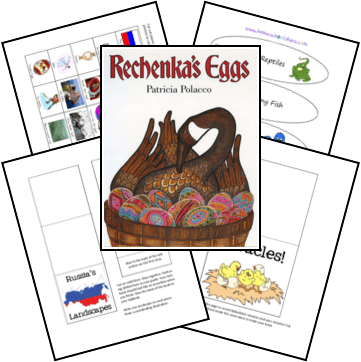
Rechenka

Rechenka's Eggs
 

Author: Patricia Polacco
Illustrator: Patricia Polacco
Summary: Babushka loves miracles, painting eggs, and animals; She nurses a goose back to good health and the goose gives back to Babushka. 
ISBN:
0698113853


Literature Based Unit Study written by Ami Brainerd and Helena Gosline


Lapbook Components
 
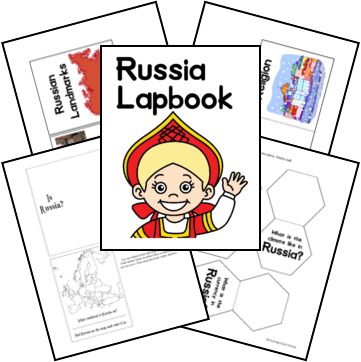
Russia Shutterfold Minit Book
 
Vocabulary Cracked Eggs
 
Oviparous Fan Booklet
 
Flag of Russia Minit Book
 
How Many Eggs? Accordion
 
Eggs in a Basket
 
Miracles Mini Book
 
Egg Anatomy Shape Book
 
Onion Dome Simple Fold Book  
Math Patterns Numbers
Blank Patterns Page

 
Math Patterns Colors
Blank Patterns Page

 
Let's Tour Russia Shutterfold
*option for older students instead of Russia Shutterfold
 
Eggs Poem (younger)
Eggs Copywork Book (older)
One Dozen Pocketbook
One Dozen Pocketbook (traceable numbers)
Russia Landscapes Accordion


Helpful Links (if you want to add more minit books)

Russian Activities at Enchanted Learning

Simple Egg Story booklet from Kizclub


Social Studies:  Geography—Russia

Russia is the largest country in the world.  It is almost twice as big as the United States.  It has eleven time zones where as the main land of the United States has four.  Russia extends across two continents – Europe and Asia.  Russia extends from the Arctic Ocean in the north to the Black Sea in the south, and from the Pacific Ocean in the east to the Baltic Sea in the west.  It is divided by the Ural Mountains into a European region in the west, and an Asian region in the east.

On your map locate and color:  Arctic Ocean, Black Sea, Pacific Ocean, and the Baltic Sea.

Moscow is the nation’s capital.  Locate that on your map with a star.  St Petersburg is Russia’s second largest city and was once the capital of the Russian Empire.  Mark St. Petersburg with a circle on your map.  Czars from the 1300’s to about 1917 once ruled Russia.  The Russian Revolution took place in 1917 and a temporary government was set up.  Vladimir Lenin, who was a communist, set up the USSR (Union of Soviet Socialist Republics) in 1922.  People were forced to hand over their land to the governments.  If you did not like what was going on and spoke out against the communist government you were put in prison or killed.  Communism fell in 1991 and is now the government is a federation.

Landscape and climate of Russia:
Russia has the Caucasus Mountains in the south near the black sea.  It also has the Ural Mountains, which separates the European Russia from the Asian Russia.  Moscow is located in the European portion of Russia.  Mark the mountains on your map with little hills.

The tundra is land in the far north, bordering the Arctic Circle.  The climate here is very harsh.  The tundra is cold and flat.  It has long, cold winters and the soil is always frozen.  Color this area blue or circle it blue.

The taiga is a large forested area south of the tundra.  It extends across central Russia.  The land in the taiga is frozen throughout winter but in summer the top layer melts, forming pools and marshes.  Color this area on your map green or draw trees.

Finally, we have flat grasslands called the Steppes.  The winter in this area has cold winds, snow and very long dark nights.  The summer is hot with dry winds.  In the fall the soil of the steppes is turned in the seas of mud from the cold rains.  The Steppes are located south of the taiga.  Color this area brown.

Complete the Russia Landscapes Accordion.  Write one landscape on each piece (mountainous, tundra, taiga, steppe). 

Kid's Culture Center-- Russia


Lapbook Components:
Flag of Russia Minit Book

Russia Shutterfold Minit Book

Onion Dome Simple Fold Book   (use the inside to record information about Russia or about Onion Domes)


Language Arts:  Imaginary vs. Real
Most authors include things in their stories from the imaginary realm as well as the real world.  This tactic gives the reader some reality to hang on to while at the same time allowing them to escape their own world. 


Babushka is a charming character.  She notices “miracles” (or unexplainable events) that someone else might take for granted.   Some are imaginary and some are real, but Babushka responds to all of these events with wonder.   Make a chart with your child.  On one side write imaginary and on the other side write real.  Examine the “miracles” throughout the book and help your child decide which miracles are which.  Then, have your child think of their own surroundings and jot in some natural "miracles" that occur in their own environment. 

If you are making a lapbook, you could use this Miracles Mini Book instead of making a chart.  Directions:  Cut the large rectangle out and fold in half.  Cut the other two pieces out for journaling.  Fill in the "Babuska's Miracles" and "My Miracles" journal boxes.  Paste the boxes inside the folded "Miracles" book.  Paste into your lapbook.

If you have an older child, ask them to write a story that includes some aspects from the real world as well as some that are imaginary.  Have your child make a chart (pre-writing) of the imaginary and real things he would like to include, so he will have a map as he writes.
*idea adapted from www.readingrainbow.com 

Language Arts:  Vocabulary and Verbs
You can teach the following words as vocabulary, or you can introduce your child to the concept of using vivid verbs in writing, or you can do both. Patricia Polacco uses great verbs throughout this story.  If your child is old enough, point out the difference between saying—She ate the candy vs. – She savored the candy.  Why is one better?    Why is hobble a better word choice than walked?  Why is faltered?   You can act all these actions out with your children to show them what the words mean.  You can even play a game of pantomime once they learn them –see if you can guess which word they are acting out.

Quiver– to shake with a slight and rapid movement
Savor–to taste or smell with pleasure; to appreciate, enjoy, or relish
Hobble-to walk or move along with difficulty or limp
Falter –to stumble
Are there other action words that Patricia Polacco uses in her story that can be acted out? 

Go-along book about verbs:  Kites Sail High by Ruth Heller

Language: Russian
Babushka—old woman/grandmother
dacha—a small house
Kulich—a sweet Easter Bread
Pashka—a spread of cheese
Hello—Zdravstvuite (learn how to pronounce it and other Russian greetings)


Math:  Geometry – Patterns
In the story, it says that Babushka uses “shapes of stars, flowers, triangles, and circles…”  You can make manipulatives for your younger child (maybe cut out triangles, circles, and stars) and put them in a pattern.  Ask her to replicate your pattern.  For your older child, you can draw a pattern on paper…ask him to finish the pattern.  You can even use different colors and see if he can complete the pattern as you have.  You could also use number patterns (2,4,6,8 or 1,2,4,5,7,8 or 1,2,4,8,16)…the possibilities are endless. 

Lapbook Components:

Younger
Math Patterns Colors
Blank Patterns Page


Older
Math Patterns Numbers
Blank Patterns Page

Math:  A Dozen
“Every morning for twelve mornings there was another egg…”
You can use this phrase to teach your child the concept of a dozen (12 eggs, 12 cookies, etc.)  Ask your child, if there was one egg every day for 12 days, then how many eggs?  If your child doesn’t understand cut out some pretend eggs or use plastic or even real ones (yikes).  Tell them that twelve eggs is a dozen.  In fact, twelve of anything is considered one dozen.  Do you have a dozen Legos?   Help them as needed, but have them find dozens all over the house.  If your child is older, you can show them that 1 dozen is 12; 2 dozen is 24; 3 dozen is 36, etc.  You may want them to draw small groups of eggs (in twelves) on a piece of paper to do this.  This would be the very basics of multiplication by twelves.  

Lapbook Components:
One Dozen Pocketbook
One Dozen Pocketbook (traceable numbers)


How Many Eggs? Accordion


Science:  Biology- Oviparous Animals
Talk with your student about eggs.  Who lays eggs?  You can read the poem (“Eggs”) to your student if you wish.  If not, just mention that birds, fish, reptiles (lizards, alligators, dinosaurs, snakes), amphibians (such as frogs), and insects all lay eggs.  If you think your student would enjoy it, get some colored plastic Easter eggs and “hide” pictures of animals who lay eggs in each egg.  Let your student “hatch” the eggs and make a chart of the animals who lay eggs.  Once your student opens all the eggs, talk about some animals who don’t lay eggs and add them to your chart, too.   

                                                                                                                     
Eggs

Eggs! Eggs! Who lays eggs? 
Hens lay eggs. That I knew 
Only hens? All birds do! 
Only birds? Not true! 
Fish lay eggs And quite a few! 
Birds and fish And insects too! 
And reptiles and Amphibians do! 
Who's in an egg? 
Someone new! 
Time to hatch 
Open, you Eggs! Eggs! Eggs!

You could also read the book, Chickens Aren't the Only Ones: World of Nature Series by Ruth Heller.   After you read the book, make this minit book together (for your lapbook or just for fun).  Oviparous Fan Booklet (print on card stock).  To make the fan, simply have your student cut out each piece.  Glue the words to the fan pieces and discuss each one.  Your older student could simply write the words on the fan pieces.  When you are finished, punch holes in the hole area and use a brad fastener to hold the fan book together. 

(another) Lapbook Component
Eggs Poem (younger)
Eggs Copywork Book (older)


A Small Hatchery in Your House
Consider getting an incubator (they make smaller versions called chick-u-bators), and a fertilized egg for this FIAR study; it would be fun for your children to watch it hatch!  I see the chick-u-bators for auction on Ebay; you could use it again when you row Make Way for Ducklings.
Simple Egg Story booklet from Kizclub (you could include in a lapbook or notebook)

Science:  Biology- Egg Dissection
You could hard boil an egg with your student.  As you crack it, note the outer shell, inner shell (membrane—the thin white layer that is suppose to come off with the shell), the yolk, and the albumen (egg white).  You may or may not want to mention to your student that the eggs we eat are not fertilized (do not have a baby chick growing inside).

Lapbook Component:
Egg Anatomy Shape Book

Science:  Chemistry—Making a Soft Egg
Tell your child that calcium is what makes their bones and teeth strong (hard).  Then, ask them what they think makes an egg strong enough for Babushka to paint on it?  It’s calcium!  In this experiment, they will learn that vinegar can remove the calcium from the egg and make it soft. 

You will need:
2 Raw Chicken Eggs
Vinegar
Plastic Spoons (2)
Clear Plastic Cups (2)

Allow your child to put an egg in a clear plastic cup.  Cover it with water.  Write water on the outside of the cup with a permanent marker.  Allow your child to put another egg in a clear plastic cup.  Cover it (completely) with vinegar and label the cup.  Discuss that you are going to watch the eggs over the next few days to see if the hard shell (hard because of the high calcium content) can withstand the water or the vinegar.   Compare the two eggs everyday.  After the shell on the vinegared egg has been eaten away, talk about why.  Just for fun, allow the child to pick the egg up with a plastic spoon—be very careful (outside may be best!).  Have her drop her egg (about 4-5 inches).  What happens?  How many times can she drop it before it breaks?  Also mention to your child that some animals have “soft” eggs like this one without the shell—reptiles do (turtles, snakes, etc.).  

Egg Experiment:

Supplies Needed:
a chicken egg
jar (mouth of the jar slightly smaller than the egg)
saucepan
water
hot pads or mitts

  1. Put water in saucepan.  Place egg in saucepan.  hard boil egg on stove. Allow egg to cool.
  2. Once egg has cooled, remove shell.
  3. Turn on the hot water faucet and let it run until the water gets hot.  (Water must be very hot.)
  4. Fill the jar with hot water, carefully.  Let the water sit in the jar for 3 - 4 minutes.
  5. Pour out the hot water -- in order to avoid the wrath of the Parent Wizard -- pour water into the sink.
  6. Place the egg on top of the jar. (Chant:  Big bop, big drop; Big bop, big slop!)
  7. Watch.  The egg will quickly be sucked into the jar.

Hot air takes up more space than cool air.  The air inside the jar was hot. When the egg was placed on top of the jug it kept any outside air from getting into the jug. As the air inside the jug cooled, it took up less space.  The pressure dropped.  There was greater air pressure pushing down on the egg than pushing against it. The outside air forced the egg to be sucked into the jar.


Art:  Architecture—Russian Onion Domes
See Lesson in FIAR manual for Another Celebrated Dancing Bear/Onion Domes and adapt to this story

Art:  Painting Eggs
Painting Eggs is called Pysanky and is a very important part of the Easter celebration in the Ukraine.  Let your child know that different people in different parts of the world celebrate holidays differently.  We do color Easter eggs here in the U.S., but we don’t really paint them—not in the way that Babushka does.  You may want to look up more about the history/culture of Pysanky if your child is interested. 

There are many different ways you can paint eggs with your child.  If you have a younger child, you may want to consider picking up some wooden eggs and acrylic paints at a craft shop.  You may want to have your child paint the egg one color (allow it to dry) and then use a toothpick to add details. For a really young child, you could even get a plastic egg and allow them to add stickers.   You could also wash an egg, poke holes on the top and bottom and blow it out (like Babushka did!)…You may want a few of these for backup in case it breaks as your child is working on it.  You would probably want for them to paint this with a good set of watercolor paints.  If you are feeling really artsy, have your child(ren) create an egg tree. 

For your older child, you may consider the following egg painting technique--
Materials:
Raw Egg
Yellow, Blue, Red food dye
No. 2 Pencil
White Wax crayon
Small plastic margarine tub filled with crumbled white tissue paper
Fine felt tip marker
Acrylic Spray, if desired
Directions:
1.  Draw a design on paper…repeat lines and symbols to make patterns and create symbols
2. Dye each egg yellow
3. As the dry egg rests in the nest of tissue paper, the student copies his design onto the egg with pencil
4. The white crayon is then used to cover any part of the egg that will remain yellow
5.  After three layers of white crayon, the egg is then dyed with the second color (either red or blue)
6.  Two holes are then poked in the ends of the egg and then contents are blown out
7.  Place the blown egg into the microwave for 7 to 10 seconds until the crayon wax begins to melt. 
8.  Wipe the softened wax away with paper towels
9.  The student uses a fine tip marker to outline the shapes and add details
10.  If you want to make the egg more durable, spray it with clear acrylic spray in a well ventilated area

If you want to try REAL Pysanky, see www.learnpysanky.com

Watch a video of a Babushka painting eggs!


Art: Design and Patterns
Look through the book again with your child noting the different patterns Polacco has used.  Try to reproduce one of her illustrations.  With your younger child, the snow page (where the caribou first come) would be easy to replicate.  Use a piece of blue construction paper or paint a piece of paper blue and give your child a foam stamp (found at most crafty type stores) to dip in white paint and make a “pattern” illustration.  For your older child, you may want to try one of the more complex pages  Look for the page that starts with, “the festival was bright and exciting”—You may want to trace (or have your child trace) the figures and then allow your child to fill in with patterns like Polacco’s or try some of her own. 

Lapbook Component:  (make designs and patterns on these eggs!) 
Eggs in a Basket


Websites


Supplemental Books


Eggs

The Chicken or the Egg! (Rookie Read-About Science) by Allan Fowler

Inside an Egg (Lerner Natural Science) by Sylvia A. Johnson**

Chicken and Egg (Stopwatch Series) by Christine Back, Jens Olesen

The Egg by M. P. Robertson

Green Eggs and Ham by Dr. Seuss

The Woman With the Eggs by Jan Wahl**

The Great Big Especially Beautiful Easter Egg by James Stevenson

Horton Hatches the Egg by Dr. Seuss

Birds, Nests, and Eggs (Take Along Guide) by Mel Boring
Chicken Sunday by Patricia Polacco
 

Geese

Goose by Molly Bang

Goose's Story by Cari Best

Honk! by Chris L. Demarest  *Fun book for your toddler

Gertrude, the Goose Who Forgot by Joanna. Galdone

The Day the Goose Got Loose (A Puffin Pied Piper) by Reeve Lindbergh

Benny and his geese by Tjerk Zijlstra

Honkers by Jane Yolen

The Flight of the Snow Geese by Deborah King 

Geese (Barn Yard Friends) by Jason Cooper

The Goose with the Golden Eggs (Aesop)

The Enormous Egg by Oliver Butterworth
 

Russia
Babushka's Mother Goose by Patricia Polacco

The Commonwealth of Independent States - a New True book by Karen Jacobsen 

Count Your Way Through Russia (Count Your Way) by Jim Haskins

The Turnip: An Old Russian Folktale by Pierr Morgan

The Magic Babushka: An Original Russian Tale by Phyllis Limbacher Tildes

Supplemental Videos
Rechenka's eggs. (Reading Rainbow)

Music Suggestions:
Sergei Prokofiev's Peter and the Wolf : With a Fully-Orchestrated and Narrated CD
Tchaikovsky Discovers America


Cooking:  Making Kulich (Sweet Easter Bread)
This is one of my favorite parts of Five in A Row J.  Maybe you will add this recipe to your own Easter traditions.  Or, maybe you will have a Russian tea party complete with your own Kulich (don’t forget to spread it with pashka, butter, and add raisins).  *There are many other recipes for Kulich on the internet, but I wanted one that didn’t require me to buy vodka or rum.

Russian Easter Bread (Kulich)
Baked in coffee cans to achieve the traditional cylindrical (church-tower) shape, these frosted loaves are an important part of the Russian Easter celebration, often served with a pyramid-shape cheese mixture called pashka.

4 1/2 to 5 cups unsifted all-purpose flour
2 packages fast-rising yeast
1/2 cup granulated sugar
1 teaspoon salt
1/2 cup (1 stick) butter or margarine
1 cup water
3 large eggs
1/2 cup dark seedless raisins
1/4 cup chopped, blanched almonds
1 tablespoon grated lemon peel

Combine 3 1/2 cups flour, yeast, granulated sugar and salt.

Melt butter; add water and heat. Beat hot liquid and eggs into flour mixture until smooth. Stir in raisins, almonds and lemon peel. With hands, gradually mix in enough of remaining flour to make dough stiff enough to leave side of bowl. Knead dough 5 to 10 minutes. Place in a lightly greased, large bowl; cover and let rise until almost double, 30 to 45 minutes.

Grease well 3 (1-pound) coffee cans. Divide dough into 3 equal parts; shape each part into a smooth ball. Place each ball in a can. Cover; let dough rise until double in bulk and slightly above tops of cans, 45 to 50 minutes.

Preheat oven to 375 degrees F. Bake loaves on lowest rack of oven 30 to 35 minutes, or until golden brown. Place on wire racks; cool 5 minutes.

Remove from cans; finish cooling on wire racks.

Icing
1 cup confectioners' sugar
3 to 4 teaspoons lemon juice (or milk)
1 tablespoon multicolor decorations

Combine confectioner’s sugar and enough lemon juice to make mixture smooth and spoonable. Spread icing over tops of warm loaves; drizzle some down sides. Sprinkle with decorations.

To serve, cut each loaf crosswise into 15 (1/2-inch) slices. Nice served with whipped butter.  Makes 3 loaves.

Pashka Russian Easter Dessert Recipe (to be eaten with Kulich)  VERSION I
Ingredients
1lb
unsalted cream cheese
0.25tsp salt
4oz seedless raisins
4oz mixed crystallized fruit
4oz chopped blanched almonds
4oz unsalted butter
6oz vanilla sugar
3 egg yolks
1 egg beaten
0.25pt whipped cream

Method
Take a large mixing bowl and push the cream cheese through a fine sieve into the bowl. Mix the raisins, salt, crystallized fruit and almonds with the cheese.
Cream the butter and sugar together and beat the egg yolks into the mixture. Mix this thoroughly with the cream cheese mixture. Stir in the beaten egg and fold in the whipped cream.
The mixture must then be heated gently over simmering water either using a double boiler or a basin put over a saucepan. Heat gently, stirring with a wooden spoon all the time until the mixture is thick enough to coat the back of the spoon.
Pashka is traditionally set in a special wooden pyramid shaped mold. You could use a 1 liter, empty, round ice-cream tub
or a new 2 quart clay or plastic flowerpot with drain holes in the bottom. Pierce a few holes in the bottom of the tub to allow the dessert to drain. Line the tub with a piece of muslin or cheese cloth and stand it on a plate to catch any moisture. Pour the Pashka into the lined tub, fold the cheese cloth over the top and put a small plate or saucer on top with a weight on it. Put it in the fridge for several hours. Turn it out and serve with Kulich.

Pashka, Russian Easter Pudding  VERSION 2

Delicious pudding from Russia, ideal for Easter. The originally recipes required 2 egg yolks and one egg white, but as there is no cooking involved, I adapted it, as eating raw eggs can be rather tricky at times.

1 lb ( 450 g ) ricotta cheese or curd cheese
1/2 lb ( 225 g ) thick cream
4 oz caster sugar
2 oz unsalted butter
2 oz chopped candied orange and lemon peel 
grated rind of 1 orange and 1 lemon ( unwaxed or organic )
2 oz chopped almonds
2 oz chopped raisins 
a few drops vanilla extract or vanilla pod

you need 1 new clay flowerpot and some muslin

  1. beat the butter until soft
  2. add sugar, vanilla extract, grated rinds and the cheese, mixing it well
  3. now add the chopped candied fruit, almonds and raisins
  4. whip the cream and fold into mixture
  5. line the flowerpot with the muslin and add the cheese mixture and press down firmly 
  6. fold the muslin over the pudding and place a saucer with some weights over it.
  7. put the pot on a saucer and refrigerate over night, excess liquid will drip out at hole in the bottom
  8. turn pot upside down and place onto a serving dish


Recipes for Kulich and Pashka (yet another version!)
(One recipe for kulich I found had a dozen eggs...can you say coronary?. This one only has six!)

Kulich: (Easter cake)

2 lb. of flour
1 1/2 cups milk
6 eggs
10 oz butter
1 1/2 - 2 cups sugar
1 1/2 oz yeast
3/4 tea spoons salt
5 oz raisins
1 1/2 oz candied fruit
1 1/2 oz almonds
1 1/2 package of vanilla extract

To prepare the batter: stir 1 1/2 oz of yeast in warm milk, add 4 cups of flour. Mix thoroughly, until smooth. Then add the salt, sugar, whipped with egg yolks, melted butter, and whipped egg whites. Mix thoroughly.

Powder the batter lightly with flour, and leave overnight at room temperature. In the morning, add the remaining flour, and vanilla flavoring. Mix thoroughly. The dough should be smooth but not thick, and should not stick to the sides of the mixing dish.

Cover the batter, and put it in a warm place, until it leavens to twice its original size. Then, mix in the raisins, crushed almonds and candied fruit (diced). Pour batter into Spring Cake pans. For a fluffier kulich, fill the pan up to 2/3. For a thicker kulich, fill the pan up to one half. Leave in warm temperature for about 30-45 minutes.

Bake for 50-60 minutes at medium temperature (375o F)


Paskha:
(Rich mixture of sweetened curds, butter and raisins eaten at Easter)
1 lb. of cottage cheese
3 tablespoons sour cream
3 1/2 oz butter/whipped butter
1 cup sugar
1/2 package of vanilla
3 oz raisins

Cut butter in small pieces, soften and whisk until it turns white or buy whipped butter and just soften it (do not melt down). Mix in sugar, vanilla, 1/4 teaspoons salt. While mixing add cottage cheese, sour cream and raisins by small portions.


Materials and information on this website belong to the original composers. It may be used for your own personal and school use. 

Material may not be used for resale © 2005-07 HSS