Google
 
New Page 1

Hill of Fire

Author:  Thomas P. Lewis
Illustrator: Joan Sandin
ISBN: 0064440400
Summary: "Every day is the same for Pablo's father.  Then one afternoon the ground growls, hisses smoke, and swallows up his plow.  A volcano is erupting in the middle of his cornfield!"

Literature Based Unit Study by: Lisa Dickinson  
Lapbook by Ami Brainerd


LAPBOOK

Social Studies

Mexico Shutterfold Map by Wende
Mexico Flag Simple Fold
Ways That I Can Help My Dad Tri-fold

 
Character/Bible

Character Traits Layer Book


Language Arts

Words in Spanish
Vocabulary Words
Blank Sombero Templates
Listmaking

Interjections Accordion
one student
two students

Personification
one student
two students

Misc. 
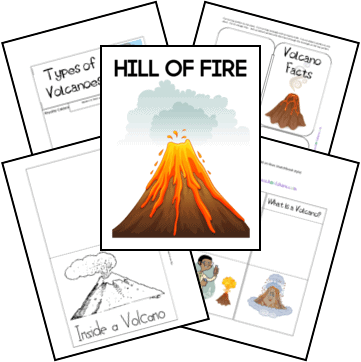
Hill of Fire Lapbook Cover
Photos/Clip-art


Science

Volcano/Volcanologist Matchbooks
Signs that a Volcano Will Erupt Tri-fold Book
Exploding Volcano  (from Scholastic)
Label a Volcano Simple Fold

Volcano Facts with Pocket
Types of Volcanoes Tab Book
Extreme Volcanoes Shutterfold

Parts of a Volcano Flap Book

Temperature
one student
two students

Three States of a Volcano
Blank
With Descriptions
With Titles and Descriptions


Volcanologist Certificates
one student
two students

SOCIAL STUDIES

Geography:  Mexico
Make a storydisk (a small, round piece of paper with a symbol from the story) and place it  in Mexico.  Mexico's population is comprised of a wide variety of racial and ethnic groups.  Various Indian groups (such as Aztecs and Mayans) along with Europeans dominate the country in population.   Discuss Mexico's culture with your student (the language--Spanish, the food, the clothing styles, etc.)

Mexico's capital is Mexico City.  Mexico's climate varies from deserts to forests to tropical rainforests, and includes some chapparal (a shrubby coastal area that has hot dry summers and mild, cool, rainy winters).

Mexico is divided into 32 states (Aguas Calientes, Baja California, Baja California Sur, Campeche, Chiapas, Chihuahua, Coahuila, Colima, Durango, Estado de México, Guanajuato, Guerrero, Hidalgo, Jalisco, Michoacán, Morelos, Nayarit, Nuevo León, Oaxaca, Puebla, Querétaro, Quintana Roo, San Luis Potosí, Sinaloa, Sonora, Tabasco, Tamaulipas, Tlaxcala, Vera Cruz, Yucatán, Zacatecas) plus a Federal District (Mexico City).

Lapbook Components:
Mexico Shutterfold Map by Wende
Mexico Flag Simple Fold

Helpful Links:
Mexico Outline Map
Mexico Map with States Labeled (members)
Mexico Map with States Outlined (members)
Kid's Culture Center-- Mexico

Family Relationships-Father/Son
Pablo helps his father farm.  What does your student help his father with?  Discuss various ways that your student can be a help to his dad. 
Lapbook Component:  I Can Help My Dad Tri-fold

Human Relationships-Teamwork
Ask your student--How did the village get rebuilt?  Did one person do it?  Discuss teamwork and  how the villagers together to rebuild.  Ask your student how your family is like a team...and discuss how the family works together. 


LANGUAGE ARTS

Spanish
A few words are mentioned in the story: 
Fiesta! (feast or party)
Amigo (friend)
El Monstruo! (a monster)

Learn some other Spanish words this week, too!   If you have the opportunity, go to an authentic Mexican restaurant for a meal.

Lapbook Component:  Spanish Words

Learn more Spanish!  Enchanted Learning's Spanish Language Activities

Listmaking  
List (from memory) what the villagers sold to the tourists (melons, oranges, corn cakes, Pepsi, hot dogs)
Lapbook Component: 
Listmaking Simple Fold

Vocabulary 
        village-
a small group of people living in a rural area
        plow-
a farm machine used to cut, lift, and turn over soil, usually hitched to a team of animals
        burro- a small donkey often used as a pack animal
        erupt- to explode
        lava-
liquid rock that reaches the earth's surface through a volcano; it cools as it is exposed to the atmosphere

Lapbook Component:  Vocabulary Words Sombrero Shapes
      

Simile
A simile is a figure of speech in which things different in kind or quality are compared by the use of the word like or as
Example: page 61  "from the field they could see the volcano smoking LIKE an old man smoking his pipe"

Personification
Personification is the representation of a thing or idea as a person or by the human for.
Example(s): "the ground growls" and the "volcano coughs"

Lapbook Component:
Personification Split Matchbook
one student
two students

Parts of Speech: Interjection
An interjection is a word or cry expressing sudden or strong feeling, and it is followed by an exclamation point. 
Example: page 32  "Look! Look there!"
Let your student practice reading some interjections.  How should they be read?  With emotion and feeling! 

Lapbook Component:
Interjections Accordion Book
one student
two students

School House Rocks Interjections! (you may want to preview before playing for your kids; some words are used that aren't appropriate for some families)


SCIENCE

Parts of a Volcano
image courtesy of http://school.discoveryeducation.com/clipart/

Volcano: a mountain composed of cooled lava built up by repeated eruptions
Ash Cloud:  cloud of ash formed by a volcano exploding
Magma:  the hot, liquid rock that is found in the center of the earth
Magma Chamber:  the holding tank for the magma
Vent: the opening in the earth that allows the magma to flow out on to the earth's surface
Crater:  a steep-sided hole at the top of the volcano that sometimes contains a pool of lava

Be sure to discuss magma with your student.  Could you melt a rock on your stovetop?  How hot would it have to be to melt a rock?!?  Well, the temperature inside the earth's surface is HOT!  Just a few miles into the earth, the temperature reaches as high as 1,600 degrees!  

Lapbook Components:
What is a Volcano? Matchook
(this file also includes the matchbook for What is a Volcanologist?; you only need to print it once)
Label a Volcano Simple Fold
Parts of a Volcano Flap Book
Temperature (inside the earth's surface)
one student
two students


Volcanologist
A volcanologist is one who studies volcanoes.  They have the exciting chance to study active volcanoes in beautiful and often exotic places. The volcanologist's work makes advances in science, but they also play a critical role in helping people (those living near volcanoes) to stay safe!

You can read the true account of the boy who watched the volcano erupt in his father's field.  He grew up to be a volcanologist! and this is his website.

Lapbook Components:
What is a Volcanologist? (this file also includes the matchbook for What is a Volcano?; you only need to print it once)
Jr. Volcanologist Certificate (1 certificate)
Jr. Volcanologist Certificate (2 certificates)

Warning Signs
Before a volcano blows its top, there are some warning signs.  Discuss the following with your student. 
1. Smoke and Ash coming from the mountain
2. Animals run in fear
3. Crack in the ground
4. Earthquake

Lapbook Component:  Let your student record the various warning signs (one per section) in this Warning Signs Tri-fold Book.  The template for this book was made by Jimmie.  If you'd like a blank book, you can use this pattern, Volcano Tri-fold Book (created by Jimmie)
.

Different Kinds of Volcanoes
There are MANY different kinds of volcanoes.  Here are a few:

1. Shield Volcano - A volcano that is low and broad in shape with very gentle slops.  It emits very fluid lava that flows in long-lasting, relatively small eruptions.  It doesn't explode very often.  An example is Mt. Kilauea (in Hawaii, USA).

2. Composite or Strato Volcano - A steep-coned volcano that explosively emits gases, ash, pumice (rock), and a small amount of stiff, silica lava. This type of volcano can have eruptions accompanied by deadly mudflows (lahars). Most volcanoes on Earth are of this type. Stratovolcanoes kill more people than any other type of volcanoes (because of their abundance on Earth and their powerful mudflows). Examples are Krakatoa in Indonesia, Mt. Pinatubo in the Philippines, and Mt. St. Helens in Washington, USA.

3. Lava Dome - A rounded volcano that forms when very thick lava barely flows. An example is Mont Pelée in Martinique.

4. Cinder Cone - A cone-shaped volcano whose steep sides are formed by loose, fragmented cinders that fall to the Earth close to the vent. The lava flows through a single vent that is usually only up to about 1,000 feet tall. There is usually a bowl-shaped crater at the top.
Solid rock and ash shoot up into the air and fall back around the volcano opening. Sunset Crater in Arizona is an example.

5. Rhyolite Caldera Complex - these are the most explosive volcanoes. They do not look like common volcanoes -- after an eruption, the result is a caldera (crater) caused when the area around the vent collapses. Examples are Yellowstone in Wyoming, USA and Lake Taupo in New Zealand (which erupted around A.D. 80).

Source:  Enchanted Learning

Lapbook Component:  Types of Volcanoes Tab Book


States of a Volcano
Volcanoes don't constantly erupt, and some volcanoes go hundreds of years between eruptions.  In fact, some volcanoes have gone so long without erupting, that scientists consider them extinct.   Here are the three states of a volcano:

Active:  has erupted recently (during the last few hundred years)
Dormant: has not erupted in 2,000 years 
Extinct: has not erupted in over a few thousand years and will not erupt again

Lapbook Component: 
Blank
With Descriptions
With Titles and Descriptions


Research
After your young volcanologist has completed his study on volcanoes, let him write a small report on this Volcano Notebooking Page.  He could also write a report about one of the volcanoes in the world and use the volcano paper to record it. 

A younger volcanologist may test his knowledge by seeing if he can answer the questions on this Volcano Facts Page.

Here is a pocket to store the page(s) in your lapbook.  Pages made by Wende.

Be sure to congratulate your student with a Junior Volcanologist Certificate!
certificate for one student
certificates for two students
 

Additional Resources
No volcano study is complete without building your own model!
p. 217 Evan Moor's Giant Science Resource Book  (Label the parts of a volcano)
Ch. 17 (Hill of Fire) Science Through Children's Literature, 2nd Ed.,  by Butzow
Ch. 16 (Hill of Fire) Science Through Children's Literature, 1st Ed.,  by Butzow
Have an older student along for the ride?  Let him make a 3-D Volcano Diagram

ART

Activity Ideas

1.  Make a CLAY drinking cup to drink out of  just like Pablo!
2.  Try to replicate the illustration on page 44.  Draw a photo with the top sticking out...the village is covered in volcanic debris. 
3.  Found the pages where the moon was shown...for early morning  not just for night time.
4.  For older experiment with wood carving ...Pablo gives his son a wood carved Bull toy.  (or "carve" with a butter knife and a bar of Ivory soap)


APPLIED MATH

Set up Shop
Make a menu from the foods listed in the book and price them.  Play store.  Teach your child how to count back change.  
Option for older students: research Mexican currency. 

Counting
Count the different animals in the book.


BIBLE AND CHARACTER

Bible
1.  Discuss the parable of building larger barns and knowing not about tomorrow (Luke 12)

2.  God is in Control of his Creation!  Leading Little Ones to God  page 73  "Jesus Controlled the Wind and the Sea"    Mark 4:41  Even the  wind  and the  sea obey Him!  Compare this story to our story of Hill of FIre!    Discuss the villagers acknowledged God and prayed for his help...maybe God had mercy and controlled the speed of the volcano exploding...He could have made it one huge explosion; but it was a gradual explosion...The villagers went home and some packed and some went to bed, trusting God...The next morning they looked and saw a volcanoes standing about 100 feet high.  This volcanoes stayed active for about 9 years.  Yes, they had to move away; but God took care of them and gave us an amazing WONDER!  Isn't God amazing?!

3.  Discuss the people praying to God and the church with the cross on top.

Character Traits
(you may want to discuss one each day for a total of five days)
1.  Diligence
The farmer works hard everyday.  Someone who has a habit of working hard is diligent.  How does your student exhibit diligence? I Corinthians 15:58 admonishes us to be steadfast, unmovable, always abounding in the work of the Lord.  What is the work of the Lord for your student? (to obey parents, complete school work, etc.)  You can discuss this as well as what the work of the Lord is for you, the teacher. 
2.  Contentment 
The farmer is unhappy and wishes something would happen....
We should learn to be content with what we have where we are.  (Be happy about what you have not unhappy about what you don't have.)  In the Bible, Paul learned to be content even in bad circumstances such as being put in jail for spreading the gospel.  Even though Paul was in jail, he was able to say, "...I  have learned, in whatsoever state I am, therewith to be content." (Philippians 4:11).   As you walk by the way this week, remind your student to be content in all circumstances.
3.  Flexibility 
Sometimes we have to do things differently than planned.  Ask your student if he can remember an instance where this has happened in his own life.  In the story the village had to relocate to a new area and start over building their village. 
4.  Helpfulness 
Pablo helps his father farm.  How does your student help at his house? (chores, etc.)  You may want to discuss Philippians 2:14-15 which tells us to do all things without complaining so we will shine as light. 
5. Orderliness 
Pablo follows a schedule/routine daily.  I Corinthians 14:40 says, "Let all things be done decently and in order."  This passage isn't speaking to everyday life, but the principle can be extracted as we know that God is a God of order.  Discuss how we see God's order in creation.  Practice living orderly.

Lapbook Component:
Character Traits Layer Book


MUSIC

"MY GOD IS SO BIG! so strong and so mighty there's nothing my God cannot do!  The mountains are His, the valleys are His The stars are his handiwork too!" repeat with motions

Listen to Mexican Music


RESOURCES

Library List

Teaching Children About Life & Earth Sciences:  Ideas and Activities Eery Teacher and Parent Can Use
by Elaine Levenson  (Ch.5 is entitled "Volcanoes, Rocks, and Erosion")

Science Through Children's Literature by the Butzows  (Ch. 16 is Hill of Fire)

The Legend of Mexicatl


Volcano!  Ellen J. Prager

NOVA  Video In the Path of a Killer Volcano

Magic Schoolbus Blows it's Top!
Experiments
 

JUST FOR FUN

1.  We made homemade stilts using buckets and rope.  The boys loved to walk around on these and race.      Discussed why Pablo was using stilts to walk around the volcano...HOT rocks! 
2.  End the week by having a FIESTA! 
3.  Play the game Pablo did with 5 stones and a hole in the dirt outside.
4.  Buy or make cinnamon tea and Mexican hot cakes with honey
5. 
Check the Reading Rainbow Schedule
6.   Volcano chocolate ice cream sundae! 
7.  Recipe for non edible exploding Volcano!
8.  Do an image-google search (Paracutin) and you will get some great photos for your lapbooks! 
View Hill of Fire Lapbook
9. 
Make a volcano cake
10.  Mexican Crafts and Activities
11.
Magic School Bus Blows Its Top Game
11. Make Mexican Sugar Cookies (recipe below

Recipe:  Mexican Sugar Cookies
2 1/2 cups shortening
1 cup white sugar
1 tsp. ground anise seed
2 eggs
6 cups flour
1 Tb. baking powder
1/2 Tb. cream of tartar
1/2 tsp. salt
1/4 cup orange juice

3 Tb. cinnamon
1 cup white sugar
(make a mixture for rolling the cookies after they are out of the oven)

Preheat oven to 350.  Beat shortening until light and fluffy; add one cup of the sugar and the anise seed.  Cream together.  Add eggs and mix well.  Add flour, baking powder, cream of tartar, salt, and orange juice.  Mix and then knead dough until smooth.  On a lightly floured surface, roll the dough to 1/2 inch thickness.  Cut into shapes with desired cookie cutters.  Bake until light brown (5-8 minutes).  Roll the cookies in cinnamon sugar mixture while still warm.


Materials and information on this website belong to the original composers. It may be used for your own personal and school use. 

Material may not be used for resale© 2005-07 HSS