Google
 
reverberated tethered brilliant

Gabriella's Song
Author: Candace Fleming
Illustrator: Giselle Potter
Summary: A young girl finds music all around her as she walks about the city of Venice, Italy, and she shares her song with everyone she meets.
ISBN: 0-689-80973-5; 0-689-84175-2

Literature Based Unit Study written by: Ami Brainerd and Celia Hartmann
 

Geography: Venice, Italy
Discuss the city, the canals, the gondolas, the landmarks (Piazza San Maro, The Grand Canal, St. Mark's Cathedral).  You may also note the fresh food being sold in the open market as is customary in Italy. Make story disk, locate Italy on map, and place disk. If you have tracing paper, your student can maker her own outline map of Italy by tracing the picture on the back cover of the book; she can even mark where Venice is.    (If you have already rowed Papa Piccolo from Five in a Row Volume I, your student may remember Venice...this may be a nice review). 

Discuss with your student that Venice was once known as "the city of music"; if your student knows what opera is,  let her know that this form of musical expression began in Venice and read the author's note together (right before the story).  If your student isn't familiar with opera, you may want to check out some cassettes or CDs from the library to introduce her to this form of music.    There are music samples (to listen to!) of World's Very Best Opera for Kids at amazon.

Where is Italy?

Flag of Italy minit book

Italy at Enchanted Learning (includes maps, flag, quizzes, and much more!)

Social Studies/Music: Composers
Ask your student about the different jobs the people in the book had (street traders, baker, gondolier).  A not so common occupation is mentioned in this book-- a composer.  Leaf through the pages that depict Giuseppe.  What does your student think a composer does?  (write music, play music, create new music, perform music).    If your student is interested in music, this would be a grand opportunity to introduce her to a famous Italian composer (Vivaldi, Verdi, Puccini).  You may want to request Classical Kids Series: Vivaldi's Ring of Mystery (A tale of Venice and violins) CD from your library.  You can also listen to Vivaldi music and hear lots of Vivaldi facts here.  Your older student may want to research an Italian composer.  

Social Studies:  Human Relationships
Discuss how Giuseppe Del Pietro gives credit to Gabriella instead of accepting it all for himself.


History: Church Bells
Your older student may want to research the history of the church bells.


Language Arts: Vocabulary

reverberate--a succession of echoes (repeatedly reflected, as sound waves); a prolonged or continuing effect
Gabriella's song reverberated throughout all of Venice.

tethered--to fasten or restrict
Gabriella heard the rhythm of the tethered boats thumping against the canal walls.

brilliant--superb; wonderful
The composer was brilliant.

inspired -- to be to influenced, moved, or guided 
I was inspired by a simple song I heard out my window.

Language Arts: Alliteration
Candace Fleming using a poetic style to write this story (which is very appropriate since it is about music).   One of the poetic devices she uses is alliteration. Discuss or review the term  with your student.  It is  defined as the repetition of the same initial consonant sound at the beginning of two or more words (that are immediately succeeding each other or at short intervals).   After you examine the following examples (or go looking together in the story on your own), try to write some alliterations.   You can use anything to do this--including household objects or musical instruments!  Help your child learn to love our language. 

examples from the text--

"Morning melody"

"Blended and blurred"

"Such a sad song"

"Gondoliers gliding"

"Housewives heard and hummed"

"Simple song"

Language Arts:  Onomatopoeia
Onomatopoeia is another way Fleming's poetic style is incorporated throughout the story.  You have probably already studied this with your students, so review and look for onomatopoetic words (words that imitate the words they represent such as ring, splash, boom).   I really enjoy Peter Spier's Crash, Bang, Boom book for an addition study of onomatopoeia.  It is FULL of great examples; it's like an onomatopoeia dictionary!  You and your student may enjoy it as much as I do!  (Your student may even be inspired to write a short story full of onomatopoeia!). 

Language Arts/Music:  Making a List
Make a list with your student of all the musical expressions in this story.  Sometimes we think of music as something grand-- a concert played on a piano or a soloist performing for an audience.  Some of your answers may include: humming, whistling, singing, playing an accordion, playing a piano, and bells ringing (and more!).

Language Arts: Making a List Game
In one minute, come up with as many words as possible that relate to "music."

Language Arts:  Compound Words
A compound word is made when two words are joined to make one word.  Can your student find examples of compound words throughout this story?  (marketplace, alleyways, waterways, housewives, dockworkers, schoolchildren, notebook, woodwind)

Foreign Language:  Italian
Some Italian phrases have been incorporated into the text of this story.  Here are some of the words and their meanings.  If you student has fun trying to learn them and trying to pronounce them, you may want to find some additional resources to teach him some more Italian words.

Italian Language Activities at Enchanted Learning 

                Bravissimo-- very well done; splendid!  (We derive our word bravo from this Italian word)
                Grazie-- thank you
                amore mio-- my love
                Bellissima-- beautiful


Math:  Counting Change
Set up a street market (fish stand, hot pies, sweet cream, etc.) and sell your wares. Have your student count out money to buy things. Or if he needs practice making change have him play the role of the street trader.

Math:  Story Problems
1. Signor Pagliana has four cannolis and sells one to Garbriella.  How many cannolis does he have left?
2. Signor Pagliani sells cannolis for .25 each and bread for $1 per loaf. How much money did Signor Pagliani make from Gabriella and the widow Santucci?
3. Signor Pagliani had nine loaves of bread.  He sold four to widow Santucci.  How many loaves does he have left?   If he makes four new loaves of bread how many will have have?
4. Signor Pagliani has three rows of cookies with three in each row.  How many cookies does he have?
5. Widow Santucci spent $4 at the bakery.  She had to pay the gondelier $2.  How much did she spend?


Science: Sound
Discuss the anatomy of the ear and how we hear sound. Discuss how sound travels. When an object vibrates, a moving energy is formed. This energy, called vibrations, travels through the air to your ear and makes your eardrum vibrate. Then the nervous system of your body registers the vibrations as a sound.

all about the ear
ear anatomy

Try the experiments on pages 20 and 21 of Volume 2 of the The Usborne Book of Science Activities and page 34 and 35 of Volume 3. 
Volume 1 of KONOS has a fun activity for younger children:  setting up a human ear for the child to crawl through (pretending to be a vibration traveling into an ear. 215 and 243-247 Evan-Moor Giant Science Resource Book
p. 220-221
DK Big Book of Knowledge

Science:  Pigeons (Observing Bird Behavior)  *park field trip
After reading and gleaning from the following article, take your student to a park to observe pigeons.  "Pigeons are great for studying bird behavior for several reasons. They are accustomed to having people around so they can be approached and studied up close, there are flocks of pigeons in most city parks, and in general they do not migrate, staying in roughly the same area year round. So take your child to a park where you know there are pigeons around, sit on a bench, and watch what goes on.

In the park you're in what would best be described as the pigeon's "feeding ground." The pigeons probably don't nest in the park, they prefer to nest high above the ground where there are dark cubbyholes, like churches or elaborate plasterwork on high buildings or the crossbeams of bridges. There are still several behaviors you should be able to identify, since much of the pigeon's "courtship" occurs on the feeding ground. For example, watch birds entering or leaving the feeding area. Are they clapping their wings together as they fly? This behavior is done by males, as a way for them to advertise their sexual maturity. Males may also lift their heads very high and run for short distances with their tales dragging the ground. They're showing off for their mates.

If you see a pigeon pick up a twig and fly off with it, watch where it flies. The bird is probably nesting. At the nest site, you'll observe a whole different set of behaviors between the mates as they prepare their nest.

The "territory" of different birds varies greatly, from a few inches to a few miles. Pigeons only defend the territory immediately adjacent to their nest site. Their nests will be about 8 inches long and is built of short, stiff twigs. Once a nesting site is chosen by the pair, the male will fly off and pick up a twig, shaking it around and dropping it to test it for stiffness. If he finds one he likes, he'll fly back to the female and lay it in front of her. She'll pick it up and place it into the nest underneath her. This will continue until the nest is built. Once the nest is completed the female will lay her eggs, normally two. The male and the female will take turns incubating the eggs, but generally only the female remains on the nest at night and the male will roost elsewhere. Incubation will probably last about 18 days. When the eggs hatch, the parents will first feed their chicks regurgitated food then will gradually increase their diet to include more solid foods such as caterpillars and fruits. The checks will remain in the nest for only about 10 days, then they'll be ready to join the feeding flocks on their own. Within a day or two after the chicks leave the nest they will be totally independent, and the parents will be preparing for the next brood."  taken from www.easyfunschool.com


Music:  Classifying Instruments
Many different instruments comprise the orchestra.  The story mentions, "[the music] grew higher and higher and higher still, until strings, woodwinds, and percussion met in a heart-stopping crescendo.  Explain to your student that strings, woodwinds, and percussions are groups of instruments with certain characteristics.  You may even want to visit a local music shop for this discussion. 
Woodwinds-- use vibrating air to produce their sound; they can be played with an open hole or with a reed
The flute, clarinet, oboe, bassoon, and saxophone are all members of this group.
Strings-- instruments that have strings stretched over them and are played with a bow.  The violin, viola, cello, and double bass are all members of this group.
 
Percussion-- is a diverse group including any instrument that generates sounds when it is scraped, shaken, or struck.   The xylophone, cymbals, woodblocks, gongs, chimes, triangle, snare drum, and even the piano are members of this group. 

You may want to listen to sounds of different instruments with your student to help her to differentiate between strings, woodwinds, and percussion. 

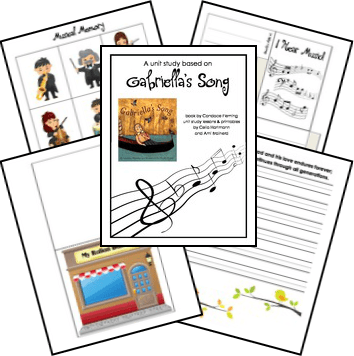
Musical Instruments Clip Art (Coloring Sheet or use for your Lapbook)

Musical Instrument Word Finds

Music:  Making Instruments
Simple Woodwind Instruments

  1. Students create a simple single reed instrument by placing a piece of grass or strip of paper between their two thumbs. Paper should be pulled tight between the curved portion of the thumbs (with both thumb nails facing up). Students blow through thumbs to vibrate paper. Experiment with different air pressures to change pitch.
  2. Students make soda bottle flutes by filling empty soda bottles with water. Create different pitches by filling bottles to different levels. After bottles are tuned, play simple songs with each student responsible for one specific pitch of the song.
  3. Students make a double reed instrument out of a plastic drinking straw
    ---each student is given a plastic straw and a pair of scissors
    ---squeeze one end of the straw flat and crease to make flattened end pertinent
    ---with scissors, cut flattened end with two cuts into a pointed "V" shape
    ---check to be sure the "points" are separate
    ---play instrument by placing pointed end in mouth approximately 1/2 inch and blow (hard)
    ---small holes can be cut into the side of the straw and used to change pitch (be careful to make the holes as small as possible)    
     from http://gc2000.rutgers.edu

Make your own percussion instruments from things around the house (remember anything that makes sound when it is scraped, shaken, or struck)

Music: Music Everywhere!
Discuss "how music can be heard in everyday noises" and "how music, when shared, can enrich lives." (See author’s letter at the end-- not in the book with the ISBN ending in 5.)  Where does your student hear music? (rain, sizzling of the frying pan, wind blowing the leaves, etc.)

Music:  Vocabulary
      
      Opening Movement-- the first movement (the first part) of the piece
                Scherzo--    Pertaining to the sonata form, a fast movement in triple time
                Grand Finale-- Movement or passage that concludes the musical composition
                Orchestra--  a large group of instrumentalists playing together
                Symphony-- Three to four movement orchestral piece, generally in sonata form (Music of a particular form consisting of four
                movements. Each of the movements differ in tempo, rhythm, and melody; but are held together by subject and style)
                Crescendo--Gradually growing louder
                Opera-- a drama where the words are sung instead of spoken


Bible:  Making a Joyful Noise!
Psalm 100 is a very fitting passage for this story.  We are to be praising our God all the time!   Exhort your children to make a joyful noise (no, whining doesn't qualify!) and to sing, hum, whistle praises to God all day long.


Supplemental Book Titles

Music
M is for Music by Kathleen Krull
M is for Melody
by Kathy-Jo Wargin
I Wonder Why Flutes Have Holes by Josephine Paker
Zin! Zin! Zin! A Violin!
by Lloyd Moss
The Magic of Music
by Lisl Weil
The Story of the Orchestra
by Robert Levine
This is an Orchestra by Elsa Posell
Rubber-Band Banjos and a Java Jive Bass:  Projects and Activities on the Science of Music and Sound by Alex Sabbeth (*highly recommended!)

Sound/Hearing
The Story of Your Ears
by Dr. Alvin and Virginia Silverstein
The First Book of Sound
by David Knight
Sounds and How They are Made
by Harold E. Tannenbaum
Sound by Dorothy S. Anderson
Sound Experiments by Ray Broeke
The Ear and Hearing by Brian R. Ward
The Five Senses: Hearing by Maria Rius
Sound: An Experiment Book by Marian E. Baer
Sound Science by Melvin Alexenber
The Loudest Noise in the World by Benjamin Elkin
A Riot of Quiet by Virginia Sicotte
 
Orchestra/Classical Music/Vivaldi:
Season's Greetings from Vivaldi (Ann Rachlin Composer Story CD)
The Usborne Story of Music
Classical Cats:  Children's Introduction to the Orchestra

Just for Fun

Cooking (you can make an Italian feast on your last day rowing this book; on a different day, try a cannoli)

Recipe:  Italian Frosted Cookie Rings
3/4 cup margarine
1/3 cup white sugar
3 eggs
1 tsp. vanilla
2 Tb. orange juice
3 cups flour
1 Tb. baking powder
powdered sugar and water (or milk)

Preheat oven to 350.  Cream margarine and white sugar.  Add eggs, vanilla, and orange juice.  Combine flour and baking powder and gradually add to creamed mixture.  Knead dough on a lightly floured surface for five minutes.  Using tablespoons of dough, roll into 6-inch "snakes"; press ends of the dough together to form rings.  Let stand on ungreased cookie sheet for about 15 minutes.  Bake at 350 for 15-20 minutes.  Mix powdered sugar and water (or milk) to make a glaze.  Dip each hot cookie into the glaze and decorate with candy sprinkles while glaze is still wet. 

Recipe: Cannoli (make sure you have a recipe for both the filling and the shells!)
http://www.homeschoolzone.com/m2m/recipes/cannoli.htm
http://www.dvo.com/recipe_pages/italian/Cannoli_Fillings-The_Quick_Way.html
http://www.goldencannoli.com/recipes.html