| about us |
what's new
|
unit studies
|
unit study helps |
fiar resources
|
indexes | lapbooking |
|
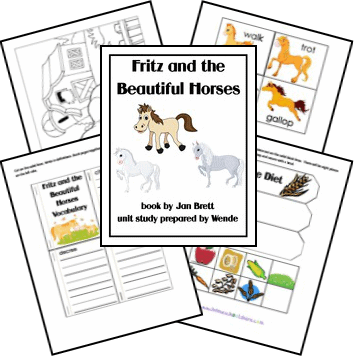
Author: Jan Brett
Illustrator: Jan
Brett
Summary (from amazon): Fritz, a pony excluded from the group of beautiful horses within the walled city, becomes a hero when he rescues the children of the city
ISBN: 0395453569
|
The citizens in the story passed a law that only allowed the most
beautiful horses into the city. Do you think this was a good law? Talk about
what makes a good law. Have child make up a set of laws for home. Are they
good laws? Are they able to be followed by all family members? Have a family
vote to see if the laws should be passed. You may want your older student
to research how a law is made.
If you want to have some fun with this, allow your student to be King for a day.
Make a crown and implement one law the "king" decrees even if it's "have
chocolate at every meal!"
Geography
Think of the time and place the story may have happened.
Look for clues – walled city, bridge with arches, travel by horse, the clothing,
etc. Research to see if there are still any walled cities today. While the
author doesn’t tell us where or when it takes place, it appears to be 17th century
Europe, possibly the French walled city of Carcassonne, or one like it.
You may want to place your storydisk in Europe and
spend time discussing Europe this week. Review different countries you
have previously "visited" in your studies. You may also want to print an
outline map and let your student write the names of the different countries in
Europe on the map.
Tons of information
for Europe at Enchanted Learning (outline map, rivers, flags, more!)
Human Relationships: Teasing
The townspeople are mean to Fritz; they laugh at him and say he looks
silly. Discuss with your student when it is (and is not) appropriate to
laugh at someone. Discuss teasing and why your student should not take
part in it. You may also want to discuss how one should handle being made
fun of.
Hero
What is a hero? A hero is defined as someone set apart for his exceptional
courage, nobility, and strength. Our society tends to tell our children
that you have to be a movie star or a super athlete in order to be someone's
hero. This is not necessarily true. Think of some common everyday
heroes in your student's life. Help him decide how they fit the hero
criteria (exceptional courage, nobility, and strength); discuss the multiple
meanings of the word strength. You may even want to make a list of your
everyday heroes (dad, firefighters, policemen, a friend who has battled cancer,
heroes from the Bible, etc.). Consider writing a letter to one and to
thank them for being a hero.
What is beauty? What makes something beautiful? How do you feel
about the author saying the pony isn’t beautiful? Discuss how Fritz felt, being
left out of the walled city just because of the way he looked. Share with your
children a time that you were left out of something. Discuss what you can do to
help someone “different” fit in and not feel like a “misfit”. The Ugly
Duckling may be a good tie in here.
Character: Making Excuses
When the children were stuck on the other side of the river, the
citizens called, "Stay where you are! We will come and get you."
However, their horses wouldn't budge! What were the horses excuses?
(hill was too steep, mane might get tangled, don't want to get wet) Were
these good reasons for not rescuing the children? Discuss excuses with
your student. When you ask her to clean her room, does she ever reply with
an excuse? Discuss the right response.
Bible: Choosing David for King
Read I Samuel 16. Samuel tried to choose a king based on outward appearance, but God had other plans! How does this apply to the story of Fritz? Do things always seem as they appear? (No, we can't judge a book by its cover.) What is the outward appearance of one worth? Would your student rather have Fritz as a pet or one of the beautiful horses? Why?
Bible: God's Law
The Bible speaks often of
God's Law. Use this week to memorize the ten commandments or spend time
reading and discussing other verses that mention God's Law.
The Ten Commandments- (found in Exodus 20)
What do the first four commandments teach us? To love and serve God
What do the last six commandments teach us? To love and serve our
neighbors
The sum of the ten commandments is to love God with all our hearts and love our
neighbor as ourselves.
If you are making a lapbook or notebook, you may want to make 10 small
matchbooks to include (one for each commandment).
Possible memory verse-- Matthew 22:37-39, " 'Love the Lord your God with all
your heart and with all your soul and with all your mind. This is the first and
greatest commandment. And the second is like it: 'Love your neighbor as
yourself.'"
You may wish to study other verses about God's Law with your older student
(Psalm 19:7+ comes to mind).
Additional Resources to use:
Little Visits With God – “God’s Law is Good”, pg. 225
Egermeier’s Bible Story Book – “The Ten Commandments”, pg. 99
Science
Horses
Read
books about horses. There are tons available at the library. You may also
enjoy identifying different
types of horses in story. An Album of Horses by Maguerite Henry
will help you do this; it will also give you lots to read about the different
breeds.
Horse Anatomy Print-out
Horse Gaits
This book mentions different words describing how horses move:
stride, buck, prance, gallop, etc. There are four terms to describe the
basic ways a horse can move (gaits):
1. walk- just a regular old walk
2. trot- a jog
3. canter- to run slow
4. gallop- to run fast
Make a "Horse Gaits" Minit Book for your
Lapbook (or Notebook)
After you have discussed the terms, you can play an easy "game" with your
student(s). Call out one of the words (walk, trot, canter, or
gallop) and let your student walk/run around the room like a horse.
Continue with different words. Let your student take a turn calling out
the words, too.
Horses: Diet
On page eight Fritz has something in his mouth? What is it?
Horses eat grass and hay. What else do they consume? (This is NOT an
all-inclusive list, but it will give your student a good introduction.)
Apples - a treat!
Barley - should be boiled or soaked for at least two hours before feeding as it swells when wet (this prevents swelling in the horse's stomach), which prevents it
Maize - this should be flaked and cooked to make it easier to digest
Oats - they are easily digested if crushed, rolled or cooked
Root vegetables - such as beetroot, carrots, parsnips, and turnips can be fed (but in small quantities)
You may want to make book for your lapbook or notebook as your complete this
lesson- What Horses Eat Accordian
Minit Book
Horse Vocabulary
Here are some "horse" words your student will encounter as you spend
time with this book:
Muzzle – the projecting jaws and nose of an
animal; snout
Mane - long heavy hair growing about the neck and head
Sure-footed -- not likely to stumble or fall
Prancing -- to rise up or move about on the hind legs
Hooves -- a covering of horn that protects the front of or encloses the ends of
the toes
Buck -- to spring into the air with the back arched
Language Arts
Vocabulary
Citizen – a resident of a town or city
Decree – a decision or law
Tangled – knotted
Dependable – reliable; trustworthy
Magnificent -- having impressive beauty
Reluctantly -- showing doubt or unwillingness
Despair -- to lose all hope or confidence
Story Sequence
Print a copy of the
Prepared Story Sequence Cards. After you've read the story a few
times, read the cards to your student and help him illustrate each one.
After he is finished, tell him to put them in the correct order (based on the
story). If you are making a lapbook or a notebook, you may want to put
these cards in a pocket in your book.
Use this
after completing the discussion in the "Character: Beauty" lesson (in Social
Studies)
A
thing of beauty is a joy forever;
Its loveliness increases; it will never
Pass into nothingness; but still will keep
A bower quiet for us, and a sleep
Full of sweet dreams, and health, and quiet breathing.
--by
John Keats
Nursery Rhyme/Copywork
Ride a cockhorse to
Banbury Cross,
To see a fine lady
upon a white horse;
With rings on her
fingers, and bells on her toes,
She shall have
music wherever she goes.
Comprehension Questions
These are found on Jan Brett's website
Comprehension Questions 1
Comprehension Questions 2
Parts of Speech: Adjectives
Adjectives are words that describe. They answer questions about
the noun; they give us more information. Jan Brett uses lots of adjectives
throughout this book.
beautiful horses
magnificent jumpers
splendid chargers
elegant horses
tangled mane
short legs
braided tails
lovely ladies
Use this Prepared Adjectives
Worksheet to extend this lesson.
If you have a younger student, consider the following idea:
Print this
Horse Template.
Tell your student it represents Fritz. Go through the book together and
tell your student to stop you when he hears a word to describe Fritz.
Write the word on the horse shape pattern. Continue until your pattern is
full or you've finished the story. After you are done with the story, you
could let your student think of some of his own adjectives for Fritz.
Math
Counting
Count all the beautiful horses in the story. You can include the
pony if you want.
Story Problem (Multiplication)
If there were ten children to rescue, how many times did Fritz have to cross the
river? (10x2=20)
You may also want to explain the term round-trip to your child. Fritz had to make ten round trips.
What if there were eight children? seven? nine?
Story Problem
Jan Brett was born in 1949. Look for book copyright and figure out
how old the author was when she wrote this book.
Extra Idea:
Look at Jan Brett’s
booklist. Put titles in chronological order of copyright dates.
Art
Drawing
Draw your own horse!
Instructions
How to draw a
horse video with Jan Brett! (Free)
Details
Look
at the artwork by Jan Brett, paying particular attention to the details in the
paintings of the horses. Jan Brett claims that it takes 1 hour to paint 1 inch
of picture, using a small brush. How long does it take your student to
paint 1 inch of picture? Compare the times. How much longer does it
take Jan Brett? After your student draws a horse (above), have him spend
some time adding details (similar to Jan Brett's if he desires).
Possible Rabbit Trail- Artist
Study: Franz Marc
Read biography
Franz Marc Pictures
Go-along book
All The Pretty Little Horses (A Traditional
Lullaby) illustrated by Linda Saport.
Just for Fun
PE –Run around the yard riding a stick horse. Learn to gallop and trot.
Field Trip – Visit a horse farm. If not possible, visit the virtual horse farm here (very slow if you are on dial-up):
Horse coloring pages
Library List
Jim Jump by Betty Ren Wright
Five O'Clock Charlie by Marguerite Henry
The Wild Little Horse by Rita Gray