| about us |
what's new
|
unit studies
|
unit study helps |
hss resources
|
fiar resources | indexes | lapbooking |
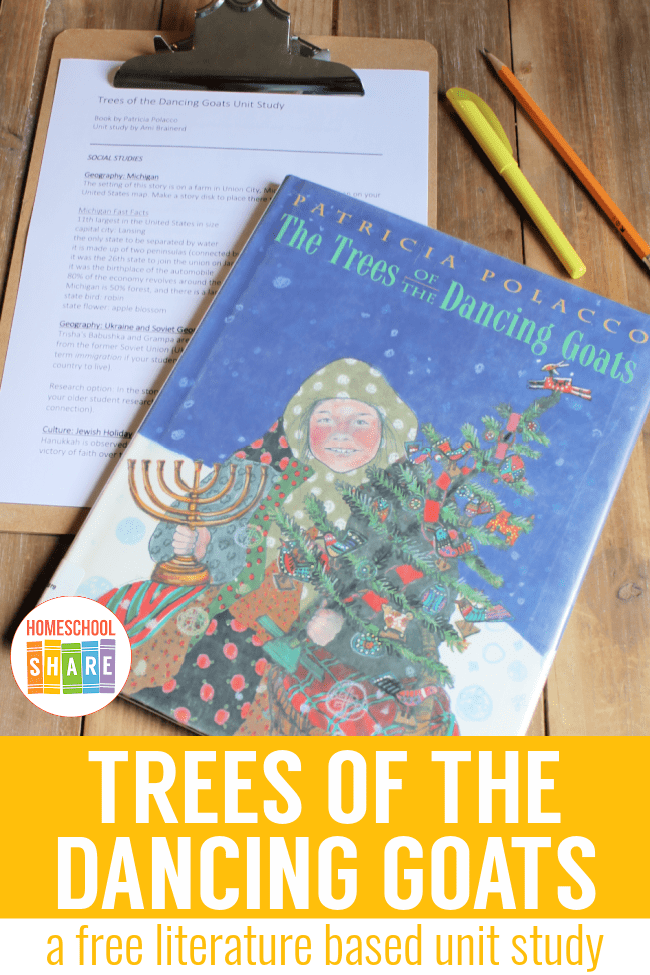
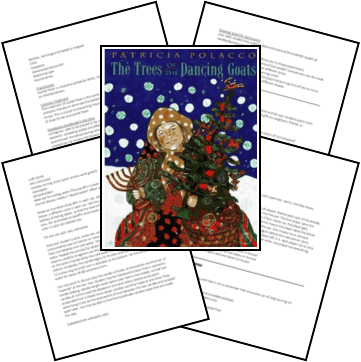
The Trees of the Dancing Goats
|
Author/Illustrator: Patricia Polacco ISBN: 0689838573 Summary: During a scarlet-fever epidemic one winter in Michigan, a Jewish family helps make Christmas special for their sick neighbors by making their own Hanukkah miracle. |
Unit Prepared by: Ami Brainerd
SOCIAL STUDIES
Geography: Michigan
The setting of this story is on a farm in Union City, MI. Find MI
on your United States map. Make a story disk to place there this week.
Michigan Facts
11th largest in the United States in size
capital city-- Lansing
the only state to be separated by water
it is made up of two peninsulas (connected by the Mackinac Bridge)
it was the 26th state to join the union on January 26, 1837
birthplace of the automobile
80% of the economy revolves around the car industry
50% forest -- large lumber industry
state bird-- robin
state flower-- apple blossom
Outline Map of Michigan
Flag of Michigan
--see Math section for another
Geography lesson (map skills)
Geography: Ukraine and Soviet Georgia
Trisha's Babushka and Grampa are not from the United States. They
immigrated from the former Soviet Union (Ukraine and Soviet Georgia).
Discuss the term immigration if your student is unfamiliar with it (to
come into a foreign country to live). You may want to place a special
marker (like a storydisk) in this area on your map.
Flag of Ukraine
Map of Ukraine
(scroll down for many printables)
--see Art section for an extension for this lesson
Research option: In the story Grampa mentions that they could never return.
Help your older student research and find out why (possibly a Jewish/WWII
connection?).
Culture- Jewish Holiday: Hanukkah
(Source)
Hanukkah is observed by millions of Jews around the globe, commemorating
the victory of faith over tyranny and, more specifically, the triumph of Jewish
rebels over their Syrian rulers more than 2,000 years ago. Although Hanukkah is
technically a minor Jewish festival, it is the only holiday for which Jews
exchange gifts. It is celebrated in the Jewish month of Kislev, which usually
falls in December. Hanukkah is not "the Jewish Christmas"; it is a
festival with a rich history and tradition of its own.
The celebration of Hanukkah goes back to 165 B.C. At that time, the Jews of
Judea had lived for many years under the oppressive hand of Syria, whose rulers
outlawed Jewish worship and desecrated the temple in Jerusalem. Even though they
were outnumbered, the Jews took up arms to defend their lifestyle and religion.
They overwhelmed the Syrians in two decisive battles. Their leader was Judah
Maccabees, whose mythic strength earned him the nickname "The Hammer."
Legend has it that when the Jewish army entered the temple to reconsecrate it,
their first task was to rekindle the Eternal Light, a sacred oil lamp that was
left burning continuously. The Maccabees had only one jar of oil, enough to keep
the flame lit only for a single day. They sent out a messenger to find and bring
back more sanctified oil, and it took the messenger eight days to return.
Miraculously, the Eternal Light continued to burn those eight days. Hanukkah,
which also is called the Festival of Lights, celebrates that miracle.
Hanukkah Lapbook from HSS
Library List
The Borrowed Hanukkah
Latkes by Linda
Glaser
Chanukah Lights
Everywhere by
Michael Rosen
A Hanukkah Treasury
by Eric Kimmel
The Stone Lamp: A
Hanukkah Collection: Eight Days of Dark, Eight
Nights of Light by Karen Hesse
Latkes and Applesauce by Fran Manushkin
The Power of Light by Isaac Bashevis Singer
Eight Tales for Eight Nights: Stories for Chanukah by Peninnah Schram and
Steven M. Rosman
Judah Who Always Said "No!" by Harriet K. Feder
The Story of Hanukkah by Amy Ehrlich
Character Building: Sharing
Grampa had hand-carved wooden animals for Trisha and Richard including
the dancing goats. Their mother suggested that they use the animals to
decorate Christmas trees for their neighbors. At first Trisha was
disappointed. Discuss the saying, "it is better to give than
receive." Is this true?
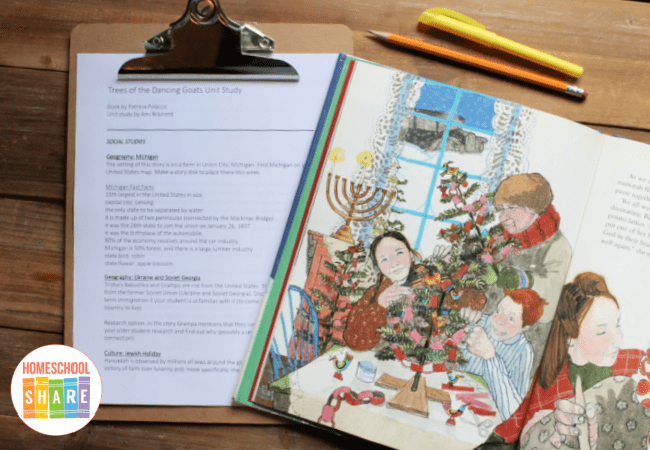
At the end of the story, what happens? The neighbors make a menorah for
Trisha's family complete with some of the wooden animals that were given away!
So, in the end, Trisha did get some of the animals.
Character Building: Enjoying Work
"[Babushka] hummed as she dipped, never seeming to tire of the long
process." Is it possible for us to enjoy work?
I have a quote on my kitchen window sill that says, "To be happy, don't do what
you like...like what you do!" What does this mean? Can we learn to
find joy in any task that we have to complete? The next time you and your
student have to complete chores or mundane household tasks, try humming songs or
whistling why you work. Try to find things to be thankful about (that you
have able hands that can work), instead of things to complain about.
Human Relationships:
Teamwork
This family really worked together to make Christmas a reality for their
sick neighbors. Make a list together of what all was done and who helped
complete each job.
Discuss how your family works together as a team. If this is an area that
needs improvement, consider making a list of things you can do to foster more
teamwork in your household.
Human Relationships/Bible: Neighbors
A neighbor is usually thought of as a person who lives near another, but
the word can also be defined as a fellow human being. So, who is your
neighbor? Everyone!
The Bible commands us to love our neighbors as ourselves (Matthew 22:39,
Leviticus 19:18).
How did Trisha's family put this principle into action? How can you show
love to your neighbors during the holiday season?
Family History
Patricia Polacco knows a lot about her family history. If you've read
many of her other stories together, you know this is true. What is a family
history? Does your student know where her ancestors are from? What
countries did your student's ancestors immigrate from? Why? Pass
these stories down to your student. You may even want to help your student
record some family history this week.
LANGUAGE ARTS
Vocabulary
anticipation- pleasurable expectation (waiting for something with
excitement!)
tarnished- to become dull, dim, or discolored
mimicking- to imitate (note: you may have to demonstrate)
dreadful- very disagreeable, unpleasant, or shocking
scurried- to move briskly
flickered- to burn unsteadily or with a constantly changing light
bolted- to move suddenly, rapidly, or nervously
cherished- to hold dear: feel or show affection for
bustling- to move about busily or noisily
pale- light in color or shade
Prepared Vocabulary Pocket and Cards
(for your lapbook or notebook)
Directions: Write vocabulary word in the blank that corresponds with the
definition. Review words each day as you use this unit study. Let
your student choose a few each day and have him find the sentence in the story
that includes the word. You can also act many of these words out.
Foreshadowing
Foreshadowing is when an author gives the reader a hint or suggestion of
something that is yet to come. Grampa says, "Miracles can
happen even today." This is an example of foreshadowing; it gives the
reader a clue that there will be a miracle in this story. Can
your student recall the miracle at the end of the story? (The candles in
the menorah haven't burned down at all.)
Language: Russian
Patricia mentions that her grandparents both speak Russian. You may
want to see if your library has Teach Me Russian and/or Teach Me More
Russian by Judy Mahoney; these CDs are a gentle introduction to the Russian
language.
Russian
Activities at Enchanted Learning (includes tons of language activities!)
APPLIED MATH
Geography and Math:
Mapping Skills and Measurement
Using an atlas of the United States, show your student how to find
Michigan...then show your student how to find Union City and Battle Creek.
Find a route from Union City to Battle Creek. Measure the mileage.
Determine how many miles Momma had to travel each day (from Union City to Battle
Creek and back again). Discuss what the term round trip means.
You may want to find other routes from Union City to Battle Creek. Can you
find a shorter route? How many miles difference is there between the two
routes?
Story Problem
How many days total will it take for Trisha's family to prepare and
celebrate Hanukkah? ("We would have a week to prepare and eight days of
Hanukkah festivities"-- 15 days total.)
SCIENCE
Health: Staying Healthy in Winter
Your younger student may enjoy completing this
Staying Well in Winter
booklet complete with
Clip Art to
cut and paste.
Can you think of other ways to stay well?
Illness-- Strep Throat/Scarlet Fever
Trisha's neighbors had scarlet fever. What is this? Scarlet fever
is a disease caused by an infection of the throat with group A beta-hemolytic
streptococcal bacteria (strep throat).
Symptoms
Sore throat
Fever
Vomiting
Rash on neck and chest
Rough "sandpaper" feel to the skin
Swollen, red tongue (strawberry tongue)
Chills
Headache
Generalized discomfort
Abdominal pain
Muscle aches
Transmission
Scarlet Fever is a bacteria spread by direct, close contact (coughing,
sneezing) with an infected person.
Common Treatment
The treatment of scarlet fever is the same as the treatment of strep throat
-- antibiotic therapy to eliminate the bacteria that causes this infection from
the throat. This is crucial to preventing rheumatic fever, the most feared
complication of strep throat and scarlet fever.
Vocabulary introduced in the story
contagious- able to be passed on by contact between individuals
epidemic- spreading widely and affecting many individuals at one time
quarantined- the period during which a person with a contagious disease is kept
isolated (as not to pass the disease on to others)
Research Option: Have your older student research viral and bacterial
infections. What are the differences?
Candle making
In the story, candles were made for Hanukkah. You may want to try
making some hand-dipped candles with your student. Please see science
connections at the bottom of the lesson. If you are completing a lapbook
with this unit, print this prepared
Candle Making minit book for your student to record her observations.
Materials:
paraffin blocks
2-8 thin metal cans without paper labels (tennis ball cans are the perfect
size); you will need more than one can if you plan to do more than one color
candle
broken crayon fragments sorted by color (labels peeled off)
cotton string for wicks, cut into 18" lengths (or you may purchase wicks from a
craft store)
very cold water
wooden stirring sticks (paint stirrers work great!)
newspaper
old potholders
deep pot for boiling water (The paraffin is never melted directly over the heat
source! Always create a "double boiler" effect as described below.)
Break up one block of paraffin in each can. Add a generous amount of crayon
pieces, a different color in each can. Set the cans upright in a deep kettle (or
kettles) of boiling water, so that the level of the water is halfway up the side
of the cans. Stir and break up paraffin and crayon wax until it is entirely
melted and the color in each can pleases you.
Fill one can with very cold water.
Give your student a wick, a wax can, and a water can. Leaving about six
inches untouched by wax to hold on to, have your student dip the string first
into wax, then immediately into cold water...then again into the wax...then back
into cold water...repeating the process for about five minutes. After the first
few dips, you may need to carefully straighten out the wick if it curls in the
hot wax. Each layer of wax on the wick is hardened by the cold water and allows
the next layer of wax to adhere. Gradually, the candle begins to thicken and
take shape. When it is about 12 inches long and 3/4 inch in diameter at the
bottom, let the candle sit in the cold water for about 30-60 seconds to firm.
You may want to discuss why the candle is thicker at the bottom and thinner, or
"tapered" at the top hence the other name for candles -- "tapers." Your student
may be interested to learn that in authentic candle dipping, double-length wicks
were used, held in the middle, so that two candles at a time could be dipped on
one wick. Many double wicks were suspended from a dowel and a dozen candles
could be made at one time! They were hung to dry by the exposed bit of wick
between the two candles and snipped apart later. You may be able to find fine
handmade candles today that are made this way.
(adapted from scholastic.com)
Go-along book: Making Candles by Judy Sadler
Drawing Scientific Conclusions (your older student may want to delve into
more of the scientific aspect of candles/burning candles)
Remember to make predictions before you try these experiments.
Does wax color affect the burning time of the candle? Comparisons can be
made between white and colors or between different colors.
Does the room temperature affect burning time?
Does the shape affect burning time? Compare the burning time of two or more
candles that weigh the same but have different shapes.
ART
Painting Wooden Ornaments
Get some wooden ornaments from a craft store and let your students paint
them (they may even want to give them as gifts to neighbors, friends, or
relatives).
Colors of the Soviet Union
Grampa painted the carved ornaments "with the colors of his homeland"
Get a box of crayons (the bigger the better) and let your student match the
crayons to the colors Grampa used to paint the woodcarvings. Give your
student an outline map of the Soviet Union; let him crayon
the map with the colors of Grampa's homeland.
Woodcarving
If your student is fascinated by Grampa's woodcarvings, try this idea
(adapted from
The Christmas
Miracle of Jonathan Toomey)
Draw an outline on a piece of Ivory soap (possibly a dancing
goat). Put the soap in the refrigerator overnight to make it harder. Then
carefully, using a knife, with a parent present at all times, carve the bar of
soap.
JUST FOR FUN
Make Paper Chains to decorate your trees
More Hanukkah
Word Searches and Word Finds (various levels)
Put the Hanukkah Menorahs
in order
Hanukkah Paper Garland
Hanukkah Paper Cones
Homemade Menorah
Jazz up your lapbook or notebook with this clip-art
Hanukkah Clips 1
Hanukkah Clips 2
Play Dreidel (a Hanukkah game)
Materials Needed:
1 dreidel
Objects for the pot such as chocolate coins (pennies, raisins, Hershey kisses,
buttons, etc.)
Evenly divide the betting objects among all players. Before each spin of the
dreidel, each player antes up by placing one item into the pot. The first player
spins the dreidel. There are four possible outcomes. If Nun comes up, the player
gets nothing and the next player takes a spin. Gimel means the player takes the
whole pot. If Heh comes up, the player takes half the pot. Shin means he or she
puts another item in the pot. All players ante up again before the next person
spins. Whenever the pot is empty or has only one object left in it, each player
has to ante up again before the next spin. The game is over when one player has
everything and everyone else is cleaned out.
Nun נ -
Player does nothing
Heh ה -
Player takes half the tokens in the pot
Gimel ג -
Player takes all the tokens in the pot
Shin ש -
Players add one token to the pot
Dreidel Minit Book (for your lapbook)
Instructions: Cut out the booklet at the top of the page (as one piece);
fold in half. Cut out the inserts and glue into the book.
COOKING
Latkes
Note: They are fried in oil to remember that miraculous jar of
long-burning oil.
Ingredients
2 cups peeled and shredded potatoes
1 tablespoon grated onion
3 eggs, beaten
2 tablespoons all-purpose flour
1 1/2 teaspoons salt
1/2 cup oil
Directions
Extract as much moisture as possible from the potatoes (use a cheesecloth and
wring). In a medium bowl stir the potatoes, onion, eggs, flour and salt
together.
In a large heavy-bottomed skillet over medium-high heat, heat the oil until hot.
Place large spoonfuls of the potato mixture into the hot oil, pressing down on
them to form 1/4 to 1/2 inch thick patties. Brown on one side, turn and brown on
the other. Let drain on paper towels. Serve hot with toppings to choose from--
chopped green onions, sour cream, and applesauce.
More Hanukkah Recipes
Hanukkah
Doughnuts
An Article on
Hanukkah with many recipe ideas