| about us |
what's new
|
unit studies
|
unit study helps |
hss resources
|
fiar resources | indexes | lapbooking |
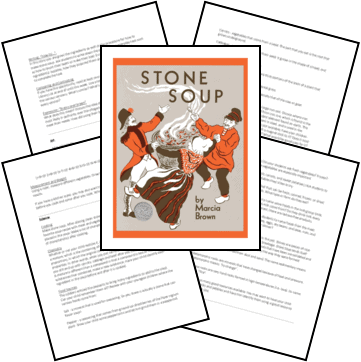
Stone Soup
|
Author: Marcia
Brown |
Unit by: Michelle Kiser and Wende
Social Studies
Geography: France
S
Language Arts
Vocabulary
Banquet: a meal held in recognition of some occasion
Barley: a cereal grass with flowers in dense spikes (try to find a picture to show your student)
Peasant: a member of a European class of persons tilling the soil as small landowners or as laborers
Genre: Folktales
Stories that are told rather than read; they are passed down from one generation
to another generation. Maybe your child has played “Whisper Down the Lane”
before. If not, play this game to demonstrate how a story can change, sometimes
only slightly and sometimes not, as it is told and retold again. As folktales
are passed down, the stories take on characteristics of the time and place in
which they are told, as well as the personality of the person telling the tale.
Here are some common characteristics of folktales. Which characteristics do you
find in Stone Soup?
Use this list to explore other folktales.
~Universal and timeless themes or morals, such as sharing, compassion, being gullible, etc.
~They speak to our need to understand and make sense of our existence (such as tales about creation)
~About the common person, something anyone rich or poor could relate to.
~Supernatural elements that may include magic, witches, wizards, dragons and/or other mythical creatures
Read other folktales to give your child a good taste of this genre. Here are some suggestions:
Best Loved Folktales of the World by Joanna Cole
Favorite Folktales From Around the World by Jane Yolen
Anansi Tales (African Folk Tales) by Eric Kimmel (and others)
Why Mosquitoes
Buzz in People's Ears
by Verna Aardema
Russian Folk Tales
by James Riordan
Listening Skills
Folktales are stories from long ago, before books were common. They were
designed to be listened to again and again. Use your reading of Stone Soup
as an opportunity to develop your child’s listening skills. After reading Stone
Soup for the first time, have your child narrate back to you the story in his
own words. See if his narration answers all the who, what, when, where, why, and
how questions. Have him narrate again after reading the story a few times and
look for improvement.
Writing:
"How-to..."
Art
Monochromatic
As you look through the pictures in Stone Soup, does your child
notice anything about the colors in the pictures? Marcia Brown has used a method
called “monochromatic”, meaning that the painting or drawing are in a single
color or in various shades of the same color. While Marcia Brown has chosen to
use shades of red, your child could color or paint a monochromatic picture in
his choice of color.
Math
Addition
How many different ingredients were added to the pot of soup? Including the
water, stones, vegetables, barley and beef, there were ten different
ingredients. Ask your child how many different combinations of numbers he can
put together to come to the answer of ten. Use baby carrots as manipulatives to
figure out:
1+9=10 2+8=10
3+7=10 4+6=10 5+5=10 6+4=10 7+3=10 8+2=10 9+1=10
Measurement and Weight
Using a ruler,
measure different vegetables. Draw the vegetable and record the results.
If you have a kitchen scale, you may also want to weigh your veggies.
Weigh some before you cook and some after you cook. Which weighs more?
Why?
Science
Cooking
Chemistry
Whether or not your child realizes it,
making soup is a lesson in chemistry. Soup is a mixture, which is the
combining of two or more substances in varying proportions, in which the
original components retain their original chemical properties. In other words,
when you put carrots, cabbage, and beef into a soup, you still end up with
carrots, cabbage and beef after you cook the soup. A mixture is different
than a compound in that a compound is two or more substances that
combined, make a new substance. Have your child identify each ingredient in the
soup before and after it is cooked.
Food Sources
The soldiers enticed the peasants to bring many
ingredients to add to the soup. Can your child remember them all? Review with
your youngest children where the various foods come from:
Salt - a mineral that is used for seasoning. So yes, there is actually a stone that can flavor soup!
Pepper - a seasoning that comes from ground up dried berries of the Piper nigrum plant. Show your child some peppercorns and let him grind them in a peppermill.
Carrots - vegetables that come from a seed. The part that you eat is the root that grows under ground.
Cabbages - vegetables that come from seed. It grows in the shape of a head, and you eat the leaves.
Beef - meat that comes from a cow.
Potatoes - grow from tubers, which are thick portions of the stem of a plant that grow underground.
Barley - a grain that grows on a hardy cereal grass.
Milk - comes from female mammals, especially that of the cow or goat.
Iron
The soldiers had the peasants bring them a large iron pot. Discuss where
iron comes from. Iron is a metal that is extracted from iron ore, which is found
in the ground. It is believed to be fourth most abundant element found on earth.
The symbol for iron is Fe. Iron is the main component in steel, and is
used in the production of many metals. If you have an iron pot available, have
your children perform simple tests to check its properties: Will a magnet stick
to it? Does it hold water or is it “porous” (a new word)? Is it heavy? What
would be good uses for it? Iron holds heat for a very long time, and doesn’t
melt like some softer metals, which makes it good for cooking over a fire.
Mention the irons used for pressing clothes, and how they were originally made
of cast iron, thus their names.
Health and Nutrition
Discuss the food groups & the servings
required for a balanced meal. Allow student to make a meal by cutting pictures
from magazines & gluing them to a paper plate. Help them determine if the meal
is balanced.
Grains – (6-11 servings a day) Point out foods students might not think of as grains –oatmeal, corn meal, or rice and popcorn. Tell students that some grains are whole grains. At least half the grains they eat should be whole grain. Some names for whole grains are whole wheat, whole-grain corn, and oatmeal. Show them the words “whole grain” on the ingredients label or the front of a cereal box and ask them to look for it on a cereal box at home.
Vegetables – (3-5 servings a day) Do your students eat fresh vegetables? Frozen? Canned? Dark green and orange vegetables are especially important.
(Examples include spinach, broccoli, carrots, and sweet potatoes.) Ask students to name dark green and orange vegetables they’d like to try.
Fruits – (2-4
servings a day) Explain that fruit can be fresh, canned, frozen, or dried. Ask
children about their favorite fruits. What type or form do they eat?
Milk –(2-3 servings a day) Ask students to name some foods in the milk
group (milk, cheese, yogurt, ice cream). Where does milk come from? Do they
drink milk every day? For children who are lactose intolerant, there are
lactose-free products.
Meat and Beans
–(2-3 servings a day) Ask students to name foods from the meat and beans
group (meat, fish, chicken, turkey, eggs, dry beans, and peas, nuts, and seeds).
Do they ever eat beans at home for dinner?
serving suggestions
Rocks
The soldiers put three round, smooth stones in the pot. Stones are pieces of
rock that have been worn down in size by water or breakage. Stone Soup
lends itself perfectly to the study of rocks. Rocks are minerals that have been
consolidated and make up the earth’s crust. They are classified by the way they
were formed:
~Sedimentary rocks are formed from dust and sand. The name sedimentary means “to settle”.
~Metamorphic rocks are minerals that have changed because of heat and pressure. Metamorphic means, “to change”.
~Igneous rocks are very hard rocks formed in high temperatures (i.e. lava). Its name means, “fire”.
There are so many good resources available. You may want to have your child collect up rocks and pebbles and have him identify them using a good resource book, or a web site like this one. If you want to discuss the rock cycle you could use the explanation and diagram from here. Just grab some books about rocks from the library, and have fun!
Bible
Greed and
Sharing
Discuss Greed vs. sharing.
What possible reasons could the villagers have for not wanting to share what
they had? What dose the Bible say about our response to those in authority ?
Read the passage Matthew 5:38-48. How are we to treat those that are unkind to
us? Why?
Links
http://www.augusthouse.com/_pdf/lesson_plans/ah_lesson_plan_stone_soup_prek.pdf
http://www.pushcartplayers.org/download/STONE_SOUP_BIBLIOGRAPHY.htm
http://www.centre4artsboca.com/Pdf/StoneSoup_study_guide.pdf
Library List
Mean Soup
by Betsy Everitt
Veggie Soup by Dorothy Donohue
Growing Vegetable Soup by Lois Ehlert
Stone Soup by Ann McGoven
Stone Soup by Tony Ross
Stone Soup by Heather Forest
Stone Soup by Jon J Muth
Materials and information on this website belong to the original composers. It may be used for your own personal and school use.
Material may not be used for resale.
© 2005-07 HSS