| about us |
what's new
|
unit studies
|
unit study helps |
hss resources
|
fiar resources | indexes | lapbooking |
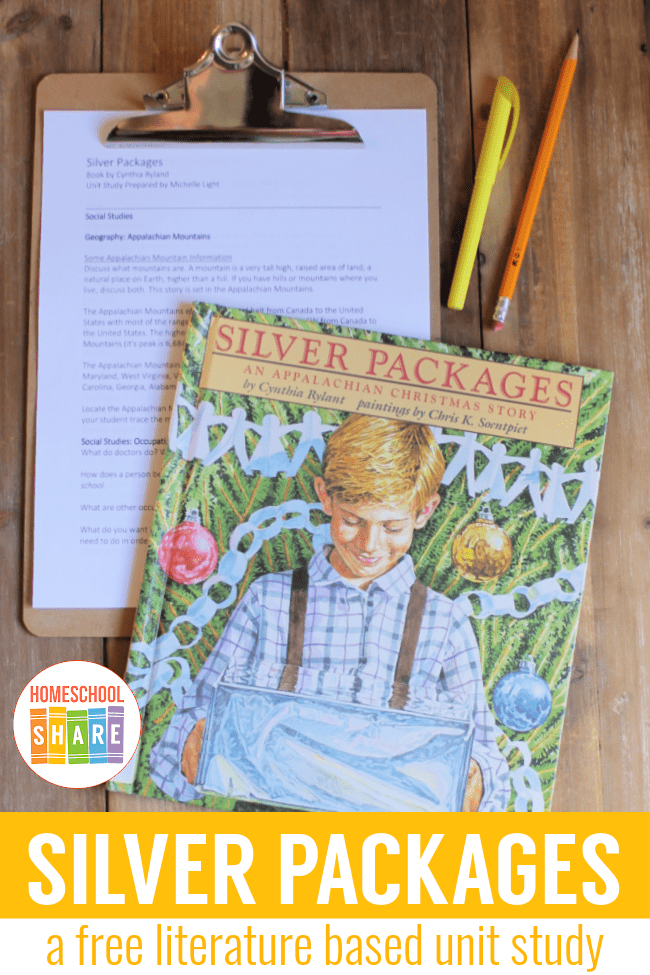
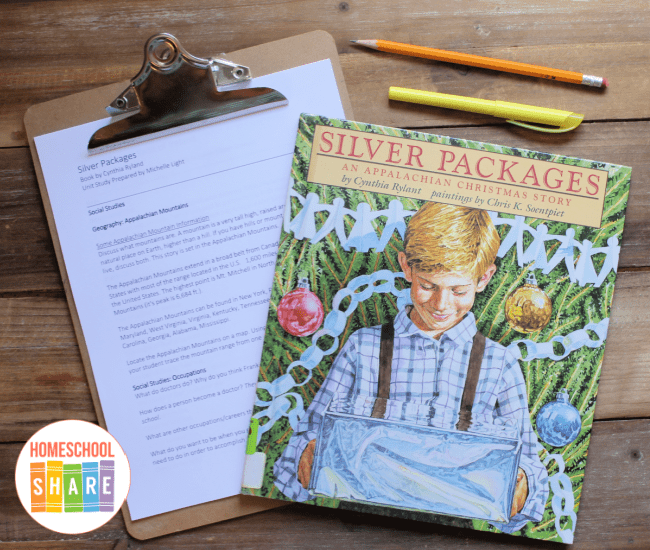
Silver Packages
An Appalachian Christmas Story
|
Author: Cynthia Rylant Illustrator: Chris K. Soentpiet ISBN: 053130051X Summary: In Appalachia each Christmas, a boy named Frankie waits beside the tracks for the Christmas Train, which will bring presents to the children who live in coal towns and hollows. Year after year, Frankie hopes that one particular gift a very special gift will be tossed to him from that train. It is this enduring hope that will guide him to the true meaning of the season. |
Unit Study Prepared by Michelle Light
Social Studies: Geography
Make a story disk and put it in the Appalachian Mountain Region. Do a study on the Appalachian Mountain Region or one or more of those states.
Some
Appalachian Mountain Information
North American
Mountains extending in a broad belt c. 1,600 miles SW from Canada to the United
States (with most of the range located in the U.S.). The highest point is
Mt. Mitchell in North Carolina's Black Mountains (it's peak is 6,684 ft.).
This eastern North American mountain system extends in a broad belt c.1,600 mi
(2,570 km) SW from the Gaspé Peninsula in Canada, to the coastal plain in
Alabama, USA. Mt. Mitchell at 6,684 ft in North Carolina's Black Mts. is
the highest peak. The Appalachian Mountains can be found in New
York, Pennsylvania, Ohio, Maryland, West Virginia, Virginia, Kentucky,
Tennessee, North Carolina, South Carolina, Georgia, Alabama, Mississippi.
Map
Another option would be to study all the
mountain ranges in North America or the United States.
Social Studies: Occupations
What do doctors do? Why do you think Frankie became a doctor?
How does a person become a doctor? They study hard, attend college and medical school.
What are other occupations/careers that can help people?
What do you want to be when you grow up? Why? What do you think you will need to study hard and go to college, etc. Is this occupation something that can help to serve others?
Pray that God leads you into the career he has for you, so you can help and serve others.
Social Studies: History -- The Santa Train
The
"Santa Train" been making it's annual run since 1943. (math lesson: How many
years will it have run this Christmas?) Each year it runs from Pikeville,
Kentucky to Kingsport, Tennessee and takes 15 ton (math lesson: how many pounds
is that?) of gifts, candy, and toys and distributes them to children along a
110-mile trip through Tennessee, Virginia, and Kentucky. (math lesson: If the
trip is 110 miles, how many miles has the train ran since it first began?)
Thousands of people come out for it.
A PDF file showing the 110-mile route of the Santa Train
Language Arts: Comprehension Questions:
Someone helps the man-but won’t accept his money? Why do you think they wouldn’t take the money? Would you? Do you think Jesus would have done?
(Tie in Good Samaritan story and the Golden Rule.)
Look at Frankie and his family, Do you think Frankie is rich or poor? Does he have everything he needs? (Notice the ornaments on the tree-where do you think they came from?)
How does the gift he receives from the train
each year help him?
Do you think they had a lot of gifts or few?
Do you think you will receive more gifts this
Christmas than Frankie did at Christmas?
How would you feel if you didn’t get what you wanted, but got what you needed instead? How would you act?
Does Frankie ever get his wish? (He becomes a doctor)
Who is the grown man in the story? (Frankie)
What did he become? (A doctor)
Do you think Frankie would have become a doctor if his desire for a doctor kit had been fulfilled?
Why does he come back to the mountains? He feels he owes a debt to others.
Language Arts: Memory/Recall
Yearly Frankie waits for the train: See how much your child can remember.
Recall the items that Frankie received each year? What does he receive the first year? Second year? How does he feel? How does he respond?
Have your child recall past Christmas gifts.
Language Arts: Plot
Refer to your Five in a Row Volume I Manual (page 44) for plot
review: setting, conflict, rising action, climax, and denouement. Discuss
each part of Silver Packages-- setting, conflict, etc. You may even wish
to map out the plot elements (see
PLOT MAP
for explanation/directions).
Language Arts: Writing Activity
Have your
student write to the Kingsport Chamber of Commerce to request information about
the Santa Train.
Kingsport Area Chamber of Commerce
ATTN: Santa Train
151 East Main Street
Kingsport TN 37660
Giving Opportunity: Let your child be a "rich man." Help your child to
choose a gift (must be new) to send to the above address. Perhaps a doctor's
kit? This gift will be handed out to a child on the next run of the "Santa
Train."
Language Arts: Vocabulary
Choose five or six words from the story that your student may not know. Have him write the words and their meaning on strips (perhaps 2 inches by 6 inches) of brown construction paper. (You could also choose to have him write this week's spelling words instead.) Make two long strips of aluminum foil or light gray construction paper (perhaps 2 inches by 18 inches, longer if you use more words). Arrange the silver strips vertically and parallel to one another about 3 inches apart. Attach the brown word strips horizontally across the two silver strips to make a railroad track of words. Display for the rest of the week you row. (Idea adapted from The Mailbox.)
Applied Math: Counting
Count any number of things in the book on the pages. (children standing by
train, toys, packages, etc.) Group and count people or things. See
math story problems in Santa Train (history) lesson.
Science: Steam
During
the 19th century, nearly all trains were powered by steam locomotives. A steam
engine requires that water be boiled (often by heating it with coal or wood) to
produce steam. The steam is then used to power the train, to make it go. It
was the job of the fireman to keep the fire burning. Today's firemen put out
fires, but the firemen of the past, on the steam locomotives, had to keep the
fire burning at just the right heat by shoveling coal or wood into the firebox.
See also the steam lesson from HSS's
Little Toot on the Mississippi.
Steam engines were noisy and produced a thick black smoke. You may wish to
discuss pollution. One reason steam locomotives are rarely used now, it because
they started powering them with diesel, which is cleaner (less polluting).
If your student enjoys trains, perhaps he would enjoy learning the correct terms
for various parts of a steam locomotive:
http://en.wikipedia.org/wiki/Steam_locomotive_nomenclature
Steamers get together all over the world! Perhaps your family can take a field
trip to one! Call your Chamber of Commerce to find out if there are any Steam
festivals in your area or check out:
http://www.discoverlivesteam.com/calendar/index.html
(You could also google for steam show or steam festival and your state.)
Go-along books:
Steam, Smoke, and Steel: Back in Time with Trains
by Patrick O'Brien (This book traces the development of the railroad
engines.)
Possible websites for the teacher to explore:
http://en.wikipedia.org/wiki/Locomotive#Steam
http://en.wikipedia.org/wiki/Steam
http://en.wikipedia.org/wiki/Steam_engine
Science: Coal
and Coal Mining
If your student has rowed The Rag Coat
(FIAR Vol. 1), you may wish to review the lessons on coal. Many
steam engines used coal to heat the water to make steam.
Coal is formed from dead plants that have been compacted and changed over time
into sedimentary rock. The types of coal are:
Lignite--a soft coal, contains the least amount of carbon.
Sub-bitmuminous--a medium-soft coal
Bituminous--a medium-hard coal with high heat value.
Anthracite--a hard coal, contains the highest amount of carbon. It
burns slowly and is the best kind of coal for heating homes.
To learn more about coal, visit:
http://www.teachcoal.org/aboutcoal/articles/coaljourney.html
(note: this website mentions "millions of years.")
http://en.wikipedia.org/wiki/Coal
Get great information as well as samples of peat, lignite, bituminous coal, and
anthracite by ordering a free coal kit from
The American Coal Foundation
Science: Flora/Fauna of the Appalachian Mountains
Smokey Mountains
Bible Study: Needs Vs. Wants
Does God promise to give us everything we want? Will he give us what we need?
Read Matthew 6:25 together
God supplies our needs.
Make two lists:
1. Needs
2. Wants
Draw, write or cut out pictures and paste them under the appropriate headings
Listing items in the story that Frankie received
and/or items you may want vs. what you may need
Bible:
Memory Verses
Frankie gets the desire of his heart (as discussed in Comprehension
Questions). You may want to discuss/memorize these verses.
Proverbs 13:12 Hope deferred makes the heart sick, but a longing (desire) fulfilled is a tree of life.
Proverbs 13:19 A longing (desire) fulfilled is sweet to the soul.
Bible: The Greatest Gift
Someone did something great for us…It
was God-and on Christmas he gave us a great gift…His Son-Jesus to come and die
for our sins, so we could live with God forever. The Bible says we were without
hope-lost (dead) in our sins. But Jesus came so we could live again.
Do you think we owe a debt to God? (Yes) Can we ever repay God? (No)
What could we do to show God we appreciate the gift he gave us? (Share Jesus with others and give of ourselves to others for His Sake.)
Art
Pretend You live where the train comes every year. What do you wish for?
Draw a picture of it, Cut out a piece of aluminum foil and glue the top of the foil over the picture and decorate the foil to look like a package. (Lift to see the picture.)
Draw a picture of God’s greatest gift to us. (Jesus) Glue a decorated aluminum foil piece over the picture-so you can lift it and see Jesus.) Thank God for his gift to us
Then make a picture of your gift to God and put a silver foil over it in the same manner.
(Who we become can be our gift back to God.)
Just for Fun
Read The Polar Express
Watch the movie The Polar Express (preview first)
Craft Idea
Hand make ornaments for your tree-similar to those in the book. You could also decorate your Christmas tree by wrapping small silver packages to hang.
Add even more to your Christmas Unit Study
Hands of A Child Symbols of Christmas Lapbook
Christmas Cheer Project Pack
Amanda Bennett Christmas Unit Study
Amanda Bennett Christmas Notebook Pages
Christmas Games Lapbook
Celebrating the Season: Our Christmas Copy Work and Activity Book
Materials and information on this website belong to the original composers. It may be used for your own personal and school use.
Material may not be used for resale. © 2005-07 HSS