| about us |
what's new
|
unit studies
|
unit study helps |
hss resources
|
fiar resources | indexes | lapbooking |
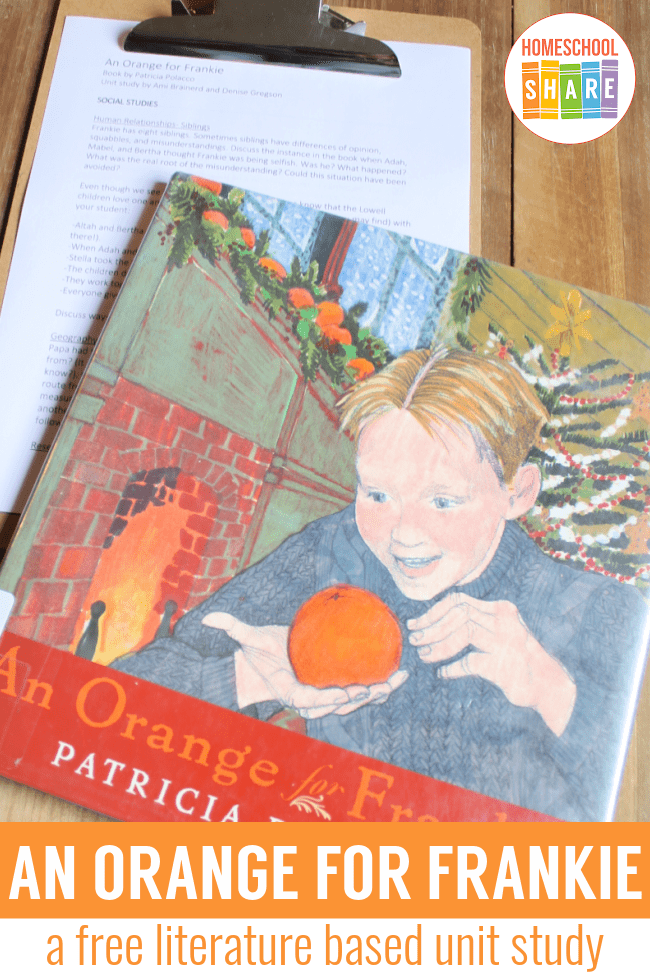
An Orange for Frankie
|
Author/Illustrator: Patricia Polacco ISBN: 039924302X |
Summary: Autobiography melds with history in this poignant tale of a family
tradition, set around Christmastime during the Great Depression. Polacco
introduces the Stowell family, a brood of nine living on a farm just outside of
Detroit. Though they don't have a lot, the family never hesitates to share its
good fortune, often feeding hungry hoboes as they pass through the nearby train
station. Frankie, the youngest son, even gives one of them his favorite sweater.
When Frankie loses the precious Christmas orange given to each child, he tells
his mother about his error and also fesses up about his missing sweater. His
family is so moved by his charitable gesture, that they rally to make sure
Frankie has the most special gift of all. Polacco illustrates the story in her
trademark watercolor-and-pencil style, with key elements picked out in bright
color against more muted backdrops. Like many of Polacco's picture books, this
holiday story about gifts and giving is based on a chapter from her own family
history.
Unit Study Prepared by Ami Brainerd and Denise Gregson
SOCIAL STUDIES
Human Relationships- Siblings
Frankie has eight siblings. Sometimes siblings have differences of opinion,
squabbles, and misunderstandings. Discuss the instance in the book when Adah,
Mabel, and Bertha thought Frankie was being selfish. Was he? What happened?
What was the real root of the misunderstanding? Could this situation have been
avoided?
Even though we see his sisters get upset with him, we know that the Lowell
children love one another. Discuss these examples (and others you may find)
with your student:
-Altah
and Bertha working together in the kitchen (and they appear happy to be there!).
-When Adah and Mabel arrive, they are showered with hugs.
-Stella took the time to knit Frankie a sweater and a matching muffler.
-The children don't argue while they are looking for their Christmas tree.
-They work together to decorate the tree.
-Everyone gives up a section of orange for Frankie.
Discuss ways your student can demonstrate love for his own siblings.
Geography- Michigan and Florida
Papa had to go to Lansing, MI to get the oranges, but where did the oranges
come from? (It mentions this in the story -- does your student remember or
already know?). Oranges come from Florida. Get out an atlas of the United States. Find a route from
Lansing to Florida. Measure the mileage. Find another route and measure the
mileage. Compare. Which one is shorter? Can your student find another route
that's even shorter? (Continue this lesson by determining the following: How
far is Florida from your house? Lansing?)
Prepared Michigan Notebooking Page
Michigan Information Page
Michigan Outline Map
Research Option: Great Depression
This story is set in the time of the Great Depression. Let your older
student research this time era.
Great Depression Notebooking Page
BIBLE
Bible & Human Relationships: Hobos and Compassion
Compassion Notebooking Page
A hobo is a homeless and usually penniless wanderer. Mrs. Stowell is kind and
compassionate to the hobos. She gives them plenty of food to eat; she even
prepares it ahead of time for them. Can your student remember all the different
kinds of food that are being prepared?
Society, in general, doesn't really care
for people such as these, but Mrs. Stowell is teaching her children
differently. She sees them as human beings deserving respect. She calls each
one mister instead of calling them by their hobo nicknames (Jump-up Billy or Too
Tall Jake).
Frankie also shows compassion. Can your student recall Frankie's act of
kindness? (giving up his special sweater)
Read and discuss the following verses from the Bible:
"For I was hungry and you gave me something to eat, I was thirsty and you gave
me something to drink, I was a stranger and you invited me in." Matthew 25:35
"Sell your possessions and give to the poor. Provide purses for yourselves that
will not wear out, a treasure in heaven that will not be exhausted, where no
thief comes near and no moth destroys." Luke 12:33
"Suppose a man comes into your meeting wearing a gold ring and fine clothes, and
a poor man in shabby clothes also comes in. If you show special attention to the
man wearing fine clothes and say, 'Here's a good seat for you,' but say to the
poor man, 'You stand there' or 'Sit on the floor by my feet,' have you not
discriminated among yourselves and becomes judges with evil thoughts? Listen, my
dear brothers: Has not God chosen those who are poor in the eyes of the world to
be rich in faith and to inherit the kingdom He promised those who love Him? But
you have insulted the poor. Is it not the rich who are exploiting you? Are they
not the ones who are dragging you into court?" James 2:2-6
"If anyone has material possessions and sees his brother in need but has no pity
on him, how can the love of God be in him? Dear children, let us not love with
words or tongue but with actions and in truth." 1 John 3:17-18
Perhaps you could serve a meal at a soup kitchen/homeless shelter as a family to
reinforce this lesson.
The Christmas Story
Pa proclaims, "It being the morning of the eve of our Lord's birth..." Who
is our Lord? Take some time this week to read Jesus' birth from the Bible.
Luke 2:1-20, Matthew 1:18-25; Matthew 2:1-12
Sowing and Reaping
The Bible says, "whatesoever a man soweth, that shall he also reap."
(Galatians 6:7)
Ma sows seeds of kindness when she provides breakfast for Mr. Dunkle and the
hobos. Does she reap kindness? How does Mr. Dunkle show kindness to the
Stowells?
Disobedience
Memory Verse: "Children, obey your parents in the Lord for this is right."
Ephesians 6:1
The Bible commands obedience. What did father tell the children about the
oranges? (Don't touch them!) Frankie put himself in a bad situation; he
shouldn't have been in the parlor alone. First, he looked at the fruit...then,
he got so close he could smell it. Temptation was inevitable. Discuss this
with your student. The Bible tells us to flee (run!) from temptation. We need
to be careful not to put ourselves in situations where we know it's going to be
difficult to make the right choice. Of course, we can't avoid every temptation
in life, but we need to be aware. We also need to pray and ask the Lord to help
us resist temptation.
After Frankie slipped the orange in his pocket (to hide it from his mother-- yet
another bad choice!), he thought "no one would know that he disobeyed his
father." However, the Bible says be sure your sin will find you out (Numbers
22:23). Even if our parents don't find out (which Frankie's do), God can see us
all the time and He knows.
What was the result of Frankie's disobedience? He lost his orange-- the orange
his father had worked so hard to get. How do you think Frankie felt once he
realized the orange was gone? Frankie had to deal with that terrible sinking
feeling in his stomach until he confessed to his mother. Even though his mother
was disappointed, she showed Frankie love. His entire family gave him grace
(grace is getting something we don't deserve)! You may want to parallel this
story to the story of God's love and grace for us.
LANGUAGE ARTS
Writing from Experience
Does your child
think that maybe this story is based on a true story? Why or why not? The
italicized introduction and conclusion give the impression that it is based on
the author’s own life and family. Turn to the dedication at the end of the book
and see if that helps your child decide. Ask your child if he can think of an
incident in your own (extended) family’s life that would make a good story? He
could write it down or dictate it to you.
Language Arts & Social Studies- Compare and Contrast Christmas Traditions
Make a list of all the Stowell Christmas traditions. After you complete the
list, make a list of your own family Christmas traditions. Next, make a Venn
Diagram comparing and contrasting the Stowell's Christmas traditions to your
own. Remind your student that comparisons go in the middle section that
overlaps. You can use this
Prepared Venn Diagram to help you with this lesson.
Language Arts- Simile
Pa says, "Our family is like your orange...love holds us together like that
there ribbon."
Does your student recognize this literary device? It's a simile (a comparison
using like or as). Encourage your student to think of a simile that describes
your family.
"Our family is like a ____________________" Have him explain
and extend the comparison as
well.
Language Arts- Vocabulary
Prepared Vocabulary Puzzle
stoking- to stir up or tend
lingered- to be slow in quitting a place or activity
hurtling- to move suddenly or violently
surveyed- to look over and examine closely
raggedy- torn or worn to or as if to tatters
fainter- not clear or plain
scold(ed)- to find fault *scold is used in the puzzle
withering- to lose liveliness, force, or freshness
abundant- plenty, existing in or possessing abundance
vexed- to bring trouble, distress, or worry to
lamenting- to express sorrow for
luscious- having a delicious taste or smell
gazed- to fix the eyes in a steady intent look
horror- strong fear, dread, or dislike
burlap- a rough fabric made usually from jute or hemp and used mostly for bags
and wrappings
SCIENCE
Botany: Citrus Fruits
Oranges are citrus fruits. Other citrus fruits include lemons, limes and
grapefruit. Citrus fruits contain vitamin C. Vitamin C helps our bodies to heal
and to fight infections, and we should get a good source each day. Other good
sources of Vitamin C include: strawberries, kiwi, papaya, melons, peppers,
broccoli, cauliflower and cabbage.
It is recommended that we get at least five servings a day of fruits and vegetables for optimum health. Take this opportunity to encourage healthy food habits in your child. Use the prepared Fruit/Vegetable Checklist for your child to keep a record of the fruits and vegetables he eats each day for a week. Strive for five servings a day with as much variety as possible. Your older student should write in the name of the fruit/vegetable eaten; your younger child can apply a sticker for each one. Repeat this activity from time to time to remind them of the importance of nutrition for good health.
Try making fruit kabobs by adding a variety of fruit chunks onto skewers. They are colorful, fun to eat, and nutritious!
Nutrition
for Kids
Dole 5 a Day
Orange Slice Science Experiment witih Robert Krampf
Botany: Coniferous Trees
Deciduous trees
are trees with leaves that fall off, usually in autumn. Coniferous trees, on
the other hand, do not have leaves like a deciduous tree. They have needles and
scales instead. Some produce a berry-like fruit. The leaves are sticky and have
a scent. The leaves/needles are poisonous to eat. Pine, fir, spruce, cedar,
hemlock and redwood trees are all examples of coniferous trees. These
trees/shrubs are evergreens- meaning they stay green all year and is why
conifers are used for Christmas trees and greens.
The seeds of pine trees are
hidden deep inside the pine cones, and you may have eaten them before – pine
nuts! Because they are so difficult to harvest they are expensive. Pine nuts
are used in pesto sauce or taste nice lightly roasted. Like most nuts and seeds
pine nuts contain protein, healthy fat and vitamins and minerals. Find some to
snack on this week!
Coniferous Trees Notebooking Page
Pine
Cone Bird Feeder Craft Idea:
Supplies Needed:
· A large pine cone
· Some string
· Vegetable shortening, lard or suet
· corn meal
· Bird seed
Food
mixture:
Mix 1/2 cup Vegetable shortening, lard or suet with 2 1/2 cups cornmeal until
well blended. (Optional: add chopped fruit or nuts as well)
Tie a few feet of the string to the pine cone.
Cover the pine cone with the food mixture.
Roll the pinecone in the birdseed.
Hang on a branch of your tree outside.
Steam Engines
Steam Locomotives were designed in the early 1800s to improve the speed of
carrying goods.
Steam makes the steam locomotive move. Steam comes from boiled water. Have you ever seen steam come out of a pot when someone is boiling water? Inside the steam locomotive there is water and a fire to heat the water to make the steam. Steam under pressure provides the power to make the wheels go round. The used steam, along with the smoke from the fire, goes up the smokestack.
Modern locomotives are powered by electricity and diesel fuel (fuel that has been processed from petroleum/oil).
Refer the the Steam Locomotive Worksheet for more on steam locomotives
A Printable Book for Early Readers
Nervous System, Skin + The Five Senses
Can your child name the five senses?
The more senses that an author evokes from his/her writing the more memorable the story will be for the reader.
Sight: What colors stand out in the illustrations? (answers could include: the bright color orange contrasting against the greens, colors of Christmas, white snow)
Hearing: What sounds that aren’t in the text can you “hear” as you look through the illustrations? (e.g. train whistle, clattering of pans, chattering of voices, animals playing, wind howling)
Smell and taste:
Review
these portions of the story:
“The
kitchen was already smelling like hoecakes and warm molasses. The aroma of
coffee and chicory was hanging low in the air."
The orange "smelled like sunshine".
Play a smelling game. Without your child watching, gather up some items such as a citrus fruit, a few spices, coffee, vinegar or others recognizable scents/smells. Blindfold your child, let them sniff the items individually and have them guess what it is they are smelling.
Now try a similar tasting game. Have your child close their eyes and pinch their nose and see if they can differentiate the flavors of some various juices or some flavored candy. Have them let go of their nose and try it again. Taste and smell are closely related. Tiny smell particles come off things and go into your nose. Your nerve cells then send information to your brain as to what you are smelling. When you eat, some of these particles go up your nose which means your nose helps with taste. Did you ever notice when you are sick and your nose is stuffed up that you can’t taste or enjoy your food as much?
Touch/Feeling – (The Skin You’re In):
Your skin is like a protective bag. Try this skin experiment: Use a zip-lock
plastic bag, and two pieces of bread that have been dampened. In the bag place
one piece of bread and seal it. Leave the other piece of bread out in the
open. Our skin keeps moisture in and dirt out. Just as the bread in the bag
stays clean and damp, our insides stay clean and damp inside our skin "bag".
The piece of bread that was not protected by "skin" dried out and was exposed to
"germs". You have two main layers of skin. The outer layer is called the
epidermis and the layer underneath is called the dermis. Your body is always
making new skin and most of the skin you see is dead skin that sloughs off to
make room for the new skin.
In the story it says "he noticed how [the oranges] seemed to have pores, just like his own skin."
Using a small scope or magnifying glass look at the skin of an orange; then look at your own skin to compare. Draw what you see.
Sometimes skin is especially dimpled like an orange if there is cellulite. Cellulite is usually found on hips, thighs, and buttocks. Cellulite is actually just bunches of fat that push against the tissue beneath a person's skin and causes the surface of the skin to dimple or pucker. Most girls and women - and some men - have some cellulite. Nobody likes cellulite but there aren't any miracle treatments that can make it go away. (Sad to say you may have some to show your child – if your pride can handle it show an example :>)
Use the Skin Observation and the Skin Comparisons sheets (from highland hitchco) to help your child make further observations about skin.
Your skin is filled with tiny nerve endings or sensors. Sensors help you to feel the characteristics of things you touch such as whether it is smooth or rough, warm or cold etc. A message is sent to your brain. These sensors also help you to feel pain – another way your skin protects you. The message is sent to your brain to stop touching the thing that is causing pain. When you pull your hand away from a hot stove quickly, that is called a reflex.
Reflexes
A reflex is something that you don’t have to think about making happen -- it
happens automatically. Reflexes happen quickly and are difficult or impossible
to stop. Reflexes are the reaction your nervous system produces in response to
conditions your body finds itself in. Your nervous system is made up of your
spinal cord (a large bundle of nerves which your backbone protects), all the
other nerves that reach to every part of your body, and your brain. The nerves
are like telephone wires in that they carry messages back and forth from the
different parts of your body to your brain. The brain is like the central
office in that it gives instructions to the rest of your body about how to react
(usually to protect itself). This all happens so fast we sometimes don’t even
realize it has happened.
Feeling Heat
The pores on your skin are where sweat comes out when your whole body is hot.
Sweat glands in your skin make this sweat and as the sweat evaporates it takes
heat away from your body, thus cooling you off.
Feeling Cold
Shivering is also reflex. If the temperature outside is cold, the nerves in your
skin feel that and send the message to your spinal cord. From there the message
quickly moves to the other nerves in your body and your muscles respond by
tightening and loosening repeatedly (your body shivers). This movement of the
muscles creates heat which warms you up!
Goose flesh, as some call it, appears when the muscles get cold and contract. In order to try to trap the heat the hairs stand on end and the skin puckers. This is also known by some people as chicken skin, goose pimples or goose bumps.
Skin Vocabulary (simplified) Worksheet
Use
the expanded vocabulary sheets with your older student to research more about
skin:
Skin Vocabulary (expanded)
Have your child record what he has learned about skin using the Skin Notebooking Page
APPLIED MATH
Reasoning Skills
Print out the names of the Stowell children using the
Name Sheet. Using the clues from the
first few pages of the story, have your student arrange the names in order from
oldest to youngest. Note: We do not know the exact spots of Adah and Mabel, but
we can infer that they are #2 and #3 (we just don't know which one is which).
Answer (have your student check his answer with the dedication note at the end
of the book where they are listed in order):
1. Stella
2. Adah
3. Mabel
4. Ernest
5. Will
6. Frankie
7. Bertha
8. Alta
9. Ivah
Skip Counting
By
Eights:
Frankie's mother used eight wedges from his siblings to replace his orange.
Learn to skip count by eights this week (or review your 8 family multiplication
facts). Take an orange and cut it into 8 slices by cutting it in half, into
quarter, and then cutting each quarter in half again.
By
Twos:
Look
at the illustration that shows a large portion of the train. Try counting by
2’s the wheels that are visible in the illustration (note each car has two sets
of wheels at the front and two at the back.
ART
Progression of the Illustrations
Note
the progression of the illustrations and how they draw you as a reader into the
story. The inside cover shows an early morning aerial view of the home and area
around the home. Next, a train pulls up and some people get off heading toward
the house (these are both still the introduction to the story). As the story
begins we see the children looking expectantly out the window. The reader gets
a sense of being invited into the home. Sure enough, a turn of the page
welcomes us right into the family home . The illustrations that follow show us
more details and experiences in the life of the family, with an increasing focal
point on Frankie. As we say goodbye to the family, the inside cover at the back
of the book shows us an evening view of the outside of the home. The story is
complete…
Illustration Effects
Study the following effects (snow, transparency and wind) in the
illustrations and have your child try her hand at one or more of them:
Illustrating Snow:
Study
Polacco's snow illustrations. Ask your student what medium she thinks Polacco
used. Ask her, how do you think Polacco made that snow? Experiment with
creating a winter scene (in the medium of your student's choice) and when your
student is finished, add snow (you may want to try more than one way and decide
what works best).
Transparent effect:
Note how the sheer curtains are illustrated to give a transparent effect through
layering of the mediums. A transparent effect could result from white water
color over paint or from chalk over paint, perhaps chalk pastel pencils.
Illustrating the effect of wind:
There
are several illustrations in which the wind appears to be blowing quite hard.
Can your child spot them? How do they know that it is windy? Look at some of
the illustrations in which the scarves are blowing. From which direction is the
wind blowing? It is important for an illustrator to be sure that an illustration
shows consistency in the direction of the wind.
Details
Note
the various expressions on the faces which show expectancy, excitement, pride,
love, joy and other emotions. Did you notice that the siblings show resemblance
to one another. I’d say it is easy to tell that they are related!
In the early morning illustration at the window one of the boys has messy hair. He likely hasn’t had time to comb his hair yet!
On the faces of the hoboes you can see wrinkles. The lines in the hands are also detailed.
Look very closely at the scene where the hoboes are being fed and notice the steam coming out of the kettle and the hot coffee.
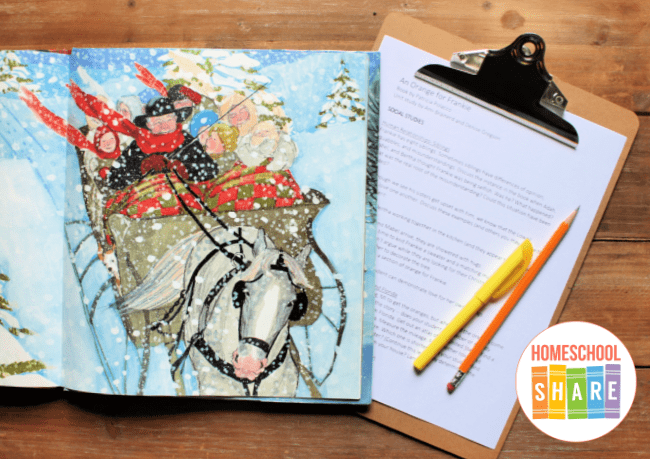
Are there footprints in the snow scenes and sleigh tracks as well?
Did you see the horse shadows in the barn illustration in the back inside cover of the book?
Such details give validity to the illustrations making them seem realistic.
OTHER SUGGESTED ACTIVITIES
*Make a gift for someone (instead of buying a gift)
*Try finding a recipe for Hoecakes with molasses
*Bake Christmas Cookies together
*Go to a Christmas Play
*Eat popcorn and drink hot chocolate (be sure to "slurp it with great gusto!")
*Try making fondant candies/creams with
the Fondant Recipes
*Read some other Patricia Polacco Christmas stories together:
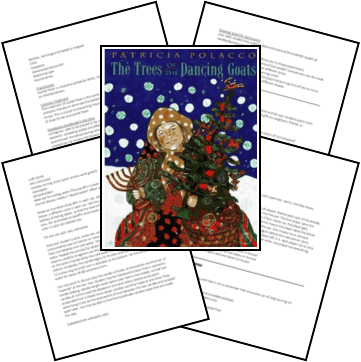
The Trees of the Dancing Goats
Christmas Tapestry
Materials and information on this website belong to the original composers. It may be used for your own personal and school use.
Material may not be used for resale. © 2005-07 HSS