Google
 
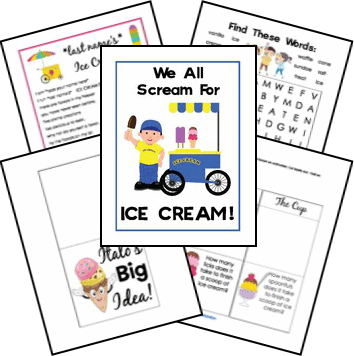
Free Icecream Unit and Lapbook

We all Scream for Ice Cream!

A multi-book unit and lapbook created by Kris Doyle


Lapbook Templates and Printable Resources

July Calendar (full size)
 
Cone Venn Diagram
 
Avayou Accordion
 
July Calendar (wallet size)
 
Italo's Big Idea Simple Fold
 
Fornachou Accordion
 
Vocabulary Shapes
 
From Cow to Cone Wheel
 
Doumar Accordion
 
Cream Acrostic Poem
 
World Map (2000 Top Five)
 
Hamwi Accordion
 
Ingredient Cards & Pocket
 
Double the Fun Recipe L Book
 
Marchiony Accordion
 
Taste Test Sequencing
 
Metric Conversion L Book
 
Menches Accordion
 
Estimation Matchbooks
 
From Pasture to Pasteur Clipboards
 
Odious Organisms FAQ
 
Frozen in Time Timeline
 
Trivia Gameboard
 
Air ~ What Does it Do? (small lines)
 
Timeline Information
 
Trivia Gamecards
 
Air ~ What Does it Do? (larger lines)
 
Memory Game Cards
 
National Ice Cream Month T-book
 
Different Treats Flap Book
 
How Many Words Accordion
 
Salty Slush Trifold - younger
 
Ice Cream in a Bag  Pocket & Cards
 
Trading Cards & Pocket Salty Slush Trifold- older Custom Carton Cartoon

Main Books (needed to go with lessons)
Ice Cream written by Elisha Cooper

Ice Cream: Including Great Moments in Ice Cream History written by Jules Older

Ice Cream Cones For Sale written by Elaine Greenstein   


Optional Library List
Ice Cream: The Full Scoop written by Gail Gibbons

We All Scream for Ice Cream: The Scoop on America's Favorite Dessert written by Lee Wardlow

From Cow to Ice Cream: A Photo Essay written by Bertram T. Knight

Ice Cream Treats: The Inside Scoop written by Paul Fleisher


Social Studies

Time Line
There are many different stories about how ice cream might have been discovered or invented.  The history outlined in the history/timeline file is based on information found in Ice Cream: Including Great Moments in Ice Cream History by Jules Older. 

Discuss how it is very possible for more than one person to have a similar idea.  This seems to be the case with the evolution of ice cream! One thing we know for sure is that it took a lot of people and many, many years of experimenting to perfect the balance of texture and flavor we come to expect from today’s ice cream.

There is also a trading card activity to work on alongside the timeline unit.  Students will write down the name of the person, specific year this person was mentioned in the ice cream history timeline, what this person contributed to ice cream history and then can either print out a picture of the person or draw a picture on the trading card.

Printables
Frozen in Time – teaching guide

Frozen in Time Accordion

Ice Cream Trading Cards

History and President Regan
On July 9, 1984 President Ronald Reagan issued a special Presidential Proclamation declaring the month of July as National Ice Cream Month.

Our United States law allows for the declaration of special selected public observances.  These observances allow the President of the United States (“as designated by Congress or by discretion of the President”) to issue a declaration or proclamation in regards to a special occurrence.  The President typically provides an explanation or reasoning behind the special occurrence.  As the president does this, he calls on the people of the country to observe the day “with appropriate ceremonies and activities”. T-Book National Ice Cream Month

Geography
On page 30 of the book Ice Cream: Including Great Moments in Ice Cream History by Jules Older, the top five ice cream consuming countries are listed for the year 2000.  They were:
5) Sweden
4) Australi
3) Finland
2) New Zealand
1) The United States of America

 With the help of an atlas your child will locate the country and either label it, number it, or indicate its location on the attached map.


Language Arts

Vocabulary
Write the vocabulary word and definition on the ice cream scoop graphic. Glue the scoops on the ice cream cone!

1) Bacteria: large group of disease causing microorganisms

2) Cream: Yellowish fatty part of milk that rises to the surface

3) Emulsifier:   a substance added to milk after it is homogenized that attaches to the small bits of leftover fat and prevents them from lumping back together

4) Homogenization: Process that pushes small fat particles in milk through tiny holes in an effort to break down the particles and make the milk smooth and even

5) Inventor:  A person who the first to make or create something

6) Palate: roof of the mouth where food is held for the tongue to taste

7) Pasteurization:  Heating process that destroys bacteria in fresh milk and lengthens the time which milk can be safely stored 

8) Patent:  An official document provided from the government that allows the inventor sole rights to make, use and sell the described invention for a set period of time

9) Stabilizers: keep ice cream from forming ice crystals and help keep the ice cream from melting too fast

10) Udder: Sack that hangs under the cow’s belly where milk is produced and stored by the cow.

11) Vanilla: flavoring extracted from the vanilla seed pod

12) Waffle: A crisp cake made from batter poured on a hot grid-like iron

Poetry (Acrostic)
An Acrostic Poem is a simple poem to teach.  First you need to choose a word and write it vertically.  The first letter of each line forms a word or group of words that describes the subject or tells a story about it.  In this version we will use the word “CREAM”.  Here is an example:

Cows
Really
Expel
A lot of
Milk

Acrostic Flap Book  (If your student would like to use a word other than cream, just make your own flap book.  You can find templates here.)

Alphabetical Order
Pages 20-21 of Ice Cream lists ingredients used to make various flavors of ice cream. Cut the ingredient cards out and have the kids place them in ABC order.  Store them in the pocket.
Ingredients ABC cards and pocket

Story Sequencing:
Pages 30-31 of Ice Cream outlines the steps an ice cream taste tester must take when testing a batch of ice cream.  Have child cut the strips out and organize them in the correct order.
Taste Test Strips

Biography Booklets: Who’s Who?
Ice Cream Cones for Sale! tells us a story about the great 1904 ice cream cone controversy.  The book introduces us to six individuals that claimed to invent the ice cream cone. 

Use the various accordion books (found in the chart at the top of the unit) to record information about each inventor.  Inventors include Hamwi, Avayou, Menches, Fornachou, Doumar, and Marchiony. 

Creative Writing:
Italo’s Big Idea - On page 17 of Ice Cream Cones for Sale!, the author imagines how Italo might have stumbled upon his cone invention.  Using your imagination, come up with a story of your own.  Italo’s Big Idea Simple Fold 

Compare/Contrast Cones
As we read in Ice Cream Cones for Sale! several people claimed to have discovered the ice cream cone at the World’s Fair.  However, we learn Italo had applied for a patent for his version of a cone before the World’s fair opened.  One page 23 the author shows an illustration of Italo’s cone and the cone introduced at the fair. What are the individual characteristics of the two cones?  What are some of the similarities of these two different cones?  The differences? Use the provided Venn diagram booklet.

Words Within a Word- Pasteurization
After you complete the science lesson on pasteurization, complete this minit book with your older student.


Math

Calendar
Since July is National Ice Cream Month, you can make your own July Calendar Page to include in your lapbook.   You can use this to teach your younger student counting and/or days of the week.  An older student can write other important July dates (holidays, birthdays, etc.) on his calendar. 

Blank July Calendar full page
Blank July Calendar (wallet size)

Metric Conversion
Convert the ingredients in the provided ice cream recipe from Customary US measurements to Metric Measurements. Your student will need to research unit conversions.
Metric Conversion L Book

Double the Fun
Double the ingredients found in the provided ice cream recipe to make a double batch.  Want to really show off?  Triple them!
Double the Fun L Book

Estimation
Do you know many licks does it take to finish a single scoop of ice cream?  How about how many spoonfuls to finish a cup of ice cream? Of course it will vary from child to child!  Have you child write an estimation on the inside of the matchbooks and then try it out!  Make sure to remind them to keep count as they complete their math for the day! 
Estimation Matchbooks 


Science

From Cow to Cone
The book Ice Cream outlines the steps milk takes in order to get from the cow to the cone.  List the process milk takes from the cow in the pasture to the cone in your home in six steps. Write each of these steps in the circle book per the circle book instructions.

  1. Milking
  2. Transportation to Factory
  3. Pasteurization and Processing
  4. Flavoring
  5. Freezing
  6. Transportation to Store

From Cow to Cone Wheel


Freezing Temperature Experiment

Making Cold Water Even Colder
Pages 4-6 of Ice Cream: Including Great Moments in Ice Cream History Salt talks about how salt lowers the temperature of the water, allowing it to get colder quickly.  This drops the temperature of the water to below freezing (around 28 degrees F and  -2 degrees c).  This super cold icy water quickly helps turn our liquid ice cream mix into a solid.

The children will take part in a very simple science experiment.  They will need the following:

2 clear plastic cups
Salt
Ice
Water
2 thermometers (ones that are easily read, preferably in both Celsius and Fahrenheit, and safe for use by children)
Measuring spoons
Timer 

1)    Fill two clear plastic cups 1/2 full with crushed ice.  
2)    Pour 1 Tablespoon of water into each cup. 
3)    Place the thermometers in each cup.  
4)    In one cup place two teaspoons of salt. Label that cup “Salt”. Stir the water. 
5)    Observe the temperature of each cup and record.  
6)    Check and record the temperature of each cup ever 15 minutes (for a total of 30 minutes) 

Answer the questions in the Salty Slush Trifold (younger)

Molecule Rule: Giving the Cube a Cold Shoulder (extension for older students)
Water molecules bump against the ice cube.  The ice molecule takes heat energy away from the water molecule. In doing this the water molecule has less heat energy and so it’s colder. Without salt the cold water molecule would refreeze back on the ice cube.  When you add salt to the icy water the water molecule can’t reattach itself to the ice cube.  And as more ice cubes strip the heat energy from the water and use this energy to detach the water drops in temperature allowing our liquid ice cream mix to form into a solid.

Answer the questions in the Salty Slush Trifold (older)

Pasteurization
Page 26 of Ice Cream talks about the various steps milk needs to go through before being made into ice cream.  One of those steps is pasteurization.The Odious Organisms Printable for this lesson explains how organisms enter our milk supply and how pasteurization helps to eliminate them.  Have the older kids research the pasteurization process. 

Milk: From Pasture to Pasteur (older kids) 

Ice Cream Making Process
The booklet for this lesson explains why air is so important in making ice cream smooth and creamy.  A picture of the major parts of a hand crank ice cream machine is included for the kids to label using pages 6 and 7 of Ice cream: Including Great Moments in Ice Cream History as a guide.  The kids are encouraged to describe how the hand crank machine works to create creamy ice cream and also the commercial ice cream machine.

Air Booklet – older kids

Air Booklet – younger kids


Fun

Design your own ice cream carton label
On pages 23-24 of Ice Cream the author talks about how ice cream factories order their own special custom cartons.  These cartons include a name and a drawing on them. This is your opportunity to design your own Custom Carton Cartoon!

Custom Carton Cartoon

Memory Match-Up Game
Cut out the cards, separating the pairs.  Place the cards face down on the floor and have your child flip one card, then turn it back over.  See if they can remember where the matching pair is located.

Ice Cream Trivia Game
Print out the game board and game pieces on cardstock.  Game cards can be printed on card stock or regular printer paper.  Cut out cards.  Fold cards and glue them together.  Follow directions for trivia game.

Ice Cream Treat Match Up
Flap Book
Answers are: a. Ice Cream Sandwich, b. Ice Cream Soda, c. Banana Split, d. Ice Cream Sundae, e. Ice Cream Bar, f. Pie a la Mode, g. Ice Cream Cake  

Ice Cream in a Bag Recipe
A real working recipe for making ice cream in a ziplock bag!

Cupcake Cones
1 package dry cake mix (any flavor)
24 flat bottomed ice cream cones
water, oil and eggs indicated on box of cake mix

1) Preheat oven to 350F.
2) Mix cake mix per directions on box.
3) Place ice cream cones in muffin pan and fill about 1/2 to 3/4 full.
4) Bake 15 to 20 minutes or until done.
5) Cool on a wire rack. Let cool completely if frosting.

When frosting cupcakes, place frosting inside quart sized ziplock bag.  Seal.  Snip corner of bag with scissors.  Squeeze frosting onto cupcake in a swirl so the icing resembles a soft served cone. Makes 18 to 24 cupcakes

Ice Cream Cookie Cups

*Package refrigerated cookie dough

(2) 12-cup Muffin pans

Aluminum foil

1) Divide dough in half.  Form each half into a disc. Wrap each disc in saran wrap. Chill for 2 hours.
2) Preheat over to 375 degrees F. Turn muffin pans bottom side up.  Cover bottoms of cups with squares of foil. Only use every other cup to allow for space between cups.  Spray foil with non-stick cooking spray.
3) Unwrap one disc of dough.  Roll it out into a 1/8 inch thickness (place between two pieces of waxed paper for more ease in rolling).  Cut out 4 inch circles of dough using water glass.  Place circle of dough over bottom of cup bottom, smoothing any cracks.  Repeat with other discs.  Re-roll as needed re-using dough scraps.
4) Bake cookie cups for 10-12 minutes or until light brown. Cool for 10 minutes then remove the foil and cookie cup together from the muffin pan bottoms.  Peel off foil and let cups cool completely on a cooling rack.
5) To serve, fill each cookie cup with a scoop of ice cream.  Makes 10 cookie cups
*You can substitute your favorite homemade cookie dough for refrigerated cookie dough.


Materials and information on this website belong to the original composers. It may be used for your own personal and school use. 

Material may not be used for resale © 2005-07 HSS