Google
 
Fatuma

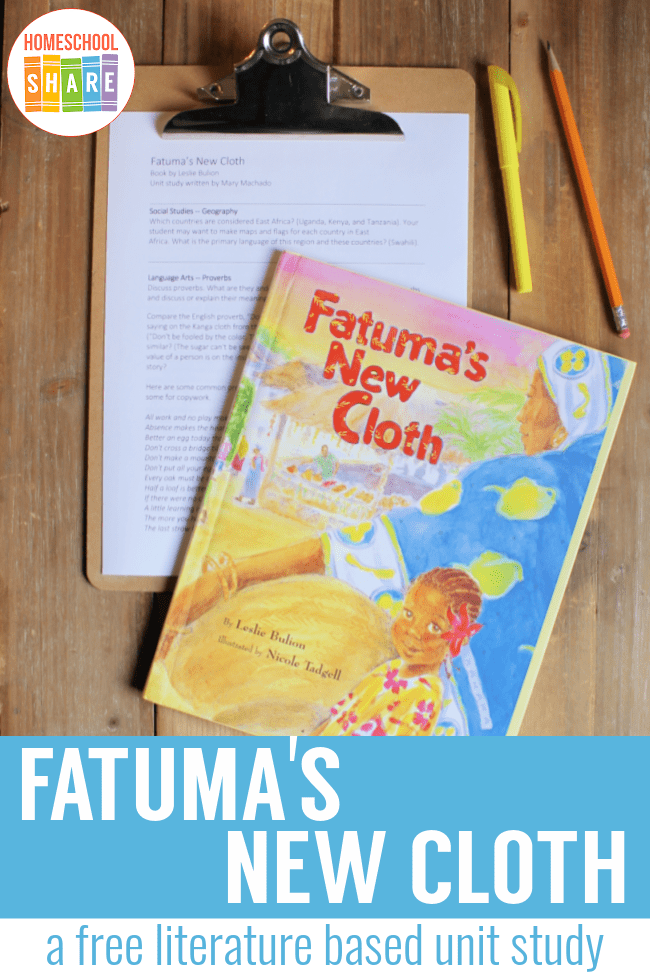
Fatuma's New Cloth

Author: Leslie Bulion
Illustrator: Nicole Tadgell
ISBN: 0-9677929-7-5
Summary:   In East Africa, a young girl learns that one cannot always judge by appearances as she and her mother visit a market in search of kanga cloth and meet merchants who all claim they have the secret to good Chai (tea).


Literature Based Unit Study by Mary Machado and Ami Brainerd


Social Studies -- Geography
Which countries are considered East Africa? (Uganda, Kenya, and Tanzania). Your student may want to make maps and flags for each country in East
Africa.  What is the primary language of this region and these countries? (Swahili).

Kenya Map Outline
Kenya Flag

Tanzania Map Outline

Tanzania Flag

Uganda Map Outline
Uganda Flag


You or your older student may want to research East Africa customs and traditions.

In the Hands of a Child- Africa Lapbook


Language Arts -- Proverbs
Discuss proverbs-- what are they and how are they used?  Share common proverbs and discuss or explain their meanings. Compare the English proverb,
"Don't judge a book by its cover" with the Swahili saying on the Kanga cloth from the book  "Usihadaike na rangi tamu ya chai sukari" ("Don't be fooled
by the color. The good flavor of tea is the sugar.") How are they similar? (the sugar can't be seen as the inside of the book is also unknown-- the
value of a person is on the inside)  How does this saying relate to the girl in the story?

Here are some common proverbs to discuss with your student.  You could also use some for copy work.

All work and no play makes Jack a dull boy.
Absence makes the heart grow fonder.
Better an egg today than a hen tomorrow.
Don't cross a bridge till you come to it.
Don't make a mountain out of a molehill.
Don't put all your eggs in one basket.
Every oak must be an acorn.
Half a loaf is better than no bread.
If there were no clouds, we should not enjoy the sun.
A little learning is a dangerous thing.
The more you have, the more you want.
The last straw breaks the camel's back.
One is never too old to learn.
No news is good news.
They brag most who can do least.
Time and tide wait for no man.
When in doubt, leave it out.
You can't have your cake and eat it, too.
Where there is smoke, there is fire.
When all men speak, no man hears.


You can also add in a Bible lesson about proverbs.  What sayings in the book of Proverbs provide wisdom for children?   You may want to have your student
memorize a verse in Proverbs this week as part of his Bible memory. Here are a few to get verses  (not all are directly for children, but I had to
include my favorites!):

Proverbs 1:8
Proverbs 4:1
Proverbs 16:8
Proverbs 17:17
Proverbs 17:22
Proverbs 18:24
Proverbs 20:7
Proverbs 20:11
Proverbs 22:6
Proverbs 23:22


Language Arts-- Description
The story includes vivid descriptions of colors by comparing them to objects
or sights in nature.
"...the color of the deep sea and the early morning sky."
"...the color of eggplant and new grass."
"...the color of tomatoes and the sky at midnight."

Have students create similar descriptions of different colors. Or give them a description and ask them what color it makes them see in their mind. Or pull out a variety of crayons and have cards that describe different colors and have them match crayon color to the description.

Language Arts-- Vocabulary
Prepared Vocabulary Cards

        spices- a plant product (as pepper or nutmeg) that has a strong pleasant smell and is used to season or flavor food
        flavor- the quality of something that affects the sense of taste
        creamy- full of or containing cream; resembling cream in appearance, color, or taste
        eggplant- a widely cultivated herb that is related to the potato and yields a glossy blackish-purple fruit
        fooled- tricked
        blessing- a good thing; favor from God
 
        Foreign words:
        Chai
        kanga
 

Math-- Cooking
There is a recipe for African Chai tea in the book. Use the recipe for discussing the concepts of doubling & halving. How much of each ingredient would you need if you doubled the recipe? How much of each ingredient would you need it you halved the recipe?   Make a recipe card for each (one for the recipe doubled, one for the recipe halved).  Determine which recipe--  the original, the halved, or the doubled would be the best one to make for your family.

Math-- African Vendors
You may want to set up shop and let your students pretend to be some of the different vendors mentioned in the story.

In East Africa, they don't use dollars and cents, instead they use shillings (each country has its own shilling).  Your students may want to design some shillings (one to represent each country).   If your student wants to know what the currency in each country looks like, you can attempt a google image search (search for Kenya shilling, Uganda shilling, etc.).    You could also print out some of the pictures to use as play money (determine a value for each piece).  Let your students buy and sell wares just like the vendors you read about.

Math-- Patterns
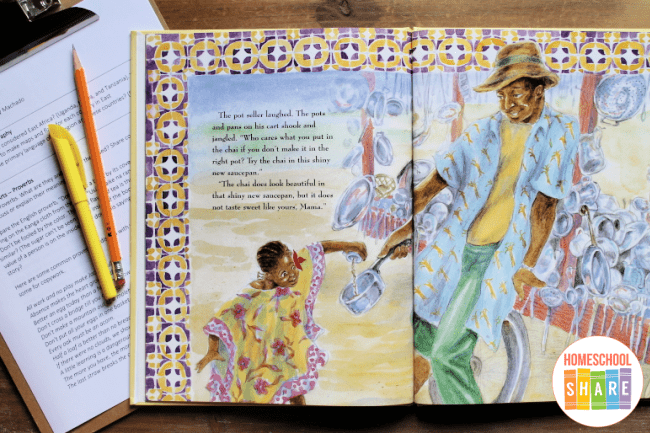
Discuss the concept of patterns using the patterns in the Kanga cloth borders from the borders of each of the pages.


Science-- Tea
Research about tea: what plant it comes from, how it is grown and cultivated, what is the difference between green/black/oolong teas, what are the chemical components of tea, what are its health benefits.

For older students this could cross over with additional history - the history of tea and how it has impacted the world through history (trade,
exploration, culture/tradition, politics)

Some tea information links/sites:
http://www.planet-tea.com/
http://www.teatalk.com/index1.htm
http://www.leaves.com/info/articles.cfm

Have a tea party! 

    - try a variety of different types of tea
    - make the chai tea from recipe in book

Art-- Kanga Cloth
Kanga cloth - the kanga cloth has many uses - dress, shawl, head wrap, baby sling. See author's note. In addition to the bright colors and beautiful designs each piece contains a Swahili saying printed on it. The sayings are similar to our proverbs - sayings that have multiple meanings.

Info on Kanga cloths and sayings:
http://www.glcom.com/hassan/kanga_history.html

Make a Kanga – Use a plain white bandana or other cotton cloth cut into a large square.  Use fabric paint, watercolors, or markers to color patterns and pictures on their Kanga cloth.  Using watercolors will make the cloth look similar to the muted, flowing colors used it the book’s illustrations. This could also be done as a project on paper if you choose not to do cloth.  Don't forget to add a proverb!  Then, let your student wear the finished product.


Just for Fun


Get a large piece of cloth and experiment with creating various types of wraps.

Recipe:  East African Sweet Pea Soup
2 cups chopped onion
2 tsp minced garlic
1 tsp grated fresh peeled ginger
1 tsp salt
1/4 tsp cayenne pepper
1 tbsp garam masala (spice) OR
    1/2 tsp ground black pepper
    1 tsp ground coriander seeds
    1 tsp ground cumin seeds
    1/4 tsp ground cardamom
    1/8 tsp ground cloves
    1/4 tsp cinnamon
2 tomatoes, chopped
1 sweet potato, diced
3 1/2 cups water
3 cups green peas (*fresh* if possible)
Braise onions and garlic in a pot for 5-10 minutes. Mix in the ginger, salt, and all spices and cook for a few minutes, stirring often. Add tomatoes and sweet potato, stir. Add 1 1/2 cups of water, stir.  Bring soup to a boil, reduce heat, cover, and simmer for 5 minutes. Add 2 cups of the peas and simmer, covered, for 10 minutes. Remove from heat and add remaining 2 cups of water. Puree in batches in a blender until smooth. return to the pot, add the last cup of peas, and cook on medium heat for 3-5 minutes.
 

Materials and information on this website belong to the original composers. It may be used for your own personal and school use. 

Material may not be used for resale © 2005-07 HSS