| about us |
what's new
|
unit studies
|
unit study helps |
hss resources
|
fiar resources | indexes | lapbooking |
The Sea Chest
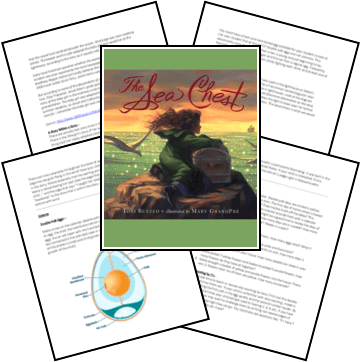
| Author: Toni Buzzeo Illustrator: Mary GrandPre ISBN: 0803727038 Summary: A young girl listens as her great-great aunt, a lighthouse keeper’s daughter, tell of her childhood living on a Maine island, and of the infant that washes ashore after a storm. Lessons by Debbie Palmer |
Draw Write Now book 1
Draw Write Now book 2
Beacons of Light: Lighthouses by Gail Gibbons
The Little Red Lighthouse and the Great Gray Bridge by Swift and Ward
Light at Tern Rock (chapter book) by Sauer
Atlas
Double Yolk Math Manipulatives
Aunt Maita was home schooled because her family lived on an isolated island. In colonial America, home education was the norm. During that time people felt that it was important for children to be able to read so that they could read the Bible. Occasionally, families would pool their money together and hire a teacher for their children. In the 1880’s, the compulsory attendance (public schools) movement began. In the 1960’s the US Supreme Court declared it was a violation to pray, read the Bible and post the Ten Commandments in public schools. Since then private schools have become popular and home schooling has become a nationwide trend. Your student might be interested to know that there are some very famous individuals that were home schooled. If your child is older you could have him/her research one of them. Here is a small list of those that were home schooled.
Leonardo Da Vinci
Alexander Graham Bell
Thomas Edison
The Wright Brothers
John Quincy Adams
Thomas Jefferson
Abraham Lincoln
James Madison
Franklin Delano Roosevelt
Theodore Roosevelt
George Washington
Charles Dickens
Phillis Wheatley
Clara Barton
Florence
Nightingale
The story takes place in Maine. Can your student find it on a map? See the map here. Using an atlas, your child can label it according to the directions. Its capital city is Augusta and the most eastern capital in the country. It is our 23rd state and was adopted into the Union in 1820. There are numerous lighthouses along its coast including Portland Head Light, which is the oldest lighthouse in Maine. Some fun facts on Maine:
Maine produces 99% of the blueberries in our country!
Maine’s nickname is the Pine Tree State since 90% of its land is covered in forests.
Maine is the only state that shares its border with only one other state. Which one?
Maine used to be a part of the Massachusetts Colony.
Maine is the most northeasterly state in the Union.
See this link for a cool “tree of facts” about Maine
Aunt Maita and Seaborne slept in a trundle bed. Does your child know what that is? Trundle beds are a pair of beds. The upper bed is a twin bed and the lower one is slightly smaller and on rollers. The smaller bed can be rolled under the larger one to save on space.
The little girl at the beginning of the story is listening to her Aunt Maita. Maita is actually her great-great aunt because Seaborne is her great-grandmother. Does your child know what an aunt is? An aunt would be his/her mother’s or father’s sister. A great aunt would be the sister of your grandmother/grandfather and a great-great aunt would be the sister of your great-grandmother/great-grandfather. Use your child’s family as an example. What are the names of his aunt, great aunt and great-great aunt?
There is a lot of personification in The Sea Chest. Personification is when an author gives human characteristics to inanimate objects. Can your student spot the personification in the book? Here are some examples:
“City lights flicker in the dusk like winking fireflies.”
“Wind shrieked”
“Our breath painting clouds”
“The frozen hinges squeaked their resistance”
“My dancing heart”
Adjectives are describing words. They describe a noun (person, place, thing or idea) better. Some adjectives are “weak” and don’t give a clear picture of the noun. Others are “strong” and enable you to almost feel, see, smell, etc. the noun being described. Can your student spot the adjectives in the story? Here are some of them: shiny, rocky, craggy, warmer, icy, towering, frozen, fragile, tiniest, frosty, purple, yellow, only.
Play this word game with your child to see if he/she can spot the stronger adjective. Call out the two adjectives in the row and your child can tell you which one is more descriptive. Can your student come up with pairs like this-a weak adjective and a strong one?
Red-ruby
Purple-violet
Turquoise-blue
Big-monstrous
Small-miniature
Hot-sizzling
Cold-shivery
Slimy-wet
Smelly-musty
Thunderous-loud
Irritated-angry
Talkative-jabbering
Fierce-mean
Read the author’s note at the end of the book. Although The Sea Chest is fictional, it is based on a legend. What is a legend? A legend is a story that may have some truth to it, but the story is old or been passed from person to person so that it is hard to tell the truth from the fiction. This website gives more information about the legend and the Hendricks Head Light and mentions the book, The Sea Chest. http://www.lighthouse.cc/hendrickshead/history.html
There are actually two story lines in the book. Have your student identify both. There is the little girl’s story of her waiting with her Aunt Maita for her parents to bring back her newly adopted sister from across the Atlantic. And then there is Maita’s story of living on an island, finding Seaborne, and their life together.
On the author’s note page (last page) there is a picture of a candle by a window with a reflection of the candle in the window. Point out to your child that the reflection is not painted with as much detail and is not as bright. Can your child create a drawing with a reflection in a window? You can also see another example of reflection on the page opposite the sea glass. Can your child find it? (It is the reflection of the sun in the water). Notice that it too is not as distinct as the sun itself.
There are many examples throughout the book of swirling winds. Even the title page has sea gulls flying in the wind! Have your child find all the examples of wind in the story. Notice especially that the swirling wind is used to show that Aunt Maita is remembering her past (See the page that starts with, “I was a solitary child…” and the page that says “I taught her reading…”). These two pages are like “bookends” to the story that is within the story. Have you child create his/her own picture with wind.
If you have the Draw Write Now books there are a few pictures that your child could draw that are related to the story.
Book 1-page 10-Chickens (Remember Maita collecting the eggs and double yolk days.)
Book 2-page 58-sailboat
Maita circles on the calendar double-yolk days. Go over with your child the parts of an egg: the shell, the membrane (which can sometimes be seen with a hard-boiled egg), the air cell (seen with the hard-boiled egg), Chalaza (stringy part in the white but connected to the yolk-best seen in a raw egg), the white or albumen (contains all the protein to help and chick grow) and the yolk (which has the fat for the growth of the chick). See diagram. You could have a fresh and hard-boiled egg available for your child to look at. Can he /she find all the parts? Double-yolk eggs are not common. This abnormality normally happens when a hen is young and just beginning to lay. Normally, a double-yolk egg is longer and thinner than a regular egg. Frequently, double-yolk eggs result in the unborn chicks fighting each other and at least one of them dying.
There is mention of a Fresnel lens that was used in the lighthouse on Maita’s island. The Frensel lens was developed by a Frenchman named Augustin-Jean Fresnel. He originally developed it for use in lighthouses. Look at the diagram below (taken from Wikipedia where you can find more information on the lens). The Frensel lens is much thinner which allows the light to been seen for farther distances. The lens labeled #1 is a Frensel lens. The second lens is what we would normally think of as a lens.
Lighthouses are built along coasts and on islands to warn ships of danger. They normally use lights and bells (in foggy and stormy weather) to warn boats and ships. This website on New England lighthouses is incredible. You can look at several different lighthouses in each state and see pictures and get their history. Your older child might be interested in researching a particular lighthouse.
Minot’s Ledge Light in Massachusetts is particularly fascinating. It was built in the middle of the ocean on the Cohasset Rocks. If your child is interested, check out this website which even has video footage of the lighthouse being battered by a storm.
Maita marks off the days on her calendar. Double-yolk days are circled in yellow. Supply boat days are given double blue stars. The first day of home school is boxed in red. Does your child have a calendar? Does he/she mark off the dates? This might be a fun activity. If he or she shows interest provide them with a calendar where they can mark off the dates. This might be a good time to review the days of the week and the names of the months. How many days are in a week? How many months in a year? How many days in a year? Weeks in a year?
This is a great time to teach or review skip counting by two’s. Print out the double-yolk eggs and cut them out. If your child is unfamiliar with skip counting, model it first by counting the first yolk in the egg quietly and the second number louder. By doing this several times your child will get used to hearing 2, 4, 6, etc. If you have an older child your may want to challenge them by printing out several pages of eggs and seeing how high they can go. You could also ask questions like, “If I have 7 eggs, how many yolks do I have?