Google
 
The Wild Christmas Reindeer   Au

The Wild Christmas Reindeer

Author/Illustrator: Jan Brett
ISBN: 0399221921

Summary:
Little Teeka's attempts to train Santa's reindeer for their Christmas ride meet with disaster until she realizes that she needs to work with the animals in a new way. "Tomorrow," she says, "no yelling, no screaming, and no bossing, I promise," and with her patient teaching, on Christmas Eve the "wild reindeer rise up together and carry the sleigh off into the night."


Unit Study Prepared by: Kim Fry
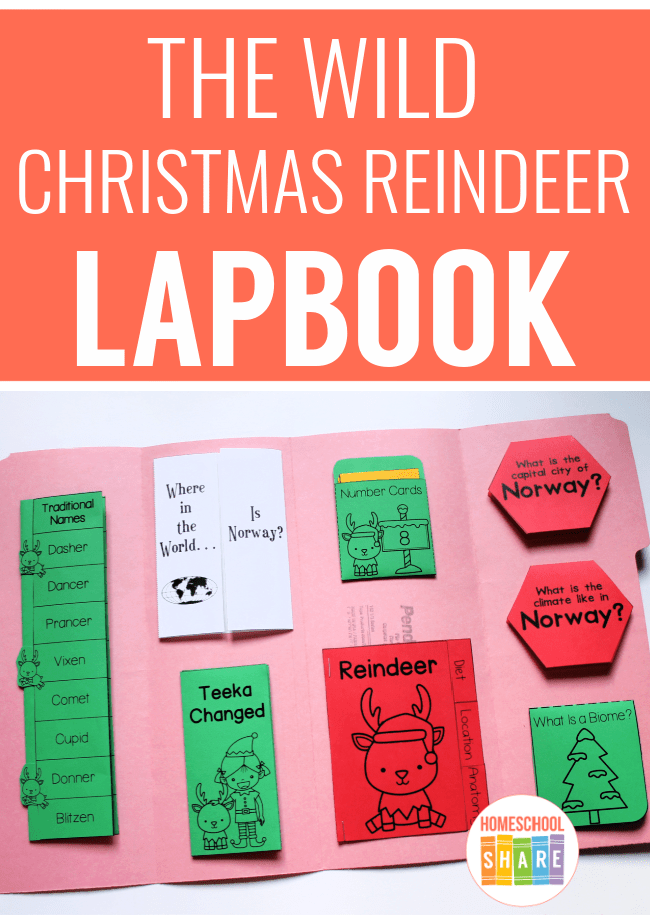
*Note:  Lapbook Ideas are found in the Additional Resources section


Social Studies


Geography

Make a story disk and place it in the North Pole.

The North Pole is located in the middle of the Arctic Ocean.   The Arctic is inhabited by people unlike the Antarctic (South Pole).

The North Pole is significantly warmer than the South Pole.  Winter (January) temperatures at the North Pole can range from about −43°C (−45ºF) to −26°C (−15°F), perhaps averaging around −34°C (−30ºF). Summer temperatures (June, July and August) average around freezing point (0°C, 32°F).  During the summer months, the North Pole experiences twenty-four hours of daylight daily but during the winter months the North Pole experiences twenty-four hours of darkness daily. Sunrise and sunset do not occur in a twenty-four hour cycle.

Arctic Outline Map


Human Relationships: Emotions (pg 2)
Discuss times when you feel excited and scared all at once like Teeka did (pg 2).
 

Human Relationships:  Diplomacy (pg 6)
Discuss how best to negotiate with a person without humiliating them or attacking their pride.  You could even role play some different situations.  Discuss the different ways Teeka could have responded to the reindeer.  What would the outcome have been?

Human Relationships:  Kindness and Compassion (pg. 20)
Kindness is showing or growing out of gentleness or goodness of heart
Compassion is sorrow or pity caused by the suffering or misfortune of another

How were these traits exhibited?  Discuss ways your student can be kind to those around him.  In what ways can he be compassionate this season?


Language Arts

Story Discussion
    1. Discuss how Teeka changed by the end of the story.  Encourage your student to site evidence from the text to illustrate.
    2. Discuss the mingling of fiction and reality.  Are reindeer real? (yes)  Can they fly? (no).  What other examples of fiction and fact are woven
        throughout the story? 


Story Within a Story and Creative Writing
Discuss the story within the story by observing the sidebar pictures that Jan Brett is notorious for.  Encourage your student to narrate a story about elves preparing for Christmas; encourage your older student to write his story from the elf's perspective.


More Creative Writing
In Jan Brett's video
she describes how she drew each reindeer to express certain personalities.  Ask your student to choose a reindeer and tell the story from his or her perspective.

Creative Writing/Listmaking
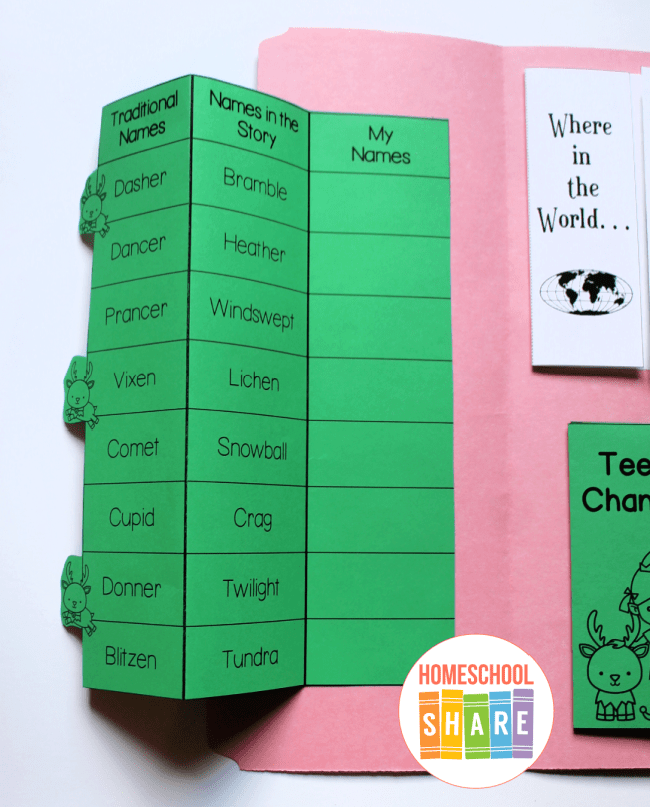
The story lists the names of the reindeer.  Have your student write them out (
Bramble, Heather, Windswept, Lichen, Snowball, Crag, Twilight, and Tundra).  Does your student also know the traditional names of Santa's reindeer? (Dasher, Dancer, Prancer, Vixen, Comet, Cupid, Donner, and Blitzen.) Have him write those out as well.  Now, ask your student to make his own list...what would he name eight reindeer?

Compare and Contrast
Make a Venn diagram, comparing the Rudolph story with Wild Christmas Reindeer

Vocabulary

Prepared Vocabulary Crossword Puzzle
 

Lichen- any of numerous plantlike living things made up of an alga and a fungus growing together on a solid surface
Tundra-
a treeless plain especially of arctic regions having a permanently frozen layer below the surface soil and plant life made up mostly of mosses, lichens, herbs, and very small shrubs
Frantic-
wildly excited
Bolted- to move rapidly; to run away
Nudged-
to touch or push gently
Nestled-
to lie close and snug
Sleek-
having a smooth healthy well-groomed look
Bold-
willing to meet danger or take risks
Bossed- to be in charge; to give orders in a demanding way


The Letter R
Teach your younger student the letter R (for reindeer) and how to print it
Tradtional R
Modern R
Cursive R


Art


Watch the
online video for Wild Christmas Reindeer and listen to Jan Brett discuss her book

Discussion Questions

Why do her drawings have so much detail?

What inspired the drawings in this story?

What inspired the storyline?

Look carefully at all the details.  After having listened to the illustrator, do you have a greater appreciation for the detail?

Try your hand at a detailed drawing of what you would imagine the North Pole to look like if Santa lived and worked there.


Applied Math
 

Eight
Ask your student how many reindeer there are in this story (
Bramble, Heather, Windswept, Lichen, Snowball, Crag, Twilight, and Tundra).  There are eight.  If your student is young (or if you have a younger sibling along for the ride), teach her how to write the number 8.  Gather groups of 8 objects from around the house. 

For your older student, practice skip counting by 8's (8, 16, 24, 32, 40, etc.) or work with the family of 8 multiplication facts.  You could even write up some story problems involving the reindeer for your student to solve.


Cooking- Reindeer Cookies

Ingredients

    1 cup Brown sugar
    1 cup Sugar
    1 cup Butter, softened
    1 cup Peanut Butter (smooth)
    3 cups Flour
    2 Eggs
    2 teaspoons Baking soda
    1/2 teaspoon Salt
    1 teaspoon Vanilla

Directions
Cream the butter and sugars, eggs and peanut butter, salt and vanilla. Add the soda and flour and mix well. Roll into balls. Flatten the ball and shape it into a triangle. Place pretzel pieces into 2 of the triangle corners for antlers. Place a red M-M at the other corner (Rudolph's red nose), and 2 green M-Ms on the cookie for eyes. Bake at 375 degrees for 10-15 minutes or until golden brown.
 

Cooking- Reindeer Cookies II

1 cup sifted powdered sugar
2 tablespoons whipping cream
1 teaspoon vanilla
12 (21/2 inch) square graham crackers
24 semisweet chocolate mini morsels
12 red cinnamon candies
12 miniature pretzels broken in half

Combine the first three ingredients in a small bowl, stir well and set aside.  Cut the graham crackers in half diagonally using a serrated knife, using a sawing motion. Spread a little frosting over half of the cracker and top with remaining half to form a triangle. Spread the top with frosting to cover top of cracker.  Press two chocolate morsels into each frosted cracker for eyes, 1 cinnamon candy for the nose and 2 pretzel halves for antlers. Let dry on wire rack.

Cooking- Reindeer Faces
1 slice bread
peanut butter
4 mini pretzels
4 raisins
2 mini marshmallows, maraschino cherries or red-hot cinnamon candies

Cut bread in half from corner to corner, making two equal triangles.  Spread peanut butter over bread.
Decorate as follows:
Lay in front of you, point facing you and long side of triangle facing away from you.  Place one mini pretzel on each upper corner (the antlers); two raisins in the center of each slice (the eyes) and one mini marshmallow (or maraschino cherry or cinnamon candy if you are making Rudolphs) on the tip of each short point nearest you (the nose). Presto! Two reindeer faces looking back at you.


Science


Reindeer

The reindeer, known as caribou when wild in North America, is an Arctic and Subarctic-dwelling deer (Rangifer tarandus). Reindeer are found throughout the world including places such as Scandinavia (including Iceland); in Finland; in Russian Europe including Northern Russia; in Russian Asia; in North America on Greenland, Canada, and Alaska.

The weight of a female varies between 60 and 170 kg. In some subspecies of reindeer, the male is slightly larger; in others, the male can weigh up to 300 kg. Both sexes grow antlers, which (in the Scandinavian variety) for old males fall off in December, for young males in the spring and for females during the summer. The antlers typically have two separate groups of points (see image), a lower and upper. Domesticated animals (reindeer) are shorter-legged and heavier than their wild counterparts (caribou). The caribou of North America can run at speeds up to 50 miles per hour and may travel 3,000 miles in a year.
Reindeers are ruminants, having a four-chambered stomach. They mainly eat lichens in winter, especially reindeer moss. However, they also eat the leaves of willows and birches, as well as sedges and grasses. They can also eat voles, lemmings, birds and bird eggs.
Source: Wikipedia

Books to Read
 

The Reindeer People by Ted Lewin (mid elem grades)

Reindeer A New True Book (youngers/mid grades)


W
ebsites to Visit
Enchanted Learning Reindeer Printout
Webquest  
For more information

Reindeer Shape Book (this is a great add on!)


Biomes
A biome is a large ecosystem where plants, animals, insects, and people live in a certain type of climate.  There are many different types of biomes throughout the world.  This story, The Wild Christmas Reindeer, takes place in the Arctic Tundra. 

The Arctic tundra is a cold, vast, treeless area of low, swampy plains in the far north around the Arctic Ocean. It includes the northern lands of Europe (Lapland and Scandinavia), Asia (Siberia), and North America (Alaska and Canada), as well as most of Greenland. Another type of tundra is the alpine tundra, which is a biome that exists at the tops of high mountains.

This is the earth's coldest biome. Since the sun does not rise for nearly six months of the year, it is not unusual for the temperature to be below -30°F in winter. The earth of the Arctic tundra has a permanently frozen subsoil, called permafrost, which makes it impossible for trees to grow. Frozen prehistoric animal remains have been found preserved in the permafrost.

In summer, a thin layer of topsoil thaws and creates many pools, lakes, and marshes, a haven for mosquitoes, midges, and blackflies. More than 100 species of migrant birds are attracted by the insect food and the safe feeding ground of the tundra. Other animals that live in this biome include polar bears, Arctic foxes, caribou, and grey wolves. Plants that you might find include small shrubs and cushion plants, and the lichen which cover the many rocks on the tundra's terrain. The Arctic is also famous for the beauty of its flowers during early autumn.

Information is taken from Fact Monster (click link for more on BIOMES)


Craft Ideas

Reindeer Ornaments Coloring Page (from Jan Brett's site)

Make a Reindeer Puppet


Rudolph Popsicle Stick Craft

Reindeer Pin
You will need:
3 jigsaw puzzle pieces ( with knobs on either end)
2 small wiggle eyes
1 small red pom pom
brown acrylic paint
craft glue
pinback

Paint puzzle pieces.  One will be the head and the other two will be glued on the back at an angle for the antlers.
Glue wiggle eyes about 1/3 of the way down the head, and pom pom at the bottom knob for a nose.  Glue a pinback to the opposite side.


Additional Resources and Ideas

Websites

Jan Brett's Piggybacks (more ideas for this story!) for teachers


Tons of Reindeer Ideas!


How Many Arctic Animals (book to make for young readers)

Arctic Animals Printouts from Enchanted Learning
 

Supplemental Books

    Jan Brett Christmas Stories
    Trouble With Trolls
    Gingerbread Baby
    The Twelve Days of Christmas
    Christmas Trolls
    The Night Before Christmas
    Who's That Knocking on Christmas Eve?


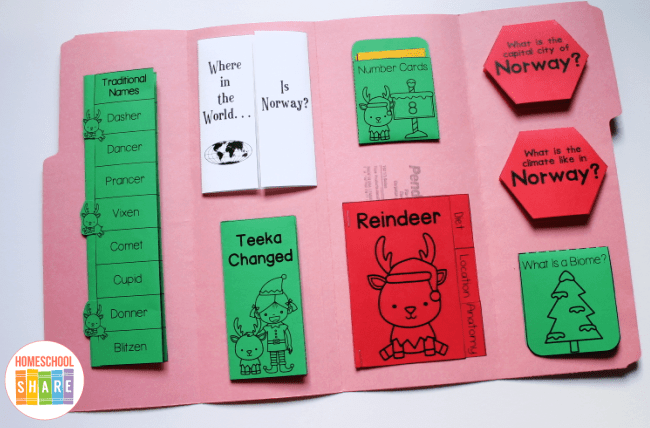
Lapbook Ideas

for Social Studies
    print a map that includes the arctic (paste your story disk to it if you wish); paste the map into your book

for Language Arts
    create a planner-style page and have your student write one of the creative writing exercises on the page; decorate the pages with Jan
    Brett styled borders
 http://www.printfree.com/CalendarCustomMonthly/weeklyin.htm

    Paste the Venn Diagram into your lapbook

    Using Vocabulary words, make a vocabulary flap book


for Science
   
 Make a tab top book to include habitat, diet, life cycle, etc
    W
rite the facts from your research on reindeer printed and cut from the graphic on this site 
    Then make a pocket from the Winterfarm
graphic at this site
    Slip the reindeer into the pocket in your lapbook. 


for Art
      Put the North Pole drawing into your lapbook

Rabbit Trails
Your older student may wish to research -Animal Training

Explorers of the Arctic

Learn about the other major biomes of the world (including Coniferous Forest, Deciduous Forest, Desert, Grasslands, Mountains, and Rainforest)


Add even more to your Christmas Unit Study

Hands of A Child Symbols of Christmas Lapbook
Christmas Cheer Project Pack
Amanda Bennett Christmas Unit Study
Amanda Bennett Christmas Notebook Pages
Christmas Games Lapbook
Celebrating the Season: Our Christmas Copy Work and Activity Book


Materials and information on this website belong to the original composers. It may be used for your own personal and school use. 

Material may not be used for resale© 2005-07 HSS