Affiliate Disclaimer
We sometimes use affiliate links in our content. This won’t cost you anything, but it helps us to keep the site running. Thanks for your support.
A loud clap of thunder booms, and rattles the windows of Grandma’s old farmhouse. “This is Thunder Cake baking weather,” calls Grandma, as she and her granddaughter hurry to gather the ingredients around the farm. A real Thunder Cake must reach the oven before the storm arrives. But the list of ingredients is long and not easy to find . . . and the storm is coming closer all the time!
from Thunder Cake at amazon.com
Patricia Polacco is a master storyteller, and this book contains one of her childhood stories. Grab our free Thunder Cake unit study and spend a week with this wonderful book.
Thanks to Ginger A. for contributing this Thunder Cake unit study to Homeschool Share.
Thunder Cake Unit Study Lessons
Here are a few sample lessons from the Thunder Cake Unit Study:
Language Arts: BIG WORDS!
This story has multiple words that are IN ALL CAPS. Ask your student why the author chose to do this. She wants to reader to read these words loudly. Review exclamation points, too, and discuss how we should read words and phrases that are followed by an exclamation point.
Ask you student to practice reading the BIG WORDS in the story.
Math: Geometry
You will need two pieces of white card stock, two to four rubber stamps (small shapes work best), and an ink pad. The student will study repeating patterns and random placement.
Study closely the fabrics in the story. Show the student examples of repeating patterns and randomly placed designs. Look around your home to find more repeating patterns and randomly placed designs. Create an example of each.
Random Placement
Allow the student to rubber stamp designs anywhere on the paper: upside down, sideways, etc. Label this picture “random placement” (handwriting connection).
Repeating Patterns
Show the student how to create a repeating pattern. The student will create a repeating pattern of his own design.
History: Family Tree
Help the student to create a simple family tree. Include snapshots or drawings of each family member listed on the family tree. Discuss how other cultures have special ways to say mother, father, grandmother, grandfather, etc.
Life Skills: Cracking an Egg
Show the student how to crack and separate an egg. Let the student assist in making a Thunder Cake!
You can grab a copy of the entire Thunder Cake unit study in an easy-to-print file at the end of this post.
Thunder Cake Activites
Use these printable activities to give your students an engaging, hands-on experience.
Thunder Cake Story Sequencing Mini-book
Students will sequence the story and use ordinal numbers to create a mini-book about gathering ingredients. Ingredients included: milk, chocolate, flour, tomatoes, strawberries, eggs, and sugar.
Weather Sounds Page
This corresponds with the lesson on onomatopoeia (found in the unit study). Students will write onomatopoetic words on the page.
Adjectives: Words That Describe Activity Page
Word Building Pages
Using Scrabble Tiles, alphabet stamps, magnetic alphabet tiles, or another manipulative of your choice, build the words from the story, Thunder Cake. After your student has built the words a few times, see if she recognizes them in the story. Let her read them to you!
Words to build: cake, rain, milk, eggs, hen, cow, oven, and time.
My Weather Journal Page
Let your student track the weather each day during your Thunder Cake unit study.
The Water Cycle Diagram
Cut and paste the words to help your student learn how the water cycle works.
A Proper Place Setting Activity Page
Create a proper place setting.
My Family Tree Activity Page
Where Is Michigan? Matchbook
Where Is Russia? Matchbook
How to Get Started with the Thunder Cake Unit Study
Follow these simple instructions to get started with the Thunder Cake unit study:
- Buy a copy of the book, Thunder Cake, or grab one from your local library.
- Print the Thunder Cake unit study.
- Choose the lessons you want to use with your student (a highlighter works great for this).
- Choose and prepare the printables you want to use with your student.
- Enjoy a week of fun-filled learning with your student.
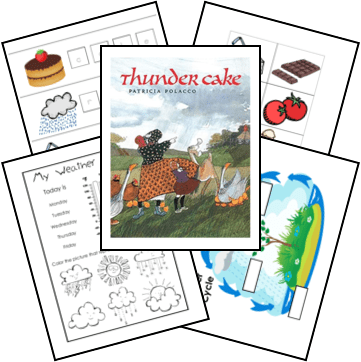
Download Your Thunder Cake Unit Study and Printables
Simply click the image below to grab your free Thunder Cake unit study and printables.
More Weather Related Resources
If your student is fascinated with weather, try these other Homeschool Share resources:
Unit Study & Lapbook