Google
 
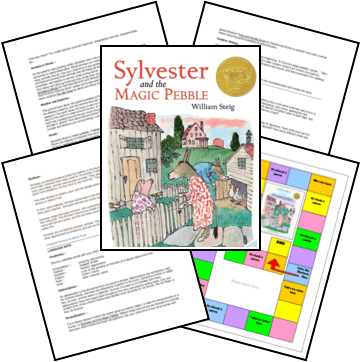
Sylvester and the Magic Pebble
Sylvester and The Magic Pebble
Author: William Steig    
Summary:  In a moment of fright, Sylvester the donkey asks his magic pebble to turn him into a rock but then can not hold the pebble to wish himself back to normal again.
ISBN:  067166154X

A literature based unit study written by Wende
 

SOCIAL STUDIES

Neighborhoods and Community Helpers
Sylvester and his family live in a neighborhood on Acorn Road in the town of Oatsdale (note: you may want to create a town named Oatsdale on your Land of Make Believe Map  and place a storydisk there). A neighborhood is a group of people living within a certain range. Familiarize your children with your neighborhood. Do they know their street and town names? Take a walk or a drive around your neighborhood, with children noting street signs, pointing out familiar sights, and soaking in the surroundings. Show them where the police station and firehouse are, explaining to them how they are community helpers. Maybe they would like to try their hand at making a map of the neighborhood.

Sometimes your neighbors can be community helpers too. Does your child remember who tried to help Sylvester’s parents find Sylvester? All of the neighborhood dogs went looking for him. Reminisce about a time that you or your child may have been community helpers. Maybe you helped to find a runaway dog, or picked up trash along the street. Maybe you helped the people of your neighborhood in a time of natural disaster. Share these adventures with your children.

Feelings
Sometimes we act out in anger or frustration because we don’t know how to express our feelings. This is especially true with children. The Donkey, and other characters, went through many, many different feelings throughout this story. Have your child act out these various feelings:

excited  surprised   startled   frightened   confused   perplexed   puzzled   bewildered   scared
worried   helpless    hopeless    miserable   unhappy

Discuss with children how a problem can be helped more quickly if they are able to express their feelings.


SCIENCE

Animal Babies
Sylvester’s parents asked all the animal children if they knew where his son was. Does your student know the adult and baby names of the various animals? The story mentions puppies, kittens, colts, and piglets. Have student name the parent animal (dog, cat, horse, pig). Does he know any more? You could mention cow/calf, bear/cub, sheep/lamb, lion/cub, kangaroo/joey, etc. 

Animal Babies/Parent Matching (for younger students)

Animals in Winter
As the weather was growing colder Sylvester went into a deep sleep. This deep sleep during the wintertime is called hibernation. While donkeys (or rocks!) don’t usually hibernate, there are many animals that do. Can your child think of any animals that hibernate? Bears, groundhogs, and bats are among those animals that will sleep all winter. Other animals, such as birds and butterflies, will migrate to warmer areas during winter, where food and shelter is more plentiful. And others will store up food and stay inside their cozy homes when the weather turns cold. Animals in Winter by Henrietta Bancroft and Richard G. Van Gelder is part of the “Let’s-Read-And-Find-Out Science Book” series and is educational and enjoyable. Another good go-along book could be The Big Snow by Berta and Elmer Hader, winner of the 1949 Caldecott award.

Weather and Seasons
This picture book gives very good examples of the changing of seasons. Discuss with your child the different seasons, and the months they fall under. Does your child know what causes the seasons? The earth takes 24 hours to spin on its axis, to create day and night. And it takes 365 days for the earth to rotate around the sun, to create a year. The seasons tell us how far the earth has traveled around the sun since the year began. What happens to the plants and animals in spring? How about fall and winter? What is your child’s favorite season? Why? Go outside and observe your surroundings, noting the changes specific to the seasons. Read this poem out loud to your children (source):

Months And Seasons

January, February, middle of March,
Brrr! In the cold I'm stiff as starch!
Let's make a snowball, sled down a hill.
Wintertime, wintertime, time to chill!

April, May, to the middle of June,
Ahh! What a nice cool afternoon!

Let's fly a kite, and plant pretty flowers.
Springtime, springtime, time for showers!

July, August, middle of September.
Ouch! Got a sunburn I'll always remember!
Let's go swimming, let's eat a peach.
Summertime, summertime, time for the beach!

October, November, middle of December.
Hey! each day grows shorter than September!
Let's see the leaves fall, let's bake a cake
Autumntime, autumntime, time for a rake!

Hooray for the seasons all through the year,
One just left and another one's here!
I love the seasons, each is a ball:
Wintertime, springtime, summertime, fall.

Meish Goldish.
 

Rocks
This story lends itself perfectly to the study of rocks.  There are so many good resources available.  You may want to have your child collect rocks and pebbles and have him identify them using a good resource book or a website.  

If you want to discuss the rock cycle you could use this explanation and diagram.  If you are using Considering God's Creation, Lesson 6 is very fun and informative.  Just grab some books about rocks from the library and have fun!  

More information


MATH

Billion
Sylvester thought that the chance of someone wishing that a rock were a donkey was one in a billion at best. How much is a billion? It is a one, followed by nine zeros, reading like this: 1,000,000,000. Have child write out the number and identify the place value of each digit. Ask him if he thinks that 1 in 1,000,000,000 is a good chance or bad?

Counting
Look with your child at the picture of the dogs searching for Sylvester. Have child count all the dogs. How many brown? How many gray? How many spotted? How many different kinds can your child find?

Graphing
using the pebbles and stones your child collected in the science lesson, have child make a bar graph of rocks by color, texture (smooth, rough), size, etc. Have him group the rocks in different ways, and look for his input as to how he would graph each one.
 

LANGUAGE ARTS

Abbreviations
An abbreviation is the shortened form of a word or phrase. Abbreviations are sometimes used for common words, and most are followed by a period. In this story, Sylvester’s mother is called Mrs. Duncan, and his father is called Mr. Duncan. If student is not familiar with these abbreviations have him locate them throughout the story and practice writing them. Can your student think of any others? Some more familiar ones would be Dr. for Doctor, Rd. for Road, or Ave. for Avenue.

Personification
It is a literary device in which the author gives an animal, object, or idea the characteristics of a human. In Sylvester and the Magic Pebble, William Steig has humorously dressed the animals and given them names and even occupations! Can your child think of any other stories with personification? Katy and the Big Snow by Virginia Lee Burton (FIAR vol. 1) is another story with a winter theme featuring good examples of personification. 

Biography of author
This biography is interesting to read, as your child might recognize that the movie Shrek is based on the book of the same title written by the same author as Sylvester and the Magic Pebble.

Creative Writing
have your student write or narrate a story about a magic pebble. You could use a storyboard from here
to help your child along with the writing process, showing how every story needs an introduction, middle, and conclusion. After writing the story, you may want to have the older student revise it for content and style by reading it out loud listening for the overall sense and sound, and then proofread it for spelling, capitalization, and punctuation errors.


ART

Caldecott Award
Sylvester and the Magic Pebble by William Steig is the winner of the 1970 Caldecott Award. Have child find the medal on cover of story. In 1937 the secretary of the American Booksellers Association, Fredric Melcher, proposed that a special award should be given to the artist of “the most distinguished American picture book for children published in the United States during the preceding year”. The award was named in honor of Randolph Caldecott, a 19th century picture book illustrator. The winner is selected and announced in midwinter by the American Library Association. As you examine the pictures of the story with your child, discuss reasons it may have been selected as a “distinguished American picture book”. Have child design his own medal, using foil, to award to his favorite picture book.

Just for fun
See if children would like to paint a rock bright red just like Sylvester’s.


BIBLE / Character
What does the Bible say about being a good neighbor? Read Luke 10:2-37 to your child, Jesus’ parable about the traveler. He tells us that a neighbor is a person of compassion, helpfulness, and thoughtful care, not just someone you live close to. Ask your child to brainstorm how he might be a good neighbor.

Some other verses about neighbors:

Leviticus 19:18 – thou shalt love thy neighbor as thyself

Proverbs 3:29 – Devise not evil against thy neighbor, seeing he dwelleth securely by thee. 


Materials and information on this website belong to the original composers. It may be used for your own personal and school use. 

Material may not be used for resale© 2005-07 HSS