| about us |
what's new
|
unit studies
|
unit study helps |
hss resources
|
fiar resources | indexes | lapbooking |
Pumpkin Jack
| Written
and Illustrated by Will Hubbell ISBN: 0807566659 Unit Study Prepared by Carrie Piper Summary: In the course of one year, Tim watches as his discarded jack-o-lantern, Jack, decomposes, spouts and finally produces more pumpkins in time for fall. |
FYI: Homeschool Share does not necessarily prohibit titles that include
reference to magic, ghosts, etc. (although we reserve the right to).
This book contains a few references that may not be suitable for your family.
Please preview this book before you begin your studies.
"At night, when a candle made Jack's face
dance on the wall and filled the dark with warm pumpkin smells, Tim felt Jack
was almost magic. Yet, too soon, the spell was
broken. Jack's Halloween magic was a distant memory now."
"He carried Jack to the garden, which was filled with the brown ghosts of
last summer's plants." (ghost here is simply a metaphor, but I
realize that some families are not ready to discuss this word, so I wanted to
point out that it is in the book.)
Social Studies:
Geography
Where might Jack live? Could it be in your state or neighborhood?
The location of this book is not specific, but it is somewhere that pumpkins
grow easily. Discuss why it cannot be certain places such as the desert
southwest of America (too hot, not enough rain. etc…) Choose a place on the map
to be Tim’s home.
Occupation – Pumpkin Farmer
Ask your child were he thinks pumpkins come from? They come from
farms as do all produce. Make a simple book and have your child illustrate it.
The page captions can go something like this:
The farmer grows pumpkins in a field.
When the pumpkins are ripe they are picked off the vine.
Then the pumpkins are loaded on a truck and taken to the grocery store (or market, etc…)
We can
buy the pumpkins at the store (or market, etc…)
Character Building -- Generosity
"There
were many [pumpkins], for the plant had been generous. Tim was generous, too.
He gave away all but one."
Generosity is being willing to give...and to give large amounts of something.
Does your student willingly share things that he owns? Can your student
think of a time when someone was generous with him? A time when he was
generous? What did he give away? (time, treasures, talent?)
You may also wish to discuss the opposite of being generous-- being stingy.
Culture-- Holidays
Many holidays
are mentioned in this book. Holidays are usually the best days of the
year; they are days on the celebrated calendar that are repeated each year.
Most people get a break from their regular jobs, friends and family gather
together to eat, play games, and remember why they are celebrating that day.
Most holidays have a very special meaning (for instance, Easter is celebrated
because Jesus rose from the dead, Christmas marks Jesus' birth, etc.)
Can your student remember which holidays were mentioned in the story?
(Halloween, Thanksgiving, Christmas, and Valentine's Day). Can your
student make a list of other holidays that weren't mentioned? (St. Patrick's
Day, Easter, Independence Day, etc.) What special traditions does your family
have for each holiday mentioned?
Language Arts:
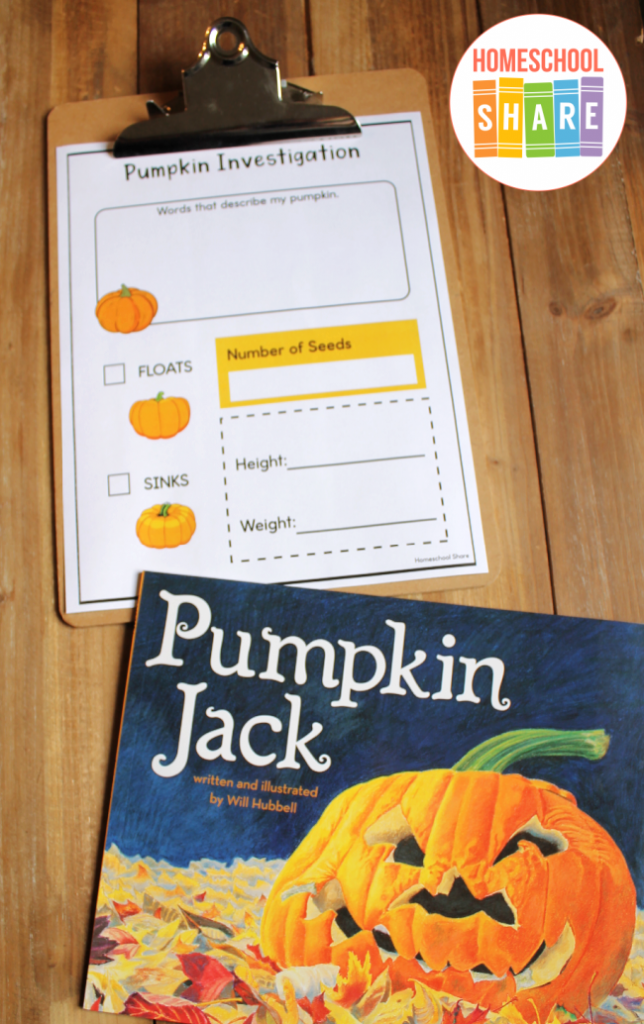
List Making – Describing Pumpkins
Get 2 or 3 pumpkins or mini pumpkins. Make a list of words that
describe your pumpkins. Make sure to feel, look at closely, and even smell your
pumpkins in order to think of as many descriptors as possible. Ex. rough, bumpy,
spotty, orange, etc… Call attention to the words used to describe Jack
throughout the book. Introduce that these words are called adjectives if
appropriate.
Metaphors
A metaphor is a figure of speech in which a word or phrase literally
denoting one kind of object or idea is used in place of another to suggest a
likeness or analogy between them (as in drowning in money vs. drowning in
water-- money is being compared to water). Unlike a simile, a metaphor does not
use like or as. Draw attention to the metaphors in the book and
discuss the meaning of each. Try to think of some metaphors on your own. You
could also draw pictures of the literal meaning such as a person in a pile of
money for drowning in money.
Here are some metaphors from the book.
“Time scraped a thin blanket of earth over the last bits of his pumpkin.”
“…yellow stars that twisted shut forever…”(pumpkin blossoms)
Art:
Pumpkin Painting and/or Carving
Pumpkin carving has become an art form. Many carvers go far beyond
the simple jack-o-lantern. You could attempt an intricate design using tiny
pumpkin saws. For younger children let them paint the pumpkins with simple
tempera paints. Pumpkins can also be drawn on with washable markers and then
rinsed off and drawn on again. Little ones love this!
Medium
– Water Color Pencils
The illustrations are done with colored pencils and solvent wash
effects. You can get the same effects with water color pencils. Water color
pencils can be found in any art supply store. They can be used at least three
ways: draw on a pre-moistened paper, draw on paper and spread color with paint
brush and water, or on a separate piece of paper color a spot of heavy color and
then pick up the color with a wet paint brush. Enjoy exploring this new medium.
Applied Math:
Comparing Pumpkins
Compare and contrast 2 or 3 pumpkins or mini-pumpkins. Measure the
circumference of each pumpkin. For each pumpkin wrap a piece of yarn around the
middle and cut it to length. Compare each yarn piece to see which pumpkin has
the greatest circumference. Its fun to have the children predict which one will
be bigger before you do this.
Compare
the pumpkins weight. A bathroom scale will do. Be sure to make predictions as
to heaviest and lightest beforehand.
Pumpkin Circumference Worksheet
Pumpkin Weight Worksheet
Multiplication Word Problems
The illustrations show Tim covering 5 pumpkin seeds with dirt, but
he harvests many more pumpkins. Using a manipulative such as small blocks or
beans, help your child figure out some simple multiplication word problems.
“Time planted 3 pumpkin seeds. Each pumpkin seed grew a vine that produced 2 pumpkins. How many pumpkins grew in all?” Vary this as needed. Have your child ask you some word problems.
For younger children do simple addition and subtraction. “Tim grew 3 pumpkins and gave 1 to a friend. How many pumpkins does Tim have now?”
Science
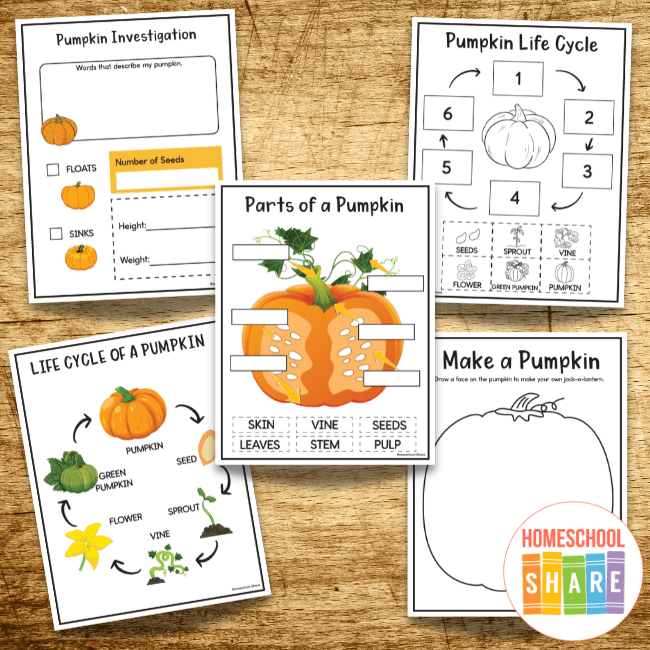
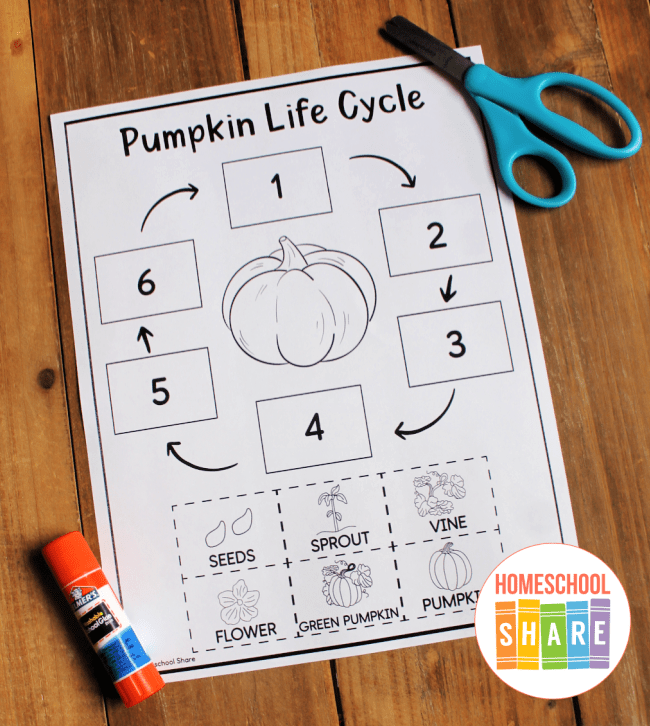
Pumpkin Life Cycle
The book clearly illustrates the life cycle of the pumpkin. Discuss
this with your child drawing attention to what stage occurs in which season.
Seed –
comes from mature pumpkin
Sprout
– spring
Vine
with flowers – Early summer
Vine
with green (immature pumpkins) – Late summer
Almost
ripe pumpkins – Mid October, pumpkins continue to ripen after picked.
Enchanted Learning has a pumpkin page with a print-out of the lifecycle
Pumpkins are Fruits
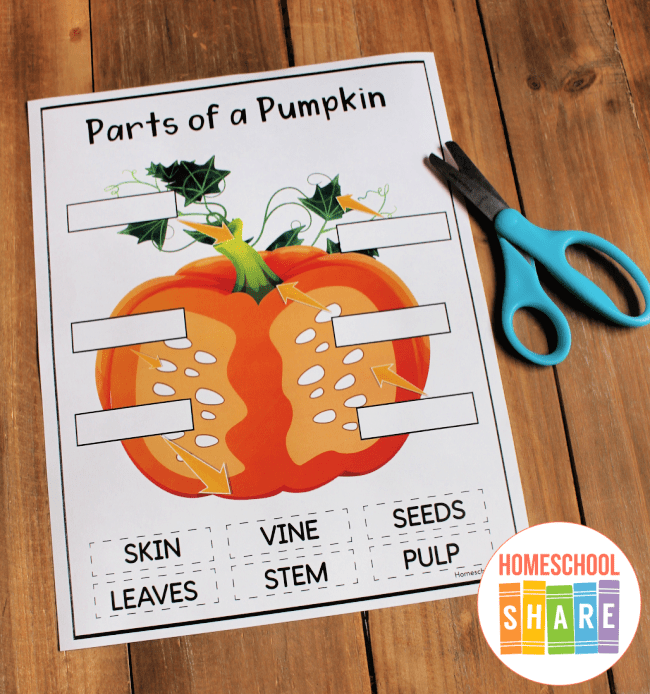
Carve out a pumpkin and show your child all the seeds. This makes
pumpkins fruits. Tomatoes and cucumbers are also fruits. Fruits are the mature
fertilized ovary of the flower the preceded the fruit. The seeds are wrapped in
these tasty packages so that animals will eat them and then disperse the seeds
with their waste (yes, I mean poo). It is their way of spreading their seeds
around. Approach this topic to the level you feel is appropriate. For more
information about flower anatomy and fruits try these links.
Flower Anatomy
Fruit at Enchanted
Learning
Mold
(contributed by Celia)
"Mold spread over Jack's bright orange skin. As the days
turned colder, Jack grew flatter."
Mold is fungus. It is important to the decomposition process. When Jack is
beginning to rot, he is tossed outside into the garden. The story notes that
every time Tim went out in the garden, Jack looked different. He began to get
flatter. Mold had begun to grow (feed) on Jack.
Mold starts as spores floating in the air. When these spores land on moist
food, they grow into mold. Unlike plants that contain chlorophyll, mold cannot
make its own food, so the mold produces chemicals which will make the food begin
to rot. The mold feeds on this and grows, while the food decomposes until
gone. This process sounds pretty gross, but God knew we needed mold! What if
nothing decomposed? There would be lots of left over foods lying
around.....after hundreds of years, where would we put it?! God designed mold
to decompose things and return them to the earth, where they become nutrients
for other plants to grow! Isn't it amazing how God planned that!
Experiment:
Take a jar with a lid (larger baby food, a peanut butter or jelly jar,
mayonnaise jar, etc.). Put inside several pieces of left over foods like
fruits, vegetables, etc. Tightly seal the jar with its lid. Duct tape it to
ensure it is not removed. Watch what happens to the foods inside over several
weeks. Have your student record his observations weekly, perhaps taking pictures
weekly. Be sure to note whether any of the items originally put in the jar had
preservatives and note the amount of mold on those items during the experiment
period. When done with this experiment, throw the jar away without opening
it.
Source
Another mold experiment (compare the conditions which are favorable for mold
growth):
While discussion mold and decomposition, you may wish to also introduce/review
the food chain. The decomposers are the last in the food chain (and often
overlooked in teaching) . Producers are first, the consumers are second, and
the decomposers are last. Research further if desired. Perhaps you could have
your student make a three-part book for your lapbook.
You may wish to have an older student research
fungi and write about the various kinds.
Just for Fun:
Cook and mash pumpkin just for the sensory experience! It’s great gooey fun.
Make pumpkin pie. Follow the directions on any can of pureed pumpkin easily found in any grocery store.
If you can read this book in the fall and save some pumpkin seeds to plant in the spring ,you will have your own pumpkin patch!
Roast the seeds from your pumpkins. Rinse seeds and remove all strings. Coat seeds with a little oil. Spread the seeds pout on a baking pan and roast slowly at 250 degrees until golden brown. Season to taste. We like salt.
Pumpkin
Worksheets from bryback manor:
ABCs Worksheet
Make a
Pumpkin Pattern
Materials and information on this website belong to the original composers. It may be used for your own personal and school use.
Material may not be used for resale. © 2005-07 HSS