| about us |
what's new
|
unit studies
|
unit study helps |
hss resources
|
fiar resources | indexes | lapbooking |
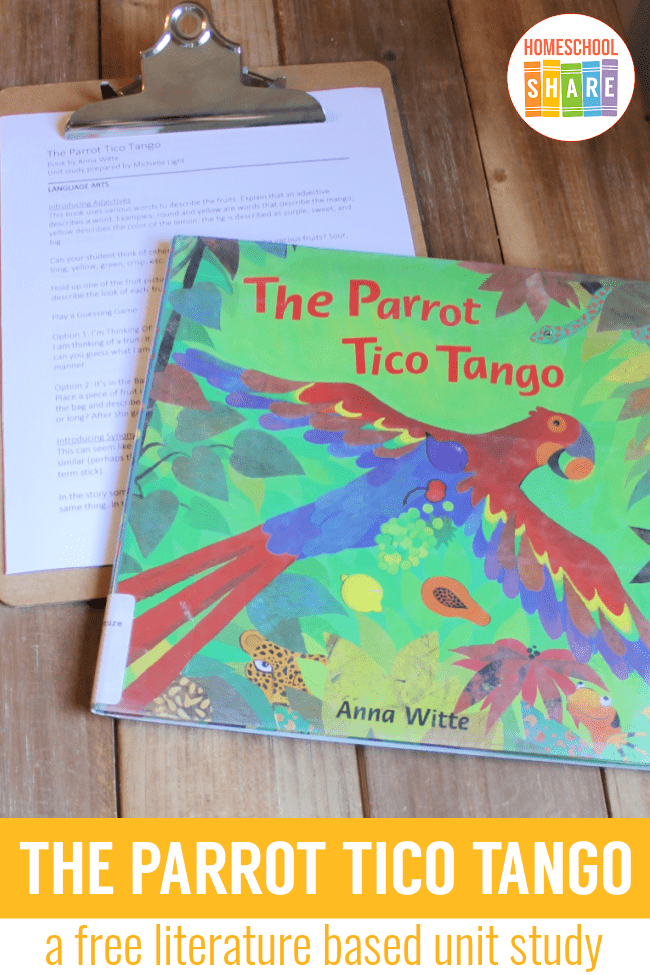
The Parrot Tico Tango
|
Written and Illustrated by Anna Witte ISBN: 1905236115
Summary:
a cumulative rhyme in which a greedy parrot keeps taking fruit from the other
creatures of the rainforest until he can hold no more.
|
Note: This unit study is best suited for K-1st, but can easily be adapted to the needs of your student.
LANGUAGE ARTS
Introducing Adjectives
This book uses various words to describe the fruits. Explain that an
adjective describes a word. (Example: round and yellow are words that describe
the mango; yellow describes the color of the lemon; the fig is described as
purple, sweet, and big.)
Can your
student think of other words that would describe various fruits? Sour, long,
yellow, green, etc.
Hold up one of the fruit picture cards (see story sequencing lesson) and have
your student describe the look and or the taste of each fruit.
Describing Games:
Option 1-
A Guessing Game
I am thinking of a fruit: It is red and round, it has small seeds inside and is
sweet, can you guess what I am thinking of? (Apple.) Continue describing fruits
in this manner.
Option 2- It's in the Bag
Place a piece of fruit in a bag without your student seeing it. Have them reach in
the bag and describe what they feel. Is it rough, bumpy, smooth, round, long,
etc. After she gives you a description, can she guess which fruit it is?
Introducing Synonyms
This can seem like a big word for little ones. I try to think of synonyms as
being similar (perhaps the word similar since it sounds almost like
synonym will help the term stick).
In the
story some words are used throughout the book and they basically mean the same
thing. In the description of how Tico took a fruit, different words are used.
Have your student listen to the story and see if he can pick out the different
words the writer chose to use. This would be a good activity to assign prior to
the story reading. You could name a few of the words-- took, grabbed, seized--
and then ask what other words were used in the story that meant the same thing
(clutched, stole, snatched, etc. ) Why do you think the writer changed the words
instead of using the same word over and over?
With an older student, read the story using only one of the words (maybe took).
Is the story as interesting?
Think
of other synonyms together with your student.
Example- eat (munch, consume, nibble, devour).
What about these words:
Tiny
(small, little)
Huge (giant, big, massive)
Quick
(speedy, fast)
Your student may only be able to think of one word for each one at this age.
Rhyming and Repetition
Discuss the rhyming words in the story. To check for understanding, begin a
story from the sentence and have your student end the sentence with a rhyming
word.
Story Sequencing and Memory Games
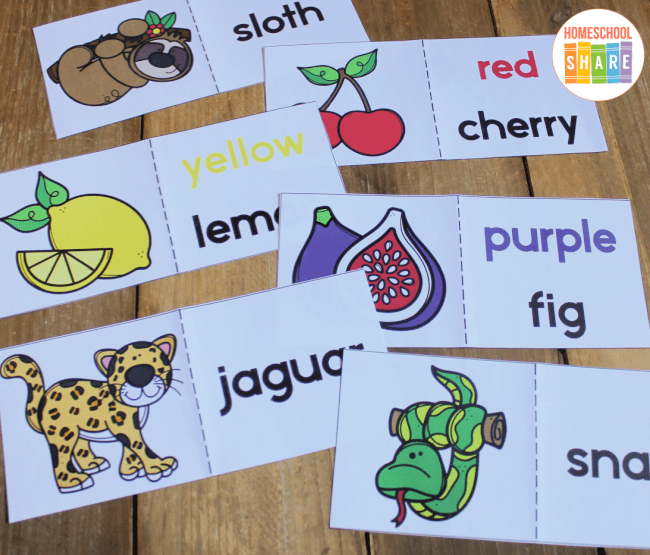
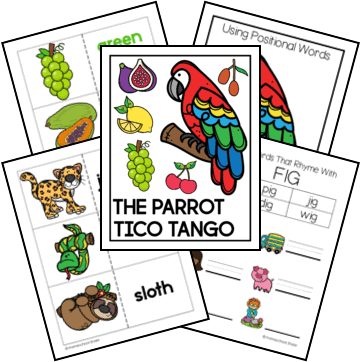
Using the pre-made cards, you can play lots of games with your student.
Fruit Cards (note: the color
of the fruit may be based on the INSIDE of the fruit -- fig/brown,
coconut/white, mango/yellow, etc. Also, a few additional fruits have been
added to correspond with the Bible lesson on fruits of the Spirit.)
Animal Cards
Color Cards
1. Story Sequencing
Option 1: Set all the fruit cards out for your student. Have your student put
the fruits in order based on the story starting with the mango.
Note: You will not use avocado or coconut for this activity.
Option 2: Set all the animal cards out for your student. Have your student put
the animal cards in order based on the story starting with the parrot.
Option 3: Put the fruit and animal cards out. Let your student match the fruit
card to the animal card and put them in order based on the story.
2. Memory/matching game
Option 1: Using the fruit cards and color cards play traditional memory
(concentration) with your student (match lemon to yellow. papaya to orange,
etc.)
Note: Yellow has more than one answer (lemon, mango) so does green
(avocado, grapes).
Option 2: Using the fruit cards and animal cards, play traditional memory
(concentration) with your student.
Option 3: Print two copies of any of the files and use them to mach up for a
traditional memory game.
More Card Fun- Silly Sentences
Put all the cards face down. Have your student choose one or two and
make a sentence using the words. Take turns with this activity. Make
your sentences silly and fun. Once your student masters two, tell him to
try drawing three words to use in a sentence.
Alphabetical Order
Your older student can try putting the fruit or animal cards in alphabetical
order.
SOCIAL STUDIES
Geography and Culture
Read the book
dedication. This will help your student determine the setting of the story
(Costa Rica).
Let your student draw a picture of a parrot on a small disk and place it on the map to indicate where Costa Rica is. Tell your student that Costa Ricans are Americans. They live in Central America. Tico is a colloquial term for a native of Costa Rica. The plural form is ticos. Costa Ricans are usually referred to as ticos by themselves and persons of other Spanish-speaking countries.
The name Costa Rica means "Rich Coast" and it was named by Christopher Columbus
in 1502. This could be a good time to read a short story about who Christopher
Columbus was.
Language
and Industry
People in this region speak Spanish. The most important crops are coffee and
bananas. Costa Rica today has the greatest coffee productivity per acre in the
world. Bananas are the number one
fruit crop of Costa Rica. Costa Rica's banana industry is currently the country's number one earner
of foreign currency.
Costa
Rica Tourism
Costa Rica is the world's fastest-growing destination for adventure and nature
travel.
Flag of Costa Rico
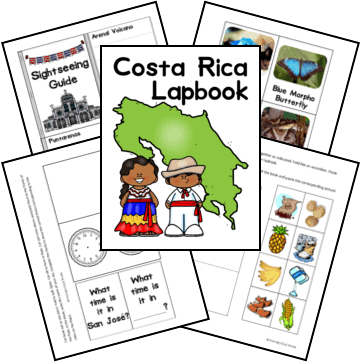
Costa Rico Flag Minit Book
Outline Map of Costa Rica
Map of Costa Rico
More
Information about Costa Rica from World Atlas
About
the Rainforest
This is an incredible, informative site with a Christian view.
This is something you may want to look through daily with your studentren. It
discusses the people, the animals and the rainforest in general. (See more in science.)
SCIENCE
Rainforest Facts
The Amazon Rainforest covers over a billion acres, encompassing areas in
Brazil, Venezuela, Colombia and the Eastern Andean region of Ecuador and Peru.
If Amazonia were a country, it would be the ninth largest in the world. The
rainforest is vital to man’s survival. The plants it contains are used both for
food and medicine. More importantly the earth's atmosphere is sustained by the
oxygen and carbon dioxide exchange that takes place when plants convert
sunlight into energy.
Rainforest
Facts
Rainforest Information at Enchanted Learning
Hear rainforest animals sounds.
See videos of rainforest animals
The amazing Amazon River-pictured from the space shuttle
Rainforest Fruits
At least
3,000 fruits are found in the rainforests. Discuss
the fruits mentioned in the story with your student. Which ones can he
remember?
In the tropical rain forest, fruits are plentiful including avocados, coconuts,
figs, oranges, lemons, grapefruit, bananas, guavas, pineapples, mangos and
tomatoes; vegetables include corn, potatoes, rice, winter squash and yams;
spices like black pepper, cayenne, chocolate, cinnamon, cloves, ginger, sugar
cane, tumeric, coffee and vanilla and nuts including Brazil nuts and cashews.
At least 80% of the developed world's diet originated in the tropical
rainforest.
The Animals of the Rainforest
Option 1-You can pick one or more of the following animals to do a further study on.
Option 2-Show the animal card pictures to your student as you tell them a little about each animal. Then lay the cards face down (on a green piece of construction paper if you have one) and tell your student they are in the "jungle"; have your student pick a card and turn it over and give you a few facts back about that animal. If he is right let him keep the card.
Sloth
mammal
shaggy hair grows down from it’s body (helps the rain to run off easily)
hardly ever washes-- green slime grows on it’s hair (yuck!)
Enchanted Learning Sloth Printable
Emerald Tree Boa
reptile
hang from trees ready to pounce on a tasty frog snack
after a really big meal, the snake may not eat again for a while year!
they coil their body tightly around tree branches to keep themselves steady
Enchanted Learning Emerald Tree Boa Printable
Iguana
reptile
members of the lizard family
omnivores-meaning they eat plants and fruits
Enchanted Learning Iguana Printable
Jaguar
mammal
large cat-- the biggest and most powerful cat in the rain forest
can climb trees and swim after crocodiles
spotted coat makes it hard to see in the shady grass and trees
Enchanted Learning Jaguar Printable
Poison Dart (arrow) Frog
amphibian
referred to as Poison Dart or Poison Arrow Frogs
poison from their skins is taken by Colombian Indians to smear on the tips of
darts/arrows to help kill animals when hunting
170 different species
appearance varies, but the colors are always bright (you will find them in neon
colors including red, orange, yellow, green, and blue)
the Strawberry Poison Dart Frog is sometimes called the “blue jean frog” because
it has a bright red or orange body with blue legs
Enchanted Learning Poison Dart Frog Printable
Parrot
bird
very intelligent
can mimic the human voice
short, hooked bills to help with cracking open seeds and nuts
16 different kinds in Costa Rica
make loud screeching sounds as they fly
Tico looks to be a macaw with his brilliant markings
Printable Parrot
Online Coloring
Parrot
Howler
Monkey
mammal,
primate
named and known for the loud, howls they make
howls
can be heard from over 3 miles away
Black howler monkeys are the largest monkey in Latin American rainforests; they
grow to be about two to four feet tall (Taller than many of your preschoolers)
and weigh from eight to twenty-two pounds. They have big necks and lower
jaws, where their super-sized vocal cords are housed. They have long tails which
they use to as an extra arm to hold onto branches.
Diet: Howlers eat mostly leaves, but occasionally supplement their diet with fruit and maggots.
Predators: Large birds of prey (like the harpy eagle) prey upon the howler monkey.
Howler Monkey info and online photo
Enchanted Learning Howler Monkey Printable
Health and Nutrition
Fruits are a very important part of a nutritious diet. The food
pyramid suggests 2-4 servings of fruit per day. Fruit gives us fiber and
antioxidants that help our bodies fight disease. Fiber keeps out intestines
clean and helps us move waste out of our bodies. Fruits also provide us
with many vitamins like A and C. Vitamin C is powerful for helping us fight
colds and heal rapidly.
Make a fruit chart with your student to track and see if she is getting her 2-4
servings each day.
DOLE- fun, informative site
for kids and parents
You may want to check-out the Howler monkey, parrot, sloth, jaguar, and iguana report forms and copywork pages on Homeschool Share's Animal Forms page.
MATH
Counting, Addition, and Subtraction
Count
any number of objects in the story, number of animals, fruits etc. How many
fruits did he have in all? If you want, you can use the Fruit Cards as
manipulatives. Here are a few sample problems:
Tico has three fruits, but he drops the fig. How many fruits does he have
now?
Tico has one fruit and he steals two more. How many fruits does he have
now?
Right
and Left (and positional words)
Tico carried a lemon on his right and a fig on his left.
Set your
book on the table (or use the printable parrot below). Give your student
the fruit cards. Tell your student to put the fig on the left side of Tico.
Continue with this type of instruction (put the lemon on the right side of Tico,
etc.) You could even use this activity to help your student learn
positional words (put the cherry over Tico, put the papaya under Tico, put the
grapes on Tico, etc.).
Parrot Coloring Page (if you would like to use this for the activities
above instead of the book cover)
Measuring
The
Black Howler Monkey is said to grow to be about two to four feet tall (taller
than many of your preschoolers). Using a measuring tape or yard stick
measure two feet and then four feet. This is how big this monkey would be if it were
standing next to you. How tall are is your student? Is he shorter or
taller than a two foot Howler Monkey? Is he taller or shorter than a four foot Howler
Monkey?
ART
Collage
The artist developed her own style working with collage art that utilizes
fabrics, acrylics, paper, ink, and pastels. Create a collage using various things
like the illustrator did. Draw some of the fruits using simple shapes-- circles,
ovals etc. If your student is able, discuss and work on shading and coloring as
seen in the two different greens used in the grapes.
Shwoopie
Shwoopies are the curly things in the illustrations that look like pig tails or in some cases
spirals. The artist uses them in many of the pictures-- for monkeys tail, the
tree branches, background foliage, weeds. Let your student practice drawing them.
CHARACTER BUILDING
AND BIBLE
Anna makes a statement here about her art. “I would like the reader to reflect on the story of these characters, to ask where they come from, what they will be doing next, and in what ways their journeys mirror those of the reader." You could discuss how Tico’s journey is like our lives. What did Tico do and what did he learn?
This could be a good time to discuss Tico’s greed and the lesson he learned. His friends had every reason to be upset with him, yet they forgave him. I wonder how his friends felt when he greedily snatched their food. How would you feel if someone did that to you? Have you ever snatched a toy from a friend or brother or sister?
How do you think it made them feel?
You can also discuss these traits with your student:
Greed
Luke
12:15
Read through this story. Jesus warns against every form of greed. Tico
later exhibits humility in the fact that he accepts correction from his friends.
Humility
humbling
ourselves and understanding who we are in relationship to God.
Accepting Correction
Proverbs
3: 12
Whom the Lord loves, he corrects. This is something that as parents we also must
do if we are to show our studentren we love them.
Repentance
Tico
Tango admits that he feels bad for what he has done wrong.
1 John
1:9 God says that if we will confess our sins and turn from them that he will
forgive us! Luke 17:3 If your brother sins against you, rebuke (correct) him,
and if he repents (turns) forgive him.
Forgiveness
Tico’s
friends show him forgiveness. Matthew 18:21 How many times shall we forgive?
Seventy times seven.
The Fruits of the Spirit
Key Verse: But the fruit of the Spirit is love, joy, peace, patience, kindness, goodness, faithfulness, gentleness and self-control. (Galatians 5:22-23)
Tie in story of the good vs. bad tree. Matthew 12:33 A tree is known by it’s fruit. What does this mean?
Visual Character Exercise. Hold up a nice yellow banana in one hand, and Ask your student, “would you want to eat this?“ Then hold up an old brown or black banana in another hand. Ask your student. “Would you want to eat this?” Ask why and why not. In the same way we are known by our fruits. When we are showing godliness and kindness, we look like the good banana. But when we show ugliness- selfishness, greed, disobedience, etc. We are like the bad fruit. The Bible says we are known by our fruits. So are we showing beauty or ugliness? This can be the kickoff of why you will be learning about the fruits of the spirit. Because we want to be like a good tree with good fruits.
Read through one or more traits each day. Use the fruit pieces with scripture references to make a fruits of the spirit tree add one or two traits per day to the tree as you go through the unit. Note: I added in two more fruits so there would be enough for the character studies. These fruits would be found in a rainforest.
Mango- Kindness, Be kind to one another. Ephesians 4:32
Lemon - Love - Love must be sincere…Romans 12:9
Fig - Faithfulness - Well done, good and faithful servant!.. Matthew 25:21
Cherry - Joy -Be Joyful always… 1 Thessalonians 5:16
Grapes - Gentleness -Have a gentle and quiet spirit. 1 Peter 3:4
Papaya - Patience -Be patient…Ephesians 4:2
Date - Peace - live at peace with everyone. Romans 12:18
Avocado -Goodness- we are created to do good works… Ephesians 2:10
Coconut- Self Control -Be self controlled… 1 Peter 1:13
JUST
FOR FUN and RESOURCES
Music/Dance
The Tango is a popular dance in Spanish culture.
Cooking
Make a tropical fruit cocktail and try tasting some fruits you have never
taste before.
Library List
World
Book Encyclopediea presents RainForest Animals ISBN 0-7166-7703-2
More Sites
Materials and information on this website belong to the original composers. It may be used for your own personal and school use.
Material may not be used for resale. © 2005-07 HSS