| HSS Forum Ami's Blog - Walking By The Way HSS on Facebook | ||||||
| about us |
what's new
|
unit studies
|
unit study helps |
fiar resources
|
indexes | lapbooking |
Odd Boy Out: Young Albert Einstein
|
Author: Don
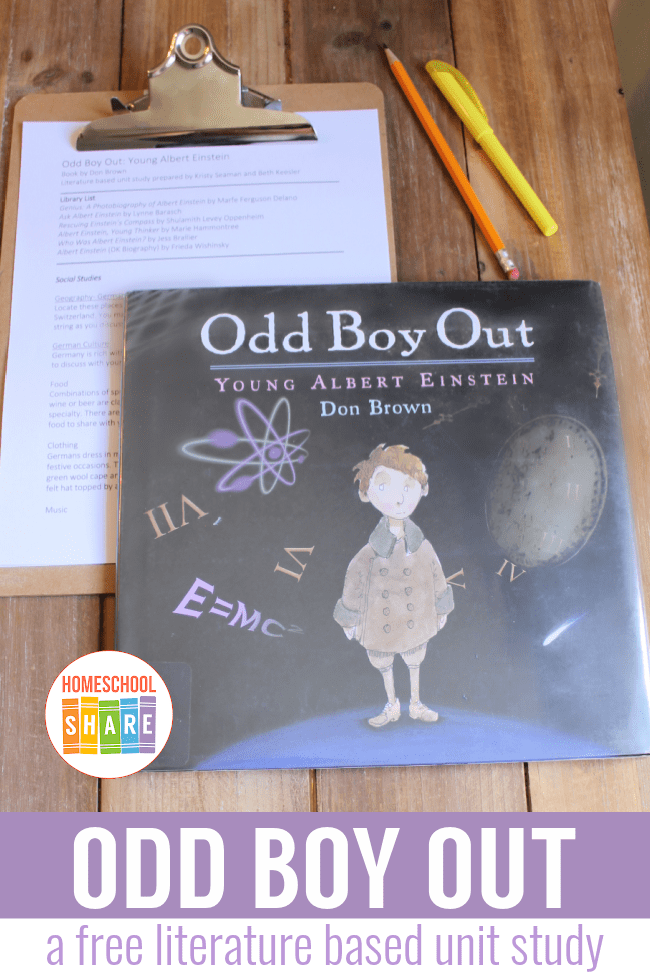
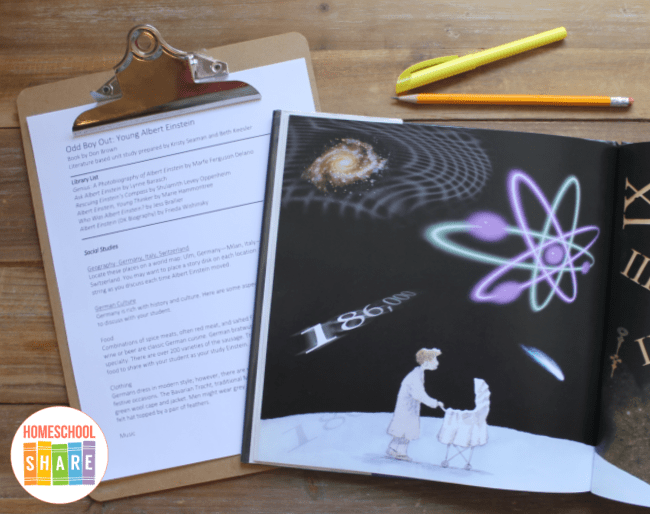
Brown ISBN:054701435X Summary: Einstein found himself the "odd boy" at school, and as the only Jewish student, was sometimes taunted by other children. He puzzled his instructors as well; though clearly gifted in science, math, and music, he was an indifferent student in most subjects. Brown's pen-and-ink and watercolor illustrations, rendered in a palette of dusky mauve and earthy brown, portray a doubtful, somewhat unhappy-looking child, except for a picture in which he gazes fondly at a compass, a gift that astonishes him as he ponders its mysteries. In many scenes he is marginalized on the sidelines, set apart by color and shading. One dramatic spread features an adult Einstein pushing his child in a carriage, looking small against a backdrop that highlights some of the scientific puzzles that so engaged him. Unit by Kristy Seaman and Beth Keesler Level 4 Unit |
Library List
Genius: A
Photobiography of Albert Einstein by Marfe Ferguson Delano
Ask Albert Einstein by Lynne Barasch
Rescuing Einstein’s Compass by Shulamith Levey Oppenheim
Albert Einstein, Young Thinker by Marie Hammontree
Who was Albert Einstein? by Jess Brallier
Albert Einstein (DK Biography) by Frieda Wishinsky
Social Studies
Geography- Germany, Italy, Switzerland
Locate these places on a world map: Ulm, Germany—Milan, Italy—Zurich, Switzerland. You may want to place a story disk on each location and attach with a string as you discuss each time Albert Einstein moved.
German Culture
Germany is rich
with history and culture. Here are some aspects of German culture to
discuss with your student.
Food
Combinations of spice meats, often red meat, and salted fish with vegetables and
wine or beer are classic German cuisine. German bratwurst, or wurst, is a local
specialty. There are over 200 varieties of the sausage. Try to find
some German food to share with your student as your study Einstein.
Clothing
Germans dress in modern style; however, there are native costumes worn during
festive occasions. The Bavarian Tracht, traditional Munich-style dress,
includes a green wool cape and jacket. Men might wear grey or green trousers
with a green felt hat topped by a pair of feathers.
Music
Many great musicians including Wolfgang Mozart, Franz Haydn, Johann Sebastian
Bach, Ludwig van Beethoven and Richard Strauss lived and worked on
Germany. Thus, music is a passionate aspect of German culture. Even today,
music education is strongly supported with concerts or choral groups being a big
part of social activities.
Festivals
The Munich Oktoberfest has been held every year since 1810.
It began as a horse race celebrating the marriage of Prince Ludwig I and
Princess Therese von SachsenHildburghausen of Saxony. Today, the festival lasts
16 days and includes large beer tents, side shows, fun fair, musical
performances, food and craft stalls.
Language
We use many German words in our every day English. A few are: hamburger,
kindergarten, bratwurst, dachshund, delicatessen, diesel, dollar,
Fahrenheit, flack, fest, school, and spritz. To
find more look here :
http://germanenglishwords.com/
German History,
WWII
The events that led up to World War II are complex and may be difficult for
younger children to grasp. You may choose to briefly review or go into more
depth as you deem fit. Germany was the main aggressor in the first world war,
1914-1918, and was punished severely by the United States, France and England.
The Treaty of Versailles in 1919 caused that Germany pay heavy fines and Germany
was prohibited from manufacturing heavy weapons. Germany’s state of affairs
spiraled downward afterwards. It’s currency lost its value, people were not
able to afford their homes or food and were hungry and sick, political parties
were severely divided. In the midst of this chaos, a new political party, the
Nazi Party, was formed opposing the current government rule. The Nazi Party was
led by Adolf Hitler. The Nazi Party was not the party of government;
however, Hitler staged attempts to overthrow the current govt. leaders which led
him to a short prison stay, where he wrote Mein Kampf a book of his ideas
about German superiority. The Nazi Party slowly grew throughout the 1920’s and
by 1933 Hitler became Chanellor. German people were distraught with high
unemployment rates and high cost of living and were eager for new leadership,
someone who could change their current situation, Within months, Hitler’s
popularity grew and in 1934 the President died. The German military swore their
loyalty to Hitler and the Nazis took complete control of the government. He declared the Nazi Party as the only legal party
in Germany. Hitler began to rearm Germany: Service in the German army was
mandatory for all men; children were encouraged to join youth loyalty groups; factories were devoted to manufacturing airplanes, weapons, and warships.
Hitler was a fascist, a person who believes in absolute power for the person in
charge. He became greedy and wanted to take over Europe. Hitler invaded
Austria in March of 1938, Czechoslovakia in 1939, and Poland in September of
1939 despite communications from the USA for peace. Because of Germany's
invasions, Britain and
France declared war on Germany.
Albert
Einstein Timeline
~1879
There is
much mystery and inaccuracy regarding Albert Einstein’s childhood. He was an
inquisitive, bright child. Contrary to belief, Albert did very well in school; however, he did not like school. The German schooling system at that time were
very strict and required rote memorization. If a child did not do well, he
would be subject to harsh discipine. As a result of this system, Albert was
disinterested in school. He had a great interest in math and physics that
continued into adulthood and eventually made him the world’s most famous
scientist.
~1895
At the age
of fifteen Albert quit high school (disgusted by rote learning and martinet
teachers), and followed his family to Italy where they had moved their failing business. After half a year of wandering and loafing, he
attended a congenial Swiss school. The next year he entered the Federal
Institute of Technology in Zurich.
~1900
After
graduating from Zurich, he worked as a technical assistant at the Swiss Patent
office. This is where he found much time to mull over ideas.
~1905
Einstein
published five groundbreaking papers, of which four are written all in a few
months. The first paper claimed that light must sometimes behave like a stream
of particles with discrete energies, "quanta." The second paper offered an
experimental test for the theory of heat and proof of the existence of atoms.
The third paper addressed a central puzzle for physicists of the day – the
connection between electromagnetic theory and ordinary motion – and solved it
using the "principle of relativity." The fourth showed that mass and energy are
two parts of the same thing, mass-energy (E=mc2).
~1909
Einstein
became an assistant professor at the University of Zurich, his first full-time
physics job. The next year he returned to the Federal Institute of Technology in
Zurich as Professor.
~1914
WWI
begins, Einstein rejected Germany's aggressive war aims, supporting the
formation of a pacifist group.
~1915
After a
decade of thought, with entire years spent in blind alleys, Einstein completed
his general theory of relativity. Overturning ancient notions of space and time,
he reached a new understanding of gravity. Meanwhile he continued to sign
petitions for peace.
~1919
May 29, a
solar eclipse proves his Theory of Relativity
~1921
Aided by
his fame, Einstein championed the fledgling German republican government and
other liberal causes. Partly as a result of this, he and his theory of
relativity came under vicious attack from anti-Semites. He began travelling,
attended an International Trade Union Congress in Amsterdam, and visited the
United States to help raise funds for the Hebrew University in Jerusalem. The
following year he received the Nobel Prize.
~1933
Unwilling
to live in Germany under the new Nazi government, Einstein joined the Institute
for Advanced Study in Princeton, New Jersey. He turned away from strict
pacifism, and warned world political leaders to prepare for German aggression.
He also worked to rescue Jewish and other political victims of the Nazis.
~1939
Einstein
signed a letter that informed President F. D. Roosevelt of the possibility of
nuclear bombs, warning that the Germans might try to build them. The next year
Einstein became an American citizen.
~1952
Einstein
was asked to become the second President of the State of Israel, but declined.
He was supporting many causes, such as the United Nations and world government,
nuclear disarmament, and civil liberties.
~1955
April 18
he becomes ill and dies.
Safety
According to the author,
Albert’s parents allow him to walk the streets of Munich alone at 4 years old.
Ask your student if they feel this is unusual. Discuss with them that Albert’s
mother secretly followed behind him to make sure that he was able to handle
himself. His parents encouraged independence at a young age (Genius:A Photobiography of Albert Einstein) . Discuss why it is not safe to walk
alone, and suggest ways to practice safety. A fun go along book about safety is
Officer Buckle and Gloria.
Wolfgang Amadaeus
Mozart
Einstein’s mother, Pauline, was a
talented pianist. She introduced Albert to music as a small child, beginning his
violin lessons at age six. He labored under unimaginative instruction until
discovering the joys of Mozart’s sonatas at age 13. From that point on, although
he had no further lessons, his violin remained a constant companion. Einstein
said later that, “I live my daydreams in music. I see my life in the form of
music.”
Born on January 27, 1756 in Salzburg, Austria, Mozart was a child
prodigy affluent in violin and piano. Three days before his 5th
birthday, Mozart mastered his first musical composition. He spent most of his
childhood in musical instruction by his father and traveling for concerts. He
married and had 6 children, 2 surviving. At the time of his death he composed
more than 600 pieces in many different musical styles. He
was a versatile composer and wrote in almost every major genre, including
symphony, opera, solo concerto, chamber music and the piano sonata. While none
of these genres were new, the piano conterto was almost single-handedly
developed and popularized by Mozart. He also wrote a great deal of religious
music; and he composed many dances and other forms of light entertainment.
Take some time and listen to Mozart with your student. You may enjoy Mozart's Magnificent Voyage by Classical Kids
Nobel Prize
Established in 1901 by Alfred Nobel of Sweden, the Nobel prize is one of the
highest universal recognitions an individual can get. It is awarded to most
often one person a year who has conferred the greatest benefit to mankind in one
of five areas: peace, literature, chemistry, medicine and physics. Since 1902
the King of Sweden has awarded all recipients the prize.
Each
"Nobel Prize Award" consists of a gold medal, a diploma, and a monetary grant,
today the amount is 1.5 million dollars.
Albert
Einstein was awarded the 1921 Nobel Prize for Physics for his work in the
photoelectric effect. This award is given to one individual who made the most
important discovery or invention within the field of physics.
Science
Compass
When
Albert was ill as a child his father gave him a compass to occupy his time. The
compass is an instrument used to navigate, or determine direction in relation to
the north and south magnetic poles of the Earth. A compass usually consists of a
magnetized pointer, such as a bar or needle floating in a fluid or freely upon a
pivot, that aligns with Earth’s magnetic field (usually marked North). The face
of the compass includes the cardinal points of north, south, east and west.
An
early form of the compass (a magnetized needle floating in water) was invented
in ancient China sometime before 1044.
There is evidence of the discovery
of a magnetized, navigational-like instrument in the Olmec civilization
(inventors of chocolate), pre-1000b.c. which predates the Chinese invention.
The dry compass was
invented in medieval Europe around 1300.
This was supplanted in the
early 20th century by the liquid-filled magnetic compass. Prior
to the compass, seamen determined their position and direction at sea primarily
by the sighting of landmarks and the position of celestial bodies, thus, they
often stayed close to land and did not venture far. The invention of the compass
enabled the determination of heading when the sky was overcast or foggy. And,
when the sun or other known celestial bodies could be observed, it enabled the
calculation of latitude. This enabled mariners to navigate safely away from
land, exploring and discovering other lands, people and cultures, an “Age of
Discovery”.
Make your own compass with a cork, magnetized needle and bowl of water.
1 .Magnetize a sewing needle by rubbing the needle along a magnet in one direction making sure to cover the entire surface. If the needle
sticks to your fridge your good to go.
2. Mark the needle with a marker at one end.
3. Fill a small bowl partway with water (enough so a piece of cork will float freely). Place a thin circle of cork in the bowl.
4. Gently place the needle on the cork. The marked end of the needle should point in a northerly direction.
5. Pick up the needle and place it in a different direction. Where does it end up each time? Try turning the bowl to see what happens.
As long as a magnet can pivot easily, it will always turn to point the same way: the north pole of the magnet points north and the south pole points south. If your student is interested this would be a fun time to investigate and learn more about magnets. Try Science with Magnets an Usborne Science book for fun activities.
A good go-along book is Rescuing Einstein’s Compass
Photoelectricity
Einstein believed that light is made of tiny particles called photons. Einstein
explained that when the photons in a light beam hit a piece of metal the
electrons are knocked out of it. Electrons are tiny elecrically charged
particles found in every living and nonliving thing. Try this simple
experiment: use a remote control to turn a television or stereo on. Explain
that because of Einstein’s theory we are to use a beam of light to turn on an
electrical device. Now stand between the television and remote. What
happens? Your body blocks the beam of light and so the electrical particles in
the TV are not disturbed—nothing happens. His work with photoelectricity opened
the door for future inventions of televisions, cell phones, and remote controls.
Speed of Light/
Theory of relativity
As a child, Einstein wondered what would it be like to
ride a light beam? As an adult he was able to answer this question. He
wondered if light traveled at the same speed no matter where a person was. The speed
of light is approximately 186, 000 miles per second. Imagine standing on the
side of a railroad track and a fast moving train passes you by. Because you are
standing still, the train appears to be going faster to you than for those who are
actually on the train. Now imagine you are watching someone standing on the
train throwing a baseball. Which person would see the ball moving faster? The
person on the train would see the ball moving at a speed relative to standing on
a fast moving train; however, you would see the ball moving at a much quicker
rate because you are also seeing the fast moving train.
Try this sometime while you are in a car-- watch another moving car beside yours. If you wait, it
may actually seem like you are not moving. Einstein called this the Theory of
Relativity. Time and distance appear one way to you and another to the person
moving at a different speed. He declared that the faster an object moves, the
slower time passes. Today Einstein’s theory has been confirmed. Scientists put
a very accurate atomic clock in a high speed jet that traveled around the world
and compared the clock to the same identical one placed on Earth. The clock
that was on the jet actually ticked slower. Discuss with your student the
possibility of time travel. Is it possible? Is it practical?
Applied Math
Geometry
Albert
Einstein loved math. When he was 10, a poor student named Max Talmud began
dining with the Einstein family once a week. Max would bring illustrated books
for Albert to study, and they would discuss what Albert learned. Max gave him a
geometry textbook two years before Albert was to study the subject at school.
Max later recalled, “Soon the flight of his mathematical genius was so high that
I could no longer follow.”
Geometry is the
study of shapes, lines, points, angles. This is a perfect time to
introduce some basic geometry to your student. Have your student identify
all of the shapes in the equation figure. Make a shape book including two
and three dimensional shapes depending
upon ability. Your older student may even want to tackle some equations
(perimeter or area).
When Albert was
younger he would play the geometry game with his family. Play the geometry
game together (find a square in the room, find a triangle outside, etc.).
Roman Numerals
Ancient Romans used letters rather than numbers when numbering things. Roman
numerals can still be found on watches or clocks, old buildings. Have your
student identify the numerals in the book.
|
I |
II |
III |
IV |
V |
VI |
VII |
VIII |
IX |
X |
XI |
XII |
|
1 |
2 |
3 |
4 |
5 |
6 |
7 |
8 |
9 |
10 |
11 |
12 |
|
I |
V |
X |
L |
C |
D |
M |
|
1 |
2 |
10 |
50 |
100 |
500 |
1000 |
Basic Rules:
-If a larger numeral follows a smaller one, subtract the first from the second: IV = V -1 (5-1)
-If a numeral is followed by one or more symbols that are equal to or less than it, add them together: XII = X +I + I (10 +1 + 1)
-If a numeral is a large number, such as the year, each digit is represented individually: 1933 =M + IX + III + III = M IX III III
Have your student convert to Roman numerals
-age -zip code
-height -weight
-address -year born
-phone number
Language
Arts
Vocabulary
|
Vocabulary word |
Definition |
|
fret |
An irritated or worried state |
|
brooding |
To think anxiously or gloomily about something |
|
astonishes |
To strike with sudden and usually great wonder |
|
taunt |
To reproach or challenge in a mocking manner |
|
solitude |
The state of being alone |
|
irk |
To make weary, bored |
|
mulls |
Ponder, consider carefully |
|
phenomenal |
An extraordinary person or thing |
|
knotty |
A problem |
Contrast
Writing
can be developed with one or more methods of arrangement. Contrast uses details
to show how one subject is different from a more familiar subject is.
The others love to play ball. Albert does not like sports.
Soldiers on parade excite the boys. They disturb Albert.
In both examples, the writer contrasts Albert with the “other boys” to show his differences.
Writing Clear
Directions
Working
at the patent office influenced Einstein’s thinking process. Through
this job he learns to read and draw technical drawings. Patents must have a
description page telling what the item does, and how it works. Through reading
and analyzing these, Einstein learned how to write clear, simple explanations .
You may want to have your student write or dictate some simple clear directions
about a favorite or familiar activity.
Copywork
Albert Einstein was quoted “In the past it never occurred to me that every
casual remark of mine would be snatched up and recorded. Otherwise I would
have crept into my shell." Discuss some of his famous remarks and what
your student thinks they mean. You may also choose to use these for copywork.
~Life is like riding a bicycle. To keep your balance you must keep moving.
~The only reason for time is so that everything doesn’t happen at once.
~Joy in looking and comprehending is nature’s most beautiful gift.
~Imagination is more important that knowledge. Knowledge is limited. Imagination encircles the world.
~The most beautiful thing we can experience is the mysterious. It is the source of all true art and all science. He to whom this emotion is a stranger, who can longer pause to wonder and stand rapt in awe, is as good as dead: his eyes are closed.
Art
Building
Architecture
Notice the lines of the buildings in the first few pages. German
architecture is varied and includes Gothic styles as well as baroque designs. Gothic
architecture
features include the pointed arch, the ribbed vault and the flying buttress. Important
features of Baroque architecture include
broader, occasionally circular forms, dramatic use of light, either strong
light-and-shade contrasts or uniform lighting by means of several windows,
opulent use of ornaments, and large-scale ceiling frescoes (paintings on
plaster).
Check out some
German buildings in many styles
A free paper model of Gothic castle to build
Mixed Medium
The
illustrator used digital images with pen, ink and watercolor. The artist blends
digital images with ink and watercolor in a 2 page layout representing Albert
Einstein’s thoughts and ideas which gives this layout a very unique feel. The other pages are ink and watercolor.
Shadowing
Shadowing brings depth to an illustration. It may depict where the source of
light is, give a picture a three-dimensional look or evoke a sense of mystery or
emotion
Drawing Faces
Don
Brown uses simple lines to create cartoon-like illustrations. Try to make simpe
faces using watercolor oval shapes and add details to face with black ink.
Experiment with different ways of drawing features.
Bible/Character
Courage
Discuss 2 Timothy
1:7. Albert’s schoolmates had a desire to join the military and enjoyed playing
sports. Albert remained true to himself and demonstrated much courage when he
told a soldier that he did not want to join the military. At that time, Albert
could have been arrested as it was expected of all German boys to join.
Perseverance
Read Philippians 4:13. Einstein demonstrated many examples of perseverance throughou his life (school, building with cards, working out theories, urging
US into war w/Germany).
Just for
Fun!
Build a house of cards. Albert was able to build one 14 stories high. How high can you go?
A PBS link to activities based on the Nova program.
http://www.pbs.org/wgbh/nova/einstein/lrk.html
Watch The Sound of Music, a classic movie about a family who escapes Austria during Word War II.