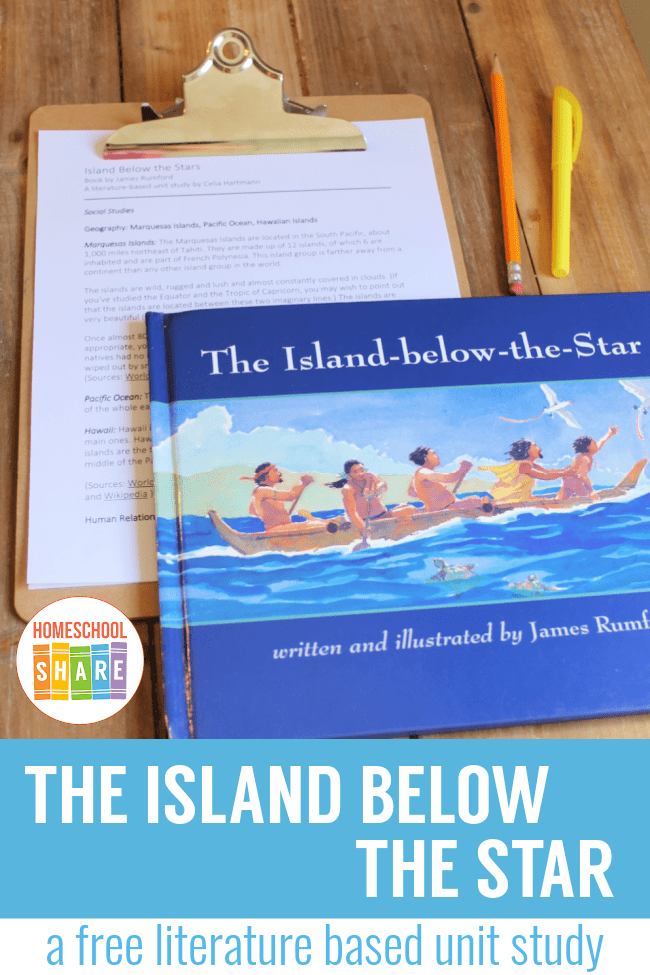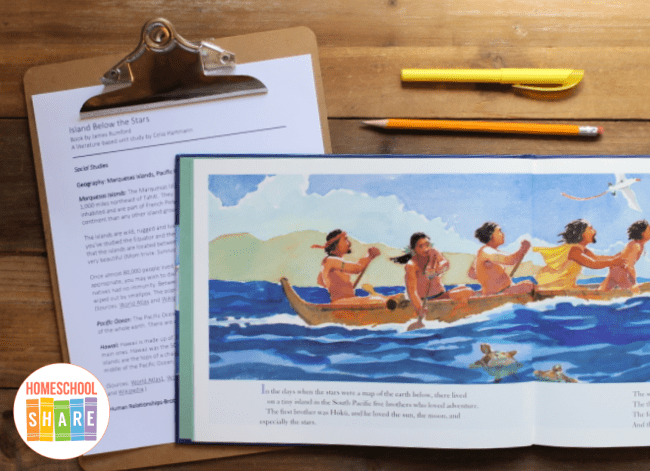
Island-below-the-Star, a literature-based unit study based on the book
by James Rumford
The Island Below the Star
|
|
Author & Illustrator: James
Rumford
Summary: Five brothers, each with a special
skill, sail across the vast Pacific Ocean to the islands now known as Hawaii.
ISBN: 0395851599 |
A literature-based unit study by Ami and
Celia
Social Studies
Geographyn: Marquesas Islands, Pacific Ocean, Hawaiian Islands
Marquesas
Islands:
The Marquesas Islands are
located in the South Pacific, about 1,000 miles northeast of Tahiti.
They are made up of 12 islands, of which 6 are inhabited and are part of
French Polynesia. This island group is farther away from a continent
than any other island group in the world.
The islands are wild, rugged and lush and almost constantly covered in
clouds. (If you've studied the Equator and the Tropic of Capricorn,
you may wish to point out that the islands are located between these two
imaginary lines.) The islands are very beautiful (Mom trivia:
Survivor was shot here.)
Once almost 80,000 people lived on these island, today only about 7,000.
(If appropriate, you may wish to discuss how explorers brought diseases to
which the natives had no immunity. Between 1600 and 1900, most of the
population was wiped out by smallpox. The population was just under 2,000
around 1900.). (Sources:
World Atlas and
Wikipedia )
Pacific Ocean: The Pacific Ocean is the earth's largest ocean. It
is about 1/3 the size of the whole earth. There are about 25,000 islands in
the Pacific. (Sources: Wikipedia
)
Make two story disks and
connect with a piece of yarn. Place one on the Marquesas Islands and the
other on Hawaii.
Brothers: The
brothers in our story share a special relationship. They all seem to get along
well. They helped one another prepare for the journey. The looked after their
little brother. They were not mad at Manu when he stowed away on their
canoe--only laughed and pretended to throw him overboard (see the picture of the
brothers laughing as Manu is held over the water). They then gave Manu
responsibilities, so he too could help out. Though the older
brothers had originally laughed at the idea of little Manu going on the
dangerous journey, they were really looking out for him. Later, when Manu spots
the bird when they had been blown off course, they believe him and set sail for
the direction the bird was going. Because Manu knew about birds, they were
willing to listen to him and to let Manu and the bird guide them back on course.
If your student has a brother (is a brother), discuss his relationship with his
sibling(s). What makes it special? What responsibilities does an
older brother have? What things does your student have special knowledge
in (like Manu and birds) or what special talent does your student possess?
What things do his (or her) siblings have special knowledge in (or what special
talents do they possess)?
Preparations for a Journey/List making:
Once the brothers decided to go on their journey, they did not leave right away.
Instead, they took weeks to prepare the canoe and to gather or make the
supplies they would need. Hoku dried the fruit, Na'ale made fishhooks and got
the harpoons, 'Opua gathered rain water, and Makani repaired the sails.
Even when we leave our home overnight, or for a few days or weeks, we too need
to prepare. Think about all the things you would need to spend the
night at a friends house and make a list. Think about all the things you would
need to go camping for a weekend and make a list.
History €“ Explorers of the Pacific Ocean:
Read the author's note at the end of the story. Discuss with your
student any or all of these explorers of the Pacific Ocean.
Vasco Nunez de Balboa
(1475 - 1519) -- Spanish explorer. Was the first European explorer to see
the eastern shore of the Pacific Ocean.
Ferdinand Magellan (1480-1521) -- Portuguese explorer.
Credited for being the first to completely sail around the world. Actually,
he was killed in the Philippines prior to end of the journey, but his
remaining crew finished the voyage.
Sir Francis Drake (1545-1596) -- British explorer. Second to
circumnavigate the earth.
Captain James Cook
(1728-1779) -- English explorer. Made three voyages to explore the Pacific
Ocean. He charted many areas and recorded several islands and coastlines.
He claimed the eastern coast of Australia for Britain and discovered the
Hawaiian Islands. He was the first to prevent scurvy by providing his crew
with fresh fruits.
Celebrations: There was a great
celebration for the four brothers. For what reasons does your
family celebrate? Birthdays, weddings, new babies? What about a
person graduating from school? A graduate is starting a new journey in life.
The friends and family of the brothers in our story celebrated the new journey
the brothers were about to embark on. It might be fun to create a
luau (a Hawaiian party) this week! Perhaps you could do this as
a celebration of your own journey with this unit this week.
Oriental Trading Company, Inc.
sells many affordable luau items. You can get 12 Poly Hawaiian Leis for $3.95,
a 6-Ft. Metallic Palm Tree for $4.95, a child's hula kit (grass skirt, lei,
and bracelets) for $6, and 24 1-Oz. Mini €œAloha€ Bubbles for $5.95 and much
more! Or
make your own leis with construction paper flowers and cut pieces of colorful
drinking straws in between. A palm tree could be made of construction paper
too. Serve punch or smoothies, fresh fruits, coconut, and maybe
some recipes from here! Here
is a link to the DLTK site for more great luau ideas!
Social Studies -- Weather Lore:
See Science lesson on Weather Prediction.
Language Arts
Vocabulary:
taro -- a large-leaved tropical Asian plant (Colocasia esculenta)
of the arum family grown throughout the tropics for its edible starchy corms
and cormels and in temperate regions for ornament; also : its
corms and cormels typically cooked as a vegetable or ground into flour.
breadfruit -- a round starchy usually seedless fruit that resembles
bread in color and texture when baked; also: a tall tropical
evergreen tree (Artocarpus altilis) of the mulberry family that bears
this fruit.
seaworthy
-- fit or safe for a sea voyage
calabash(es) -- a utensil or container made from the dried,
hollowed-out shell of the fruit of a calabash plant.
awe -- an emotion variously combining dread, veneration, and wonder
that is inspired by authority or by the sacred or sublime
Metaphors: Review with your
student that a metaphor is a figure of speech used to compare two different
things by saying one is the other. Examples
from the story:
...palm frond of a
cloud...
The waves were mountains.
The wind was a knife.
...gray blanket of clouds...
Compound Words:
Remind your student that a compound word is one word made up of two other
words. There are a few examples from the story. Go over them with your
student, or have your older student locate some in the story.
overboard, breadfruit, fishhooks,
rainwater, seaworthy, outstretch(ed), moonlit
Copywork:
Have your student write out Psalm 147:4:
He telleth the number of the stars; he calleth them all by their names.
(You may wish to save this for the Stars Science lesson.)
Art
Medium - Watercolor: Look at the pictures with your child and see
if he can guess what medium the illustrator used. If you have a watercolor set,
allow your child to experiment making ocean scenes.
Hawaiian Beach Scenes:
Give the children each a sheet of light
blue construction paper. Let them make "beaches" by brushing glue across the
bottoms of their papers and sprinkling sand on the glue (use white sand, if
available). Then let them glue on small shells and precut sun shapes, palm tree
shapes, beach ball shapes, etc. to complete their beach scenes.
Math
Ordinal Numbers:
This might be a good time to review or introduce your student to ordinal
numbers. Ordinal numbers tell us which order something comes in
or to tell the sequence of something. In our story's opening two page
spread, we are told there were five brothers.
The FIRST was Hoku.
The SECOND was Na'ale.
The THIRD was 'Opua.
The FOURTH was Makani.
And the FIFTH was tiny Manu.
Line up stuffed animals or counters/manipulatives
and have the child practice counting by ordinal numbers.
Map Skills:
....as they sailed north to the Island-below-the-Star. Does your
student know which way is north? Show him a map. Point to the compass rose
and discuss how it is used to show which way is north on the map. Many maps
will show north pointing to the top. Then south would be at the bottom, east to
the right, and west to the left. Then between north and east is northeast,
between east and south is southeast, between south and west is southwest, and
between west and north is northwest. Challenge your older student to box
the compass!! (i.e., name all 32 principal points in clockwise order!!)
A
compass rose to print out for your student to fill in eight points and
color.
Science
Weather
Predication/Weather Lore:
'Opua was always there watching the clouds...he predicted storms....
In the days of long ago, before there were various instruments used to
predict the weather, people relied on their observations of the clouds and
nature, the strength and direction of the winds, remembering what the
weather was like last year(s) in that place, and other things to predict
the weather.
This would be a good time to review the different kinds of clouds. Clouds
are generally located in three different parts of the atmosphere.
High-Level Clouds
Low Level Clouds
Mid-Level Clouds
Some types of clouds form only in certain levels, while others can form in
any level. Mid-level clouds generally have the prefix
alto-, while the high level ones often have the prefix
cirro-.
Clouds can also be classified according to type.
Stratus
- gray clouds that usually fill the sky
Cirrus - thin, wispy clouds high in the
sky
Cumulus - thick, puffy clouds with lots
of blue sky (but these can form into cumulonimbus clouds that bring
thunderstorms!)
Within these categories of clouds, fall combinations like cirrostratus,
altostratus, cumulonimbus, cirrocumulus, etc.). Knowing the different types
of clouds and their combinations help you predict the weather. Wiki
has excellent info on the different cloud types, as well as pictures.
Another great place is
Enchanted Learning.
Other websites:
In the days of long ago, based
on the observations people made about the weather, they often made up poems or
little sayings to help them remember. For example:
Red
sky in morning, sailors take warning!
Red sky at
night, a sailor's delight!
More weather sayings can be found in this PDF file at ReadWriteThink.org
Or by googling "weather sayings" or "weather lore."
See how many your student already knows. What new ones did he learn? Observe
some of the sayings over the next several weeks and keep a record of the saying
and the weather.....were the sayings accurate?
Copywork: Have your
student write out some of the sayings in his best penmanship.
Also have him write out Matthew 16:2-3. Even Jesus knew the saying about
the red sky!
When it is evening, ye
say, It will be fair weather: for the sky is red.
And in the
morning, It will be foul weather to day: for the sky is red and lowring
Go Along Books:
January Fog Will Freeze a Hog
by Hubert Davis has delightful pictures for each expression and an index in the
back explaining each saying. I highly recommend it.
Weather Wise
by Rebecca Weber is very simple book explaining a few of the weather
sayings. Recommended for the very young rowers.
A good book on weather in general is Oh Say Can You Say What's the
Weather Today? (The Cat in the Hat's Learning Library) by Tish Rabe.
It only has one weather saying it, but it does explain all kinds of weather
around the world (including hurricanes), the water cycle, lightning safety, etc.
Weather Proverbs by George D. Freier is a 200+ page reference-type
book for the parent. It explains many different weather sayings, offers
scientific explanations, and discusses lightning safety.
Another fun
thing might be to look at an Old Farmer's Almanac and discuss some of the things
you find within.
Celestial Navigation: Hoku
used the sun, the moon, and the twinkling stars like a map to guide them....
(Note: This lesson is taken from my HSS unit,
Sailing Home.)
Celestial
navigation is using the stars, moon, and planets to determine your location.
When you are out in the water, far from land, it is hard to know where you
are. Boats of today have equipment on board that allows the captain to know
exactly where the boat is. In days of long ago, sailors used math and the
position of the stars, or moon, or planets to know where to go.
You may wish to discuss some of
the tools that were used in celestial navigation: astrolabe, sextant, and
nocturnal. (See
http://www.celestialnavigation.net/instruments.html
for pictures and descriptions of each tool.)
Go along books:
The Stars: A New Way to See Them by H.A. Rey (of Curious George fame!)
Carry On, Mr. Bowditch by
Jean Lee Latham (perfect reading for the older student sitting in on this. There
is a study guide available by Carole Pelttari.
Other books for older children which you may wish
to pre-read include: Adrift
by Steven Callahan (Steve Callahan was able to survive 76 days at sea using a
sextant he made of pencils to navigate) and My Old Man and the Sea by
Daniel and David Hays (A man and his teenage son sail around Cape Horn with only
a sextant and a compass).
For an older student who is very interested in this topic, there are several
websites you might want to check out.
http://www.starpath.com/
(has on-line courses)
http://hea-www.harvard.edu/ECT/the_book/Chap4/Chapter4.html
(Scroll down to topics 3 and 4)
http://www.astronomynotes.com/nakedeye/s1.htm
(Astronomy for the naked-eye)
An older student may also want to
watch the
Nova episode Lost at Sea: The Search for Longitude. Here is a link to
a teacher€™s guide for the episode.
http://www.pbs.org/wgbh/nova/teachers/ideas/sammons/packet.html
Stars have names:
If you have rowed
Follow the Drinking Gourd (FIAR, Vol. 2), you might want to ask your
student the name of the star that the slaves followed northward. If he
says "The Big Dipper" remind him that that is a constellation, or a group of
stars. Ask him if he remembers the star to which the Big Dipper
pointed. The North Star. Inform your student that many
stars have names. The star in today's story was
Arcturus, which is part of the constellation Bootes (The Herdsmen).
Activity:
If you have time, start this activity by taking your child outside one
night and asking him to either count or to name each star he sees.
When he runs out of numbers or names, remind him of Psalm 147:4:
He telleth the number of the stars; he calleth them all by their names.
Only God is able to count all the stars in the heavens, and only He knows
each by name. Our God truly is an awesome God.
Copywork:
Have your student write out Psalm 147:4:
He telleth the number of the stars; he calleth them all by their names.
Research: Have your older
student look up references to Arcturus in the Bible.
Landform -- Archipelago:
An archipelago is a chain or cluster of islands usually in the open sea.
Both the Marquesas Islands and the Hawaiian Islands are archipelagos.
Archipelagos are often volcanic.
Bible / Character Development
Gifts:
Each of the five brothers had a unique gift that he used during the journey.
By each brother contributing his expertise, they arrived at the island
safely. The Bible tells us that the God does something similar to his
churches: each member is given a gift and when the members of the church use
their gifts, it makes the church stronger. (Romans 12:3-8; 1
Corinthians 12: 1-30)
Video go-along: The VeggieTales movie,
The Lord of the Beans,
is all about talents.
Noah and the Flood:
Seeing birds allowed the brothers to know that land was near. Read the
account of Noah's Ark and The Flood and discuss how the dove allowed Noah to
know land was near, just as the bird in our story helped the brothers.
Just for Fun
- Go canoeing!
-
Eat Hawaiian! Here are some recipes!!
- Eat
poi, a Hawaiian food made from taro or breadfruit. If you have no
taro or breadfruit, mash up some bananas and add a little water....serve for
breakfast!
- Eat coconut! Pineapple!
Dried fruit snacks this week!
- Canoe Craft:
Make a canoe similar to this
Native American one at Enchanted Learning,
but cut out a shape more like the one in our story.
- Look at the stars and
constellations and stand in awe of God's creation
Possible
Bunny Trails
Constellations of the
Southern Hemisphere, such the
Southern Cross.
There is a list about half way down at
this page at Enchanted Learning.
Volcanoes /
Hotspots
High Islands
(of volcanic origin) and Low
Islands (origin is of sedimentation or uplifting of coral reefs)
Oceans/Seas and Ocean life
(ideas to get you started:
http://www.enchantedlearning.com/coloring/oceanlife.html or
http://www.libsci.sc.edu/miller/Ocean.htm )
Herman Melville: This
American writer was inspired by the Marquesas Islands to write
Typee.
http://www.pacificislandtravel.com/books_and_maps/hermanmelville.html
http://en.wikipedia.org/wiki/Typee
Paul Gauguin: This French painter spent the last years of his life on the
Marquesas Islands and is buried there.
Study Hawaii's endangered
state bird, the Nene. Here's
a link to a PDF file to get you started.
Study Pelagic birds: the
birds in the story look to be
Red-Tailed Tropicbirds (aka
Amokuras or Phaethon Rubricauda)
Materials and
information on this website belong to the original composers. It may be used for
your own personal and school use.
Material may
not be used for resale.
© 2005-07 HSS