| HSS Forum Ami's Blog - Walking By The Way HSS on Facebook | ||||||
| about us |
what's new
|
unit studies
|
unit study helps |
fiar resources
|
indexes | lapbooking |
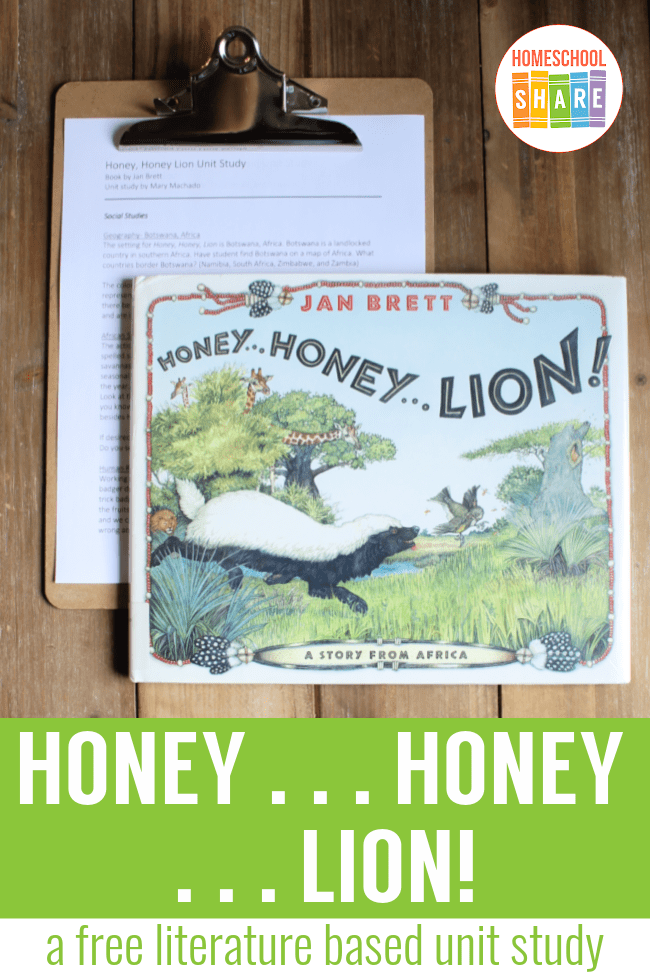
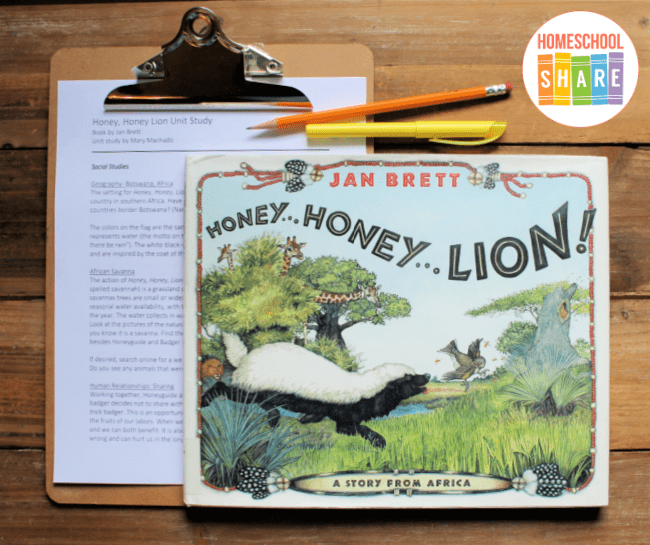
Honey, Honey, Lion!
|
Author: Jan Brett ISBN: 0-399-24463-8 Summary:
After working together to obtain honey, the African honey badger always shares
it with his partner, the Honeyguide bird, until one day when the badger becomes
greedy and his feathered friend decides to teach him a lesson Literature Based Unit Study by Mary Machado |
Social Studies
Geography- Botswana, Africa
The setting for Honey, Honey, Lion is Botswana, Africa. Botswana is a landlocked country in southern Africa. Have student find Botswana on a map of Africa. What countries border Botswana? (Namibia, South Africa, Zimbabwe, and Zambia)
The colors on the flag are the same as those on the coat of arms. The blue represents water (the motto on the national coat of arms is PULA, meaning "let there be rain"). The white-black-white bands are for racial harmony of the people and are inspired by the coat of the zebra which is the national animal. You can print out this flag outline for student to color.
African Savanna
The action of Honey, Honey, Lion takes place on the savanna. A savanna (also spelled savannah) is a grassland ecosystem with scattered trees or shrubs. In savannas trees are small or widely spaced. Savannas are also characterized by seasonal water availability, with the majority of rainfall coming in one season of the year. The water collects in waterholes where native animals gather to drink. Look at the pictures of the natural setting in this book. Point out features that let you know it is a savanna. Find the page that shows the waterhole. Which animals besides Honeyguide and Badger are at the waterhole in the picture?
National Geographic maintains a webcam at a waterhole in Africa. It is called Pete's Pond. You can visit the Wildcam Africa at their site and see live footage of the animals visiting the pond. It is most active in fall before the rainy season. There are also reruns of past video footage if the live cam is not streaming. There are lots of great resources to enjoy there including wildcards featuring African animals. Have student find the cards for the animals featured in the book.
Human Relationships: Sharing
Working together, Honeyguide and badger each were able to obtain food. When badger decides not to share with Honeyguide, the bird was angry and decided to trick badger. This is an opportunity to talk about working together and sharing in the fruits of our labors. When we work together with others it makes the job easier and we can both benefit. It is also an opportunity to talk about how being greedy is wrong and can hurt us in the long run. What can happen if we are greedy and don't share. Think of some ways we can share with others? Have your student describe a time he or she and another person helped each other.
Language Arts
Onomatopoeia
As the badger travels across the different types of terrain there are words that sound like what you would hear there. For example you see and hear "sprong" when he bounces off the termite mound. These are examples of onomatopoeia. Onomatopoeia is a word or a grouping of words that imitates the sound it is describing, such as "bang," "click," "buzz," "pop," or "zing." Have the student think of other words that imitate sounds.
Descriptive Language
The book uses descriptive visual language to help you "see" the feelings of hunger and fullness. Look together for examples in the story that let you know that one of the characters is hungry or full using descriptive language. ("his tummy almost touching the ground" "his tummy flat as a pancake" "snoring and hiccuping from his big meal")
Proverbs
The story is based on a legend that teaches a lesson. Some times these lessons are expressed by something called a proverb, A proverb is a simple saying that is popular in a culture and is repeated to teach a lesson. It expresses a truth, based on common sense, typical experience of the people, or in this case a legend. Jan Brett based this story on a proverb/legend from Africa:
"If you don't share the honey, the next time the Honeyguide will lead you to a lion." Discuss what this saying might mean for people. How should you treat people who help you?
Have student make a list of some common proverbs he has heard. Discuss their meanings.
Have student complete these proverbs. Even if he doesn't know it, have him finish the line. Talk about why he chose to complete it that way. Share the actual proverb for those he did not know. Discuss the meaning.
Better safe than..
Strike while the.....
It's always darkest before.....
You can lead a horse to water but.....
Don't bite the hand that....
You can't teach an old dog new.....
The pen is mightier than the.....
Where there's smoke, there's......
A penny saved is.......
Better late than...
Vocabulary
bellowed - to make a loud, deep sound: roar
broadcasting - to make widely known
echoed - to send back the sound of something
flitted - to move quickly and lightly
fumed - to become angry or irritated
muttering - speaking in low, unclear way with mouth almost closed
papyrus - a tall plant that grows in swamps and along rivers
rage - violent or great anger
rumble - to make a heavy, deep, rolling sound
triumphantly - to act victorious
waddled - to walk or move with short steps, swaying the body from side to side
Sequence
In this story the action progresses in a series of steps as the badger is being led to the lion. When he meets the lion he retreats quickly, backtracking through the same steps. So the action goes forward and then backward in sequence. Make a set of cards with the action steps. Mix them up and have student arrange them in the order of badger going to lion's den then reverse the order for return to badger's burrow.
Badger in burrow
Pitter patter over roots
Splish splash through water hole
Sprong over termite mounds
Boom boom along log
Clickety-click through papyrus
Swish swish through grass
Meets lion
Math
Grouping (Multiplication)
Notice the groups of like numbered objects (feathers or beads) in border. Using multiplication have student determine how many total objects there are in each picture. A student can use manipulatives to determine answer or practice times tables if they are known.
6 groups of 3 feathers (sleeping badger page)
4 groups of 5 feathers (honey eating page)
4 groups of 7 feathers (through the papyrus page)
4 groups of 10 feathers (lift the flap page)
8 strings of 5 beads (lift the flap page)
Hexagon
Bees build their honeycomb out of wax that they excrete. Each cell of the honeycomb is hexagonal in shape. How many sides does a hexagon have? How many points (vertices)? This shape makes for efficient use of space which is helpful for a bee to store more honey.
Mathematics of Honeycomb!
Zome building sets can be used for teaching about mathematical and scientific patterns including hexagons. If you have the Zome sets you can use these lesson plans from their teacher's guide. It has activities for discussing the patterns found in the honeycombs.
They also sell a kit specific to study of the bees which I think does the same types of lessons. Wonders of Nature kit
Science
Symbiosis
Symbiosis is the term for any biological relationship between organisms living in close association or direct contact with each other. From the Latin: bio - life, sym - together; symbiotic organisms "live together."
There are 3 types of symbiosis:
Mutualism - both species benefit
Parasitism - one species benefits and the other is harmed
Commensalism - one species benefits and the other is not affected either way
The relationship that badger and Honeyguide have is an example of symbiosis. Have student figure out which form of symbiosis it is. (mutualism)
Here are some other examples of symbiosis to find out about or research. Who benefits in each relationship?
-Nile Crocodile and Egyptian Plover (commensalism)
-Spruce and Mistletoe (parasitism)
-Bees and Flowers (mutualism)
-Saguaro cactus and Gila Woodpecker (commensalism)
-Remoras and Sharks (mutualism)
-Ticks and Dogs (parasitism)
-Barnacle and Whale (commensalism)
-Human and Tapeworm (parasitism)
-Ants and Acacia Tree (mutualism)
-Clownfish and Anemone (mutualism)
Feathers
Feathers are a very distinct feature of the animal class - aves (birds) - of which the Honeyguide is a member. Jan Brett uses feathers to decorate the borders in the book. To which bird (shown in the book) do you think these feathers belong? (Guinea hen)
Find out more about the parts of a feather and its functions. The website Kid Wings has a lot of great interactive information on feathers and birds. Download a worksheet from the site to complete on feathers.
Acacia Tree
The badger finds the lion under an acacia tree. Jan Brett mentions in her notes that in Tswana, the language spoken in Botswana, this shrub is called, "House of the Lion" because lions lie in the cool space under it. It is very important to the animals of the savanna since it is often the first acacia to show fresh green leaves.
Honey
When a honey bee takes nectar from a flower, she stores it in a sac within her body. When this honey sack is full, she returns to the hive and passes the nectar to other worker bees. These bees "chew" the nectar for about half an hour. During this time, enzymes are breaking the complex sugars in the nectar. Once the water has evaporated and the honey has aged, wax is used to seal it in the comb, which keeps it clean and safe. A honeybee makes 154 trips for one teaspoon of honey. To gather a pound of honey, a bee flies a distance equal to more than three times around the world.
Printout of honey bee parts and anatomy
There are
many different flavors of honey which vary due to the different flowering
plants. Do a taste test with several varieties of honey (clover, wildflower,
orange blossom) to see if you can taste the difference.
Honeybee Lapbook at HSS
Art
Beading
Jan Brett illustrates the borders of the pages with clusters of beads and feathers. These are examples of the type of decorative handicrafts one could find in Africa. Stringing beads and decorating with beads is common in many cultures around the world.
For the younger student - string pony beads on a pipe cleaner.
For the older student - string seed beads on thread. Different patterns could be made.
Students could also decorate a cardboard or wooden frame with strings of beads and feathers in a fashion similar to the illustrations in the book.
Paper Making
Badger "clickety-clicks" through the papyrus. Ancient Egyptians used papyrus plants to make a substance similar to paper we know today. Papyrus scrolls were made by taking slices of the inner part of the papyrus stem, flattening then pounded into a hard, thin sheet. The word "paper" comes from the word "papyrus". You and your student can try your hand at making your own papyrus paper.
Simple papyrus-like craft from Crayola
Feather Painting
Paint with
feathers. Have student paint a picture using the feather as a brush. Use one
feather for each color of paint
Drawing
How to Draw a
Lion - video with Jan Brett (look for how to draw an elephant, and dots &
stripes, too!)
Just for Fun Activities
Field trips
-Visit a local zoo. See how many animals you can see that are featured in the book.
-Visit an apiary to see how beehives are kept or where honey is extracted.
Recipe- Honey Buns
1/2 cup honey, divided in half
3 T. butter or margarine, softened and divided
1/2 cup chopped nuts, optional
2 t. cinnamon
1 lb. frozen bread dough, thawed according to package directions
Grease 12 muffin tins.
To prepare topping, mix together 1 T. butter, 1/4 cup honey and chopped nuts. Place 1 t. topping in each muffin cup.
To prepare filling, mix together remaining 2 T. butter, 1/4 cup honey and cinnamon. Roll out bread dough onto floured surface into rectangle. Spread filling over dough. Starting with long side, roll dough into log. Cut log into approx.1-1/2-inch thick slices. Place each slice, cut-side up, into each muffin tin. Let dough rise for 30 minutes. Place muffin pan on
foil-lined baking sheet. Bake at 375° for 20 minutes or until buns are golden brown.
If you are looking for more honey recipes, hundreds of delicious recipes featuring honey can be found at the National Honey board site.
Go-Along Book
We're Going on a Bear Hunt by Michael Rosen
-How is it similar to Honey, Honey, Lion!?
-Compare the similarities between the books: both use onomatopoeia for the sounds of going through different
terrain, the characters in each story run into something scary, they turn around and repeat travels in reverse
Game
The Scholastic site has an idea for a game of Honey, Honey, Lion that is similar to Duck, Duck, Goose for young children.
Library
List
Water Hole Waiting - Jane and Christopher Kurtz
Here is the African Savanna - Madeleine Dunphy
What the Animals Were Waiting For - Jonathan London
One Small Square: African Savanna - Donald Silver
The Water Hole - Graeme Base
The Bee Tree - Patricia Polacco
A Taste of Honey - Nancy Wallace
Magic School Bus Inside a Bee Hive - Joanna Cole
The Life and Times of the Honeybee - Charles Micucci
Bird Egg Feather Nest - Mary Jo Koch
Additional Resources on the Internet:
-Name the Botswana Animal Game