| HSS Forum HSS Blog Ami's Blog - Walking By The Way HSS on Facebook | ||||||
| about us |
what's new
|
unit studies | unit study helps |
fiar resources
|
indexes | lapbooking |
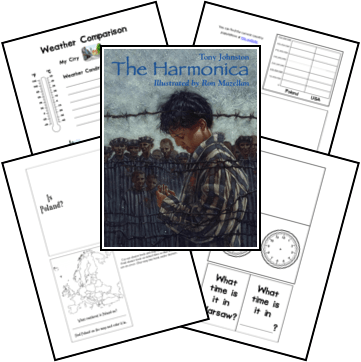
The Harmonica
| Author: Tony Johnston Illustrator: Ron Mazellan Summary: Torn from his home and parents in Poland during World War II, a young Jewish boy starving in a concentration camp finds hope in playing Schubert on his harmonica, even when the commandant orders him to play. ISBN: 1570915474 |
Literature Based Unit Study by Celia Hartmann and Ami Brainerd
Geography – Poland:
The story takes place in Poland. Reading the note at the back, we know that Henryk grew up in Czeladz, Poland and he was taken to the Dyhernfurth concentration camp. Poland was just one of many countries that the Germans invaded. Help your student locate Poland on a map or globe. Point out other countries around Poland that were occupied by Nazi troops. Help your child to understand just how many countries were affected.....and how many people. Make a story disk (Harmonica and a Star of David?) and place on Poland. Flag of Poland minit bookHistory – Holocaust (Concentration Camps): In 1933, before WWII even officially began, concentration camps were created by the Nazis. "The term concentration camp refers to a camp in which people are detained or confined, usually under harsh conditions and without regard to legal norms of arrest and imprisonment." By the beginning of the War, people taken to the camps were either killed or put to hard labor (work). "Those forced to work, were deliberately undernourished and mistreated" with the intent that they would be killed by the work. (Source)
Hope: Talk to your student about feelings of despair, of losing hope, of having no hope at all. Also discuss the importance of hope. Where does hope come from? You may want to introduce your older student to Emily Dickinson's poem "Hope is the thing with feathers..."
Language Arts
Simile:
"Singing was like breathing"
"Harmonica, cool as water"
"Breath panted in and out....like a bellows"
Finish going through the story with your student, picking out other
examples.
Vocabulary:
Prepared Vocabulary Crossword
Puzzle
crockery, (bellows-not in puzzle), wheezed, waltzed, kindling, jolted,
reeled, spat, fumbled, faltered, enthralled, epaulets, despised, grazed
Language Arts – Writing/Narration:
Have your older student
write about the "power" of music or about a time when he put his
whole heart into doing something. Have your younger student tell of
a time when he was sad, but a song made him happy.
Poetic Repetition:
Sometimes writers use certain sounds,
words, or phrases over again to make a point...to really sink those
words into our ears. Tony Johnston uses repetition in the same
way one would find it in a poem. Certain phrases are
emphasized and certain phrases are comforting through Johnston's use
of repetition.
Some examples:
"Often, to keep from losing hope, I touched the harmonica..."
"Sometimes I played it
to keep from losing hope..."
"Though he ached..."
"Though I ached..."
"I felt sick, black inside..."
"I felt sick, getting bread..."
"...the commandant spat, night after night."
"Night after night
I touched the harmonica..."
If you choose to use
The Cats in Krasinski Square as part of
your Holocaust study, you may want to ask your student to look for
Hesse's examples of poetic repetition. You may also want to
discuss poetic repetition and the book of Psalms with your older
student. Hebrew poetry depends on repetition in the same way
that our poetry tends to depend on rhyme. There are many
verses in Psalms in which it seems that the writer is saying the
same thing twice-- because he is! Can your student find
examples of this?
Art
Warm Color Palette / Cool Color Palette: Ask your student if
he noticed anything peculiar about the pictures. Most of the
pictures about his family are done in tones of reds, oranges,
yellows (warm colors) to reflect the warmth of the happy times. Most
of the pictures of his time as a prisoner in the concentration camp
is done cool colors to reflect the cold, hard times.
The artist in this story used black as a basic color (in the
concentration camp illustrations) and added bits of color for
variation. You may want to ask your student to try to use
black as a main color while adding other colors for variation.
What colors emerge from a black base? Are the differences
notable? Can your student note which colors were added in the
illustrations in the story?
Symbolism (For Older Students):
With your older student,
re-read the part about the commandant who wore ugliness and death
upon his shoulders. Then ask him to look at the picture that
accompanies that text.....does he see the skull above the soldier’s
shoulder? This was the illustrator’s way of painting the picture to
go with the text. The skull symbolizes the ugliness and death, and
he drew it above the one shoulder
Texture: Give your student some white paper and some crayons
(crayon cookies work really well or you can just peel the wrapper
off of a crayon and use it horizontally). Search through your
home for different textures-- Tile floor, rock around the fire
place, smooth wallpaper, bumpy slats on a basket, etc. Place
the paper on the object or area and rub the crayon on the paper.
For many surfaces you will have a textured look. Artists can
achieve texture by the techniques in which they paint. Many
people use these kinds of techniques in their own homes for
decorative walls (color washing, rag-rolling, etc). Where does
your student notice texture in the paintings in this book?
Math
Older Students – Fractions:
Discuss with your student how two-thirds of the total European Jews were killed by the end of the war. Give various numbers to your student and have him determine two-thirds of that number.Examples: if there were 15, 633 Jews in a concentration camp, how many were likely to be killed or die before the end of the war? 15,633 times 2/3 =10, 422.
Have him determine one-third of that number–the number that might have lived. 15,633 times 1/3=5,211 .
Have him add the two numbers together to see if they equal the
original number. 10,422+5,211=15,633.
If six million total Jews were killed in the Holocaust, how many
Jews were living in Europe before the Holocaust? (2/3 times "x" = 6
million ; x=9 million)
With your older student, please try to humanize these numbers! Each and every one was a living, breathing individual........suddenly killed as if they were nothing more than a bug. Each was a human being, loved and cherished by someone. Gone in the blink of an eye. We have become desensitized to statistics.
Science
Anatomy-- Fingerprints:
Music
Composers – Franz Peter Schubert:
Schubert by Ann Rachlin (Famous Children Series) is a go-along that gets a thumbs up from Celia. It's a nice biography for the younger set-- talks of Franz Peter being cold and hungry at school, but that writing music made him forget that. Also tells of a time when the French soldiers fired a cannon ball that went through the school. You could tie both incidences in with The Harmonica.
Find more about him...particularly what Henryk mentions in the story...about
poor and cold
More about
Schubert
Bible / Character Development
Memory (or discussion) Verses
Hope deferred makes the heart sick: but when the desire
comes it is a tree of life. (Proverbs 13:12)
Therefore encourage one another and build one another up...."
(1 Thessalonians 5:11).
Bible Story: Esther
You may want to do a Bible
study on the life of Esther as you study the Holocaust.
She made the best of a bad situation-- allowing God to use here in
some tough circumstances. How can we apply this to the story?
How can we apply it to our own lives?