| about us |
what's new
|
unit studies
|
unit study helps |
hss resources
|
fiar resources | indexes | lapbooking |
Give Thanks to the Lord
| Author: Karma
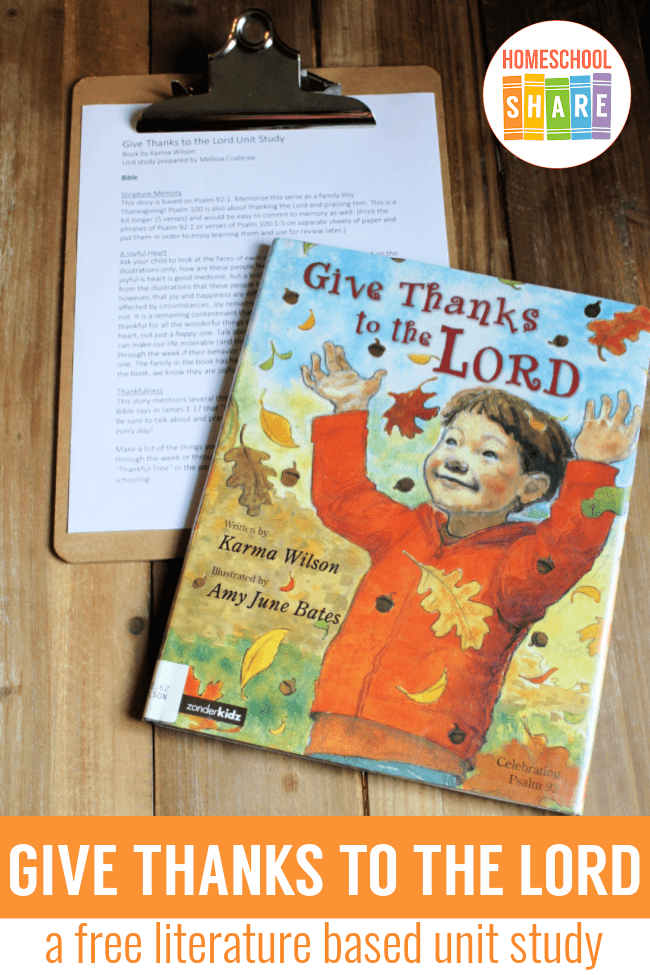
Wilson Illustrator: Amy June Bates ISBN: 0310711185 Summary: Give Thanks to the Lord celebrates joy of all kinds, from the arrival of distant relatives to a cozy house already filled with merriment, to apple cider and the delicious smells of roasting turkey and baking pies. And just when your mouth is watering, sit down and join a thankful child in prayer, praising God for "food and fun and family, all the wonderful things I see." |
Unit Prepared by Melissa Crabtree
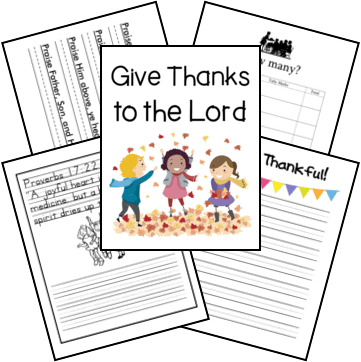
Notebook Pages
Counting
Five Senses
I'm Thankful
Cover Page
Proverbs 17:22 Copywork Page
(primary font)
Proverbs 17:22 Copywork Page
(HWOT font)
Doxology Copywork Page
Bible
Scripture Memory
This story is based on Psalm 92:1. Memorize this verse as a family this Thanksgiving! Psalm 100 is also about thanking the Lord and praising Him. This is a bit longer (5 verses) and would be easy to commit to memory as well. (Print the phrases of Psalm 92:1 or verses of Psalm 100:1-5 on separate sheets of paper and put them in order to enjoy learning them and use for review later.)
A Joyful Heart
Ask your child to look at the faces of each of the people in the book. Based on the illustrations only, how are these people feeling? Talk about Proverbs 17:22 “A joyful is heart is good medicine, but a broken spirit dries up the bones.” It is clear from the illustrations that these people have happy hearts! Be sure to explain, however, that joy and happiness are different things. Happiness is caused and affected by circumstances. Joy remains no matter if we are “getting our way” or not. It is a remaining contentment that God is good no matter what. If we are thankful for all the wonderful things the Lord has given us, we will have a joyful heart, not just a happy one. Talk about a grumbling, complaining heart and how it can make our life miserable (and that of everyone around us!). Ask your child through the week if their behavior is coming from a joyful heart or a grumbling one. The family in the book has happy smiles on their faces, but from the words of the book, we know they are joyful as well.
Thankfulness
This story mentions several things this family is thankful for at Thanksgiving. The Bible says in James 1:17 that “Every good and perfect thing is a gift from above…” Be sure to talk about and praise the Gift Giver for the wonderful gifts He gives us every day!
Make a list of the things you are thankful for. Start this list early and continue it through the week or through this entire Thanksgiving season. We have done a “Thankful Tree” in the past and had all family members participate, even those not schooling.
Praise God, from whom all
blessings flow;
Praise Him, all creatures here below;
Praise Him above, ye heavenly host.
Praise Father, Son and Holy Ghost.
Language Arts
Vocabulary
(To challenge your older child, have them look the words up in the dictionary.)
autumn - the season of year between summer and winter (Ask your child: What do we often call this instead?)
gusty - a kind of weather that has strong and sudden rushes of wind
tempting – attractive, appealing
grateful – thankful, expressing gratitude
savor – to taste or smell with pleasure
Making a list
Make a list with your child of all the foods he sees in the illustrations. (How many of these foods will you have this Thanksgiving?)
Handwriting
Use Psalm 92:1 or Psalm 100:1-5 for copy work. Consider sending this written verse to a grandparent to enjoy and share in the praise!
Creative Writing
Have your child write (or dictate/copy) a note telling someone how thankful she is for them. Or have her call someone to share this.
Poetry
Write an acrostic poem based on the words I’M THANKFUL. Fill in each line with something for which your child is thankful. (Include all the family if you need to!) Prepared Acrostic Page
Writing
Create invitations with your child for anyone you’re inviting to your Thanksgiving table this year.
Social Studies
Family Relationships
This book shows pictures of a traditional family. God intended families to have a mother, father and children if He gives them. Discuss with your child with whom you will be spending your holidays this season. Make a family tree with your child if you would like to develop this further.
The World Around Us
This book presents a great opportunity to explain to your child how privileged we are. Many children around the world do not have anything to eat today, or maybe rice or broth only. Some children in America will have only soup or bread today. Not to mention turkey, apple cider, pumpkin pie, pumpkin bread, olives, carrots, buttered rolls, mashed potatoes and gravy! What a great time to get food to donate to a food pantry, or better yet, personally deliver it with your child to someone in need.
The First Thanksgiving
Study the root of the Thanksgiving holiday in America. Be sure to point out that the Pilgrims were having a feast to thank God for all the gifts He had given them in their new land. Read several non-fiction books about the first Thanksgiving to teach this. The Thanksgiving Story by Alice Dalgliesh is a well written account of the first Thanksgiving.
Public Speaking
Have your child recite memorized scripture for Grandparents. (Praise your child for speaking well in public, but be sure she knows it pleases Jesus when we share His scripture with others, not just Mommy & Daddy.)
Science
Health: Appropriate Clothing
Look at the clothing the children are wearing in the pictures. Does that mean it is warm or cold for their Thanksgiving day? Discuss appropriate clothing for fall.
The Four Seasons
Briefly review the four seasons and their order. Winter, spring, summer, fall.
“What season is it in this story? How do we know? What other things do we notice about fall at our house?” (Temperature, wind, rain?) Take a walk and take time to notice the signs of fall where you live, even if the leaves are gone. Stop and draw a picture of something your child notices.
Our Five Senses
Discuss the five senses God has given us. Hearing, sight, touch, taste, and smell
“What are the children seeing?”
“What are the children hearing?”
“What are the children touching?”
“What are the children smelling?”
“What are the children tasting?”
You could chart these answers (with words or drawing pictures) and write or draw them if you would like to develop this further.
My Five Senses by Aliki is great to read with this lesson.
Identifying Trees
The tree where the children are playing is a white oak tree. Find a picture of these leaves online and see if there is one of these in your yard or another yard you frequent.
A page with pictures and specifics of white oaks
Labeling Trees
Collect leaves from your yard or street and notice the color, shape and sizes of them. Dry the leaves (in a phone book for several days) and glue them on paper. Label the correct tree name next to each leaf. Don’t forget about these names. Use the correct tree name as you see them with your child over the next weeks and commit the tree names to memory.
The Digestive System
The boy and his grandpa mention having very full stomachs after dessert. Point out the location of your child’s stomach. Have your child look at/feel his stomach before a meal and then after. What is the difference?
For your older child, discuss the entire digestive tract and the role it plays in our body.
What happens to a Hamburger by Paul Showers is a “Let’s Read and Find Out Science” book that explains the digestive system.
Several printables on the digestive system
Dog Breeds: Yellow Labs
In this book is a very loyal Labrador Retriever that is obviously very in love with this little boy! Labradors, or “labs” for short, are very even-tempered, loyal dogs. They are the most popular breed of dog (by registered ownership). The lab in this book is a Yellow Lab. Do you know anyone who has a yellow lab you could visit?
Some general dog printouts and a specific lab printout
A webpage with some yellow lab games, including interactive “memory.”
Math
Counting
the rolls, the leaves in the air, the olives on the boy’s fingers, how many fingers we have
Making a Chart
1) Use this prepared chart to note how many boys, girls, men, and women, and dogs your child sees in the illustrations through the whole book. To make it fun and tasty, use the pumpkin shaped candies and put down the pencil!
2) For your older child, add together boys + girls and men + women to make “children” and “adult” categories as well.
3) Count your chart totals and write them using tally marks. Be sure to point out that every fifth line crosses the previous four, making it easy to count by fives.
Fractions
Bake! Choose something your family enjoys and bake it this week! (You could choose rolls, pumpkin pie, apple cider, or pumpkin bread if you’d like to choose something from the story.)
Art
Details
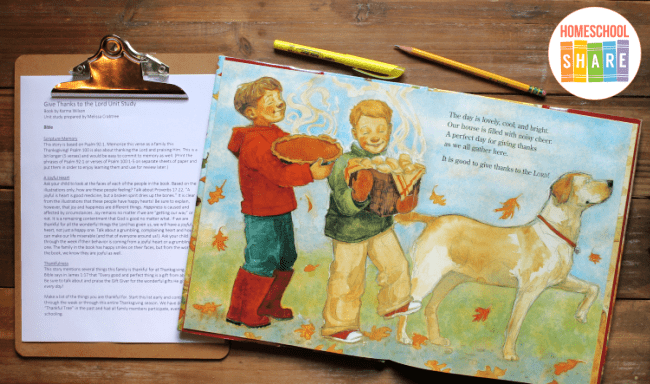
The illustrator has made it clear that the temperature is cold and the
food/drink is fragrant. Notice the lines drawn above the pie, rolls, and apple
cider? Point out that the same lines could mean the food is producing steam or
is particularly fragrant. Which do you think is represented in each instance?
Have your child draw a simple picture of something that smells good or is
producing steam in order to practice this skill.
Mixed Media
These illustrations were painted with watercolors after the main picture was
drawn. Have your child observe the pictures, noticing the pencil lines and the
paint over them. Have your child draw a picture (with pencil) of something they
are thankful for. Then paint it with watercolors.