| about us |
what's new
|
unit studies
|
unit study helps |
hss resources
|
fiar resources | indexes | lapbooking |
|
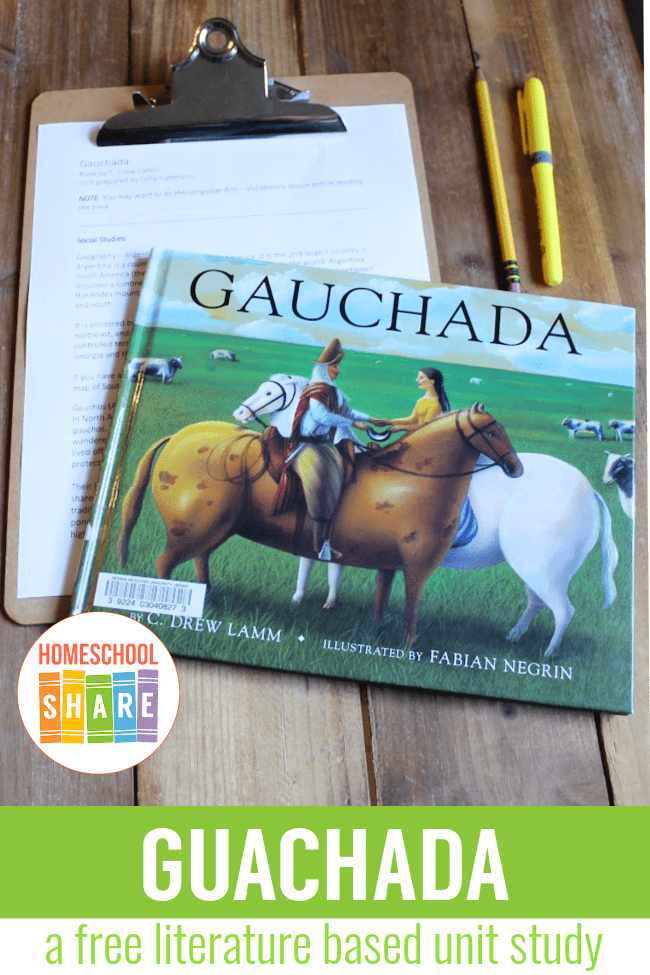
Author: C. Drew Lamm
Illustrated by: Fabian Negrin Summary: A necklace is lovingly passed from one person to another, traveling much farther than the Argentine gaucho who made it will ever go. |
**NOTE: You may want to do the Language Arts – Vocabulary lesson before reading the book.**
Social Studies:
Geography – Argentina:
Argentina is a country in southern South America. It is
the 2nd largest country in South America (the largest is
Brazil); it is the 8th largest in the world. Argentina occupies
a continental surface area of 2,766,890 km² (1,078,000 sq mi)
between the Andes mountain range in the west and the southern
Atlantic Ocean in the east and south.
It is bordered by Paraguay and Bolivia in the north, Brazil and
Uruguay in the northeast, and Chile in the west and south. The
country claims the British controlled territories of the
Falkland Islands (Spanish: Islas Malvinas) and South Georgia and
the South Sandwich Islands.
If you have an older student who is interested, you may want to
print an outline map of South America and have him label the
different countries.
Argentina Outline Map
Argentina Flag minit
book
Argentina Map from World Maps Online
Argentina Flag
from abcteach.com
South America Follow the Directions Map (this is a GREAT
teaching tool!) *members
South America Outline Maps (individual countries)
South America Outline Map (for younger students)
Argentina Unit Study (free from Homeschool in the Woods)--she
suggests making a map of South America, gives directions for how
to make the gourd to fill with Mate' tea, and so much more!
Gauchos (Argentine Cowboys):
Source (this information has been scaled down a bit, but you
can find more by clicking the link)
In North America, they are called cowboys. In South America,
gauchos. They are the people who tend and drive cattle on the
open ranges, the wanderers of the Pampas. The early horsemen
were skilled horsemen, loners who lived off the land and tracked
down lost cattle for ranchers. They also provided
protection and military service for the ranchmen.
Their life as wanderers meant little time spent at home, which
they might have shared with a wife who raised their children.
Sons followed their father's traditions. Their clothing
reflected their life on horseback: a wide hat, a woolen poncho,
long pleated trousers, or loose baggy pants called bombachas
and knee-high leather boots. They made their boots by wrapping
the hide of a freshly killed calf around their legs and feet. As
the hide dried, it took on the form of the foot and leg. They
owned nothing of value but their horse and the long knife, the
facon, that they kept sharp and ready. They had no way of
preserving meat, and after butchering a cow, would cook it
immediately over an open fire. Meat and maté (the tea mentioned
in the story), were the mainstays of their diets; they brewed
and consumed the mate' frequently throughout the day.
At one time, they were looked down on as lower-class, but when
the wars of independence against Spain began, and commanders
looked for able-bodied men, the gauchos were called into service
and commanded the respect of the military. Today, in Argentina,
June 16 is a holiday which celebrates the gaucho contribution to
the War of Independence.
Today, gauchos are still an integral part of the ranching areas
of Argentina, Uruguay and Brazil.
Language Arts
Vocabulary:
See opening page for explanation of some of the words your child may not be familiar with including gaucho, pampas, ombu, Mate', bombilla, quebrada, and zamba. This may be a good time to point out to your student that you use italics when you are referring to a certain word in your writing. Ask him to find all the italicized words in the paragraph before you even read it.
Language – Spanish:
There are Spanish words mingled throughout the text (many mentioned above). Argentina is a Spanish speaking country. Another phrase mentioned in the text is, "Esta completo" -- can your student figure out what this means by looking at the second word and putting the story in context? (It is complete.) Spanish Language Activities at Enchanted Learning
Creative Writing:
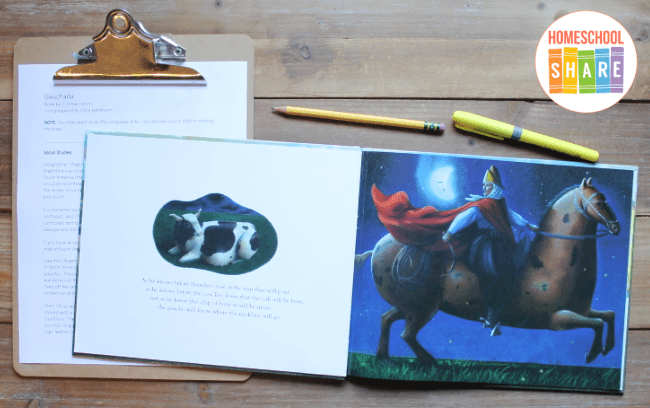
Look at the two page
spread that says, "It lives a thousand lives."
These six pictures are
telling us stories without any words. You student may want to
narrate or write a short
explanation about how the
necklace was passed from one person to the next.
Inspiration:
The information on the author tells us that she was inspired to write this story after she was given the gift of just such a necklace. She loved the necklace, but was even more taken with its story, which became the basis for this one. Many authors get ideas for their stories through real life-- a person they meet, a place they visit, a conversations they overhear, or even an object they are given. Is there an object at your house (maybe an heirloom) that you could tell your student a story about? Could he then take that story and weave it into a story of his own?
Art
Carving: If your child is interested in carving, try giving him a bar of Ivory soap and a plastic knife with which to carve (maybe a moon face).
Proportion: Many artists use correct proportions in their work to create illusions of reality. This ability to show objects as though they were real seems magical to many viewers. However, some artists use exaggeration and distortion rather than real proportion to convey their ideas and feelings. They are powerful means of expression. Artists can lengthen, enlarge, bend, twist, or warp parts of their subject (the grass, the sky, the human body, an animal). By making these changes, they can show moods and feelings that are easily understood by viewers. Artists can create feelings of great stability and calm by placing a small head on a large body. A monumental, or large and imposing, quality results. This is due to placing a small head on a large, stable base.
Look at the horses and cows in Mr. Negrin's illustrations. Are they proportionally correct? The bodies are much larger than the heads; they are boxy and exaggerated-- very long and thick. What kind of feeling was Negrin trying to convey? In what other ways are his illustrations exaggerated? Discuss the possible whys as you look for other examples.
--Source: ARTTALK 2nd edition
Artists: Explore gauchos in Argentine art: Gaucho themes and scenes of town life dominated Argentine painting in the 19th century. Prilidiano Pueyrredóón was the principal artist of the period. Artists of the 20th century included realist painter Cesareo Bernaldo de Quiróós, known for colorful canvases of gauchos and vivid folk scenes; Benito Quintela Martíín, painter of port life in Buenos Aires; and cubist painter Emilio Pettoruti. The works of sculptors Rogelio Yrurtia, Carlos Dorrien, and Alicia Penalba are widely known. Julio Le Parc experimented with movement, light, and optical effects in his sculptures. (Source:http://encarta.msn.com/encyclopedia_761556250_5/Argentina.html )
Math
Thousand: "a thousand zambas" " a thousand lives" How many is a thousand? If your child is really interested in seeing how much a thousand is, you could count out 1000 grains of rice. Or perhaps you have enough Cuisenaire Rods to show it? Or block off 1000 squares on graph paper. Can your child count by 100s (or 10s or 25s or whatever he needs to work on) to a thousand?
Science
Silver: Like gold, silver is a valuable metallic element that comes from the earth. Review lesson and teacher's information on Gold from The Bee Tree, FIAR Vol. 3. If you've rowed The Bee Tree and/or Another Celebrated Dancing Bear (FIAR Vol. 2), ask your student if he remembers that Gold and Copper had special symbols.....Au (Gold) and Cu (Copper). The symbol for Silver is Ag. Cut pictures from a magazine of things made from silver and glue onto a page for his science notebook.Pure silver is the best conductor of heat and electricity of all known metals, so it is sometimes used in making solder, electrical contacts and printed circuit boards. Silver is also the best reflector of visible light known, but silver mirrors must be given a protective coating to prevent them from tarnishing. Silver has also been used to create coins, although today other metals are typically used in its place. Sterling silver, an alloy containing 92.5% silver, is used to make silverware, jewelry and other decorative items. SourceBiomes -- Grasslands: "The pampas are flat, fertile plains. The grasses of the pampas stretch across the land like an ocean." Grasslands are generally open and continuous, windy, and fairly flat areas of grass. Almost one-fourth of the Earth's land area is grassland. In many areas, grasslands separate forests from deserts. Various grasslands exist all over the world. In North America, grasslands are called prairies. In South America, they are known as the pampas. Some of the fauna that lives in the South American grasslands includes: armadillo, opossum, fox, jaguar, llama, puma, rhea, tapir, and rodents.
Grassland Information at Enchanted Learning
Biomes- Pampas
Ombu Tree
Moon Phases (lesson from The Little House): From Earth, we can only see one side of the moon (one side is always in shadow) because the moon rotates once on its axis every time it travels around Earth. The side that we can see seems to change. However, the moon doesn't really shrink and grow. The moon reflects sunlight. The amount of reflected sunlight we get to see in our night sky depends upon the position of the Earth, the moon, and the sun so varying portions of the moon's lighted side face Earth at different times. The phases include the new moon, crescent moon, half moon, and full moon. (If your student is too young to understand the above concepts, simply mention that the moon doesn't really shrink. It appears to shrink because at different times it reflects different amounts of sunlight.)
Your young astronomer may want to watch the night sky for a month and chart the moon (on the nights he can see it) as it goes through its cycle.
Label the Moon Phases Diagram
More Moon Information
Bible / Character Development:
Gauchada: "to do something kind, something with love, without expecting anything in return. " How did God show His love for us?
John 3:16
For God so loved the world, that he gave his only begotten Son,
that whosoever believeth in him should not perish, but have
everlasting life.
Tit 3:4
But after that the kindness and love of God our Savior
toward man appeared, 5 Not by works of righteousness which we
have done, but according to his mercy he saved us, by the
washing of regeneration, and renewing of the Holy Ghost; 6 Which
he shed on us abundantly through Jesus Christ our Savior; 7
That being justified by his grace, we should be made heirs
according to the hope of eternal life.
Memory Verses (relating to silver)
Just for Fun
Drink tea!
Dance the Zamba!Plant pampas grass!
Chapter Book Read
Aloud -- Chúcaro: Wild Pony of the Pampa
Experiment with Jewelry Making
Devotion for Mom
This verse puzzled some women in a Bible study and they wondered
what this statement meant about the character and nature of God. One
of the women offered to find out the process of refining silver and
get back to the group at their next Bible Study. That week, the woman called a silversmith and made an appointment
to watch him at work. She didn't mention anything about the reason
for her interest beyond her curiosity about the process of refining
silver. As she watched the silversmith, he held a piece of silver
over the fire and let it heat up. He explained that in refining
silver, one needed to hold the silver in the middle of the fire
where the flames were hottest as to burn away all the impurities. The woman thought about God holding us in such a hot spot then
she thought again about the verse that says: "He sits as a refiner
and purifier of silver." She asked the silversmith if it was true that he had to sit there
in front of the fire the whole time the silver was being refined.
The man answered that yes, he not only had to sit there holding the
silver, but he had to keep his eyes on the silver the entire time it
was in the fire. If the silver was left a moment too long in the
flames, it would be destroyed. The woman was silent for a moment. Then she asked the
silversmith, "How do you know when the silver is fully refined?" He smiled at her and answered, "Oh, that's easy - when I see my
image in it." If today you are feeling the heat of the fire, remember that God
has His eye on you and will keep watching you until He sees His
image in you. --Author Unknown
Materials and information on this website belong to the original composers. It may be used for your own personal and school use.
Material may not be used for resale. © 2005-07 HSS