Google
 
The Fool of the World and the Flying Ship Unit

The Fool of the World and the Flying Ship: A Russian Tale

By Arthur Ransome


Unit Study prepared by Cindy West
Printables prepared by Wende


Printables

Note: with a combination of both notebooking pages and lapbook components, this unit is best suited for a “Lap-n-Note”.
 

Russia Report and Pocket
 

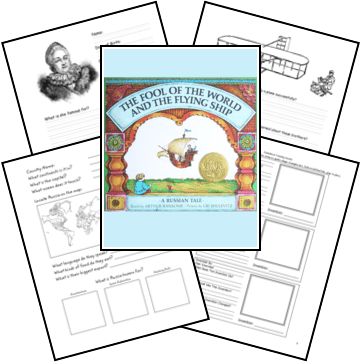
Czarina Anna Notebook Page
 

Inventor Trading Cards
 

Where in the World is Russia? Shutterfold
 

Vocabulary Crossword Puzzle
 

Trading Cards Pocket
 

Russia Flag Minit Book
 

Comprehension Worksheet
 

Leonardo da Vinci Notebook Page
 

Ivan the Terrible Notebook Page
 

Fairy Tale Detective Clipboards
 

Wright Brothers Notebook Page
 

Frederick the Great Notebook Page
 

Crown Border Paper
 

Parts of Ear Simple Fold
 

Peter the Great Notebook Page
 

Venn Diagram


Catherine the Great Notebook Page

Wind Flap Book


Optional Go-Along Books
 

Bible

Old Peter's Russian Tales by Arthur Ransome (1916 text including The Fool of the World and the Flying Ship)

Hans Clodhopper by Hans Christian Andersen

a version of The Seven Chinese Brothers or The Five Chinese Brothers

Leonardo da Vinci For Kids: His Life and Ideas by Janis Herbert

The Wright Brothers: How They Invented the Airplane by Russell Freedman

The Picture History of Great Inventors by Gillian Clements

Vassilisa the Wise: A Tale of Medieval Russia by Josepha Sherman

Clever Katya: A Fairy Tale From Old Russia by Mary Hoffman

Look What Came from Russia by Miles Harvey

This website offers Russian Fairy Tales online for free. 


Bible/Character


Fools -

God tells us many times in the Word about how we are not to be fools or foolish (Proverb 3:35, Proverbs 17:12, Proverbs 19:29, Proverbs 23:9 and many more!) But consider the “fool” of our story.  Is he a fool by God’s standards or the world’s?  “Simple” might be a fair term for our character, but “fool”?  Go over the following verses and, if you desire, use a Bible Concordance to find other verses relating to fools.  Discuss the Fool in the book and how he relates to these verses.  


Proverbs 10:14 - Wise men store up knowledge, but the mouth of a fool invites ruin.  (I see our “fool” being a very good listener and out of his mouth flows only kindness and joy.)


Proverbs 12:6 - A fool shows his annoyance at once, but a prudent man overlooks an insult.  (In his insults, the “fool” never lashes back.)


Proverbs 13:20 - He who walks with the wise grows wise, but a companion of fools suffers harm.  (Each of the “fools” friends had a special gift that we can liken to wisdom.)


Proverbs 19:1 - Better a poor man whose walk is blameless than a fool whose lips are perverse.  (Our world often considers poor people as foolish.  We see here that wealth or status have nothing to do with foolishness.)


1 Corinthians 1:26-31 - Brothers, think of what you were when you were called. Not many of you were wise by human standards; not many were influential; not many were of noble birth. But God chose the foolish things of the world to shame the wise; God chose the weak things of the world to shame the strong. He chose the lowly things of this world and the despised things—and the things that are not—to nullify the things that are, so that no one may boast before him. It is because of him that you are in Christ Jesus, who has become for us wisdom from God—that is, our righteousness, holiness and redemption. Therefore, as it is written: "Let him who boasts boast in the Lord."  (Should we even strive to be more like the “fool” of our story?)


1 Corinthians 3:18 - Do not deceive yourselves. If any one of you thinks he is wise by the standards of this age, he should become a "fool" so that he may become wise. 


Character Qualities

Praise – Songs were always rolling from the men even in the midst of trying situations.


Perseverance – The Fool persevered even when things didn’t look hopeful.


Humbleness – The Fool never thought of himself in a prideful manner.


Contentment – Even when the Fool only had water and crusts of bread, he was thankful.


Sharing – The Fool was willing to share even when he had little himself.


“Cheaters never prosper.” – The Czar tried to use trickery and deceit to try to keep the Fool from his daughter. 


Use of gifts and Talents – Each of the passengers on the ship willingly used and shared their gifts and talents. God knows the plans He has for us even if they aren’t clear to us – Jeremiah 29:11


Social Studies


Traditions –

The Fool of the World and the Flying Ship is a traditional Russian fairy tale. Russian peasants would tell their children and each other these tales to pass time. They would talk of wise and beautiful princess while drinking tea or on their way to war. It has long been part of the Russian culture to share these tales with generation after generation. Traditions that are started during childhood are experiences that are fondly remembered, but also so much more. They can shape our character, bind together families and friends, and write the chapters of our family history books. As long as traditions are carried on, so will the joy and laughter of those experiencing them. Does your family have any traditions such as this? Is there a story, or perhaps a custom or heirloom that has been passed down in your family? If so, discuss these with your child.


Russia –

Our story is a tale from Russia. Russia is another name for the Union of Soviet Socialist Republic, also called USSR. Russia is located in both the continents of Europe and Asia and is the largest country in the world. Northern Russia gets very cold, while southern Russia has a hot climate. One fourth of Russia is farmland, most of it owned by the state, and the two main crops are wheat and sugar beets. While Russian is the main language spoken, there are over sixty different languages used throughout U.S.S.R. Russia is known for its ornamental structures, being pioneers in space exploration, their Russian dancing, and handcrafts such as stacking dolls. If desired, research more about Russia.

Russia Report and Pocket

Where in the World is Russia? Shutterfold

Russia Flag Minit Book


Czars -

“Czar” is another word for emperor or king that was used by Russian leaders from around 1547 when Ivan IV (Ivan the Terrible) was labeled a “czar”, until the Russian Revolution in 1917.  Tsar is another common spelling of the word.  Czars ruled with absolute monarchy, meaning the czar had complete power to make decisions without any opposition.  Considering the Fool was a peasant or serf, he would have had no rights at all under the czar’s rule.  His family probably lived and worked on land that was owned by a prince, and the crops or animals they raised probably had to be turned over to the prince.  (This is similar to the peasant, Lord and King relationship in Medieval Europe.)  In real Russia at the time, a peasant or serf could never rise above his social status. Research a famous Russian Czar or Czarina. 

Ivan the Terrible Notebook Page

Frederick the Great Notebook Page

Peter the Great Notebook Page

Catherine the Great Notebook Page

Czarina Anna Notebook Page


Language Arts


Vocabulary

Discuss the following vocabulary words and use them in a sentence to show understanding.   Complete  Vocabulary Crossword Puzzle.

Moujik – a Russian peasant

Fagot – a bundle of sticks, twigs or branches bound together to be used as fuel or a torch

Peasant – a member of a class of persons who are small farmers or farm laborers of low social rank

Simple – (as in a person) common or ordinary, humble or lowly

Companion – a person who is frequently in the company of another person

Czar – an emperor or king

Swift – coming, happening or performed quickly, without delay

Decent – respectable; worthy; king; generous

Stifle – to crush or end by force; to suppress, curb or withhold

Defend – to ward off an attack from; guard against assault or injury; uphold

Regiment – unit of ground forces consisting of two or more battle groups

Clever – mentally bright; having a sharp or quick intelligence

Ancient – old; of time from long past

Hatchet – a small, short handled ax


Comprehension Questions –

Answer these questions orally, or complete Comprehension Worksheet.

1. What do you think the Czar first thought when he first saw the Fool and his friends?

2. What did the Czar do that was unfair?  (Kept changing the rules and adding more terms to the agreement.)  Why was this unfair?

3. Why do you think the Czar kept adding new requirements?  Why did he not want the Fool to marry his daughter?

4. It seemed as if the Fool gained some confidence by the end of the story?  What are some examples that prove this?  Why do you think he gained confidence?

5. Of all the passengers on the ship, which do you like the best?  Why?

6. It seems as if the princess was pleased with her marriage to the Fool.  Why do you think she was?


Fairy Tales –

Genre is a French word that is often used as a synonym for “type” or “form” when referring to literature. There are many genres of literature. The Fool of the World and the Flying Ship would be considered the genre fairy tales. Certain elements of a story are usually present in a fairy tale. Fairy tales usually take place “long ago” and have special beginning words such as “Once upon a time”, and ending words such as “lived happily ever after”. Fairy Tales usually have both a good character and an evil character, and the good character usually wins in the end. There is almost always royalty and castles present in a fairy tale, and sometimes magic. Fairy tales often contain a problem, and by the end, a solution. And lastly, things seem to happen in “threes” or “sevens” in fairy tales. Does The Fool of the World and the Flying Ship fit all the criteria for a fairy tale? What kind of beginning and ending? (Starts “Once upon a time”) Who were the good and bad characters? (Fool was good, Czar was bad) Were there kings, queens, and castles? (Yes) How about magic? (Yes) Can your child identify the problem and solution? (The Fool wanted to marry the Princess, and through the help of his unusual friends accomplished the task) This one may be tricky, but can your child figure out what happened in  “sevens”? (there were seven friends that joined the fool) As you read through this book, have your child keep track of details on Fairy Tale Detective Clipboards


Creative Writing -

Write a story from the Princess’ point of view. Or, continue the story from the point of the Fool and Princess being married. Use Crown Border Paper if desired.


Punctuation (Comma Usage) -

This story is full of long, descriptive sentences.  One example is  “He had not gone far when he met an ancient old man with a bent back, and a long beard, and eyes hidden under his bushy eyebrows.” Use sentences like this from the book to write out short, choppy sentences.  Then ask your child to put them together into nice, full sentences, placing commas in correct positions.


Example:

He had not gone far.

He met an ancient old man.

The man had a bent back.

He had a long beard.

The man’s eyes were hidden under his bushy eyebrows.


Parts of Speech (Adjectives) -

Adjectives are words that describe nouns. They give the reader a better visual idea of what someone or something looks like. Using the same sentence (and other similar sentences) you could ask your child to point out or underline adjectives. “He had not gone far when he met an ancient old man with a bent back, and a long beard, and eyes hidden under his bushy eyebrows.”


You could also write the sentence without adjectives and let your child rewrite it adding their own descriptive words.


Example:

He had not gone far when he met a man with a bent back, beard and eyes hidden under eyebrows.


Comparison –

The Fool of the World and the Flying Ship is a Russian fairytale much like fairytales and folktales of other countries. Similar stories include The Seven Chinese Brothers, The Five Chinese Brothers, or Hans Clodhopper by Hans Christian Anderson. Use a Venn Diagram or a compare and contrast chart to compare the similarities and differences between the books. 


Listening and Following Directions -

The Fool used his skill of not only listening, but also obeying to win the princess in the end.  Notice that there are many times throughout the book when he had to listen carefully and follow directions precisely (the old man and the czar’s many requests.) Play a game of following directions.  Start with giving one direction (the sillier the better!).  After they successfully complete the one direction, give two directions.  Continue the game, adding an extra direction each round until they mess up.  Play this many times and see if their ability to listen and obey improves.


Science


Flight -

We know that a flying ship is not possible, but at the time of the earlier czars, flying was not possible at all.  People have watched birds and been enamored with the thought of flight for thousands of years. The first known reference to flight by man is in II Kings 2:11 where Elisha watches on as Elijah is carried up to heaven with a chariot of fire. In the late 1400’s, an artist and inventor named Leonardo da Vinci sketched designs for a flapping wing and a helicopter, but never went through with building them. In the 1700’s people experimented and succeeded at flying in hot air balloons. In 1903 the Wright brothers first flew in their airplane creation. It stayed in the air for a total of 12 seconds. This was the first time that a machine carrying a person had gone into the air under its own power, and landed without wrecking. Research more about the history of flight with your child. Complete Inventor Trading Cards and store in Pocket

, or complete individual notebooking pages:

Leonardo da Vinci Notebook Page

Wright Brothers Notebook Page


Go Along Books:

Leonardo da Vinci For Kids: His Life and Ideas by Janis Herbert

The Wright Brothers: How They Invented the Airplane by Russell Freedman

The Picture History of Great Inventors by Gillian Clements


Here is a website with brief histories of various flight ideas and inventions. 


Create a flying machine.  Using whatever materials you desire, ask your child to make a model of an airplane based on their research and readings.


Make many paper airplanes. Test to see which ones fly the farthest, highest, and straightest.


Hearing/Ears –

The Listener put his ear to the ground to listen to all that was being done in the world. He was using his sense of hearing. Review the five senses with your child – seeing, hearing, touching, tasting, and smelling. Research the parts of the ear with your child. The flaps on either side of your head are called the outer ear or “auricle”. They collect up the sounds around you and send them down the ear canal.   At the end of the ear canal is the eardrum, which vibrates as the sound hits it. These vibrations are then passed on to three tiny bones, first the hammer, then the anvil, and then the stirrup. These bones magnify small sounds and reduce large sounds. The vibrations then are passed on to the cochlea, which is filled with fluid, and picked up by tiny hairs that send signals through nerves to the brain. Complete Parts of Ear Simple Fold.


Wind and Wind Power -

What causes the wind? Air is made of tiny particles called molecules. As these molecules heat up, they expand, move faster, and spread out. When the molecules get cool, they contract, move slower, and stay together. So as the sun warms the air, the air rises. The cold air rushes in to take the place of the warm air. We feel this movement of air as wind. The power of wind has been observed and used for thousands of years. People have used the wind to push sails in ships, just as the Fool did, and turn windmills such as the ones found throughout our story. Windmills are machines that use the power of the wind to create energy.  As paddles or sails catch the wind, they turn, thus creating the energy needed for things like electricity, grinding grain or pumping water or oil.  Complete Wind Flap Book 

.


Easy experiments/activities to show how wind pushes sails are kite flying and pinwheels.  You can also make model boats out of clay with paper or fabric sails attached with a pencil or toothpick.  Try moving the boats across the bathtub with wind (your breath) blowing in the sails.


This is a great site with some simple windmill information and a great pattern to copy in order to make a moving windmill model. http://www.michigan.gov/hal/0,1607,7-160-15481_19268_20778-52098--,00.html


Art and Music


Caldecott Award Winner –

The Caldecott Medal was named in honor of nineteenth-century English illustrator Randolph Caldecott. It is awarded annually by the Association for Library Service to Children, a division of the American Library Association, to the artist of the most distinguished American picture book for children. The Fool of the World and the Flying Ship, illustrated by Uri Shulevitz, was the winner of the 1969 Caldecott Award. If your book has a picture of the award point it out to your child. Have your child look through the book and decide if/why he thinks it should have won the award. The beautiful colors and details may have helped the judges to decide. If desired, read more about the illustrator here.


Architecture -

At the castle you will see some of the cupolas (ornamental structure located on top of a roof or dome) that are associated with Russian architecture.  Using the internet or a library book, observe the many shapes and colors that can be found on these buildings in Russia.  You might have your child try their hand at sculpting or drawing their favorite one.


Drawing Shadows -

The illustrations in the book use lots of hatching and cross-hatching to create shadow.  Using watercolors and a fine-tipped black permanent marker, try to recreate one of the landscape scenes.


Aerial View -

Because many views from the book are as if we were looking from the flying ship, we see many aerial views.  Have your child sit on top of a bunk bed, table, slide or even a tree limb and try to draw something they see from an aerial viewpoint. 


Color Palette –

In a New York Times book review it states, “Using a palette of rainbow colors, Mr. Shulevitz has set the Fool and his ship against a large airy format…” Does your child know the colors of the rainbow? Use this acronym to remember the colors – ROY G. BIV – red, orange, yellow, green, blue, indigo, violet. Color a rainbow. Look through the story and match up the rainbow colors to the colors in the illustrations.


Drawing -

Boys (and maybe even girls) may enjoy trying their hand at drawing a building or a vehicle like the ones found in the book. 


Russian Music -

Russian music has a very distinct sound. Check your library for an audio CD of Russian music.


Math


Time -

The Fool said, “In a year, in a whole century, I never could find that water.” Reinforce the idea of a day, a year and a century through various oral “quizzes”.  Examples:  How many days are in a year?  How many years are in a century?  How many days are in a century?


Problem Solving -

If 40 barrels hold 40 buckets of water, how many buckets are there in all? 

If one bucket holds 20 cups of water, how many cups are in one barrel? 

How many cups are in 40 barrels?


If 25 loaves of bread can be baked in one oven, how many loaves of bread can be baked in 40 ovens?


Measurement -

Let your child play in water.  Give him or her measuring cups, bowls, and buckets of various sizes and let them explore measurement equivalencies in a very hands-on way.


Just For Fun


Take a nature hike with your lunch packed in a hankie and tied to a stick like the Fool set out with.


Tell jokes like the companions did on the ship.


See if you can get your hands on a safe dart or BB gun to try your hands at some target practice like the Far-shooter.


See if you can find anywhere in your area to go on a field trip – an art museum with Russian art or architecture, a windmill, a museum of flight, a children’s museum with an ear exhibit, etc.


See if you can locate a copy of the movie of The Fool of the World and the Flying Ship.     


Make some Russian Bread called Kaleech


1 quart water or milk

2 ½ cups sugar

1 Tbsp yeast

Flour

6 eggs

½ lb butter

1 lb raisins

Candies fruit (optional)

Combine 1 quart of water or milk, 2 1/2 cups sugar, and 6 tablespoons dry yeast. Add enough flour to make a sponge dough. Let rise till doubled or so.

Add 6 eggs, 1/2 lb. butter, 1 lb of raisins, and enough flour to stiffen dough into round high loaves. Some use candied fruit in the bread.

Frost top with sugar coating. Bake in cake pan at 350° for 20-25 minutes or until bread sounds hollow.


Materials and information on this website belong to the original composers. It may be used for your own personal and school use. 
Material may not be used for resale
© 2005-07 HSS