Google
 
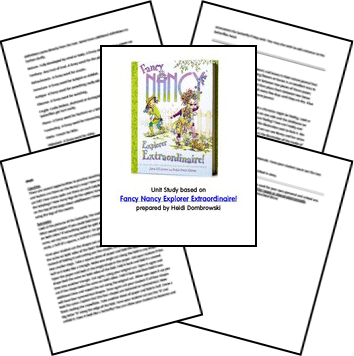
Fancy Nancy Explorer Extraordinaire Unit Study

Fancy Nancy Explorer Extraordinaire!

  Writing by Jane O’Connor
Pictures by Robin Preiss Glasser
ISBN:
0061684864

Summary:
For the fanciest girl around, the outdoors are out of this world! Fancy Nancy and her best friend, Bree, set out to explore the fascinating world of wildflowers, trees, leaves, birds, and, of course, butterflies in their exclusively glamorous Explorers' Club. With recipes for pinecone bird feeders and extra-fancy lemonade, an official club bird, and an exclusive map of the territory, Fancy Nancy is one Explorer Extraordinaire!

Take a look at Nancy's very own enlightening discoveries and find out just how fancy the outdoors can be!

Unit prepared by Heidi Dombrowski


Welcome fellow explorers.  Join Miss Fancy Nancy for an exciting nature adventure as explorer extraordinaire! Grab your notebook, pen or pencil, hat, long sleeve shirt, long pants and, of course, don’t forget your accessories as you join in on the adventure.


Bible

Marvel together at the things God has created!

Genesis 1:11 Then God said, "Let the land produce vegetation: seed-bearing plants and trees on the land that bear fruit with seed in it, according to their various kinds." And it was so.

Genesis 1:24-25 And God said, "Let the land produce living creatures according to their kinds: livestock, creatures that move along the ground, and wild animals, each according to its kind." And it was so. God made the wild animals according to their kinds, the livestock according to their kinds, and all the creatures that move along the ground according to their kinds. And God saw that it was good.

Psalm 104:24 How many are your works, O LORD!  In wisdom you made them all; the earth is full of your creatures.

Proverbs 30:25 Ants are creatures of little strength, yet they store up their food in the summer;


Science

Nature Journal
Nancy states that a notebook and pen are essential for exploring.  Throughout the story Nancy draws and takes pictures, and collect leaves and wildflower specimens to include in her notebook.  She also labels and adds important information to her notebook.  Nancy is creating a nature journal.  Go through the story and look for the pictures, specimens collected and information Nancy includes in her nature journal. This information is written in purple instead of the black print. 

Create a nature journal with your student, making sure not to forget to decorate the front of the journal to make it look fancy!  There are a lot of chooses in nature journals.  You can use any type of notebook.  You make your own using construction paper as a cover and blank pieces of paper stapled inside in the center. Or you can print notebook pages

Nature Walks
Take your student on a nature walk. Bring a bag to collect flowers, leaves and anything else your student might find interesting.  You may wish to bring a camera to take pictures of things your student finds but do not wish to bring home with you.  Help your student include their discoveries in their nature journal.

Life Cycles of Insects
Most insects go through a change in shape called Metamorphosis.  We often refer to this change as an insect’s life cycle. In the book, Nancy, her sister, Bree and Freddy find ants, ladybugs, flies and butterflies on their exploration.  Each of those insects goes through four stages metamorphosis.  They all start out as eggs that hatch into a wormlike larva, then into a pupa and finally the adult insect.  Feel free to utilize the following life cycle resources.

http://www.enchantedlearning.com/subjects/insects/ant/sequencing/

http://www.enchantedlearning.com/subjects/insects/ladybug/sequencing/

http://www.enchantedlearning.com/subjects/butterfly/sequencingpl/


Social Studies

Making Maps
Nancy has a detailed map of the territory (that’s a fancy word for places) they will be exploring.  Take some time to look at the map of the area Nancy and Bree will be exploring.  Nancy’s map has a lot of detail of the area around her house.  Talk about the map.  Can you see the yard and the houses?  Explain the various places on the map.  After talking about the map, make a map together of the area you will be exploring.  This can be as elaborate or as simple as you would like.  If you have a student that enjoys cutting, they can cut out shapes for the houses and trees or cut pictures out of magazines.  Help your student label their map.  You can place the finished map in your student’s nature journal if there is room.

Rules
Nancy has 6 rules for exploring.  Go through the book and read all six rules again.  Why do we need rules?  Using your student’s favorite board game, talk about the rules of the game.  What would happen if we played the game any way we wanted?  What if each player had a different way of playing the game?  Rules can keep us safe and they also give us a clear idea of what is expected.  What are some rules in your house and why do you have these rules?  Finish this lesson by playing the board game together.

Researching Topics
Nancy and Bree found an orb spider.  They take some time to research orb spiders.  How do you find information a topic you are interested in?  If you have an encyclopedia, pull it out and look through the various topics.  If there is a topic your student is interested in, look up the information and read it to your student.  Take a field trip to your local library.  Show your student where to find nonfiction books.  Show your student how to find some books on a topic of interest using the card catalog.  Check out a few age appropriate books on the subject of interest and spend some time learning about the topic.  Have your student tell you what they have learned about their topic of choice.  Some topics to research further with your student from the book include:  butterflies, birds, wildflowers, insects, spiders, and trees.


Language Arts

Nancy’s Fancy Words (aka vocabulary)

There are several ‘fancy’ words that are listed with the definition in parenthesis throughout the text. You can either choose a few to focus on with your student or focus on a couple each day as you work through the study.  The following definitions come directly from the text. Some have additional definitions to further clarify.  

Mature- Fully developed by mind or body. A fancy word for acting grown up.

Territory- Any tract of land. A fancy word for the places to explore.  

Refreshments- A fancy word for snacks.

Immature- A fancy word for babyish or childish.

Antique- A fancy word for something really old.

Observe- A fancy word for watching.

Fragile- Easily broken, shattered or damaged; delicate. A fancy way of saying the butterflies get hurt easily. 

Plume- A fancy word for feathers on a bird.

Fascinating- A fancy word for interesting.

Petite- French for little.

Iridescent- A fancy word for shiny.

Chic-  French and fancy for fashionable.

Aroma- Fancy for smell.

Frantic- Desperate or wild with fear.  A Fancy word for very worried.

Point of View
Fancy Nancy Explorer Extraordinaire is written in first person narrative.  We can tell because throughout the story the pronouns “I”, “my”, “we”, and “us” are used.  Ask your student who is telling the story? Choose a book that is written in third person and read it to your student.  Ask your student who is telling the story.  Ask your student if she can tell the difference between the two stories. 


Math

Counting
There are several opportunities to practice counting in the story.  How many trees and bushes are there on the Nancy’s map?  How many ants are on and around the ant hill? How many spots are there on each ladybug?  How many spots are on all the ladybugs?  How many legs do the spiders have?  How many yellow flowers or on the top of the page about wildflowers? Show your student how to skip count using the legs of the insects.

Symmetry
Look at the pictures of the butterfly, the moth, the orb spider, and ginkgo leaf.  What would happen if you could fold them in half?  Would the halves be the same on both sides?  If something could be split down the middle and both sides are the same, we say they are symmetrical. On pieces of paper folded in half, draw a half circle, a half of a square, a half of a triangle and a half of a rectangle on the fold.

Have your student cut the shapes out and ask them to unfold them.  Do they look the same on both sides of the fold?  Next make a paper snowflake.  However, instead of folding it and cutting out the shapes, the process will be broken down into smaller steps. Take a square piece of paper and fold the opposite corners in half so it looks like a triangle.  Make one single cut along the fold in any shape.  Open the paper and look at the single shape in the paper.  Ask your student if the shape look the same on both sides of the fold.  Fold it back and fold it a second time into another triangle.  Cut again, using your original cut.  Open it again and ask if the shape looks the same on both sides.  Fold it back and then fold it one additional time and repeat the cut using the original cut.  When you open it up you will have four symmetrical shapes.  Once again ask your student if all four shapes look the same. Explain that the four shapes are balanced or symmetrical.  Now finish making the snowflake.  Take another sheet of paper and fold in half.  Draw a big letter ‘B’ along the edge of the fold. Have your student cut out the ‘B’ and unfold it.  Does it look like a butterfly?  You can allow your student to decorate and accessorize the butterfly if they wish.  You may also wish to add antennas to the butterflies head.


Art

Pressing flowers and Leaves
Your student may wish to include flowers and leaves in their nature journal that they find on their explorations. Pressing flowers or leaves is an excellent way to preserve them.  Place the flower or leave between two pieces of tissue paper, cardboard, old magazines or parchment then place them between two heavy books. Keep in a cool dry place and check every few days until they are dry.  Glue the pressed leaves or flowers into the nature journal.   

Illustrated Facial Expressions
The illustrations in the book help us see how a character might be feeling.  Look at the two pages with the illustration of a house on one side and the clubhouse on the other.  How do you think Nancy and Bree are feeling?  How are Freddy and Nancy’s sister feeling and why? Take a look at the illustration next to Rule 4.  We cannot see Freddy’s full face, just his profile, but we can see Nancy and her sister.  What do you think they are thinking?  Now look at the illustration of the inside of the clubhouse when it started to drizzle.  Why are the little ones peeking in on Nancy and Bree?  Finally look at the last page.  How are they feeling?

Self-Portrait
Show your student the self portrait Nancy drew of herself.  Have your student draw a self portrait. 


Just for Fun

~Make the cookie-cutter bird feeder and the pinecone birdfeeder, following the directions in the book.

~Make Nancy’s Extra-Fancy Lemonade.  Have your student count out the two raspberries per cup. 

~Make the lavish leaf crown described in story.


~Spider crafts

http://www.enchantedlearning.com/crafts/spider/

http://www.freekidscrafts.com/sticky_spider_web-e93.html
 

~Ladybug crafts

http://www.enchantedlearning.com/crafts/ladybug/

http://www.dltk-kids.com/crafts/insects/mladybughat.htm
 

~Butterfly crafts

http://www.enchantedlearning.com/crafts/butterfly/

http://jas.familyfun.go.com/arts-and-crafts?page=CraftDisplay&craftid=10412

http://jas.familyfun.go.com/arts-and-crafts?page=CraftDisplay&craftid=11038


Material may not be used for resale © 2005-2010 HSS