| about us |
what's new
|
unit studies
|
unit study helps |
hss resources
|
fiar resources | indexes | lapbooking |

Books Used
When Lightning Comes in a Jar by Patricia Polacco
The Relatives Came by
Cynthia Rylant
Emma Jo's Song by Faye Gibbons
Library List
Family, Familia
by Diane Gonzales Bertrand
Tanya's Reunion
by Valerie Flournoy
Fireflies in the Night by Judy Hawes
Fireflies Sally
Walker (good reference book-lots of information)
When Lightning Comes in
a Jar
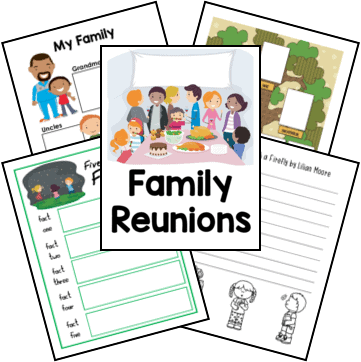
Social Studies: Family Reunions
Discuss family reunions with your student.
A family reunion is an event where a family
can all reunite (come together) and visit with one another all at one time.
Tips on planning a family reunion
Social Studies/Language Arts: Family Traditions
Family traditions are associated with practices and beliefs which are
handed over from one generation to the next generation. Discuss some of
your family traditions with your student. Do you know when the traditions
were started? Who started the tradition or why? Make a book together
about your current family traditions. Here are some ideas to get you
started:
1. What is your favorite place to go as a family.
2. What is your family’s favorite meal? The meal may be traditional for holidays, birthdays,
or other special occasions.
3. What is a favorite book your family likes to read together? Why is it a book your family
enjoys?
4. Describe two family traditions. They may include holidays, vacations, birthdays, or
other celebrations.
Note:
With your older student, you may want to make a page in your book for each
holiday.
Science: Fireflies
Fireflies are beetles. They light up to attract mates. Almost all of the
male's abdomen lights up, only the middle portion of the female's body glows.
The larva ( called wireworms ) of the lightning bug also lights up but not as
brilliant as the adult firefly.
More information about
lightning bugs
Story about lightning
bugs
Activity: catch lightning bugs in a
jar.
“ Fireflies! we all called out. We grabbed our jars and the dash was on to capture lightning and put it in a jar.”
What you need:
A clear plastic jar with a lid
A summer night
Lightning bugs
What to do: Wait for a summer night in July, August or September and observe the fireflies glowing just above the grass but no higher than the trees. Catch a few in a jar, put the lid on and observe their glow. Be sure and let the fireflies out of the jar after a few minutes so they can continue to light the night.
Go-along Books
Fireflies in the Night by Judy Hawes
Fireflies Sally Walker (good reference book-lots of information)
Language Arts: Writing- Family Stories
Write and illustrate
some of your family stories.
The older relatives at the family reunion took turns
telling stories about their lives to the children. Gramma told about the first
time she saw a flying machine ( airplane ). Aunt Adah told about the first time
she rode in a car. Aunt Ivah told about the time she saw a rattle snake.
What you need:
Paper
Pencil, crayons or markers
What to do: Tell some stories to your children about some memorable events in your life. The first time you swam in the ocean or flew on a plane or ate frog legs or some uncommon food. Remind the children to ask relatives to tell stories about their lives. Have children tell stories about their own lives. Try writing down some of your family stories. Children will enjoy drawing pictures to go with the stories.
Math: Measurement
“Grampa waved a yardstick in the air. All of us kids
dropped what we were doing and ran to the milk shed. We knew it was time to get
measured.” Practice measuring each other
and plan a place in your home to keep measurements. Over time children can see
how tall they have grown.
What you need:
A yardstick or measuring tape
The side of a door or wall or a strip of paper attached to the wall with tape.
What to do:
Measure the children and make a mark for their height. Put their age and the
date. Every six months or year measure again and do the same. Show the children
how much they have grown. Many young children will enjoy measuring you and each
other and learning about inches and feet and yards.
Crafts: Make a family photo
album
“Aunt Bertha had gone to the house and fetched all the family portrait albums.”
What you need:
Family pictures
Paper
Crayons or markers
Glue or glue stick
What to do: Cut paper to form a small book. Sew or staple the paper together so the pages turn easily. Help your child paste pictures of family members and themselves in the paper book. Be sure to help your child write the names of the people in the photographs underneath each picture. Show you child how to decorate the cover of their photo album.
Physical Education
“After we ate it was time for our annual baseball game…
Next it was time for croquet… We had bag races, watermelon – seed- spitting
contests, and rides on grandpa’s draft horse too.”
Give your students some old pillow cases and let them have an old fashioned bag
race. You could also introduce them to croquet if you have the right
equipment.
Cooking
Make orange Jell-O salad (or try many different types of Jell-O salad this week!)
“Wonder how many jell-O salads there will be ?” my cousin Freddie asked. "Gazillions. There always are," my cousin Billy answered. Sure enough, there were gazillions. They jumped and shook every time we bumped the table. They seemed alive.
What you need:
1 package of orange jello
1 cup of boiling water
1/2 cup of sugar
1 small can of crushed pineapple
1 can of Mandarin oranges
1/ 2 pint of sour cream
What to do:
Mix jell-O, sugar and boiling water until dissolved. Add other ingredients and pour into a bundt cake pan. Chill several hours before serving.Make your own book using construction paper.
Here is a site showing how to make a staple free book
Buy a dollar store journal and add index cards or hand write the recipes inside
Here is a site with some great ideas for making a recipe book
The Relatives Came by Cynthia Rylant
Social Studies: Human Relationships- Relatives
Discuss the different relationship words we use (aunt, uncle, cousin, great
aunt, etc.) and what each means.
Social Studies: Family Tree
Help your student construct a family tree.
Enchanted
Learning Family Tree Information
Very
easy family tree for younger students
Free Family Tree
program to help build your family tree (includes timeline viewer)
Geography: Map Your Relatives!
Where did the relatives in this story come from? (Virginia). Show
your student where his relatives come from. Then, put markers on your map
indicating where various family members live. You may even want to make markers (cut small circles from extra family photos)
and add them to your map. You may even want to ask some relatives to
send your student a letter or postcard. Look at the postmark together and
find the location on the map.
Math: Count and Graph Your Relatives
Make a list of all the relatives you can think of (cousins, aunts, uncles,
grandparents, etc.). Then, create a graph to organize and record your data.
Which category has the most? Least? You may want to make two graphs
(one for paternal relatives and one for maternal relatives). Your student
can then use the two graphs to compare the two sides of his family. On
which side are there more uncles? Cousins? etc.
Math: Distance
In the story it mentions that the relatives traveled for miles.
Can your older student use a map and determine how many miles he lives from some
of his relatives? Which relative is closest? Which one lives the
farthest away?
Science: Local Fruits
What fruits are mentioned in this story? Discuss that different types of
fruits grow in different climates (you may even want to find out where different
fruits such as oranges, bananas, coconuts, apples, etc. grow the best).
Learn about the fruits that grow in your neck of the woods. You may even
want to make a fruit minit book or go to a u-pick farm.
Challenge your older student to make a large list of fruits and to find out
where each fruit is grown.
Writing Prompt
Write about a time when your relatives came for a visit, when you visited them,
or when you gathered at a family reunion.
Emma Jo‘s Song
Language
Arts: Dialogue and Proper English.
Faye Gibbons chose to give the characters some
colorful dialect in this story. Using your best accent read some of
the examples of dialogue to your student.
You can also use this as an opportunity to discuss proper English. Read some of the passages the "right" way. Do the characters lose their flavor?
With your older student, you may choose
to dive into a lesson on characters and how to develop great characters when
writing a story.
Language Arts: Vocabulary
Rekon-I understand
Kinfolk-relatives
Makeshift tables-using just about anything you can find to make a table.
Waded-going into the water keeping it below the waist.
Plunked-sat down hard.
Toppled -turned over
Funeral home fans-these are ordinary cardboard fans used in older homes without AC.
Language
Arts: Expressions
On page three Emma Jo says she “lit out for the barn
lot.” What does this mean? (She ran fast out of the barn.) What does
it mean when she said, "I flew mad"? Look for other expressions in
this story that your student may not be familiar with and discuss.
Language
Arts: List Making
List several things that this family and the
children liked to do at their reunion-- play music, wade and swim in the
creek, swing on grapevines, play hide and seek and pop the whip.
What would your student like to do at a reunion?
Language
Arts: Compare and Contrast
Make a Venn Diagram and compare and contrast this book
with Lightning in a Jar.
Prepared Venn Diagram
Art: Medium
The illustrations in the book were done
with watercolors. Discuss this with your student. Encourage your
student to create a water color picture of a family reunion.
Music:
Instruments
Discuss the instruments in the book.
Harmonica
an instrument you play with your mouth by blowing air into
it.
Harmonica wailing means playing the harmonica in a way that it would almost sound like crying (wailing).
Dulcimer
Is a stringed
instrument with three or four strings; it is played by laying it flat on the
lap and pluck or strum the strings with one hand, while fretting with the
other.
More information
at wikipedia
Fiddle
The term fiddle refers to a violin when used in folk music.
More information at wikipedia
Guitar
A guitar is played by strumming it-- running your thumb or
pick across the strings of the guitar to play it.
Piano
A piano is a
stringed instrument; the keys are moved by the strings. It is also
considered a percussion instrument (since the keys are pressed). Plinking
is a term that means to press on the keys.
More information at wikipedia
Banjo
A smaller stringed instrument played by picking-- to use your
thumb and fingers together to make music. (An older lady is playing it on
page 18.)
More information at wikipedia
Music: Different Types of Singing
Discuss the different types of singing that are mentioned throughout
the story; you may even want to demonstrate and try some of these different
types together!
Humming- to produce musical tones while keeping the lips closed
Yodeling- to sing while frequently going back and forth between the range of
one's natural voice and a higher range
Example of Yodeling
from Youtube
10 lessons on yodeling
Whistling- a shrill clear sound made by forcing air through puckered lips
Music: Songs
Learn some of the songs mentioned in the story
This Little Light of Mine
(you could tie this back in to the lightning bugs from When Lightning
Comes in a Jar)
This little light of mine, I'm gonna let it shine.
This little light of mine, I'm gonna let it shine, let it shine, let it
shine, let it shine.
(The kids hold up their index finger and move it in a circular motion.)
Won't let Satan blow it out.
I'm gonna let it shine.
Won't let Satan blow it out.
I'm gonna let it shine, let it shine, let it shine, let it shine.
(When the kids sing "Won't let Satan blow it out....they blow on their
finger.)
Let it shine til Jesus comes.
I'm gonna let it shine.
Let it shine til Jesus comes.
I'm gonna let it shine, let it shine, let it shine, let it shine.
(The children cup one hand over their finger
and when shouting NO they remove their cupped hand)
Hide it under a bushel - NO!
I'm gonna let it shine.
Hide it under a bushel - NO!
I'm gonna let it shine, Let it shine, let it shine, let it shine.
Let it shine over the whole wide world,
I'm gonna let it shine.
Let it shine over the whole wide world,
I'm gonna let it shine, let it shine, let it shine, let it shine.
"Shall We Gather
at the River" music and lyrics
Craft Idea: Fan
Make a hand held fan. You could draw your own design on a piece of cardstock or posterboard or just glue on a coloring page and add it to a popcicle stick.
Here is a template
Materials and information on this website belong to the original composers. It may be used for your own personal and school use.
Material may not be used for resale. © 2005-07 HSS