Google
 
Daisy Comes Home Free Unit Study


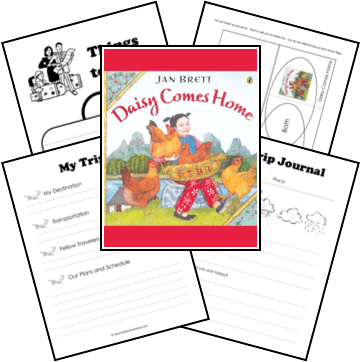
Daisy Comes Home

  Author: Jan Brett

Summary:  Set in China, the story is about a little girl who carefully tends to her six hens.  Then, one day one of the hens gets lost.  When Mei Mei brings the eggs to market, a friend helps reunite her with Daisy her lost hen. 

ISBN: 039923618X

A unit by Denise Gregson (with some ideas contributed by Chelle in NZ)


Bible

The Parable of the Lost Sheep
In the story, Daisy was very precious to Mei Mei.  Even though she had other hens, when Daisy was lost Mei Mei was very upset and couldn’t stop thinking about her.

This reminds me of the parable that Jesus told of the lost sheep in Luke 15:1-7.  In it He says if (a shepherd) had 100 sheep and lost one, he would leave the 99 to try to find the one that was lost. 

Jesus is our Good Shepherd.  His children are His sheep. In John 10:27 Jesus said His sheep listen to His voice, He knows them and they follow Him. He gives them eternal life and they will never perish.  Likewise, Daisy recognized Mei Mei’s voice and this is what helped save her.


Art

Details
Look closely at the illustrations of the mountains.  Do you see various animals? Go through each illustration and discover what animals are there. Have you ever looked at a mountain or tree and seen an animal or figure there?  How about some clouds?  My daughter thinks that a tree in our neighborhood looks like The Statue of Liberty.  (before I could take a picture of it to show you, the tree grew and changed too much!)

It’s My Cloud by Joe Troiano is a delightful picture book that encourages your child to use his imagination to see things in the clouds.

Medium
Jan Brett’s illustrations are said to be done in watercolors and gouache with airbrush backgrounds. Gouache (also referred to as “bodycolor”) is similar to watercolor except that the particles are larger, and also includes some white pigment such as chalk. The resulting artwork is thicker and more opaque. It also has reflective qualities. Airbrushing involves using an air-operated  tool to spray the paint on.

Your child will probably notice that in addition to the main illustrations, on each page there are some smaller illustrations in the corners.  If you have other books by the author, look at them as well and you will see this is consistent with her style.  In some books, the illustrations foreshadow what is to come and in others they further illustrate the storyline on that page.   Read the story again and see if you can determine if these smaller illustrations in Daisy Comes Home are foreshadowing or follow the storyline on the corresponding page.

Basket Weaving
Notice the baskets (and different types of weaving) shown in the artwork in this book.   What are some uses for baskets?  If you have baskets in your home, gather them and let your student study the pattern. 

Weaving is one of those crafts that is done all over the world.  Travel almost anywhere and you will see some sort of weaving amongst the local crafts. Weaving began thousands of years ago (BC) and is one of the earliest of crafts.

Find a weaving project to do with your child; you may even choose to do a potholder kit.


Language Arts

Author's Inspiration
On the back inside cover of the dust jacket of the hardcover copy there is some information about the author.  In it we read that she and her husband, along with their son and daughter-in-law, traveled to China where their daughter-in-law was born.  As they traveled on the Li River Jan thought of a favorite children’s book from her childhood (The Story of Ping!).  This adventure became the inspiration and backdrop for the story Daisy Comes Home.  There is even a photograph of Jan with her daughter-in-law with two large baskets of eggs on the dustcover!  Additionally, Jan has hens of her own at home, adding to the inspiration of the story!  This all explains how she is able to include such detail in her story and illustrations. If you don’t have the hardcover version you can read about this on Jan Brett’s website.

Jan Brett’s biography on her website tells more of her travels which have given inspiration to her children’s books.   

Is there a trip your family took that your child would like to write/draw about?    Enchanted Learning website has some journaling pages that can aid your family in documenting your trip.

 If you haven’t taken a recent trip, you could take a local field trip and have your child write about the experience.  Encourage him to pay special attention to details in his surroundings so that he can draw or describe it later.

Onomatopoeia
Does your child know what onomatopoeia is?  (a word that sounds like what you say)  What examples of onomatopoeia can your child find in the story? (thump! peck! scratch, scratch, scratch, bump, lap lap, lap)  Notice that these are italicized in the story to differentiate sounds from the other text.

Note: Mei Mei calls the chickens by saying gu gu gu.  It is interesting to note that in other languages, people might hear a sound in a different way than we do. One reason is that they might not even have a certain sound in their language.  What sound would you make if you were calling a chicken?  One example that is perhaps familiar to your student is in Frere Jacque.  In English, we use ding ding dong for the sound of the bell and the French would say din dan don without the “g” sound at the end. 

Does a dog’s bark sound like  bow wow, ruff ruff or woof woof to you?  Or something else?

Famous Sayings
“Finders Keepers” – Does your child know what this means?  We usually use this expression to mean “If I find it, no matter whose it was,  it is mine now.”  Is that fair?  It is common for small children/toddlers to think this way since they don’t have a good understanding of ownership.  You could discuss with your child that now that they are older they may be able to understand why this isn’t a right way of thinking.  What does the Bible say about honesty?  Would it be considered stealing if you found something in a public place and kept it? What should you do with someone’s belongings if you found it in a store, for instance.  What if it was your pocketbook that you left somewhere and someone found it and had the attitude of “Finders Keepers”?  How would that make you feel?  What if it was something small that wasn’t worth a lot?  Would that be different?  What if there was no possibility that the owner would come back looking for it. (e.g. a penny in the middle of the road)  Discuss as many situations as you see fit.  If your family enjoys the Junie B. Jones series, there is one on this very topic titled  Junie B. Jones Is Not a Crook.

How about the saying, “Don’t count your chickens before they’ve hatched ” – Does your child understand what this means?  (don’t consider something as definite/ or accomplished too quickly) Do you have an example from your own life?

Sometimes, people are called “chicken” if they are timid to try something new.   Can you think of any other sayings that include chickens?

Vocabulary
Shiver
Roost
Plump
Tuck
Arrange
Furious
Clench
Cling
Peck
Damp

The author has provided some vocabulary exercises found at:
Vocabulary 1
Vocabulary 2

Compound Words
A compound word is two complete words combined to become a new word.  Go through the story and have your child find the compound words:  henhouse, farmhouse, houseboat, overhead, fisherman, something, nighttime. You might use these words for handwriting practice.  Have your child write the two individual words and then the compound word that they can make.

Prepared Compound Words Handwriting Sheet

Comprehension
The author also has provided some comprehension questions on her website: 
Comprehension Questions 1
Comprehension Questions 2

Venn Diagram
If you have The Story of Ping compare and contrast the two stories using the Prepared Venn Diagram Booklet

Some suggested similarities:
Take place in China
Along a river
An animal as one of the main characters
About birds
Kept in a basket
Animal gets lost/separated from owner
The animal was saved by a child
Reunited with owner in the end

Differences:
Yangtze River vs. Li River
Duck vs. Hen
Adult owner/caretaker vs. child
Six birds vs. Fifty-Four birds


Social Studies

Human Relationships and Teasing
In the story the other hens tease Daisy and that results in her getting carried away down the river.  By now your child has likely encountered teasing.  How does it feel to be teased?  (teasing is hurtful, embarrassing, causes shame, loneliness..) If your child can remember a specific instance, you could role play how the situation could have been handled either as the recipient or as an onlooker.  Demonstrate for your child how to say, “I don’t like it when you say that because…”   (it isn’t true, it makes me feel bad, there is nothing wrong with….).  Remind your child that what matters most is what God says about them and He says they are special.  Also, remind them of the Golden Rule of treating others the way they would like to be treated.

Chores and Responsibilities
How did Mei Mei care for the chickens?  She gave them treats, put fresh hay in their nests, gave them baths when they got muddy, fed them (sometimes even with chopsticks!), collected and sold the eggs and kept track of them if they got lost.  Does your child think Mei Mei was responsible in how she cared for the chickens? This would be a good time to review your child’s chores and create or revise your chore chart for them.

Geography – China’s Terrain
Over half of China is covered with mountains, hills, and highlands. In the southwest are the Himalaya Mountains and the Kunlun Mountains. The Himalayas are the highest mountain system in the world. Himalaya means “House of Snow”.  China has mostly mountains, high plateaus and deserts in the west with plains, deltas, and hills in the east. The mountains in this story are the Gui mountains in Guilin according to Brett.

Definitions:
Delta:  A triangular or fan-shaped area at the end of a river that is formed by eroded material that has been carried downstream.  (The heavily populated city of Shanghai is located at the Yangtze River Delta!)

Plateau:  a high flat area of land

Because of its large size, China is bordered by many countries -Afghanistan, Bhutan, India, Kazakhstan, North Korea, Kyrgyzstan, Laos, Mongolia, Myanmar, Nepal, Pakistan, Russia, Tajikistan, Vietnam – as well as some coastline (South China Sea and Pacific Ocean)

Map of China
Flag of China
Flag of China minit book

Geography—China’s Li River
Your child may already be familiar with the Yangtze River, especially if you have studied Ping in Five in a Row, volume 1. The Yangtze is longest river in China and the third longest river in the world. The Li River is a tributary of the Yangtze River.  A tributary  is a  river or stream that flows into a larger river.  A tributary does not flow directly into a sea.  The Yangtze River has over 700 tributaries in all!


Science

Nutrition – Eggs

Are eggs nutritious?  Yes!  Eggs are a good source of protein, the building blocks of the body. They also have a number of other vitamins and minerals including vitamin A, vitamin D riboflavin, folic acid, vitamin B6, vitamin B12, iron, calcium, zinc, phosphorus and potassium.  The yolk contains a higher proportion of the egg's nutrients than the white (the albumen). Eggs are eaten all over the world because they are a relatively inexpensive source of protein.

Egg yolk is an emulsifier. What does that mean?
Mix a cup of water with a couple of tablespoons of oil.  Try stirring it together and note what happens.  Next add an egg yolk and mix.  Is there a difference?  The egg yolk contains lecithin which acts as an emulsifier.  Lecithin is added to such things as salad dressings to give it the smooth uniform look.  Note that egg yolks do not work as emulsifiers in our bodies because cooking changes them and our stomach acid  breaks it down.  Bile works in a similar way and is what is found in our body that helps break down fat.

How can you tell if an egg is fresh?
1)  Generally, fresh eggs will lie on the bottom of the bowl of water.
Why?  As an egg ages, gas builds up inside it. More gas = more floating!
2)  Fresh eggs sit up tall and firm in the pan while older ones tend to spread out.
Why?  Egg white thins out as an egg ages
3)  The raw egg white of a fresh egg has a cloudy appearance. 
Why?
   This indicates the presence of carbon dioxide which has not had time to escape through the shell since the egg isn’t very old.

Why are some eggs brown and others white?
The breed of hen determines the color of the shell. Breeds with white feathers and ear lobes lay white eggs; breeds with red feathers and ear lobes lay brown eggs.  What color eggs do Mei Mei’s hens lay? Is that consistent with this information?

Is
it safe to eat raw eggs?
Eating raw eggs can be cause salmonella – a type of food poisoning.

How can you tell the difference between a boiled egg and a raw (uncooked) egg?
Spin it!  A hard-boiled egg's will spin freely because the contents are solid; a raw egg will only spin a couple of times.   Try and see!

What are some ways that eggs can be prepared?  Chicken eggs are the most widely eaten but other birds eggs such as duck, goose and quail are also eaten. Eggs can be: boiled, fried, poached,  deviled, coddled, pickled, baked (in soufflés or custards), egg drop soup, stir fried rice, meringues. Try eggs in a new way this week!

Does your child know how to separate egg whites or how to crack an egg? This would be a good time to practice or review.


Trees
Many of the illustrations show bamboo trees.   See if you can spot some of them.  Notice the uses of bamboo in the illustrations:  the structure of the hen house, boats, oars, to make a yoke for carrying baskets.  Near the end of the story there is a man carrying bundles of bamboo on the back of his bike.

Daisy’s basket gets hooked up in a banyan tree where a troop of monkeys lives.  Here is a picture of a banyan tree that I saw in Hawaii:

A banyan is a fig that germinates in the cracks of a host tree (or on structures like buildings and bridges). The seeds germinate and send down roots towards the ground. Since the roots may cover or “strangle” the host, banyan trees are sometimes known as "strangling figs”. More and more roots grow down forming new trunks, often dozens of them, making it impossible to tell which is the original..

Some interesting notes: 

Robinson Crusoe made his home in a banyan tree.

The first banyan tree in the United States is reported to have been planted by Thomas Edison.  The tree, found in Florida, was originally 4 feet tall and now it covers an area of 400 feet!

Chickens
Does you child know the characteristics of a bird? Birds are warm-blooded which means their body temperature remains about the same no matter the temperature of the environment. They have feathers, wings and beaks. Their bones are light to help in flying.  Birds have a weak sense of smell but keen sense of sight and hearing which helps them to hunt.

To further extend your look at birds and chickens you could use these activities on the kizclub.com website:

Mini book

Life cycle of a chicken


Applied Math

Multiplication + Division
We usually organize eggs by dozens – How many makes a dozen? If twelve makes a dozen, how many eggs would make a half dozen?  Sometimes we package eggs in cartons of 18 – how many dozen would that be? (one and a half dozen) 

Does your child remember how many hens Mei Mei has?  (six)  Hens generally lay about 5 eggs per week.  Approximately how many eggs, then, would all of her hens lay in a week? (six times five – or thirty).  If they were put into egg cartons, how many cartons would be needed?  How many would be left over?  Use some manipulatives, if needed, such as pennies.


Just For Fun

*Try this fried rice recipe:  Chop a couple stocks of celery and one large (green or yellow) onion. Fry in a few tablespoons of cooking oil (make half of it sesame oil) in a large frying pan or wok until tender.  Add one cup frozen mixed vegetables and a couple cloves of chopped garlic. Stir fry until everything is tender and gives off an aroma.  Add about 3 cups of cooked rice,  ¼ cup of soy sauce and a ½ tsp fresh grated ginger (or ¼ tsp ground) and stir fry until heated through.  Push all the rice to one side of the saucepan and add two scrambled eggs into the pan.  Cook eggs thoroughly and mix them throughout the rice. Note: Ingredient amounts are estimates and any of the ingredients can be adjusted according to taste.

*Craft: Make a Chinese Lantern

*Field Trip Suggestion-Visit someone who raises chickens.

* Bookmarks

*Coloring Page