Google
 
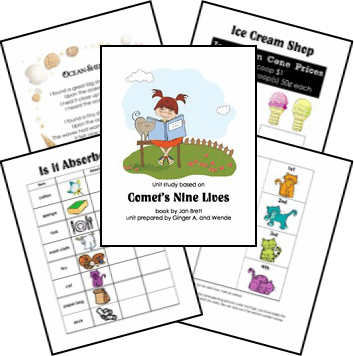
Comet's Nine Lives Free Unit Study

Comet's Nine Lives

Author/Illustrator: Jan Brett
ISBN: 0399229310

Unit Designed by Ginger A. and Wende

This unit is designed for use in the K-2nd grade level.


Language Arts


Cat Sayings and Phrases

The title of this book comes from the saying that every cat has nine lives. Is this true? No, but Brewster’s dictionary of Phrase and Fable says that a cat is said to have nine lives because it is “more tenacious of life than many animals”. Cats were considered to be sacred in the Egyptian culture. The number nine is a trinity of a trinity and so nine was probably chosen to reflect the sacredness of the cat by the Egyptians. [Information from Singapore Science Centre, question #19532]
 

Below is a list of other cat phrases that would be interesting to talk about with your child. There are many more. An older child could make a booklet of cat phrases for his notebook or lapbook.
 

Cat Phrases and Sayings

Raining cats and dogs [it's pouring down rain]
Grinning like a Cheshire cat [from Alice’s Adventures in Wonderland]

Catnap [just a little nap]

The cat's pajamas [something great]
Look at what the cat dragged in [someone who arrives somewhere looking messy]
Looking like the cat that swallowed a canary [appearing very pleased with one’s self]
Cat got your tongue? [someone who is slow with a response to a question]

Acting like a cat on a hot tin roof [from the Tennessee Williams play]
Let the cat out of the bag [a secret that has been told]

Cat’s cradle [a string game played by children]

Catcalls [booing another team’s efforts]

Caterwauling [screeching noises, this is how Granny describes Pearl’s singing on the Beverly Hillbillies]

Fat Cat [someone who is well off or has a lot of money]
When the cat's away, the mice will play [when no one is watching, people will get into trouble]

These next two phrases are not pleasant but your children will hear them in various literary works:
 

Cat of nine tails [This whip was made of three separate strands and each strand had three knots tied in it. This was used as a form of punishment. The whipping was so severe that those that survived were said to be lucky as a cat with nine lives.]

Not enough room to swing a cat [In a tight space. Sailors were sometimes punished with the cat of nine tails. Below the deck it was too crowded to swing the cat of nine tails, so this phrase became common.]


Cause and Effect

Use an example with your student to define cause and effect.
1. Bill forgot to turn off the water hose. The yard was soaking wet this morning.
2. Jane’s birthday is tomorrow, so her mother decorated a birthday cake.
Make up other examples and have your child identify the cause and effect. Read Comet’s Nine Lives again. Try to determine the cause for losing each life. 
You can make a cause/effect minit book for your lapbook or notebook with these prepared pages.


Action Words

As your child listens to the story have him identify some of the action words that relate to Comet. Examples: trotted, flicked, staggered, jumped, pranced. Tell your child to demonstrate each action word.  Go-along book about verbs:  Kites Sail High by Ruth Heller


Handwriting

Let your child practice writing in wet sand with a stick. Let your child choose some interesting words from the story.


Left to Right [pre-reading skill]

Place a basket full of shells on the table toward the left of your child. Place an empty basket on the table toward the right of your child. Give your child a pair of tongs to hold with his right hand. Instruct him to pick up the sea shells using the tongs and move them to the empty basket


Poetry

This poem is easily memorized.  You could also use it for copy work.


Ocean Shell

I found a great big shell one day [pretend to hold with both hands]

Upon the ocean floor

I held it close up to my ear [raise hand to ear]

I heard the ocean roar!

I found a tiny shell one day [pretend to hold in one hand]

Upon the ocean sand

The waves had worn it nice and smooth [pretend to stroke shell]

It felt nice in my hand.


Links
Many words begin with "cat" -- finish more words in this spelling activity
Create an "At Sea Dictionary" using different terms from this site
Reading Comprehension Sheet I from Jan Brett's Website
Reading Comprehension Sheet II from Jan Brett's Website


Arts and Crafts


Knitting

Sailors were some of the first to knit. Originally knitting was considered to be a man’s skill because it was used to create nets. Teach your child to cast on and knit stitch. This is quite possible for a 5yo. Kids knit: simple steps to nifty projects by Sarah Bradberry is an excellent resource.


Knot tying

This involves problem solving and following directions. There are many books that teach this skill but I found that it is much easier to learn by watching someone.[I thought this would be too difficult for little ones, but I was wrong.. A retired Marine officer worked with a group of boys in my home for about 2 hours teaching this skill. At the end of the lesson all the 5yo could tie a slip knot, figure eight and figure eight on a bight. The older boys learned about 6 knots.]


Learn to make a sailor’s bracelet

Sand casting [paper weight]

  1. Fill a dishpan almost full of damp sand.
  2. Pack the sand down.
  3. Press seashells into the sand to make indentions.
  4. Mix plaster of Paris according to the directions.
  5. Pour into the sand molds.
  6. Let dry.
  7. Remove the plaster seashells. Some sand will remain stuck to the shells.

Math


Measurement/Geometry: Compass and Ruler

Make a simple paper boat
Plan to make a fleet of these because children seem to really enjoy this activity.
 

Links 
Round numbers to the nearest 10- Seashell Rounding Page (Jan Brett's website)
Ordinal Numbers (Cats) from Jan Brett's Website


Science
 

Hurricanes
Comet got caught by Hurricane Elmadore. Hurricanes are powerful, whirling storms. They form over the warm oceans close to the equator and can travel hundreds of miles. As the sun heats up the seas, warm water vapor rises into the air forming large thunderclouds. Wind causes the masses of clouds to whirl strongly. The hurricanes move across the ocean creating huge waves that can crash on the shore. Often times, the hurricane never makes it to land. When they do come to land, they bring high, destructive winds and heavy rains.

To learn more about hurricanes, read these informative books:

The Magic School Bus Inside a Hurricane by Joanne Cole
Hurricanes and Tornadoes by Norman S. Barrett

Or these picture books about children experiencing a hurricane:
Hurricane by David Wiesner
Time of Wonder by Robert McCloskey

Learn about Hurricanes
How Stuff Works- Hurricanes


Making Ice Cream: Salt and Ice

Comet had some problems in the ice cream shop. Do you know how ice cream is made? Why is salt put on ice when ice cream is made? What does the salt do?

Ziploc Ice Cream

1 gallon Ziploc bag

1 quart Ziploc heavy duty bag

4 cups ice

¼ cup salt

1 cup whole milk

1 teaspoon vanilla extract

2 Tablespoons sugar

cups and spoons

Steps

1.Pour the milk, vanilla extract, and sugar into the small Ziploc bag. Squeeze as much air out as possible and seal the bag.

2. Place the small Ziploc bag down into the large bag. Cover with the ice and salt. Seal the large bag.

3. Shake ,toss, and flip the Ziploc bag for 5-10 minutes. Pass the bag around if it gets too cold. Don’t open the bag to check the ice cream because it may reseal securely.

4. Open both bags and spoon the ice cream into a small cup.


Variations

  1. Substitute other flavors for the vanilla.
  2. Omit the vanilla and half the sugar. Add strawberry or chocolate syrup to the milk mixture.

Science Explanation:

Salt lowers the freezing point of water. The water gets colder than ice [about 28 degrees]. This super-cold water and ice mixture causes the liquid milk mixture to freeze and become solid.


Water Study: Absorbent and Nonabsorbent

It may be easier to do this activity outside at a kiddy pool, but your kitchen sink or bathtub would work just fine.

  1. Experiment to determine whether an item is absorbent or nonabsorbent. Gather a variety of materials. [examples could include: cotton balls, sponge, aluminum foil, wash cloth, umbrella, plastic cup, piece of paper, sock, etc.] Explain the terms absorbent and nonabsorbent by  testing one item of each kind. This way your child will see as well as hear your explanation.
  2. Allow your child time to test each all the items. Group the items into piles. Count the number of items in each group.   Use this Prepared Chart (has list of items) if you desire. 
  3. Your child may find a few items that don’t seem to fit either category. Tell him to decide a name for that group.

Water Study: Evaporation

This activity is a simple introduction to evaporation. The purpose is to help the child move beyond the idea that water just disappears.


On a warm day give your child a bucket of water and a clean paintbrush. Tell him that today he will use water to paint the house and mailbox [or any suitable concrete/metal surfaces]. Observe how the pictures disappear after a while. Ask your child for an explanation. Use this opportunity to introduce the word evaporation. You could talk a little about the water cycle. Children are usually interested to know that we just keep using the same water over an over.


Water Safety Rules

Rules for Boating Safety
Know your boat -- each boat has its own purpose. Make sure you use your boat correctly.
Always wear a life jacket while riding on a boat.
Make sure an adult is operating the boat.
Don't stand while a small boat is moving
Don't sit on the gunwale or bow of a moving boat.
Also, it's a good idea to know your state's laws governing boating and fishing.

Rules for Swimming Safety
Learn to swim.
Always swim with a buddy.
Make sure an adult (or lifeguard) watches you.
If you can't swim, or if you are just learning to swim, wear a life jacket.
Don't use an inflatable air mattress or swim ring unless you know how to swim.
Don't swim in cold water-- it can cause dangerously low body temperature (hypothermia).
Never dive or jump into unknown waters.
Obey all "No Swimming" and other warning signs.

Cats
You may also want to spend some time learning about cats this week.

Cats at Enchanted Learning-- rhymes, crafts, print-outs (science information), language arts activities, and more!

Cats- Cat Napping Activity


Social Studies


Geography

Massachusetts –
Comet lived in Massachusetts. If desired, do a brief study of the state. Massachusetts is part of what are called the “New England States”, located in the northeastern part of our country. Have student locate Massachusetts on the US map. Your child may be familiar with the state, having learned in the past about the Mayflower landing at Plymouth in 1620, the Boston Tea Party, the Midnight Ride of Paul Revere, or maybe the Salem Witch Trials. Well Massachusetts was also among the first states to experience rapid city growth, and today is one of America’s most urbanized and industrialized regions. Massachusetts has been the home to many famous people including John Adams, our second president, and his son, John Quincy Adams, our sixth president. The state flower is the Mayflower, and the state bird is the chickadee. Looking at a map of Massachusetts, have your child locate the capital, Boston, as well as Nantucket, where Comet lived.

Nantucket – Comet lived in Nantucket, a small island off the south east coast of Massachusetts. While Nantucket is now used mostly as a summer vacation spot, during the 1800’s it was a very prosperous whaling village. By 1835, large fleets of ships were sent out from Nantucket to as far away as the Pacific Ocean off the coast of Alaska to hunt whales. These voyages often lasted three or more years. Most of the people living in Nantucket in some way depended on the whaling industry for their livelihood. The whales were used to meet the high demand of whale oil, the chief illuminant of the day. As the sale of petroleum-based oils took the place of whale oils, whaling greatly decreased. Nantucket is still rich in nautical history, with stately captain’s houses and fishing shanties, and it was depicted in Herman Melville’s classic novel Moby Dick.

Hunt for treasure on Nantucket Island (Nantucket, MA) - don't miss this!

Make a story disk and place it on your map.  You may also want to make a flag of MA, or, you can find the flag of Nantucket to replicate here

Nantucket, MA Website
Massachusetts State Flag
Massachusetts State Map
Massachusetts State Bird- Chickadee
Massachusetts State Flower- Mayflower
State Bird/Flower Coloring Page


Land Form:  Island
An
island is a piece of land surrounded by water.  Is your student familiar with any other islands?  Point some out on a map.  Which continent is an island?
 

Compass Activity Page at Jan Brett's Site


Rabbit Trails
 

American lighthouses

Efforts are being made by many historical preservation societies to preserve these landmarks. Keep The Lights Burning Abbie, by Peter and Connie Roop is a wonderful read. Reading Rainbow ‘s video for this book is great.    Lighthouse Reading by Susan Mallette


Nantucket Lightships

These were used to warn ships of dangerous shoals. The men on board began to make Nantucket Lightship baskets to pass the time and for extra income.
http://www.nantucketlightshipbasketmuseum.org/what_is.htm


Research various Native American Tribes

The internet is full of sites on Native Americans. However, I think a book from the library would be better.

Seashells
What lives inside shells?  Research and find out!


Just For Fun

Visit Jan Brett's Website and find even more!
Comet Bookmarks
Comet Coloring Page
 

Recipes

Boston Baked Beans
New England Clam Chowder


Materials and information on this website belong to the original composers. It may be used for your own personal and school use. 

Material may not be used for resale © 2005-07 HSS