Google
 
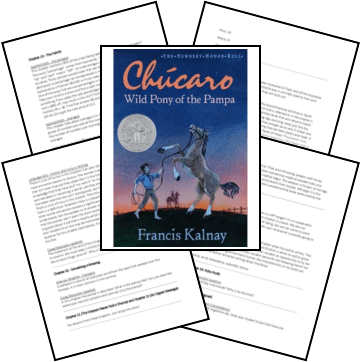
Chúcaro

Chúcaro
 

  Author:  Francis Kalnay
Illustrator:  Julian De Miskey
ISBN:
0802773877

Summary:
When Pedro spies Chucaro, the pink pony, on the Pampa, he can hardly believe his eyes. Unfortunately, the estancerio's son is as determined as Pedro to own the pony. But, as the wisest gauchos know, ponies as special as Chucaro can never truly be owned--and Chucaro alone will decide who has the privilege of riding him.

Lessons by Debbie Palmer

*Note: This book does touch on the topic of alcoholism. One of the characters struggles with alcohol stemming from the loss of his wife. There is a short lesson on grief and alcoholism.

Suggested notebooking resource: Study Starters. These pages can be used for a variety of the subjects for Chúcaro. See here www.studystarters.com


Chapter 1 - Lasso

Language Arts - Vocabulary
Here are the definitions for some of the Spanish vocabulary in chapter one.

Vaquero-cowboy

Perdiz-partridge

Estancia-ranch or cattle ranch

Gaucho-Argentine cowboy

Caramba-an interjection meaning “Gracious me!”

Criollo-creole

Rehenque- NOTE: This is actually a mistake in the book. The real word is “rebenque” and it is a wide whip used by the gauchos. The book has some drawings of them in chapters 8, 10, 17 Can your student find the pictures?

Sombrero-hat. We think of the word “sombrero” as the traditional wide-brimmed Mexican hats, but the word is for any type of hat.

Geography - Argentina
The story is set in the country of Argentina. Argentina lies in South America. Its capital is Buenos Aires, which has a population of around 13 million, is also its largest city. Argentina is the second largest country in South America and the 8th largest in the world. Argentina is a very diverse country geographically. The country is broken up into six regions. Below is the list of the regions with the provinces in that region.

Each of the above have links to Wikipedia if your student is interested in learning more about a certain region.

Culture - Gauchos
Gauchos are the cowboys of Argentina, Uruguay, and Brazil. They live on the Pampas (see lesson on the pampas) and their main activity is cattle ranching. They are called the wanderers of the pampas. The term “gaucho” comes from a Quechua (Indian group in the area) word, “huachu” which means “vagabond”. See more about their typical way of life under the lesson about gaucho dress, yerba mate, bolas, and asado.

Botany - Alfalfa
Alfalfa is a flowering plant from the pea family. It is an important forage crop, meaning it is used to feed livestock. The flowers resemble clover in that they are clusters of purple flowers. The United States is the largest producer of alfalfa with California, South Dakota, and Wisconsin as the top producing states, but it is also grown in large amounts in Argentina, Australia, South Africa, and the Middle East. Alfalfa has a high protein content which is why it is so widely used for livestock. Humans also eat alfalfa in the form of the sprouts that are normally put on salads and sandwiches.

Botany - Corn
There is corn in the fields where Chúcaro is eating. Corn, although considered a vegetable by some, is actually a cereal grain. Corn originated from Mesoamerica, which is the area of southern Mexico and the northern part of Central America. The crop eventually spread across the world. The United States is the top corn producer in the world with China, Brazil, Mexico, and Argentina following behind us.

Corn is used to make “mush” (a thick porridge) here in the States. In other countries, it is also made into mush, but is called by different names. It is also used as a “flour” to make breads, as a snack in the form of popcorn, and as a drink in South America called “chicha”.

Corn is also called “maize” which comes from the Taino Indian word for the plant. The word for “corn” in many Spanish-speaking countries is “maíz”. The word “maíz” is even used in the book Chúcaro. However, the Argentines really use another word, “choclo” for “corn”.

The Biography of Corn by L. Michelle Nielsen would be a great book to read. It covers the science, history, culture and economics of corn.

Science - Pink horse (causes)
Chúcaro is described as a pink horse! What causes this? Is there really such a thing as a pink horse (not counting My Little Pony)? More than likely Chúcaro is a strawberry roan or red roan horse. Roan means that the horse’s hair has an even mixture of white and colored hairs. There are three main types of roans when it comes to horses: red roan (reddish brown and white hairs), bay roan (reddish brown and white hairs, but with a black mane and black legs), and blue roan (black and white hairs which gives the animal a bluish hue). You also may want to investigate with your student the idea of dominant and recessive traits. The gene for an animal that is roan is dominant. Therefore, two non-roan horses can’t produce a roan offspring.

Social Studies - Grief/alcoholism
The vaquero, Pedro’s father, shows signs of alcoholism. Describe to your child what alcoholism is. What was the cause of the Vaquero’s alcoholism? Vaquero’s wife died when Pedro was about a year old. Explain that some people in their grief turn to alcohol to drown out their pain. The problem with alcohol is that it destroys your health (especially the liver), it can make some people mean and abusive, and it can make a person unable to function in society. In the vaquero’s case, he was unable to properly raise his son. The raising of Pedro eventually falls to Juan in the book.

Science - The Pampa
The pampa is the fertile plains in the provinces of Buenos Aires, La Pampa, Santa Fe, and Córdoba and in the country of Uruguay and a small southern portion of Brazil. This is the homeland of the gauchos where they raised cattle and food.

There are different names for plains across the world. Here is a list of them:

United States/Canada: prairies

Russia: steppes

Africa: savannas

Northern climates: tundra

Venezuela: llanos

Here’s a map of plains across the world

You may want to check out the series of books called “One Small Square”. These books go over different types of areas (forest, oceans, etc.) of the world and their habitats. The books that would apply to this lesson in the One Small Square series would be African Savanna and Arctic Tundra.

Language Arts - Similes
There are a few similes in chapter one. The author describes Juan, “His timing was as exact as a fine cuckoo clock.” and “he was strong, obstinate like a bull.” Both of these statements are similes, which are comparative statements using “like” or “as”. Can you student create some similes?

There are tons of similes that are common sayings also known as cliche's (good writers try to avoid overused phrases and comparisons) .  Eve Merriam has a great poem that will help you and your student both understand more about these phrases that must be avoided in writing.

A cliché
is what we all say
when we're too lazy
to find another way

and so we say

warm as toast,
quiet as a mouse,
slow as molasses,
quick as a wink.

Think,
Is toast the warmest thing you know?
Think again, it might not be so.
Think again, it might even be snow!
Soft as lamb's wool, fleecy snow,
a lacy shawl of new-fallen snow.

Listen to that mouse go
scuttling and clawing,
nibbling and pawing.
A mouse can speak
if only a squeak.

Is a mouse the quietest thing you know?
Think again, it might not be so.
Think again, it might be a shadow.
Quiet as a shadow,
quiet as growing grass,
quiet as a pillow,
or a looking glass

Slow as molasses,
quick as a wink.
Before you say so,
take time to think.

-Eve Merriam

Can your student try to think of a new way to end each simile without using a cliche'd phrase (he doesn't have to use animals to fill the blanks)?  Try a few of the following:

Blind as a____________(bat)

Strong as an _______(ox)

Busy as a__________(bee)

Quiet as a_________(mouse)

Sick as a _________(dog)

Happy as a_______(lark)

Stubborn as a________(mule)

If the above exercise is too hard, try using some of these:

________ as a goat.

________ as a butterfly.

________ as a cricket.

________ as a bear.


________ as a turtle.

________ as a bear.

Another place where you find lots of similes is in the book of Proverbs. See if your student can find the comparisons/similes in these proverbs:
Proverbs 25:11
Proverbs 25:14
Proverbs 25:25
Proverbs 26:17
Proverbs 25:18

Geography - Provinces of Argentina
The gaucho says of the alfalfa that “There’s nothing like it in the whole province.” The United States is broken up into smaller political units called states. However, in Argentina, the country is broken up into provinces. You can find more information here.

Map of provinces of Argentina (and a blank map)

Chúcaro-meaning in the name
Juan, the gaucho, said, “A name is like a sombrero. It must fit the owner. The name, Chúcaro, means “wild”. Does the name fit the owner?


Chapter 2 - Ombú

Botany - Ombú
The ombú is actually classified as a bush, but it looks like a tree. They are found on the pampas in Argentina, Uruguay, and Brazil. It is a large evergreen with an umbrella shaped top. It has a girth of about 50 feet and can reach heights of 60 feet. The massive trunk of the ombú can store water which is helpful on the sometimes dry pampas. It has dark green, glossy leaves and produces white-greenish flowers that produce crimson-colored berries. The ombú is called the “lighthouse” of the pampas because it provides shade for those traveling through the flatlands.

Language Arts - Vocabulary
Medianero-people who farm on shares of land (in the book). It also means a person who is a mediator.

Patrón-landlord, the overseer of the estancia


Chapter 3 - Casita 

Language Arts - Vocabulary

Casita-little house

Mate-a type of tea famous in South America

Poncho- A blanket-like cloak having a hole in the center for the head

Vincha-a scarf wore on the head of a gaucho

Pampero-a burst of cold polar air from the west that sweeps across the pampa. It normally happens in the summer.

Adobe
Juan’s house is made of adobe. Adobe is a building material made of sand, clay, water, and some kind of fibrous material like straw. The adobe is formed and then laid out in the sun to dry. Many native peoples of the southwest of the United States used adobe to construct their homes. For a fun activity you can make your own adobe bricks. You will need fine mud, sand, water, a tin can for measuring and a shoe box. Make a mixture of 4 cans mud and 1 can sand. Mix together. Add water to make a mud ball. Play with the mixture until you can make a ball that will stick together and not fall apart or crack. Tightly pack the mud into a shoe box. Move the box to a sunny place and turn it over. Remove the shoe box and let the mixture dry in the sun for 3 or more days.

Culture - Money of Argentina
There is mention of pesos in this chapter in reference to the MURDERER WANTED poster. The peso is Argentina’s current form of currency and has been the currency since 1992. Before this the currency was called the “austral” and before that it was the peso. See this site for a brief timeline of the currency of Argentina and for pictures of the different currencies that Argentina has used.
http://www.atsnotes.com/catalog/argentina/argentina.html

Why would a country change its currency? The US has used the same currency since the beginning of our nation. For Argentina, their currency has changed in recent history because the austral lost its value back in the 1990’s. So the government basically started over with a new currency.

There are several other Spanish-speaking countries that use the “peso”, but the peso is not the same in each country. There is the Argentine peso, the Chilean peso, Mexican peso etc. Most of Latin America was colonized by Spain and back then Spain used the peso. The word “peso” means weight. The word “austral” means “southern” as in the southern hemisphere. This is also where we get the name Australia which is also in the southern hemisphere.

Applied Math - Chances/Probability
There is a discussion in chapter 3 about Juan possibly capturing the murderer on the poster. The policeman states that his chances are 10 times greater to capture the criminal than to win the lottery. How often has Juan won the lottery? Zero times. If you multiply zero by ten, what number do you get? Does Juan believe he has a better chance at capturing the criminal? Yes! Why is this conversation funny?

Geography - Waterfalls
This would be an excellent chance to study waterfalls since the Iguazú falls are mentioned in the chapter. Waterfalls happen when a stream drops in elevation.

The water that falls over the break in elevation carves deeper and deeper into the rock below. Using this map, have your student pinpoint these famous waterfalls:

Angel Falls, Venezuela (tallest in the world)

Iguazú Falls, Argentina and Brazil

Niagara Falls, US and Canada (largest volume of a fall in North America)

Victoria Falls, Zambia and Zimbabwe (largest singular fall in the world)

This is an excellent site all about the waterfalls of the world.  They rank the Iguazú Falls as the most impressive in the world!

Here is a description of how waterfalls are formed.

If your child is interested have him or her make their own waterfall! They need to create a structure for water to flow over. This can be done with rocks, mud, or create a structure out of clay. Have fun seeing how the flow of the water changes when you change the structure.

Geography - Iguazú
The waterfalls of Iguazú are located between the borders of Argentina and Brazil. The falls divide the upper and lower Iguazú river. The name “Iguazú” comes from a Guaraní Indian (the Guaraní Indians lived in that area) “I” (meaning “waters”) and “uasú” (meaning “big”). At Iguazú there are 275 falls along a mile and a half of the river. The Devil’s Throat is a U-shaped fall that marks the border between Argentina and Brazil and is the most impressive fall there. After the falls the Iguazú river eventually flows into the much larger river, the Paraná. At this point (the confluence of the Iguazú and the Paraná are the borders of three Argentina, Brazil and Paraguay. This is called the Triple Frontier. See these maps. 
  You can have your student fill out the blank one.

Here is the official site for the falls. Click on the British flag for the site to come up in English.

La Prensa
La Prensa is where Juan got his photo of Iguazú. La Prensa means “the Press” and is the newspaper of Buenos Aires. La Prensa is also the name of several other papers in other Spanish-speaking countries. Here is the official site for La Prensa of Buenos Aires. The site is completely in Spanish, but there is one activity you can do with it. Looking at the site can your student figure out what the current temperature is in Buenos Aires? At first glance, it looks like it might be cold there, but remember that the temperature is going to be given in Celsius. Can your student convert the temperature to Fahrenheit? Here is the formula: Take the Celsius number, double it, subtract 10% of that number, then add 32. So if it is 10 degrees Celsius, double it to get to 20, subtract 10% and you have 18 and then add 32 and you have 50 degrees Fahrenheit.

Geography - Buenos Aires
Buenos Aires (which means “Good Airs” or “Fair Winds”) is the capital and largest city in Argentina. It is located on the southern shore of the Río de la Plata and is a port city. The inhabitants of the city are called “porteños” meaning “people of the port”. The population of the city is around 13 million people. The city of Buenos Aires was first settled in 1536 and was called “Ciudad de Nuestra Señora Santa María del Buen Ayre (The City of our Lady Saint Mary of the Fair Winds). Attacks by Indians forced the settlers to flee in 1541 and the site was abandoned. But in 1580 the site was reestablished. The city houses the office of the President of Argentina called “La Casa Rosada” (The Pink House).

Here are some other famous sights in the city…

~City Hall
~
Avenida 9 de julio (July 9th avenue)-This avenue honors Argentina’s Independence Day. It is a very wide avenue, spanning a city block. The most famous landmark on it is the “Obelisco”. The Obelisco (or obelisk) commemorates the 400th anniversary of the founding of the city.
~
The Plaza de Mayo is the main square in Buenos Aires. The Casa Rosada (the Pink House) is located on one side of the Plaza.
~La Boca is a famous neighborhood of Buenos Aires with brightly colored houses that are not typical of other neighborhoods of the area.
~San Telmo is the oldest neighborhood in Buenos Aires. Here is a picture of “The Skinniest House in Buenos Aires”. It is located in San Telmo.
~La Recoleta is another famous neighborhood in Buenos Aires. It has Argentina’s most famous cemetery where many of Argentina’s presidents are buried, including Eva Perón, Argentina’s first woman president. The cemetery is built above ground with each family having their own “house” to be buried in.

Photos of famous sites (use in your lapbook or notebook, if desired). 

Geography - Brazil and Paraguay
Both the countries of Brazil and Paraguay are mentioned in this chapter since they are near the waterfalls of Iguazú. Brazil is different from the other countries of South America in that its official language isn’t Spanish, but rather Portuguese. Brazil, unlike most of the rest of South America, was colonized by Portugal. Using the outline map have your child label the capital, Brasília, and the largest city, Sao Paulo. Where is Iguazú in relation to Brazil?

Brazil is also famous for the Amazon River, the largest river by volume in the world. Can your student label the river on the map?

Paraguay is one of two landlocked countries (the other being Bolivia) in South America. Its capital is Asunción. The country is named for the Paraguay river that runs through it. Can your student label the capital and the river on the map provided? Where is Iguazú in relation to Paraguay?

Geography - Rosario and La Plata
Rosario and La Plata are mentioned in this chapter. Can your student find them on a map of Argentina? What provinces are they in?

Zoology - Llamas
Llamas are camelids which are a part of the same family as camels, dromedaries, alpacas, vicuñas, and guanacos. They are even-toed ungulates (animals with hooves). They are used as beasts of burden, for their meat, and their wool. The height of a full-grown llama is 51/2 to 6 feet and they can weigh between 280 to 450 pounds. Llamas are social animals that live in herds in South America. Llamas are domesticated as are alpacas. Vicuñas and guanacos (who have similar features to the llama and alpaca) are wild. Llamas were domesticated from guanacos whereas alpacas were domesticated from vicuñas. Since the 1980’s, llamas have been used as “guard llamas” to protect herds of sheep, goats and other livestock from coyotes and other predators. They are used in the US, New Zealand, and other countries that raise sheep. Baby llamas are called crias (cree-ahs) and weight about 20-35 pounds at birth. Here is the classification for llamas:

Kingdom: Animalia

Phylum: Chordata (having a backbone)

Class: Mammalia

Order: Artiodactyla (even-toed hoofed animal)

Family: Camelidae

Genus: Lama

Species: L. glama

Culture - Guacho dress
There is an excellent description of what the gauchos wear in this chapters. Here is a review.

Corralera-a gaucho blouse with no collar.

Belt-Gaucho belts are always decorated with gold and silver coins.

Vincha-gaucho headdress…a scarf wore on the head

Poncho-a blanket like cloak having a hole in the middle for the head. Juan’s was made of llama wool.

Bombachas- (not mentioned in the chapter) loose baggy pants wore by the gauchos. Normally they are tucked in the tall leather boots.

Facón-Long knife always carried by the gauchos

Rebenque-whip of the gauchos

Boleadoras- (also called bolas) stones bound in leather strips and used as a lariat to trip cattle or other animals by looping it around their legs.
 

Missionaries in South America
Chapter three mentions “traveling missionaries”. This might be a good time to look at the lives of a few famous Americans who became missionaries to people in South America.

Here is the website for American missionaries working in Argentina with the Southern Baptists. http://www.bapmisarg.org/eng/homeeng.htm If your child has an interest you can check out this site. Also if you are of another denomination you might want to do a search with your child to see if any missionaries from your denomination are currently working in Argentina.

Let’s look at the lives of a few famous missionaries to South America:

Jim Elliot- Jim Elliot was a missionary who attempted to evangelize the isolated tribe of Waorani people of Ecuador. He was murdered (along with Nate Saint and 3 other missionaries) while attempting to build a relationship with the Waorani who had never been successfully contacted by the outside world at that time (1956). He was speared to death by the Indians on January 8, 1956 along with Nate Saint and the other 3 missionaries. This is an exciting and dramatic story. Probably the best way to learn about Jim Elliot is to read his life story. If your child is interested there are several books/ movies in which he/she could read more details about his life.

Jim Elliot:  One Great Purpose by Janet and Geoff Benge

Jim Elliot:  A Light for God by Renee Taft Meloche
The Jim Elliot Story (His Ultimate Sacrifice Lit a Torch That Could Not Be Extinguished)

End of the Spear is the movie that was recently made about Jim Elliot. This is a review about the moive, but you may want to preview the movie before allowing your student to watch it. Please either preview the movie or read the complete review as there maybe elements of the movie that you don’t want younger children to see. It is rated PG-13.

Jim Elliot is known for the famous following quote that you could use for copywork.   He is no fool who gives what he cannot keep to gain that which he cannot lose.”   You may want to discuss with your child what he meant in the statement and if his life followed this statement. Was Jim Elliot a fool? Did he give away (his life) what he couldn’t keep to gain what he couldn’t lose?

Nate Saint-Nate Saint (1923-1956) was the pilot for the four missionaries (including Jim Elliot) who tried to contact the Waorani tribe in 1956. Here are a few books about Nate Saint:

Nate Saint:  Heavenbound by Renee Taft Meloche
Nate Saint:  On a Wing and a Prayer by Janet and Geoff Benge


Bruce Olson- Bruce was born in 1941 in Minnesota. He went to South America on his own with no backing from a missionary organization. He eventually contacted the Motilone tribe (The tribe calls themselves the Barí) in Colombia and Venezuela and has been working with them ever since. He was able to reach the tribe for Jesus because they had a legend in their culture that a man would lead them to God and that they would find God in a banana plant. This “prophecy” came true in Bruce Olson. Once Bruce learned of this legend he was able to show the tribe that a banana stalk when it is cut open looks like the pages of a book (a Bible). He showed them the Bible and how the marks in the Bible told about God. He has a fascinating story and has written two books that could be used as read alouds for kids 8 and up.

Bruchko by Bruce Olson (read this one first)
Bruchko and the Motilone Miracle by Bruce Olson and James L. Lund
Bruce’s Webiste (note: there is nudity as there are pictures of the tribe in traditional dress)
http://bruceolson.com/
 

Essay/Discussion Question
What do the items hanging on the Gaucho’s (Juan’s) wall say about him?
 

Chapter 4  - Curry Comb

Language Arts - “Struck Dumb”-meaning-Explain to your student the alternate meaning of “dumb”. Dumb can speak of a person’s intelligence, but it also can mean that a person can’t talk either temporarily or permanently. In the case of the phrase, “struck dumb”, it means that the person is so shocked by what has happened that they can’t talk for a few moments.


Chapter 5 - Tears

Vocabulary

¡Qué milagro!-What a miracle!
 

Social Studies - Immigration to Argentina (Italians, Hungarians, Polish, Slovak, Nazis)
This chapter mentions immigrants to Argentina. Argentina’s population is not what you would think. Many of the people of Argentina are European in physical appearance and culture. Unlike Mexico and other Latin American countries, Argentina’s population is not mostly a mixture of the Indians of the area and Spaniards. Since the 19th century, there have been many groups that have immigrated. Spain and Italy have contributed the most people. Actually there are so many Italians living in Argentina that the Spanish of Argentina has been affected by them. Many Argentine words for foods are based in Italian. Argentines even use the word “chau” (spelled “ciao” in Italian) is used for good-bye more than the word “adios”. The rhythm of Argentine Spanish sounds very Italian. Many people comment that Argentines sounds like Italians speaking Spanish.

There were slaves in Argentina from Africa (a rather large group in the 1800’s), but they have married into the population enough to not be a distinct group.

The Patagonia region was populated (see the lesson on Argentina in chapter one) by many Welsh who still have maintain many aspects of their culture. Other notable European groups to immigrate are Germans, Ukrainians, French, Swedes, Poles, and people from the Balkans.

There is also a significant population of Ashkenazi Jews (Jews descended from medieval Jews of Rhineland, Germany). They are the largest group of Jews in Latin America. They came to Argentina to escape persecution. Ironically, Argentina is famous for welcoming the Nazis (about 150 of them) between the years of 1945-1955 after WWII.

In recent years there have been many immigrants from Asia such as Koreans and Chinese.

Using the map provided here have your student color the areas of the world where immigrants have come from to live in Argentina.


Chapter 6 - Gitana, the Gypsy 

Culture - Gitana-gypsies
Gypsies are a group of people that now live in Southern and Eastern Europe, Western Asia, Latin America, the Middle East and parts of the United States. There could be up to a half a million Gypsies in Argentina; hence the reference to them in the book. Gypsies are also called the Roma people and are believed to originate from India. Traditionally the Gypsies spoke Romani, but now they tend to speak the language of the country in which they live. The term “gypsy” comes from a Greek word “Aigyptoi” and was given to the group of people because there was the belief (an incorrect belief) that Gypsies originally came from Egypt, but were banished from there because they harbored baby Jesus. There are stereotypes of gypsies that many people need to overcome like the incorrect belief or story of stealing baby Jesus.

The Gypsies put a high value on extended family and are also known to be a “wandering people”. The Gypsies have been persecuted during the Holocaust and in many other countries during different periods of time. Romani music has greatly influenced Eastern Europe especially the composers Franz Liszt and Johannes Brahms.
 

Language Arts:  Using a Thesaurus
Chapter six has a long list of synonyms for the word “traveler”. The chapter mentions “wanderers, globetrotters, beachcombers, hoboes, and tramps”. A student can improve their writing by not using the same word over and over again. A thesaurus is a great tool to find a list of words with similar meanings so that you can vary the words in a composition and add more detail. Get a thesaurus and have your student look up a word and see what other words have a similar meaning. How are they different in meaning? Another great resource is A Word Write Now which is sold by the Institute for Excellence in Writing. Using a thesaurus have your student come up with alternate words for the following (All these words are used in the book):

Horse
Cowboy
Tea
Meat
Plains
Kerchief


Chapter 7 - Meat, Maté, Music

Culture / Cooking - Puchero
Puchero is a boiled meal of that consists of meat and vegetables. Here is a recipe. 

Culture / Cooking - Asado
Asado is a technique for grilling meats and is a typical dish in Argentina and the surrounding countries. An asado is typically a series of meats that are served. Traditionally chorizos (sausages) and morcilla (blood sausage) are served first followed by the ribs and flank steak. An asado meal also includes a salad and some form of bread. Asado can be done on a regular grill or on an “asador” which is an open fire pit in which there are metal stakes that hold huge slabs of meat and in some cases the entire carcass. You can google some images of asado if your student is curious and wants to see what it looks like.

Botany / Culture - Yerba mate (history/plant)
The process of drinking mate is discussed in this chapter. (NOTE: You will see different spellings…Yerba maté is the English spelling…Hierba mate is the Spanish spelling.) Mate is a favorite hot beverage in Argentina, Uruguay, Chile, Brazil and Paraguay. Yerba mate is a species of holly native to South America. It is a shrub and the leaves are evergreen. Maté is very high in caffeine and was originally used by the Guaraní, the native people of Paraguay. Maté is like tea and is prepared by steeping the dry leaves and twigs of the plant in hot water. Normally maté is shared among many people from a hollowed out gourd with a metal straw called a bombilla. The process for preparing maté: Put the bombilla in the maté (gourd). Fill the gourd with the yerba mate. Add hot water and sip through the bombilla. Here are some pictures of matés (also the name for the gourd) and bombillas.

Here are some pictures to use for teaching this lesson.

Notice that the bombilla has tiny holes at the end that is put into the tea leaves. This allows you to suck up the mate without getting all the leaves and twigs.

The flavor of yerba maté is rather strong and can be bitter. It is an acquired taste. Yerba mate can now be found in the US. Why not give it a try? You can find it packaged in tea bags which will be easier to prepare if you don’t have a mate and bombilla. For your first try of mate don’t steep the tea for very long (make it weak).

You could have your student draw a picture of the plant that is used to make yerba mate based on the picture found in the file above.

Essay/Discussion Question
Describe a typical gaucho meal.


Chapter 8 - What the Mayordomo Didn't Know....

Science - Seasons opposite in South America
There is mention on it being hot in December when it is summer in Argentina. December is a winter month for us. Why would it be hot in December? The seasons are the opposite in the northern and southern hemispheres. For example, in the northern hemisphere when it is winter, it is summer in the southern hemisphere. Here is the breakdown of the seasons:

Northern     Southern

winter         summer

spring         fall

summer     winter

fall             spring

Why is the opposite season happening in each hemisphere? This is because of the tilt of the earth. When the northern hemisphere is tilted towards the sun the north experiences summer and the southern hemisphere, winter. When the northern hemisphere is tilted away from the sun, then the north is in winter and the south is in summer. If your child has a hard time visualizing this take a globe and a flashlight to represent the sun to demonstrate what happens. The Earth doesn’t actually tilt one way and then the other. It always has the same tilt with respect to the universe. When the Earth is on one side of the sun that tilt causes the northern hemisphere to receive more sunlight. When the Earth is on the other side of the sun that same tilt causes the southern hemisphere to receive more sunlight. See these diagrams.

Culture / Music - The Tango
The tango is a dance that is typically associated with Argentina and the gaucho. But the dance actually originated in Spain or Morocco and was transferred to the New World by the Spanish settlers. Many stories, however, state that the tango started in Buenos Aires and the surrounding area with the gauchos. Tango also refers to the type of music that is used for the dances. Carlos Gardel is probably the most famous tango singer. He lived from about 1890 to 1935. He grew up in Argentina and started his singing career in small clubs. He recorded tons of songs and was in some movies. This would be a good time to listen to some of his music. You can do it online or see if your library has tango music. If you can listen to the tango song, Mi Buenos Aires Querido you will be listening to one of the most famous tango songs. See this link (There are several mistakes in the text of this page, but it is because it is a translated page from Spanish):
http://www.todotango.com/english/gardel/videos/default.asp

Here is the link to listen to Gardel’s songs:

http://www.todotango.com/english/gardel/voz.asp

More tango music: http://www.todotango.com/english/seleccion/seleccion.asp


Chapter 9  - The Red Kerchief

Botany - Quebracho
Quebracho is a type of wood from three types of related trees that grow in the Gran Chaco area of Argentina. You can see a picture here:
http://en.wikipedia.org/wiki/Gran_Chaco.  The word “quebracho” probably comes from a compound word in Spanish “quiebra-hacha” which means axe breaker. Quebracho trees are similar in that they are evergreen trees that rise up to 100 feet and have a wide spreading crown. Quebracho trees also have tannin which is used in tanning and other industries.

Character:  Hard heads and hearts
There is mention of men in this chapter that have heads and hearts as hard as quebracho (see the lesson on quebracho). What does it mean to have a hard head or a hard heart? Are they the same thing? Being hard headed is being stubborn. Being hard hearted means that you are don’t get emotional and are not sympathetic to others. This might be a good time to explore some vocabulary to describe hard heads and hearts. Have your child fill in the chart. Here are some ideas of synonyms to get you started:

Hard Heads         Hard Hearts

Inflexible             mean

Ornery                 retaliating

Unbending            cold

Pigheaded             unforgiving

Here are some antonyms:

Yielding            affectionate

Easy going       sensitive

Accepting         kindhearted

Agreeable         tolerant

Making assumptions
María in this chapter makes an assumption. What is an assumption? It is jumping to a conclusion without having all the information. It is very easy to jump to the wrong conclusion when we don’t have all the information. What wrong assumption does María make? She assumes that Juan is getting married because he was wearing his Sunday kerchief not on a Sunday. María assumes that something special must be happening and then she jumps to the conclusion that Juan is going to get married. She even “figures out” who Juan will marry! Who does she think Juan will marry? What is the assumption that Señora Luisa makes when she realizes that there is no picture of a girl on Juan’s wall.

Fulana
There is a woman named Señora Fulana in this chapter. The word “fulana” or “fulano” means”Mrs. So-and-So” (fulana) or “Mr. So-and-So” (fulano). It is used to talk about someone when you have forgotten his or her name or you simply don’t know the name of the person. “Fulano” and “Mr. So-and-So” are called placeholder names. Names that are used when you don’t know the real name. We have other placeholder names in English:

What's-his-name

What's-her-name

Tom, Dick and Harry (for a group of people)

Joe Blow

John Doe/Jane Doe (North American name for an unidentified corpse or suspect in a crime). The equivalent to John Doe in Spanish is “Juan Perez”.

Idiom / Cooking - Parilla
Señora Luisa has news that comes hot off the “parilla” (similar to our phrase “hot off the press”). A parilla means a “grill” in Spanish. “A la parilla” means anything that is grilled. Argentines grill a lot of their meats and even veggies such as bell peppers, eggplant, onions, etc. Why not grill something for dinner tonight!

Social Studies / Bible - Gossip
This might be a good time to talk about gossip and its effects. The women in this chapter are gossiping about Juan’s life. What is gossip? Gossip normally involves talking about other people or spreading rumors. Many times gossip can be hurtful because the rumors that are spread are either false or shed a bad light on the person being talked about. Here are some verses that talk about gossip that you can share with your student: Proverbs 21:23, James 4:11, James 3:1-12

Language Arts - Humor and Irony in Writing
There is a lot of humor in this chapter! Can your student tell you why it is so funny? Here are some reasons to discuss: The women create this story about Juan’s life that isn’t even true yet they speak like it is the truth. They use only the tidbit of knowledge that they have and “run with it” to make a good story. They are so worried about it remaining a secret; yet they are blabbing it to their friends. One of the ladies said that she can’t stand gossip, but that is exactly what they are doing. There is a lot of irony in this chapter. The irony in this chapter is “dramatic irony”. Here is a definition: Dramatic irony is a disparity of expression and awareness: when words and actions possess a significance that the listener or audience understands, but the speaker or character does not. The irony in the chapter is that the women don’t want the story twisted around and they don’t want people to gossip about it yet that is exactly what they did! After having this discussion with your student he or she may be more prepared to write an answer to the essay question for this chapter (see below), if you decide to assign that project to him/her.
 

Essay/discussion question
The statement at the end of this chapter says, “Please don’t breathe a word of this to anyone. We must keep it strictly between ourselves. You know how some folks like to twist things around”. Why is this statement funny? How is it ironic?

Chapter 10 - Something is Brewing

Science:  Weather - Pampero
A pampero is a burst of cold polar wind from the west that sweeps over the Pampas. It is most common in the summer.

Essay/discussion question
In this chapter the pampa is described. What is the pampa like? Can you describe where you live and compare and contrast it to the pampa?


Chapter 11 (The Vaquero Never Had a Chance) and Chapter 12 (An Urgent Message)

No lessons from these chapters. Just enjoy the story!


Chapter 13 - The Patrón

Applied Math -  Percentages
This chapter mentions 30% of the crops being destroyed. What are percentages? The word “percentage” comes from two words, “per” and “cent”. “Per” means “by” and “cent” means “100”. So a percentage is a number in a group of one hundred. Thirty percent would mean that out of every 100 stalks of grain 30 were destroyed. A percentage can be expressed in many ways. For example, 30% can be expressed as a fraction (30/100 or if you reduce it 3/10) and as a decimal (.30). One of the ways that we use percentages in daily life is through sales at stores. Take your child to a store and find a sale! Have them figure out the cost of something if you apply the sale percentage to it. For example, if the shirt costs $20 and is 40% off, how much is the shirt? To figure the problem have your student multiply 20 x .40. Find that answer (8) and then subtract it from the original price (20-8=12) to get the new price of $12.

Applied Math - Averages
This chapter talks about averages (i.e. the fleece average). To find the average of a group of numbers you add all the numbers together and then divide that total by the number of numbers you had originally. Do these word problems to work with averages.

Each rhea mom laid different amounts of eggs. What is the average of eggs laid by the rheas? 5, 10, 6, 3, 11, 8 (Answer: approximately 7 eggs was the average) What is a rhea? See the next chapter’s lesson on rheas.

Each gaucho had a different area of the estancia to check on. Some traveled farther than others. What was the average distance traveled? (All numbers are in miles)

6, 14, 12, 7, 5, 10, 2, 9 (Answer: approximately 8 miles)

What is the average number of ponies that the gauchos own?

Juan, 4

Pedro, 3

Carlos, 7

Paco, 10

Marco, 6

(The average is 6.)


Chapter 14 - Bolas

Handlebar mustache
Does your student know what a handlebar mustache is? Each end of the mustache resemble the handlebars of a bike. Mustache wax is normally used to train and stiffen the ends of the mustache so that they will stick out.

Zoology - Rhea
This chapter talks about an ostrich hunt. Why would there be ostriches in South America? Don’t they live in Africa? The ostrich that is referred to in the chapter is the rhea (or ñandú in Spanish). Rheas are flightless birds that are native to South America. They are brown or gray and have long legs and long necks just like the ostriches of Africa. They are smaller than ostriches and get up to only 5 ½ feet and around 90 pounds. Rheas are omnivores meaning they eat both plants and meat. It is the male that raises the chicks. There are two types of rheas: The greater rhea inhabits grassy plains from Bolivia and Brazil to central Argentina. The lesser rhea is found in the high puna region of the southern Andes and in grasslands south of the range of the greater rhea. Here is the classification for rheas:

Kingdom: Animalia

Phylum: Chordata

Class: Aves

Order: Rheiformes

Family: Rheidae

Species: Rhea

Here is a short video from National Geographic about rheas.

Bolas
Bolas are also known as boleadoras. They are a throwing weapon with three interconnected cords with three balls (sometimes made of wooden balls and sometimes made of small rocks in leather bags). The weapon is thrown at the legs of small animals to entangle them and prevent their escape. Although it is the gaucho that made them famous, there is evidence that bolas were used by the Indians of the Patagonia.

Interesting videos using boleadoras in an artistic form:
http://www.youtube.com/watch?v=K_Amkphd9Mo
http://www.youtube.com/watch?v=cYuCURAXTII&feature=related


Chapter 15 - The Match 

Language Arts - Cliffhangers
This chapter ends with a cliffhanger. What is a cliff hanger? It is a suspenseful situation occurring at the in of a scene or chapter in a book. We are not completely told what Armando is thinking of doing, but we can come to some conclusions based on his actions. Discuss with your child what is possibly going to happen as the story continues.

Language Arts - Personification
There is an example of personification in this chapter when the author writes, “the fence whimpered, moaned, and creaked.” Personification is when an author gives human-like characteristics to an object. Give your student an opportunity to try her hand at personification. How could your student personify the following items? He could use adjectives to give the items human-like characteristics or he could use verbs like the author did when writing about the fence.

Horse, wind, boleadoras, waterfall, llamas


Chapter 16- Itchy Hoofs 

Essay/discussion question
What type of boy is Armando? Why is he like that?


Chapter 17 - To Iguazú

Astronomy - Southern Constellations
There is talk of a starlit Argentine sky. Does your student know that there are different stars and constellations in the southern hemisphere that we can’t see in the north? The most famous southern constellation is the Southern Cross (officially called the Crux). It is the smallest of the official 88 constellations (which includes both northern and southern constellations). The Crux is circumpolar (circles the South Pole) and so it is always visible in the sky. The names of the four main stars in the constellation are Acrux, Delta Crusis, Gacrux, and Mimosa. There are several countries that use the Southern Cross in their flags. Here are some flags to color that include the Southern Cross.

Here is a list of the other constellations in the southern hemisphere in case your child would like to investigate others.

Apus, the bird of paradise
Ara, the altar
Carina, the ship's keel
Centauras, the centaur
Chamaeleon, the chameleon
Circinus, the compass
Crux, the southern cross
Dorado, the swordfish
Eridanus, the river
Grus, the crane
Hydrus, the water snake
Indus, the Indian
Lepus, the rabbit
Mensa, the table
Musca, the fly
Norma, the surveyor's level
Octans, the octant
Pavo, the peacock
Phoenix, the phoenix
Pictor, the easel
Reticulum, the net
Triangulum Australe, the southern triangle
Tucana, the toucan
Vela, the ship's sails
Volans, the flying fish

Creative Writing
At the end of the story, Juan and Pedrito ride off together heading for Iguazú. What happens to them on their adventures? Discuss some possibilities with your child. Does the spoiled boy, Armando, admit to lying and Juan is asked to return to his job? If not, what do Juan and Pedrito encounter on their trip to Iguazú? Do they stay in Iguazú? If not, where do they go? (If you child decides to have them go elsewhere in Argentina, it might be a good time for him or her to research another province and use that info in the story.) After discussing the possibilities with your child have him/her write about Juan and Pedrito’s adventures.

Essay/discussion questions
1. Why is saying good-bye so hard?
2. What is the meaning of the statement in this chapter, “You can’t shake hands with memories”?


Essay/discussion Question after reading the whole book
Does Chúcaro live up to his name? Why or why not?