Google
 
Free Christmas Tapestry Unit Study


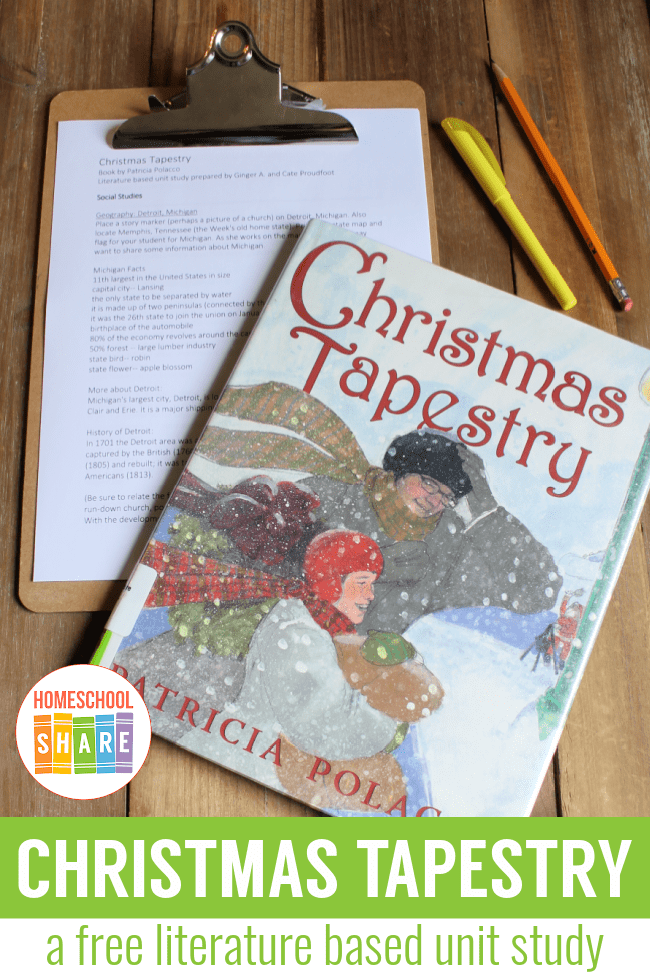
Christmas Tapestry
 
Author:  Patricia Polacco
ISBN: 0399239553
Summary:  Jonathan has made a good adjustment to life in Michigan after his father takes over as the pastor of a rundown Baptist church. The whole family has worked hard to renovate the building and restore the congregation. The boy becomes distraught, however, when a snowstorm causes a leak and ruins the wall behind the altar just before Christmas. In a series of events that would strain belief in anything other than a holiday story, he and his father find a tapestry to cover the wall and bring about a reunion between two Holocaust survivors who had used the hand-stitched cloth as their wedding canopy.


Unit Prepared by Ginger A. and Cate Proudfoot


Social Studies

Geography: Detroit, Michigan
Place a story marker (perhaps a picture of a church) on Detroit, Michigan.  Also locate Memphis, Tennessee (the Week's old home state).    Print off a state map and flag for your student for Michigan.  As she works on the map and flag, you may want to share some information about Michigan.

Michigan Facts
11th largest in the United States in size
capital city-- Lansing
the only state to be separated by water
it is made up of two peninsulas (connected by the Mackinac Bridge)
it was the 26th state to join the union on January 26, 1837
birthplace of the automobile
80% of the economy revolves around the car industry
50% forest -- large lumber industry
state bird-- robin
state flower-- apple blossom

More about Detroit:
Michigan's largest city, Detroit,  is located on the Detroit River between lakes St. Clair and Erie.    It is a major shipping and rail center. 

History of Detroit:
In 1701 the Detroit area was a French fort and fur-trading settlement.  It was captured by the British (1760), given to the Americans (1796), destroyed by fire (1805) and rebuilt; it was taken back by the British (1812), and finally, recovered by Americans (1813). 

(Be sure to relate the following information to the story-- German immigrants, the run-down church, poor people, need for hope, etc.)
With the development of transportation, came the development of Detroit which grew rapidly in the 1830s.   Immigrants from around the world made there way to Detroit including Poles, Italians, Germans, Serbs, Croats, and others.   Along with this, large numbers of migrants from the South arrived in Detroit after 1900 as factory production increased.  However, the jobs didn't last forever.  The automobile industry eventually began to decline which resulted in job loss, social problems, businesses closing, and population decline (people left). 

Geography:  Germany
The Zukors

Human Relationships:  Loving Families
In this story there are two loving, family relationships. 

The Weeks family works together for a common goal.  They all want to make the church building a beautiful, welcoming place of worship.  The children do have some negative thoughts, but because of their love and respect for their parents, they are willing workers.  Talk with your child about the importance of family members being on the same team.  Notice how content the children are to be working with their parents.  Take time to work along side your children and enjoy their company as you complete a project together. 

The other family, the Zukors, have been separated by tragedy, miles, and years.  However, the bond of love has kept them together.  This may be a bit difficult for your student to grasp, but discuss the special bond of love that exists between a husband and a wife. 

Hard Work
Physical labor and jobs associated with physical labor are often looked down on in our society, but it shouldn't be this way.  Society is built up the working class."  Many types of jobs and work are in this story.  Talk with your student about the importance of shop-keepers, bus drivers, and plasterers.  Also, point out the work that Jonathan and his sister did is good practice for future occupations.  Help your child view chores as practice for future painters, landscapers, gardeners, chefs, etc.  I want my children to know the joy and satisfaction that comes from physical work. 

Random Acts of Kindness
A random act of kindness is a kind deed done without a desire to be reimbursed or even recognized.  People that do kind deeds are always appreciated, but that is not their reason for being kind.  It is so nice to be with a person who is willing to put himself last.  Talk with your child about being unselfish and thinking of others first.  After reading Christmas Tapestry a few times, have your student identify the acts of kindness in the story.  Was the lady at the bus stop offering to sell warm tea to the cold strangers?  Did the Reverend offer to drive the lady home for a price?  Do you think Rev. Weeks wanted payment for reunited the Zukors?  Encourage your student to make kindness a habit and to look for ways to be kind to others.

Research or Review:  Holocaust
Homeschool Share has a few units that center around the Holocaust (see our Holocaust Connections Page).  If you've used any of these units with your student, you may want to review.    Discuss what's mentioned in this story-- Nazis, concentration camps, row of faded blue numbers on the arm.  Ask your student, "What do you think happened to the Zukors?  Why were they separated?  Do you remember what we learned about....?"

If this is a brand new topic for your student,  you may want to do some research (you will find lots of lessons through our Connections page mentioned above) to find out more about the Holocaust together.  You may want to give your young or sensitive student just tiny pieces of information and place a Holocaust marker on your timeline.


Language Arts

Vocabulary

sacristy a room in a church where alter linens, church furnishings and other treasures are kept
parsonage a house provided by a church for its parson
commissioned granting authority to carry out a particular task
plaster building material used on walls
alley narrow street or passage between or behind buildings
antiques objects having special value because of age (old)
magnificent splendid or grand in appearance
tapestry a heavy cloth with multicolored designs or scenes
unison at the same time; at once
wedding chuppah canopy that a bride and groom stand under during a Jewish wedding
menorah a nine branched candelabra used during the festival of Hanukkah
commemorate honor
procession to move along
commence to begin; start


Initials
Rachel Hannah Zukor stitched her initials in the corner of the tapestry. Teach your student how to write his initials.  Then have your student write the initials of each member of your family.

Descriptive Language
Re-read the pages that tell of Rev Weeks and Jonathan waiting at the bus stop.  Beginning with, "Jonathan and his father waited and waited..."  Discuss how you feel after you read these pages.  Patricia Polacco did an excellent job of describing the weather.  This sentence is wonderful-- "The wind burned as it stirred up waves of crystal snow."    Can the wind burn?  Has your student ever experienced a strong stinging wind before?    This is a great way to describe the driving wind and frigid temperature.  Let your student find words and phrases in the story that describe the cold.  Also notice how the illustrations match the word.  The people are not able to stand straight up in the cold wind.  The illustration is made to look blurry because of the snow. 

Have your student describe a cold winter day uses different ideas than Polacco used.  If it is too hard for him to separate himself from her wonderful words, then have him try describing a hot, sultry, summer day (you can just discuss this with words or have him put it in paragraph form).    He may even want to enhance the text by creating an illustration to go along with it.


Science

Snowflakes
Snowflakes are made of ice crystals. One snowflake may contain 200 crystals! Many different forms of crystals are found in nature. Have your student list or research other crystals. Snow, salt, sugar, jewels and parts of rocks are good examples.

Snowflakes form in clouds where the temperature is below freezing. They are not formed from freezing rain (see "Other Forms of Icy Precipitation" below) but from water vapor that condenses to form ice crystals. The water vapor crystallizes around a speck of dust or ice and falls to the earth as snow.

Snow crystal refers to a single crystal of ice. Snowflake is a general term that can mean one snow crystal or a cluster of snow crystals. Calling a snow crystal a snowflake is like calling a poodle a dog.

Is it true that no two snowflakes are alike? Yes, it is true, just like no two people are alike! 
Explain to your student that during a single snow storm billions and billions of snowflakes will fall and there will never be two the same.

Other Forms of Icy Precipitation
Graupel:  Snowflakes that have become encrusted with ice.  This happens when water droplets freeze on snowflakes.
Ice pellets:  This type of precipitation is also known as sleet or freezing rain.   Simply put, they are frozen raindrops.
Hail:  A frozen raindrop or graupel that is kept from falling to the ground by the upward flow of air (such as during a thunderstorm).   The droplets freeze on to one another until they become too heavy to be held up by the upward flow or air.  Hail can be very dangerous. 

Blizzard
Three things are needed to make a blizzard.
1.  Cold air
The temperature must be cold up in the clouds and at ground level, too, in order for snowflakes to form and fall.  If the air near ground level is too warm, the snowflakes will melt before they make it to the ground.  However, if the air is TOO cold, it can't produce very much snow.

2.  Moisture
Moisture is needed in order to form clouds and precipitation. 

3.  Warm, rising air
For a blizzard to form, warm air must rise over cold air. 

Winter Weather Safety
Brainstorm with your student about ways to stay safe in winter weather.  Use the list below for extra ideas.

When Driving
Do not travel during winter weather unless it is a necessity. 
Dress warm
Bring a winter storm kit (chains, booster cables, shovel, blankets, extra clothes, food, and water)
Make sure you have a full tank of gas
Drive slower than the speed limit
Watch out for fallen power lines

When Outdoors
Wear layers of clothing and a hat;  mittens will keep your hands warmer than gloves
Don't stay out too long
Remember that wind has a cooling effect and will speed the process of frostbite

At Home
Stock emergency supplies (flashlight, battery operated radio, extra food and water) in case the power goes out.
Have a back-up source for heat. 


Art

Colors of Christmas
Jonathan said "Even the colors look like Christmas!" What colors make you think of Christmas?

Red - Red is a primary color. Introduce or review the primary colors (red, yellow and blue).   It is also part of the warm color palette. Have your student name other warm colors.  Red is symbolic of God's greatest gift, the blood of His Son, Jesus Christ.

Green - Green is a secondary color achieved by mixing blue and yellow. It is a cool color. Have your student list or demonstrate other secondary and cool colors.Green symbolizes evergreens and everlasting life.

Red and Green are complementary colors, opposite of each other on a color wheel.

Medium
The art work in Christmas Tapestry was done in a combination of watercolor and pencil.
Use the two mediums to create a Christmas colored work of art. 


Math

Distance
The Weeks moved from Memphis, TN to Detroit, MI.  Have your student calculate how many miles they traveled.


Bible

The first line in this book says, "There are those who say there is no balance in the universe and that all things happen randomly. . . without purpose."  Discuss this idea with your student.  What does the Bible say about purpose and design?

Romans 8:28 says, "And we know that for those who love God all things work together for good, for those who are called according to His purpose."

Ecclesiastes 3:1 says, "To every thing there is a season and a time for every purpose under heaven".

This story illustrates that God is in control and He works things out to His will and plan even when we don't understand what's going on (or why).


Practical Living Skills

Photo Album
Mrs. Weeks showed the children a photo album of the Memphis church.  Help your student learn how to put together a photo album; you may want to choose a certain theme or time period in your student's life (a family vacation, Christmas, etc.).

Telephone Skills
Rev. Weeks called the plasterer.  Teach your student how to answer phone calls.  Teach your student how to make a phone call for a service.  Practice this your student.  Consider letting your student order a pizza or calling a pet shop to ask some questions. 


Just for Fun

Cooking

Rozijnen Koekjes (Raisin Cookies)

A traditional Michigan Dutch recipe

1 1/2 cups brown sugar
1/2 cup butter
1/4 teaspoon salt
1/2 cup sour milk (milk + 1 1/2 teaspoon vinegar)
2 eggs
1/2 teaspoon cloves
1 teaspoon cinnamon
1 teaspoon nutmeg
1/2 teaspoon baking soda
2 1/2 cups flour
1 cup raisins

Cream sugar and butter then add salt, sour milk and eggs.  Beat well.  Add soda, cloves, cinnamon and nutmeg, sifted with 1 1/2 cups flour.  Add raisins and enough flour to drop from teaspoon on cookie sheet.  Bake at 375 F, 8 to 12 minutes.

Makes 3 dozen large cookies.

Crafts
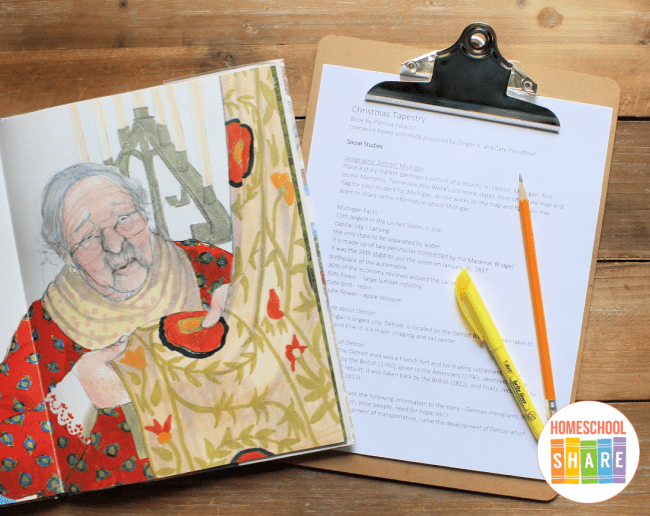
Mrs. Zucker embroidered and appliquéd the quilt.   Do a simple sampler project for embroidery and/or appliqué. 


Materials and information on this website belong to the original composers. It may be used for your own personal and school use. 
Material may not be used for resale
© 2005-07 HSS