Google
 
FREE Chicken Sunday Unit Study

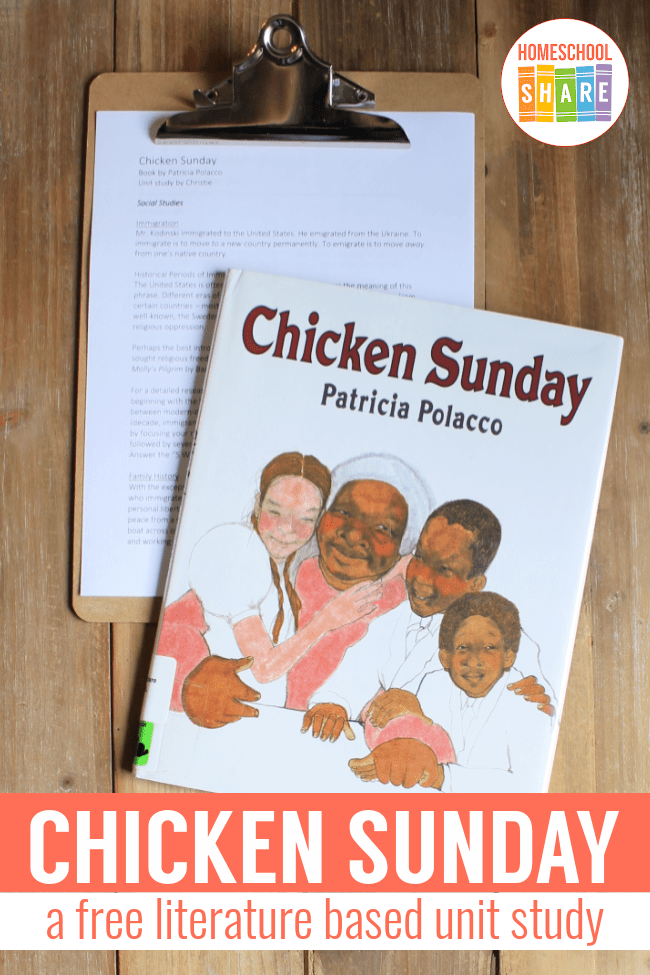
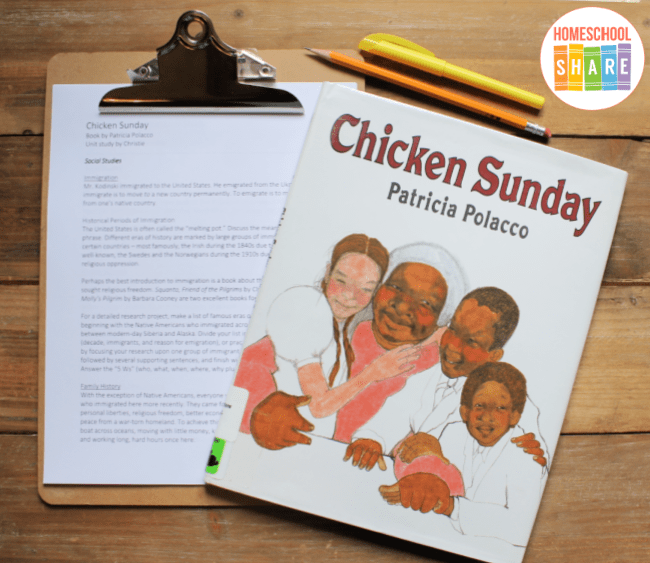
Chicken Sunday


  Author/Illustrator:  Patricia Polacco
ISBN: 0698116151

Summary: Despite the differences in religion, sex, and race, Winston and Stewart Washington are young Patricia's best friends, and she considers their grandmother, Miss Eula, a surrogate since her own ``babushka'' died. On Sundays, she often attends Baptist services with her friends, and Miss Eula fixes a sumptuous fried chicken dinner with all the trimmings, after stopping to admire the hats in Mr. Kodinski's shop. The youngsters hope to buy her one, but when they approach the merchant looking for work, he mistakenly accuses them of pelting his shop with eggs. To prove their innocence, the children hand-dye eggs in the folk-art style that Patricia's grandmother had taught her and present them to the milliner. Moved by the rememberance of his homeland, the Russian Jewish emigre encourages the children to sell the ``Pysanky'' eggs in his shop and rewards their industry with a gift of the hat, which Miss Eula proudly wears on Easter Sunday.


Unit written by Christie


Social Studies
 

Immigration

Mr. Kodinski immigrated to the United States.  He emigrated from the Ukraine.  To immigrate is to move to a new country permanently.  To emigrate is to move away from one’s native country.
 

Historical Periods of Immigration

The United States is often called the “melting pot.”  Discuss the meaning of this phrase.  Different eras of history are marked by large groups of immigrants from certain countries – most famously, the Irish during the 1840s due to famine; or less well-known, the Swedes and the Norwegians during the 1910s due to poverty and religious oppression.  
 

Perhaps the best introduction to immigration is a book about the Pilgrims, who sought religious freedom.  Squanto, Friend of the Pilgrims by Clyde Robert Bulla and Molly’s Pilgrim by Barbara Cooney are two excellent books for this topic. 
 

For a detailed research project, make a list of famous eras of immigration beginning with the Native Americans who immigrated across a land bridge between modern-day Siberia and Alaska.  Divide your list into three columns (decade, immigrants, and reason for emigration), or practice writing a paragraph, by focusing your research upon one group of immigrants.  Write a topic sentence, followed by several supporting sentences, and finish with a concluding sentence.  Answer the “5 Ws” (who, what, when, where, why plus how) in your paragraph.
 

Family History

With the exception of Native Americans, everyone who lives in the US has relatives who immigrated here more recently.  They came for improved lives, desiring personal liberties, religious freedom, better economic opportunities, or seeking peace from a war-torn homeland.  To achieve this, immigrants risked traveling by boat across oceans, moving with little money, knowing nobody in their new home, and working long, hard hours once here.

Interview grandparents or great-grandparents to learn more about your family’s immigration history.  Why did your relatives come?  What problems might they have been seeking to leave behind?  And what steps did they take to establish their new lives in a new country?
 

Geography

Ukraine is the second-largest European country, with mild yet snowy winters and hot, dry summers.  Mostly a treeless plain, Ukraine’s agriculture is rich, growing wheat, corn, vegetables, fruits, melons, berries and sugar.   Ukraine also is rich in natural resources such as oil and coal.
 

California is the third-largest state in the US.  The city of Berkeley is located on the San Francisco Bay.  The city is located between the Pacific Ocean and the Pacific Coastal Range.  Rain and fog are common, as is warm, sunny weather, making it a mild climate.
 

Find Ukraine and Berkeley, California.  Ideas for applying mapwork:  

-- Find locations on a map or globe

-- Color map

-- Draw freehand the country

-- Name the continent the country is part of


History/Gentle Introduction to WWII

Introduce this difficult topic by talking about when it happened.   You can say, “This happened just a few years before your grandparents were born, in the 1940s.”  Define decade, and discuss that this event in history happened over 6 decades ago. 


Mr. Kodinski is a Jewish man.  We can tell by his yarmulke and prayer cloth.  You might point out the tatoo on his arm.  This clue and Miss Eula's statement about his hard life are the only allusions to WWII.  When Mr. Kodinski was younger, he lived in Ukraine.  Germany invaded his country and sent Jewish people to prison even though they had done nothing wrong. When the US and Britain had victory over Germany, the prisoners were freed, and many immigrated to new countries.


Character: Generosity and Respect

Good intentions should be followed with good actions.  Talk about how the children showed Mr. Kodinski they were innocent.  Many people would be unwilling to extend friendship to a man who accused them of vandalism, but the children wanted to show respect to him and earn his respect. 


Language Arts

Copywork

Write a short sentence from the book for your child to copy.  One of the best sentences describes Miss Eula:  "She had a voice like slow thunder and sweet rain."  If your child is learning parts of speech, identify nouns, pronouns, and adjectives, by circling and underlining using differing colored pens.


Repetition of Symbols

Interestingly, eggs are used as both the catalyst for the conflict and the catalyst for resolution in this story.  Eggs are also often used as a symbol of new life, which is one reason why we use eggs at Easter.  A talented author, such as Patricia Polacco, weaves a powerful and cohesive story using symbols, especially when they are used in opposing ways. 


To teach this literary device, ask your child to list the “things in the story that repeat.”  Look page by page for words or illustrations.  The list may include the eggs, the hat, even chicken.  Then discuss “what these things mean to the people in the story.”  Possible answers include:  chicken dinner (togetherness), eggs (broken relationships when the bullies throw them, then new friendships when the main characters show respect to Mr. Kodinski), and the Easter hat  (generosity). 


Simile

Discuss what a “voice like slow thunder and sweet rain” might sound like.  Listen to gospel music for a true-to-life understanding.  Have your child write a simile to describe gospel music.  Better yet, write a meaningful simile about your child, blessing him/her with your appreciation of his/her qualities.


Plot

This is an excellent story to study the elements of plot, because the story involves the conflict and resolution of several characters intertwined by common elements (the eggs and the Easter hat). 


For younger students, introduce the idea of plot by discussing “who, what, when, where, why and how” in the story.


For older students, list the elements of plot and have the student fill in details.  Define terms as you work through the plot. 

1.  exposition (introduces characters, setting)

2.  conflict/complication (the problem)

3.  rising action (steps taken after the conflict)

4.  climax (the most exciting, or the most emotional, part of the story)

5.  falling action (steps taken after the climax)

6.  resolution (how the story ends)


Theme

Ask your older student if there are any main ideas in this story.  Theme is the dominant idea that a writer is trying to convey to his readers; it usually isn’t clearly stated (unless an Aesop’s fable with a concluding “moral,” for example), but usually addresses issues of life and the heart.  Theme is hard for anyone to put into words, so embrace ideas of theme such as “be kind” or “be generous.”  If a student can pinpoint a theme, he has a true understanding for the story.


Autobiography

The author wrote about real people she knew and loved as a child.  Read the author’s note at the beginning of the book.  Read about her on her website.


Compare to other autobiographies you have read.  Contrast to a biography (not written by the actual person whom the story is about). 


Write a short story about an interesting event in your own life.


Vocabulary

Chutzpah – nerve, boldness

Babushka – grandmother, in Polish or Russian

Solemn – characterized by deep sincerity

Intricate – very complicated or detailed


Art
 

Watercolor Resist

Draw a large egg shape on watercolor paper (or cardstock).  Using crayons, draw designs, before watercoloring over the top.


Another option is to draw a large egg shape on a piece of watercolor paper (or cardstock).  Have your child draw very simple designs/shape (stripes, circles).  Using rubber cement, cover most of the drawing, except the areas to remain yellow.  Watercolor with yellow, and allow to dry.  Then, apply rubber cement over the dry yellow areas. Rub off rubber cement from areas to be painted red.  Allow red to dry and then apply rubber cement over the top.  Then remove the remaining unpainted areas and paint black.  This is a time-consuming project-- illustrating the Pysanky process of resist and coloring, without using real eggs.


Pysanky Eggs

Search for websites or books detailing the Pysanky process, the history, and the symbolism of colors and images.  You can order supplies to create real Pysanky eggs from those websites.


Collage/Mixed Media Art

In the style of the illustrations, draw a picture of your own living room and collage small family photographs “hung” on the walls or “sitting” on tables, with hand-drawn frames around them.


Gospel Music

Listen and enjoy!


Science
 

Eggs

The egg has four basic parts: the shell, the air space, the albumen and the yolk.  The shell of the egg is the protective covering. It has very tiny openings which we cannot see with our eyes (it is porous). When a baby chick hatches, the shell is cracked open. We do not eat the egg shells, but they can be used as compost in our gardens to make the soil rich.   The air space is a small pocket of air in the large end of the egg. It is between the shell and the albumen (the egg white). The air space acts as a cushion for the baby chick as it is developing.  The yellow part of the egg is called the yolk. On the yolk there is a small white spot called the germinal disk or the egg cell. The baby chick develops from this part of the egg. While the baby chick is developing, the yolk will provide food for the chick.  The thick, clear substance that surrounds the yolk is called the albumen. We also call it the egg white. In the albumen, there are some small white strands of material that hold the yolk in the center of the egg shell. These strands are called chalazae (pronounced shah-LAY-zee). The eggs that we buy at the store are not fertile eggs. That means that baby chicks will not grow inside them or hatch. 
 

This website has four egg experiments.  A very fun and very easy experiment is to demonstrate how the curved shell of an egg provides amazing strength.  Hold the egg in your palm and apply even pressure. The egg won’t break.  (Why is it necessary for an egg to have this kind of strength?) However, applying uneven pressure in the form of breaking an egg against an edge of a bowl will break the shell. 


You could also make an entry in a nature notebook by drawing an egg, whole and broken (and even one hard-boiled).  Label the parts.


When vandals throw eggs, the effects are damaging and time-consuming.  Set up an experiment on a board, with different sections (painted, unpainted, washed right away, delayed washing, etc.) to see what the effects are.


The book Eggs by Marilyn Singer, and illustrated by Emma Stevenson, describes eggs from many different animals, the parts of eggs, nests, and the life cycle of egg-bearing animals. 


Math
 

Decade

Estimate the age of your family members in decades (teaching that the answer can be in numbers.  Example:  5 decades = 50 years old). 


Figure out the decade in which the story takes place, by researching the author’s age (teaching that the answer can be expressed in years.  Example:  the 1950s).  She was born in 1944.


Money

Younger students can identify denominations and practice counting money. Older students can practice adding and subtracting with dollar signs and decimal points, using real money as manipulatives.  For fun, you could set up a store and “buy” items using real money.


Materials and information on this website belong to the original composers. It may be used for your own personal and school use. 

Material may not be used for resale © 2005-07 HSS